Patchwork Health’s Series B deck is a masterclass in category creation, framing their workforce management software as 'Outcomes Based Staffing' (OBS). By positioning themselves as the future 'operating system' for healthcare, they move beyond simple recruitment to a strategic enterprise play. The deck relies heavily on the 'land and expand' motion within the UK’s National Health Service (NHS), showing how initial 'Bank' (temporary staffing) contracts lead to 'Rota' (permanent scheduling) deployments. While the deck lacks a specific team slide and detailed unit economics in this version, the…
Key takeaways
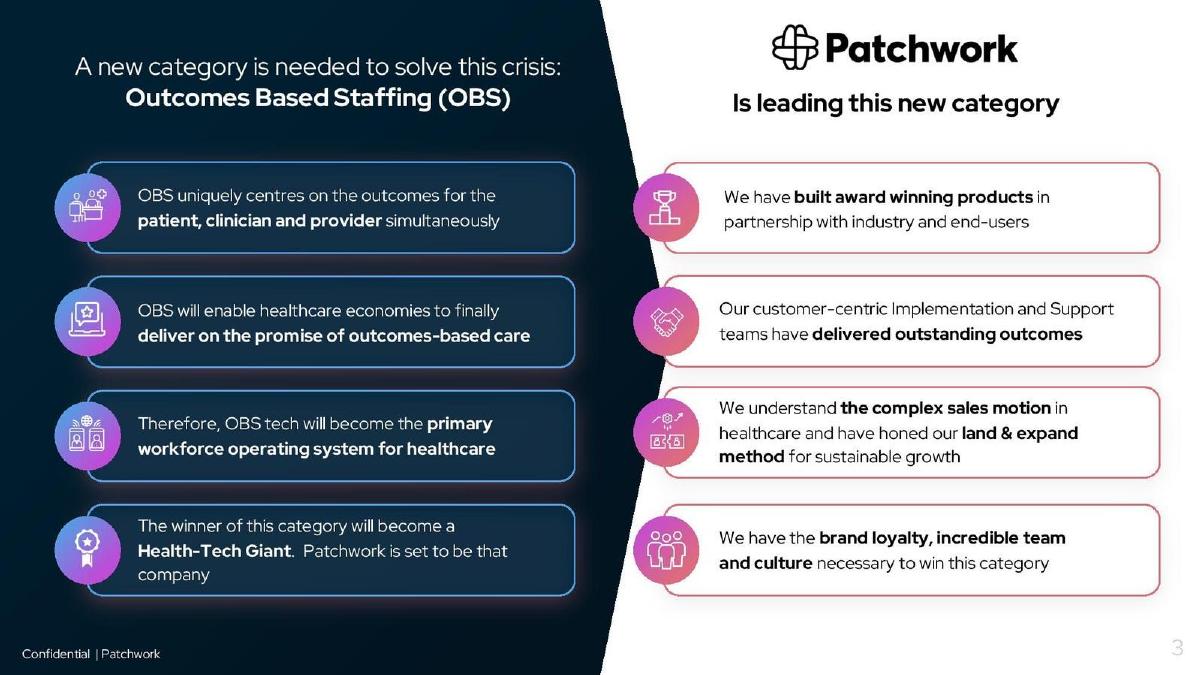
- The company positions itself as the leader of a new category called Outcomes Based Staffing (OBS) on Slide 3.
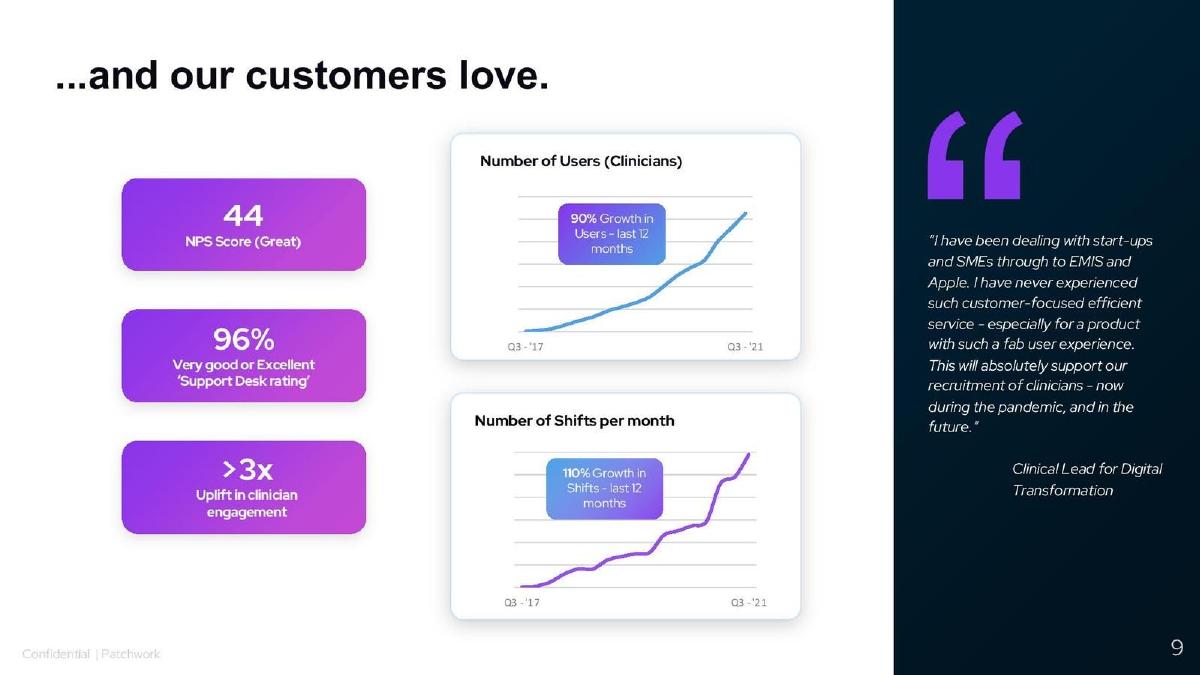
- Patchwork reports a Net Promoter Score (NPS) of 44, which they characterize as 'Great' on Slide 9.
- Clinician engagement has seen a greater than 3x uplift according to metrics on Slide 9.
- The platform has achieved 110% growth in shifts per month and 90% growth in users over the 12 months preceding the deck (Slide 9).
- The deck projects the Global Total Addressable Market (TAM) will grow 90% by 2030, reaching £35.3bn (Slide 13).
- A projected global shortage of 13 million healthcare workers by 2030 serves as the primary macro tailwind (Slide 13).
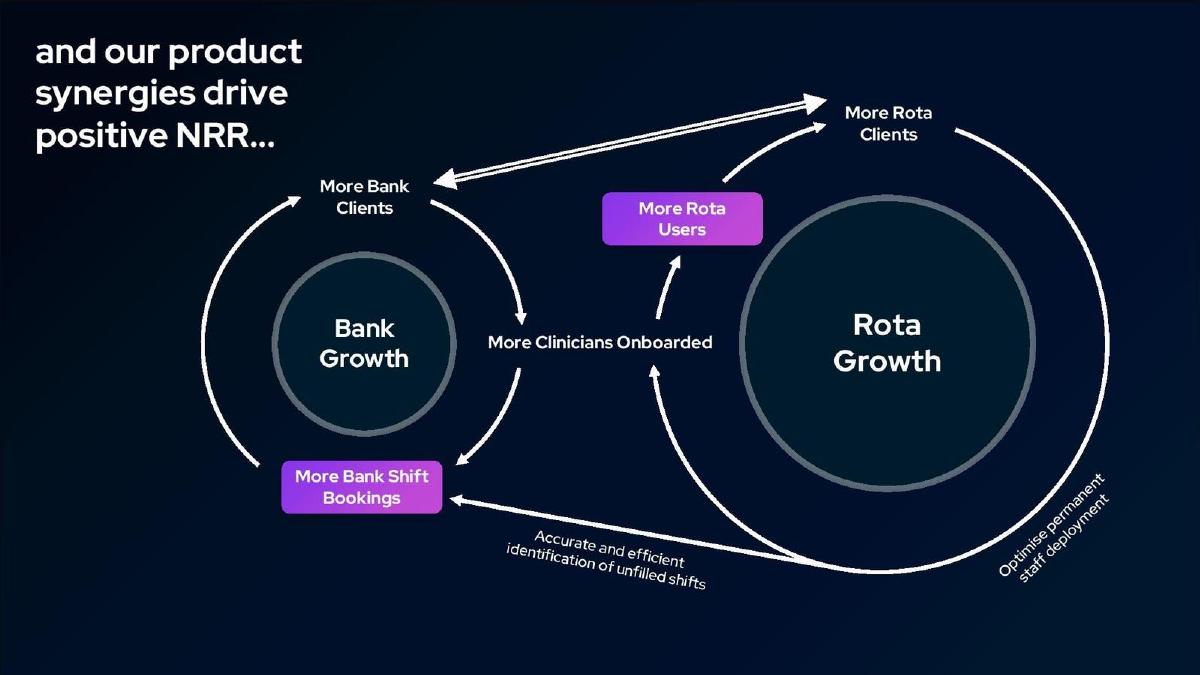
- The 'land and expand' strategy is visualized through a flywheel showing how Bank Growth and Rota Growth drive positive Net Retention Rate (Slide 11).
- The specific funding ask in the deck is £17m to hire engineers, scale customer success, and expand sales (Slide 15).
Patchwork Health: The Series B Narrative
Patchwork Health’s Series B deck, used to raise £20M in 2023 (though the slide asks for £17m), is a highly structured argument for why workforce management is the most critical bottleneck in global healthcare. The deck moves from a macro crisis to a proprietary category solution, backed by significant traction within the UK's National Health Service (NHS). By framing their software as an 'Operating System' rather than a tool, they successfully pitch a high-valuation enterprise SaaS play.
Slide 1: Title and Mission
The deck opens with a clean, dark-themed title slide. The logo is prominent, accompanied by the subtitle 'Investment Memo.' The core value proposition is stated at the bottom: 'Solving the Global Workforce Crisis in Healthcare.' This immediately sets the stakes at a global level, suggesting the solution is not limited to a specific region or niche, despite their current UK focus.
Slide 3: Category Creation (OBS)
Slide 3 is the strategic heart of the deck. Patchwork introduces a new category: 'Outcomes Based Staffing (OBS).' They argue that a new category is needed because existing solutions fail to balance the needs of patients, clinicians, and providers. The slide claims that the winner of this category will become a 'Health-Tech Giant' and asserts that Patchwork is set to be that company. This is a classic VC-facing move: don't just compete in a crowded market; define a new one where you are the only player. They list four pillars of their leadership: award-winning products, customer-centric support, a proven land-and-expand sales motion, and brand loyalty.
Slide 5: Case Studies and Expansion
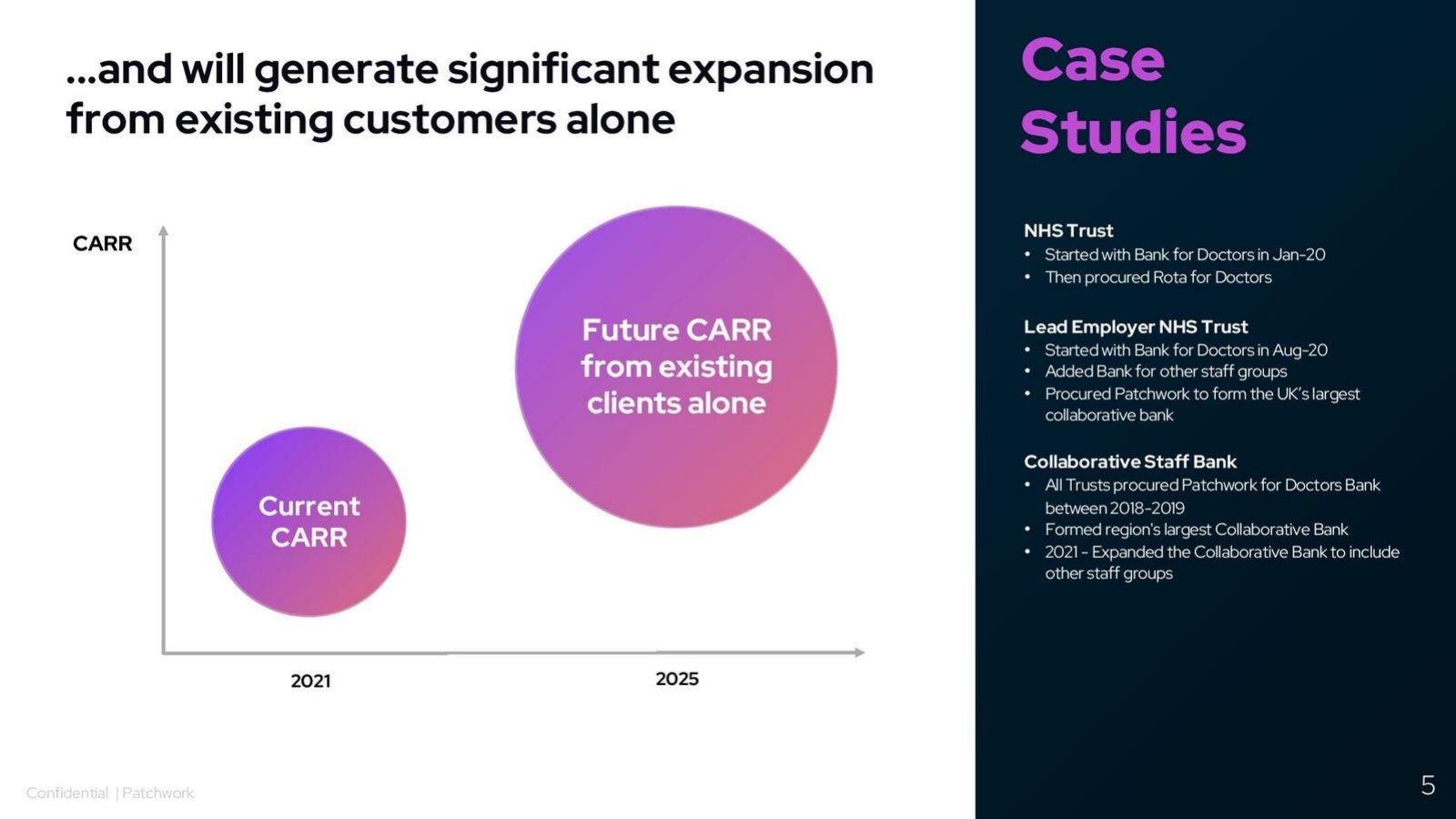
This slide addresses the 'how' of their growth. It features a bubble chart comparing 'Current CARR' (Contracted Annual Recurring Revenue) in 2021 to a significantly larger 'Future CARR from existing clients alone' in 2025. The right side of the slide provides three specific case studies within the NHS. One Trust started with a 'Bank for Doctors' in Jan 2020 and later procured 'Rota for Doctors.' Another expanded to form the UK’s largest collaborative bank. This provides concrete evidence that their 'land and expand' strategy isn't just theoretical—it is actively happening within one of the world's largest healthcare employers.
Slide 7: Product Ecosystem
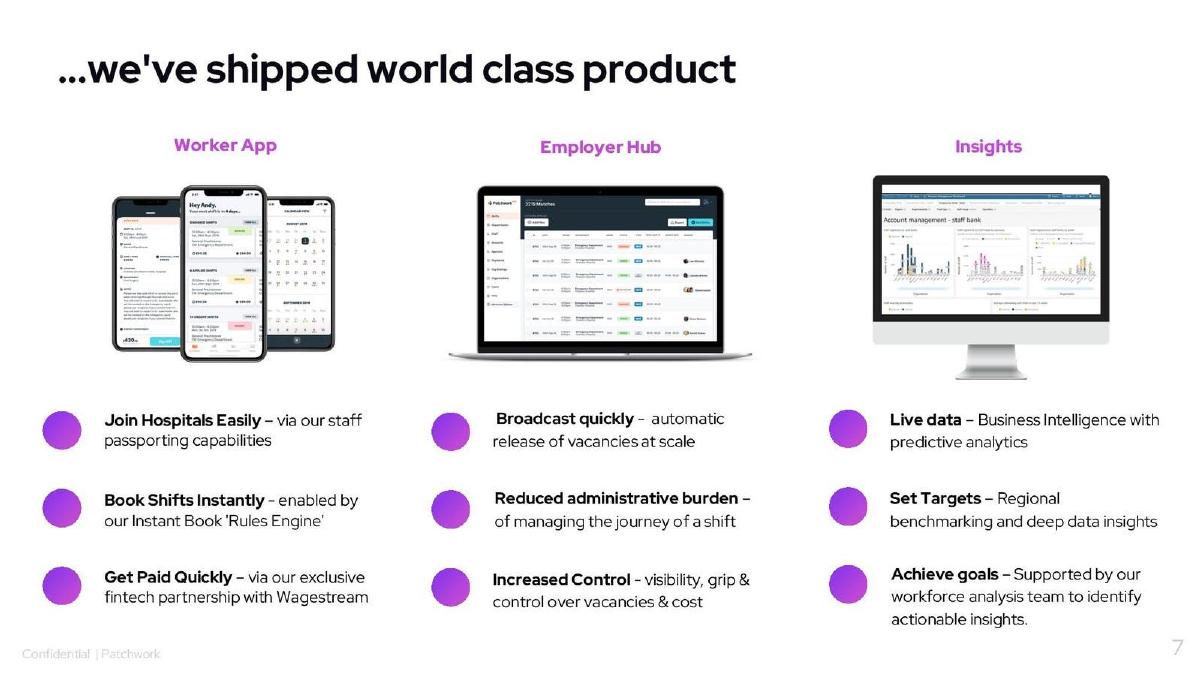
Slide 7 breaks down the 'world class product' into three segments: the Worker App, the Employer Hub, and Insights. The Worker App features 'staff passporting' and an 'Instant Book' engine, plus a fintech partnership with Wagestream for quick pay. The Employer Hub focuses on 'automatic release of vacancies' and 'increased control.' The Insights tab moves the product into the realm of Big Data, offering 'predictive analytics' and 'regional benchmarking.' This three-pronged approach shows they are solving problems for every stakeholder in the ecosystem, not just the HR department.
Slide 9: Traction and Customer Love
This is the 'proof' slide. It leads with a 'Great' NPS score of 44 and a 96% Support Desk rating. More importantly, it shows two growth charts from Q3 2017 to Q3 2021. The number of clinician users grew by 90% in the final 12 months, and the number of shifts per month grew by 110%. A quote from a 'Clinical Lead for Digital Transformation' adds qualitative weight, specifically mentioning the product's performance during the pandemic. The '>3x uplift in clinician engagement' metric is a powerful indicator of product-market fit in a sector known for low engagement with legacy software.
Slide 11: The Flywheel and NRR
Slide 11 explains why their business model is sustainable. It uses a circular diagram to show 'product synergies' that drive positive Net Retention Rate (NRR). The loop starts with 'Bank Growth' (temporary staffing), which leads to more clinicians being onboarded. This data then identifies unfilled shifts, which drives 'Rota Growth' (permanent scheduling). The Rota Growth, in turn, optimizes permanent staff deployment and feeds back into the Bank. This visualizes a self-reinforcing cycle that makes it difficult for competitors to displace them once they have a foothold.
Slide 13: Market Opportunity (TAM/SAM)
The macro argument returns here. On the left, a chart based on WHO data shows a projected global shortage of 13 million healthcare workers by 2030. On the right, they translate this crisis into a financial opportunity. They project their TAM (Total Addressable Market) will grow from £18.6bn in 2020 to £35.3bn in 2030. Their SAM (Serviceable Addressable Market) is projected to grow from £6.4bn to £13.7bn. By citing the WHO, they ground these massive numbers in third-party reality, making the 90% market growth projection feel inevitable rather than optimistic.
Slide 15: The Investment Opportunity
The final slide presents the ask: £17m. It outlines four areas of expenditure: Engineering, Implementation/Customer Success, Sales/Marketing, and 'Building a market dominant position.' Interestingly, the right side of the slide describes what they are looking for in a lead investor: experience in scaling enterprise SaaS, cultural alignment, and expertise in international expansion. This flips the script, suggesting that Patchwork is selecting a partner rather than just seeking cash.
What Patchwork Health Does Well
The deck excels at narrative framing . By naming their category 'Outcomes Based Staffing,' they move the conversation away from 'staffing agency software' (which has low multiples) to 'healthcare operating system' (which has high multiples). They also do an excellent job of visualizing expansion . In enterprise healthcare, the initial sale is the hardest part; showing that they can reliably grow a small contract into a regional collaborative bank is exactly what Series B investors want to see.
The macro-to-micro connection is also very strong. They start with a global shortage of 13 million workers and end with a clinician in an NHS Trust booking a shift on an app. This makes the problem feel urgent and the solution feel practical.
What is Missing from the Deck
The most notable omission in this version of the deck is a Team Slide . While the publisher summary mentions the company is London-based, the deck itself does not highlight the founders' backgrounds or the clinical expertise within the leadership team. For a Series B, investors usually want to see a deep bench of talent.
Furthermore, there is a lack of detailed unit economics . While they mention NRR and growth percentages, they do not provide specific figures for Customer Acquisition Cost (CAC), Lifetime Value (LTV), or gross margins. In a 2023 fundraising environment, these 'efficiency' metrics are often as important as raw growth numbers.
Finally, there is no competitor analysis . The deck assumes the 'OBS' category is theirs alone, but in reality, they face competition from both legacy workforce management players and newer digital-first staffing platforms. Acknowledging the landscape and explaining their moat would have strengthened the 'Health-Tech Giant' claim.
Founder Takeaways
Create your own category: If you are in a crowded space like HR-tech or Ed-tech, don't just list features. Define a new way of working (like OBS) that makes your competitors look obsolete. · Show the 'Land and Expand' path: Don't just say you have a high NRR. Use case studies to show the specific journey a customer takes from a pilot to a full-scale deployment. · Use macro tailwinds: Ground your TAM in reputable third-party data (like the WHO). It makes your growth projections feel like a market certainty rather than a founder's dream. · Flip the 'Ask': When raising a later-stage round, list the qualities you want in an investor. It signals confidence and helps ensure you find a partner who can actually help with the next stage of growth, such as international expansion.
Frequently asked questions
- What is 'Outcomes Based Staffing' as defined in the deck?
- According to Slide 3, Outcomes Based Staffing (OBS) is a new category that centers on the outcomes for the patient, clinician, and provider simultaneously. Patchwork argues that OBS technology will become the primary workforce operating system for healthcare, enabling healthcare economies to deliver on the promise of outcomes-based care rather than just filling shifts.
- How does Patchwork demonstrate its 'land and expand' model?
- Slide 5 and Slide 11 illustrate this. Slide 5 shows case studies where an NHS Trust might start with a 'Bank for Doctors,' then procure 'Rota for Doctors,' and eventually form a 'Collaborative Bank' with other trusts. Slide 11 visualizes this as a flywheel where bank shift bookings lead to more clinicians onboarded, which identifies unfilled shifts and drives rota growth.
- What are the key product components shown in the deck?
- Slide 7 highlights three core pillars: the Worker App (for shift booking and fintech-enabled quick pay), the Employer Hub (for vacancy broadcasting and administrative control), and Insights (providing business intelligence, predictive analytics, and regional benchmarking).
- What are the specific growth figures for the clinician user base?
- Slide 9 shows a line graph tracking clinician users from Q3 2017 to Q3 2021. The slide explicitly states there has been 90% growth in users over the last 12 months of that period, alongside a 110% growth in the number of shifts managed per month.
- What is the stated purpose for the £17m investment ask?
- Slide 15 outlines four primary uses for the capital: hiring engineers to accelerate product-to-market, scaling implementation and customer success teams, expanding sales and marketing functions, and building a market-dominant position through aggressive commercial offers to achieve a dominant position at pace.