The Parkbench pitch deck is a masterclass in 'traction-first' fundraising. Eschewing traditional long-form explanations of product features, the 15-slide presentation focuses almost entirely on the company's financial health and sales efficiency. At the time of the deck, the company reported $1.1M in ARR and claimed to be profitable, a rare feat for a startup at this stage. The core value proposition is centered on moving real estate agents away from low-conversion online leads (5%) toward relationship-based referrals (60%). By highlighting a 45-minute sales cycle and a 4.2x LTV/CAC ratio, Pa…
Key takeaways
- The company leads with a massive traction signal, stating $1.1M ARR and profitability on slide 2.
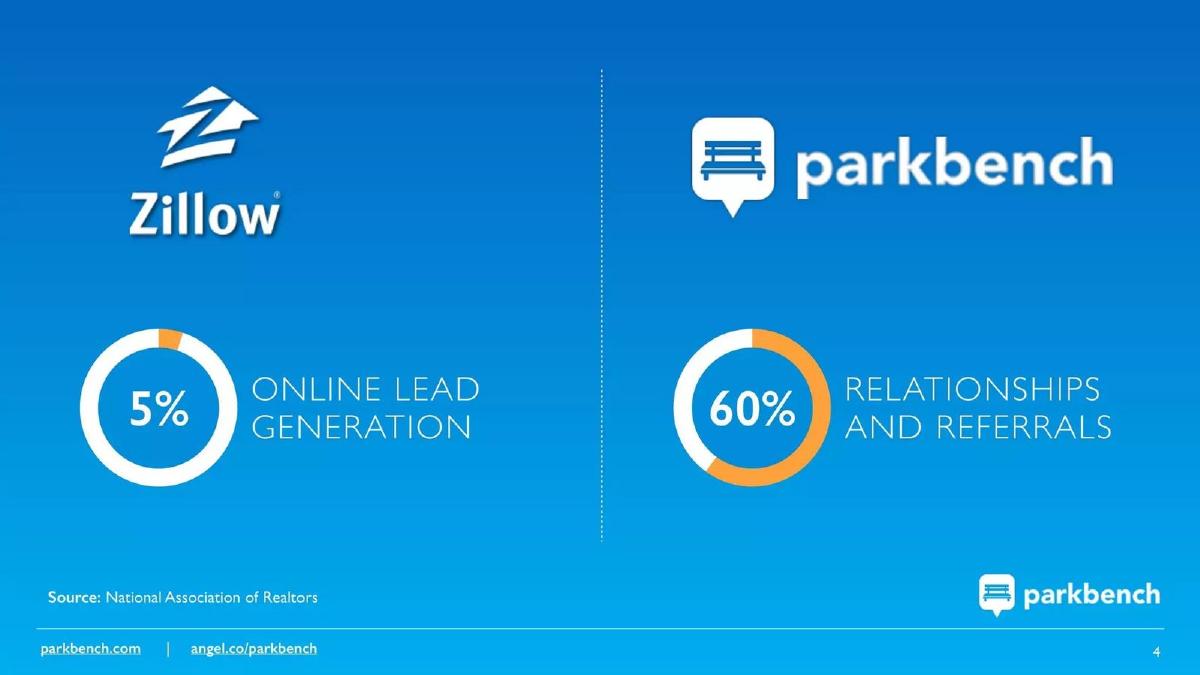
- The core problem is framed as a disparity in lead quality, noting that while Zillow provides 5% online lead gen, 60% of business comes from relationships (slide 4).
- The total addressable market is defined specifically as $27B in Real Estate Advertising (slide 5).
- The sales process is exceptionally fast, with a stated 45-minute sales cycle (slide 8).
- Geographic expansion is shown through a 3-year roadmap, growing from 97 cities in 2014 to a projected 368 cities in 2016 (slides 9, 10, 12).
- Unit economics are strong, with a CAC of $1500 and an LTV of $6300, representing a 4.2x return (slide 11).
- The deck highlights a rapid payback period, claiming the sales cycle is completed in under 30 days (slide 11).
- Revenue growth is depicted as a consistent upward linear trend from 2014 to a projected 2016 (slide 13).
The High-Velocity Revenue Engine
The Parkbench pitch deck from 2014 is a distinct departure from the typical 'problem-solution-product' narrative. Instead, it functions as a financial performance report designed to prove that the founders have discovered a repeatable, profitable sales motion. By the second slide, the investor already knows the company is making $1.1M in ARR and is profitable. This immediate disclosure of high-level traction sets a tone of confidence that carries through the remaining 13 slides.
Slides 1-3: The Hook and the Human Element
Slide 1 is a standard title slide featuring the Parkbench logo and the tagline 'Get to know your neighborhood.' It establishes the local focus of the brand immediately.
Slide 2 is the 'Traction' slide, and it is arguably the most important in the deck. It features two large pieces of data: '$1.1M ARR' and the word 'PROFITABLE' in an orange pill button. For a 2014-era startup, leading with profitability is a power move intended to signal that the company does not need the money to survive, but rather to accelerate.
Slide 3 provides the first glimpse into what the company actually does. Titled 'We get REALTORS® Face to Face Meetings,' it features a collage of photos showing people interacting in local settings—coffee shops, storefronts, and porches. This slide defines the 'product' not as software, but as a human outcome: the meeting.
Slides 4-6: Market Gap and Opportunity
Slide 4 creates a direct comparison with the industry incumbent, Zillow. Citing the National Association of Realtors, it claims that Zillow addresses the 5% of the market focused on 'Online Lead Generation,' whereas Parkbench targets the 60% of the market driven by 'Relationships and Referrals.' This is a classic 'blue ocean' strategy slide, framing the competitor as a niche player despite their size.
Slide 5 quantifies the market. It uses a background image of a 'For Sale' sign with a large overlay stating '$27B Real Estate Advertising.' This defines the Total Addressable Market (TAM) in broad but relevant terms.
Slide 6 reinforces the core philosophy of the company with the phrase 'the BIG opportunity: RELATIONSHIP BUILDING.' It serves as a transition from the market data back to the company's specific mission.
Slides 7-8: The Team and the Sales Motion
Slide 7 introduces the founders, Grant Findlay-Shirras (CEO) and Amanda Newman (CMO), standing on a mountain peak. The text 'We built Parkbench to solve our problem' suggests they have personal experience with the inefficiencies of real estate marketing, though the slide lacks specific professional biographies or past accolades.
Slide 8 is a standout for its simplicity and boldness. It simply says '45 mins SALES CYCLE.' In the world of B2B SaaS or professional services, a 45-minute sales cycle is incredibly fast. This slide tells an investor that the product is an easy 'yes' for the target demographic and that the sales team can achieve high volume without long, drawn-out enterprise negotiations.
Slides 9-12: Scaling and Unit Economics
Slide 9 and 10 show the geographic expansion. In 2014, the company was in 97 cities, primarily clustered in Ontario, Canada. By 2015, the map shows expansion into Western Canada and California, totaling 205 cities. The use of maps provides a visual representation of the 'land and expand' strategy.
Slide 11 dives into the unit economics. It lists a CAC of $1500 and an LTV of $6300. It also highlights a timeframe of ' Slide 12 projects the 2016 expansion, showing a goal of 368 cities with a much heavier footprint across the United States, including Texas, Florida, and the Midwest. This slide is intended to show the 'end state' of the current growth trajectory.
Slides 13-15: Financial Growth and Conclusion
Slide 13 presents a revenue growth chart. It shows a linear climb from CA$275k in 2014 to a projected CA$1,100k (matching the $1.1M ARR mentioned earlier) in 2016. Interestingly, the chart labels the currency as 'CA$' (Canadian Dollars), providing a specific detail about the company's origins in Toronto.
Slide 14 features a piggy bank wearing sunglasses on a beach with the word 'BOOTSTRAPPED.' This reinforces the message from slide 2: the company is self-sufficient and capital-efficient.
Slide 15 is the closing slide, featuring the founders in front of a Facebook 'Like' wall with the call to action 'Come build a relationship with us!' and an email address.
What Works
The Lead with Traction: By putting the $1.1M ARR and profitability on slide 2, Parkbench eliminates the 'is this a real business?' question immediately. · Extreme Focus on Efficiency: The 45-minute sales cycle and the 30-day payback period are 'dream' metrics for investors. They suggest that every dollar of venture capital injected will be converted into revenue very quickly. · Clear Differentiation: The Zillow comparison (5% vs 60%) is a powerful way to frame the product as a necessity rather than a luxury. It targets the 'referral' nature of real estate, which agents inherently understand and value.
What is Missing
The Product: There are no screenshots of the platform. An investor knows what the outcome is (meetings), but they have no idea what the software actually looks like or how it functions. · The Ask: This is a major omission. There is no slide stating how much they are raising, what the valuation is, or what the specific use of funds will be. Without an 'Ask,' the deck feels more like a company profile than a fundraising tool. · Competitive Landscape: Beyond a cursory mention of Zillow, there is no analysis of other 'hyper-local' platforms or CRM tools that might compete for an agent's marketing budget. · Team Depth: The deck only shows two founders. There is no mention of the engineering team, the sales force, or any advisors.
What a Founder Should Copy
The 'Metric-per-Slide' Layout: Parkbench uses very little text. Each slide focuses on one big number or one big idea. This makes the deck extremely readable and ensures the key points (like the $1.1M ARR) aren't lost in a wall of text. · The LTV/CAC Slide: Slide 11 is a perfect example of how to present unit economics. It’s clean, uses large fonts, and provides the three numbers investors care about most in a single glance. · The Geographic Roadmap: Using maps to show past, present, and future expansion is an effective way to demonstrate a 'repeatable playbook' for growth.
Frequently asked questions
- What is the primary business model of Parkbench?
- Based on the deck and catalogue facts, Parkbench is a sales and marketing platform for realtors. They sell a system that helps agents build local neighborhood brands. The deck emphasizes 'Face to Face Meetings' (slide 3) and 'Relationship Building' (slide 6) as the core product output, rather than just digital impressions.
- How does Parkbench justify its market opportunity?
- Parkbench identifies a $27B real estate advertising market (slide 5). They argue that current industry giants like Zillow focus on the 5% of leads that come from online generation, leaving a 'BIG opportunity' in the 60% of leads that come from relationships and referrals (slide 4 and 6).
- What are the key unit economics mentioned in the deck?
- On slide 11, the company discloses a Customer Acquisition Cost (CAC) of $1,500 and a Lifetime Value (LTV) of $6,300. This indicates a healthy LTV/CAC ratio of 4.2. They also claim a sales cycle of under 30 days, suggesting very high capital efficiency.
- Who are the founders of Parkbench?
- Slide 7 introduces the two key leaders: Grant Findlay-Shirras as CEO and Amanda Newman as CMO. The slide notes they built the platform to 'solve our problem,' implying they have founder-market fit as former real estate or marketing professionals.
- Is there a clear exit strategy or 'Ask' in the deck?
- No. The deck is notably missing an 'Ask' slide. It does not state how much money they are raising, the valuation they are seeking, or what the milestones for the next round of funding would be. It concludes with a 'Bootstrapped' status (slide 14) and a contact slide (slide 15).