Pathlight's Series B deck is a masterclass in category creation. By framing 'management' as an analog relic in a digital world, the company justifies a new software vertical. The deck leans heavily on high-engagement metrics, reporting a 65% DAU/MAU ratio and a 75% DAU/WAU ratio on slide 2. It effectively uses social proof, featuring logos like MeUndies, Twilio, and CLEAR, alongside testimonials that highlight specific time-saving outcomes—such as reducing coaching tasks from hours to under 15 minutes. While the deck redacts specific ARR figures, the visual growth charts and 'six-figure deal'…
Key takeaways
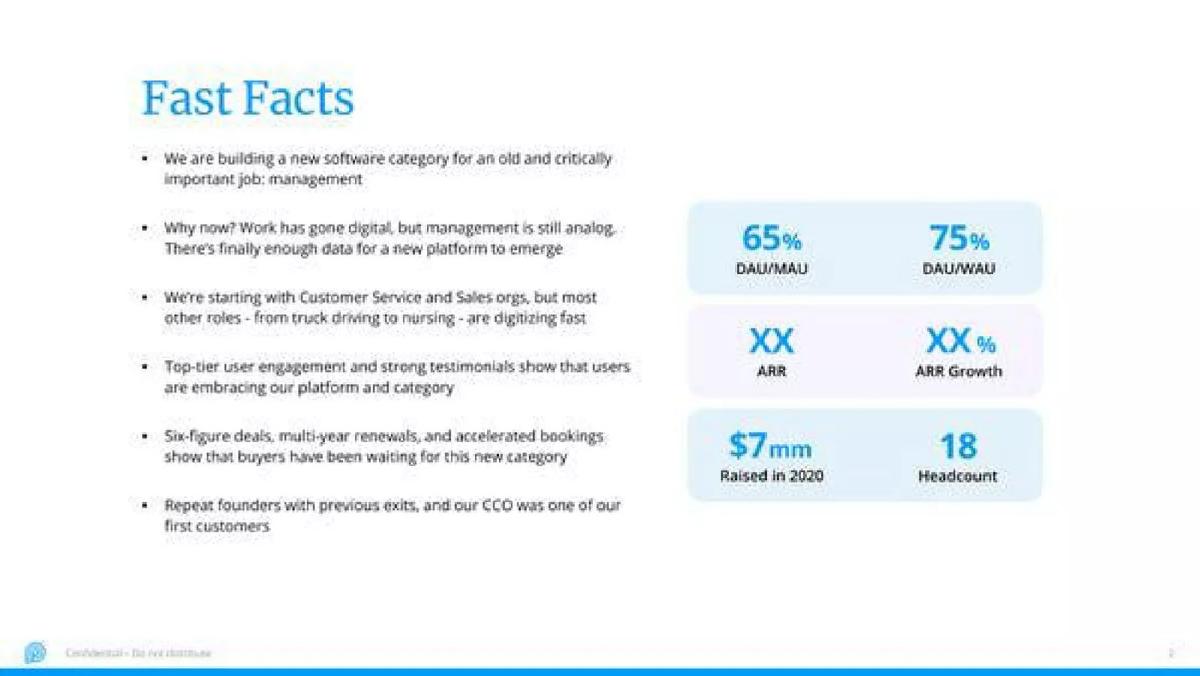
- The deck reports exceptionally high user engagement with a 65% DAU/MAU and 75% DAU/WAU as of H2 2020 on slide 2.
- Pathlight positions itself as the creator of a new '$50B SaaS category' called Realtime Performance Management on slide 11.
- The 'Fast Facts' slide (slide 2) notes that $7mm was raised in 2020 with a headcount of 18 at the time of the deck's creation.
- The product workflow is defined by five steps: Measure, Analyze, Prioritize, Coach, and Follow up, as detailed on slide 7.
- Social proof is integrated via specific customer case studies from MeUndies (slide 8), Wonolo (slide 9), and CLEAR (slide 10).
- The team slide (slide 12) emphasizes 'repeat founders' who previously sold SeatMe to Yelp in 2013.
- Engagement data on slide 13 shows distinct usage patterns for 4-day versus 5-day work weeks, proving the tool's integration into daily routines.
- The deck omits a specific 'Ask' slide and a detailed 'Competition' slide, focusing instead on the internal growth and category dominance.
Introduction: The Category Creation Playbook
Pathlight’s Series B pitch deck is a textbook example of how to pitch a 'category-defining' company. Rather than positioning themselves against existing competitors in the HR or BI space, Pathlight argues that they are building something entirely new: Realtime Performance Management. With $34,200,000 raised, this deck successfully convinced investors that management itself was a broken, analog process ripe for automation. The deck is structured to move from a massive macro problem to granular, undeniable proof of product-market fit.
Slides 1-2: The Hook and the Fast Facts
Slide 1 is a minimalist title slide featuring the company logo and an illustration of a manager at a desk, surrounded by data visualizations. It sets a professional, tech-forward tone without clutter.
Slide 2 , titled 'Fast Facts,' is one of the most information-dense slides in the deck. It serves as an executive summary, stating that they are building a new software category for an 'old and critically important job.' Crucially, it lists high-level engagement metrics: 65% DAU/MAU and 75% DAU/WAU . It also notes that the company raised $7mm in 2020 and had a headcount of 18 at the time. While ARR and ARR Growth are listed as 'XX,' the inclusion of these placeholders suggests the original deck was highly transparent with investors.
Slides 3-5: The Problem and Market Conditions
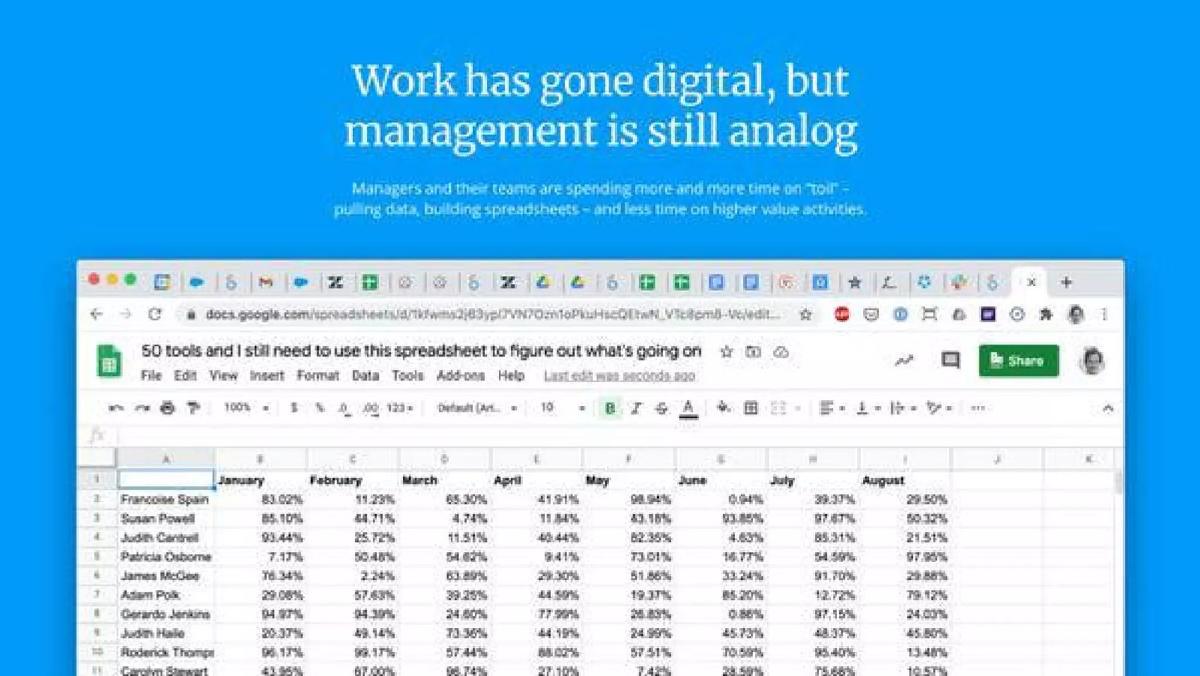
Slide 3 uses a relatable visual—a cluttered Google Spreadsheet—to illustrate the 'analog' nature of modern management. The headline, 'Work has gone digital, but management is still analog,' identifies the core pain point: managers spend too much time on 'toil' (pulling data) and not enough on high-value activities.
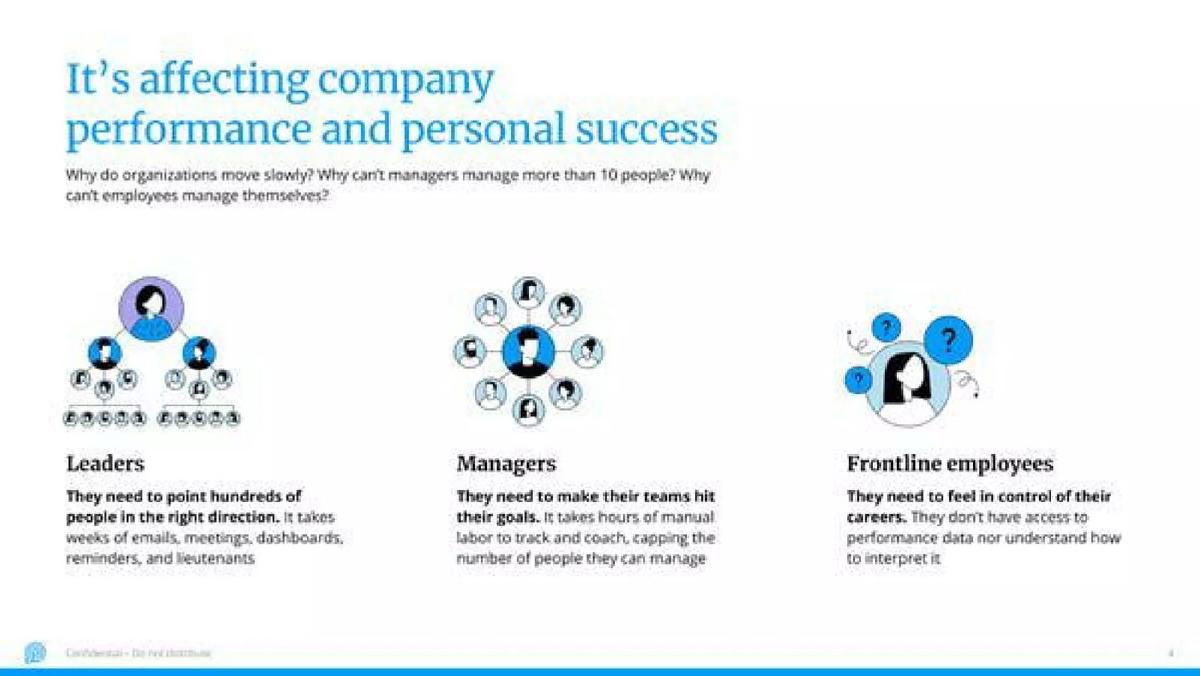
Slide 4 breaks down how this problem affects three distinct groups: Leaders (who move slowly due to manual reporting), Managers (who are capped at managing 10 people due to manual labor), and Frontline employees (who lack access to their own performance data). This slide effectively expands the Total Addressable Market (TAM) by showing the product's relevance across the entire org chart.
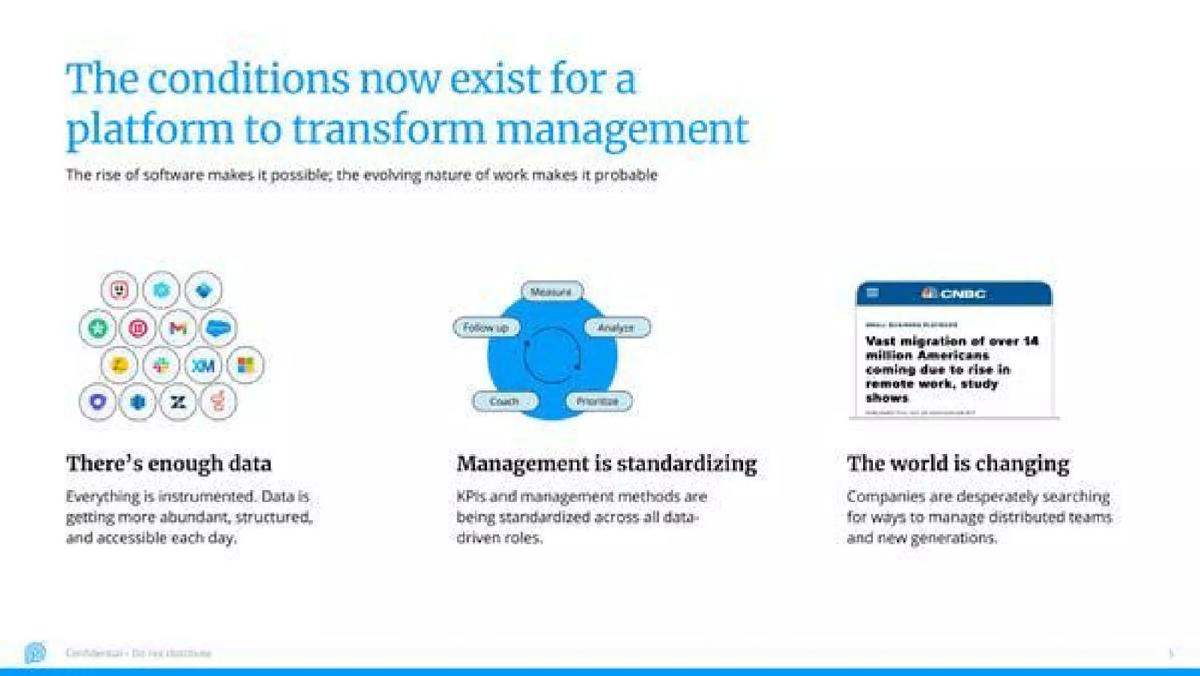
Slide 5 addresses 'Why Now?' It cites the rise of instrumented data, the standardization of management methods, and the 'vast migration of over 14 million Americans' to remote work (referencing a CNBC study). This creates a sense of urgency, suggesting that the old ways of managing are no longer viable in a distributed world.
Slides 6-7: The Solution and Product Workflow
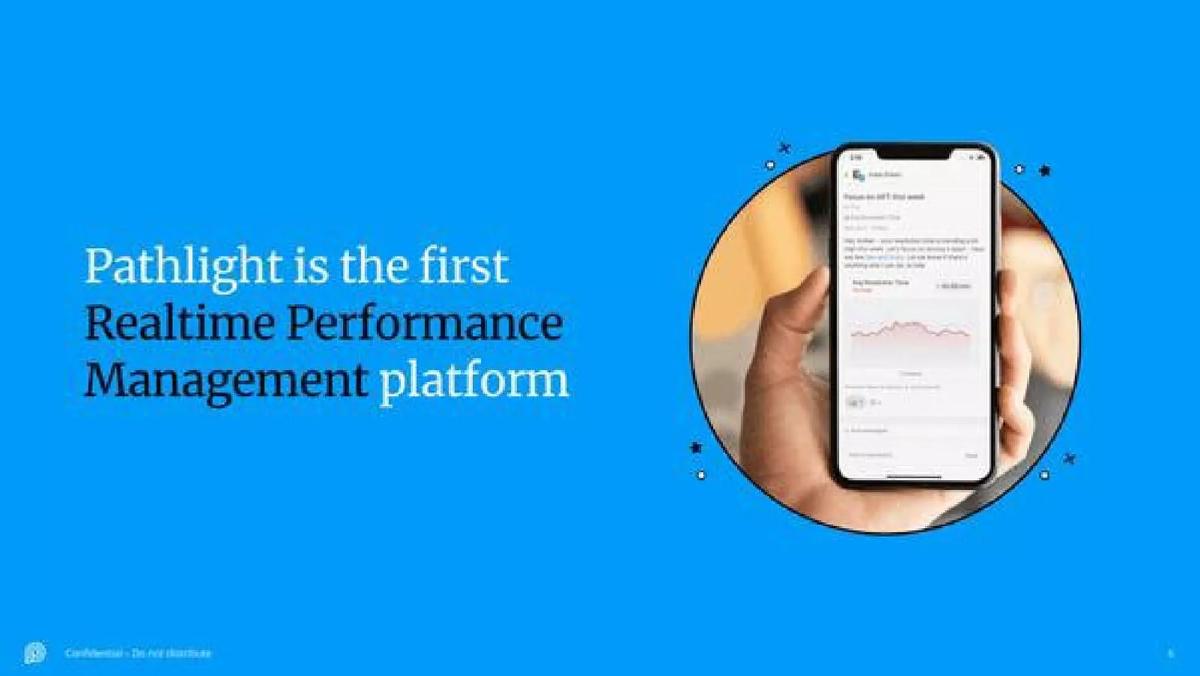
Slide 6 is a transition slide that officially introduces Pathlight as the 'first Realtime Performance Management platform.' The visual of a mobile app showing a performance trend line emphasizes the 'real-time' aspect of the solution.
Slide 7 explains the product's mechanics. It outlines a five-step automated loop: Measure (syncing core data), Analyze (benchmarking against goals), Prioritize (recommending actions), Coach (one-click workflows), and Follow up (automatic tracking). A dotted line indicates a 'Data network effect,' claiming the system learns how to manage over time. This is a critical slide for technical investors, as it explains how the 'magic' happens.
Slides 8-10: Customer Case Studies
Pathlight uses a 'show, don't just tell' approach by dedicating individual slides to name-brand customers. Slide 8 features MeUndies , showing a dashboard for a manager named Katie Green. It highlights how the tool identifies which agents are 'losing ground' on CSAT scores.
Slide 9 features Wonolo , focusing on the communication aspect of the platform. It shows an inbox where data-driven coaching and team announcements are tracked. Slide 10 features CLEAR , emphasizing that the platform ensures 'everyone is looking at the exact same thing,' whether in a huddle or a home office. These slides validate the product's versatility across different industries (e-commerce, gig economy, and security/travel).
Slides 11-12: Category Vision and Team
Slide 11 makes the bold claim that 'Management is the next $50B SaaS category.' This is the 'billion-dollar slide' intended to justify a Series B valuation by framing the opportunity as massive and untapped.
Slide 12 introduces the team. Alexander Kvamme (CEO) and Trey Doig (CTO) are highlighted as repeat founders who sold SeatMe to Yelp in 2013 . The inclusion of Ramon Icasiano (CCO) is a clever touch; he was one of Pathlight's first customers before joining the team, which serves as a powerful endorsement. The slide also lists early hires from Pinterest, Asana, and Google, signaling a high talent bar.
Slides 13-14: Traction and Engagement Data
Slide 13 provides proof of 'Best-in-class engagement.' It shows two charts: one tracking how often Pathlight is used each week (peaking at 4 or 5 days depending on the work week) and a DAU/MAU chart for H2 2020. The consistency of the DAU/MAU peaks suggests the tool is a daily utility, not a monthly reporting burden.
Slide 14 focuses on commercial success. It mentions 'six-figure deals' and 'accelerated bookings.' While the ARR bar chart is redacted, the steep upward slope of the bars communicates rapid growth. Logos for Earnin and Twilio are added to the roster of 'Customer Highlights,' further bolstering the company's enterprise credibility.
Slides 15-18: Social Proof and Closing
Slides 15, 16, and 17 are dedicated to testimonials. Slide 15 features quotes from a VP at Earnin, a Director at a global sales org, and a representative at MeUndies. The quotes are specific: one manager claims Pathlight reduced their coaching time from 'hours' to 'less than 15 minutes.' Slide 16 features Caylen McDonald from MeUndies, who notes that Pathlight 'checks all the boxes' by housing metrics, 1:1s, and coaching in one place. Slide 18 is a simple 'Thank you' closing.
What Works in This Deck
Category Framing: By naming the category 'Realtime Performance Management,' Pathlight avoids being compared to 'just another BI tool' or 'just another HRIS.' They define the rules of their own game. · Granular Engagement Metrics: Most B2B SaaS decks settle for high-level revenue growth. Pathlight includes DAU/WAU and usage frequency charts (Slide 13), which proves that the product is actually being used by employees, not just bought by executives. · Specific Value Propositions: The deck doesn't just say it 'improves efficiency.' It claims to reduce specific tasks from hours to 15 minutes (Slide 15). This makes the ROI tangible. · Founder-Market Fit: Highlighting the previous exit to Yelp (Slide 12) gives investors confidence that the leadership knows how to scale and exit a company.
What is Missing
Competitive Landscape: The deck completely ignores competitors. While this helps maintain the 'new category' narrative, investors at the Series B stage usually want to see how a company defends its moat against incumbents like Salesforce or specialized players like Lattice and 15Five. · Unit Economics: There is no mention of CAC (Customer Acquisition Cost), LTV (Lifetime Value), or payback periods. For a Series B, these metrics are usually vital to prove that the growth shown on Slide 14 is sustainable. · The Ask: The deck does not specify how much capital is being raised or how it will be deployed (e.g., '50% to R&D, 50% to Sales'). While this is common in 'leaked' decks, it is a missing piece of the fundraising narrative. · Pricing Model: It is unclear if Pathlight is priced per seat, per manager, or as a flat enterprise fee. Given the claim of 'six-figure deals,' more clarity on the pricing strategy would have been beneficial.
What a Founder Should Copy
The 'Fast Facts' Slide: Start your deck with a slide that gives investors the 'too long; didn't read' version of your success. If your engagement numbers are good, put them front and center. · The Three-Tier Problem Slide: Slide 4 is excellent because it shows how the problem affects different stakeholders. If your product helps both the CEO and the entry-level worker, map that out clearly. · Visualizing the Workflow: Don't just list features. Use a diagram like Slide 7 to show the 'engine' of your product. Investors love to see how data flows through a system to create value. · Customer-Centric Social Proof: Instead of a single slide with 20 logos, give your best customers their own slides (Slides 8-10). Show their specific use cases and dashboards to make the product feel real.
Frequently asked questions
- What is the core problem Pathlight aims to solve?
- According to slide 3, the problem is that 'work has gone digital, but management is still analog.' The deck argues that managers spend too much time on 'toil'—specifically pulling data and building spreadsheets—rather than high-value activities. Slide 4 further notes that this inefficiency limits managers to overseeing no more than 10 people and prevents frontline employees from understanding their own performance data.
- How does Pathlight define its product category?
- Pathlight explicitly brands itself as the 'first Realtime Performance Management platform' on slide 6. On slide 11, they claim this represents a new '$50B SaaS category.' The platform is designed to automate the 'science' of management (data and tracking) so that managers can focus on the 'art' (coaching and leadership), as stated on slide 7.
- What specific metrics does the deck use to prove traction?
- The deck highlights high frequency of use. Slide 13 shows that for companies on a 5-day work week, the peak usage is 5 days a week, and for 4-day work weeks, the peak is 4 days. Slide 2 lists a 65% DAU/MAU and 75% DAU/WAU. Slide 14 shows a bar chart of accelerating ARR, though the specific dollar amounts are marked as 'Confidential.'
- Who are the key members of the Pathlight team?
- Slide 12 introduces CEO Alexander Kvamme and CTO Trey Doig, who previously founded SeatMe and sold it to Yelp. They are joined by CCO Ramon Icasiano, a former executive at Earnin, Netflix, and Zynga. The team also includes engineers and product managers with backgrounds at Pinterest, Asana, and Google.
- What is the 'Data Network Effect' mentioned in the deck?
- On slide 7, a diagram illustrates a feedback loop where the system learns from the Measure-Analyze-Prioritize-Coach-Follow up cycle. The deck claims that 'Data network effects help the system learn how to manage,' suggesting that as more data is processed through the platform, the automated recommendations and prioritizations become more accurate and effective for the organization.