Pasqal’s 2021 deck is a masterclass in technical storytelling for DeepTech. The presentation moves swiftly from the macro problem—the slowing of Moore’s Law—to a specific hardware solution: Quantum Processing Units (QPUs) built with neutral atoms. The deck emphasizes a 'Co-Design Partnership Model,' showcasing early validation with heavyweights like EDF and various European HPC centers. While it lacks traditional startup metrics like CAC or LTV, it compensates with rigorous scientific citations and a concrete hardware roadmap, targeting 1,000 qubits by 2023. This technical depth, paired with…
Key takeaways
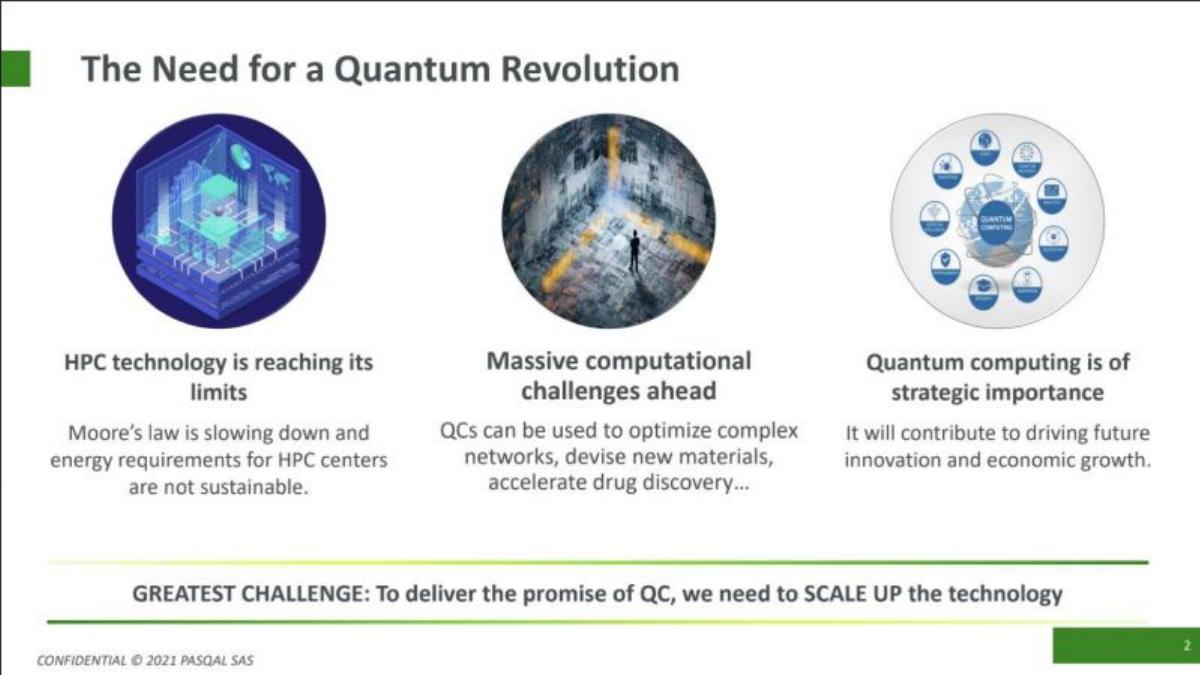
- The deck identifies the 'Greatest Challenge' as the need to scale up quantum technology to deliver on its promise (Slide 2).
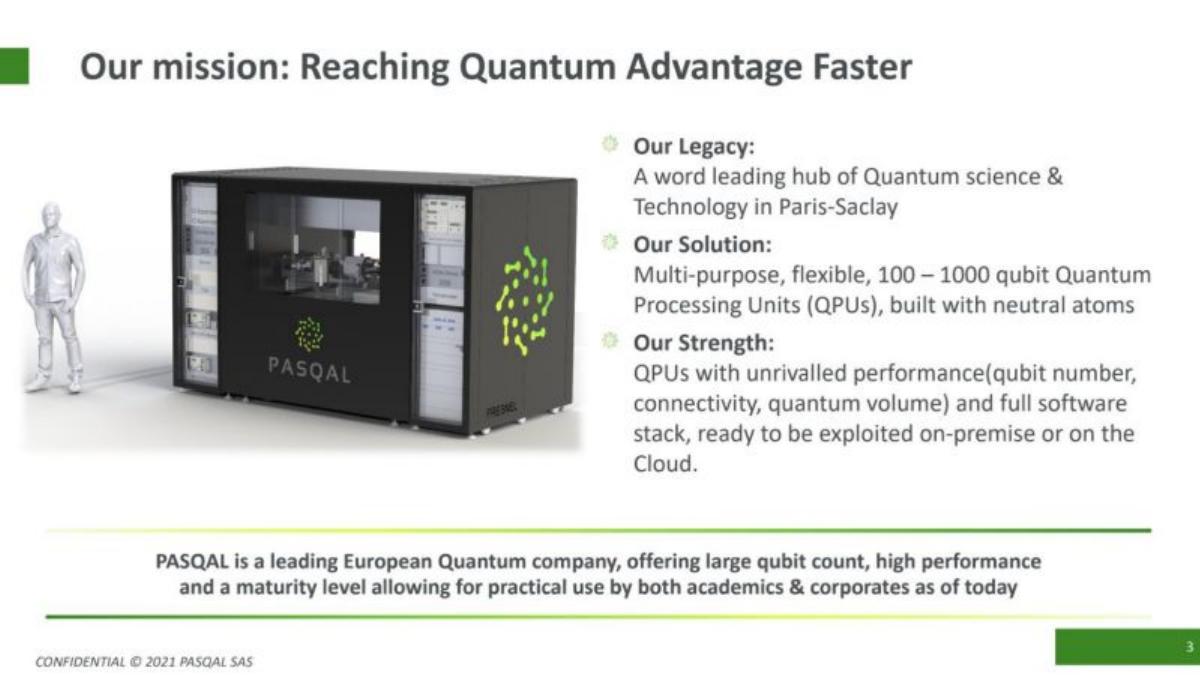
- Pasqal positions its neutral atom approach as a solution offering 100 to 1,000 qubits with high connectivity and flexibility (Slide 3).
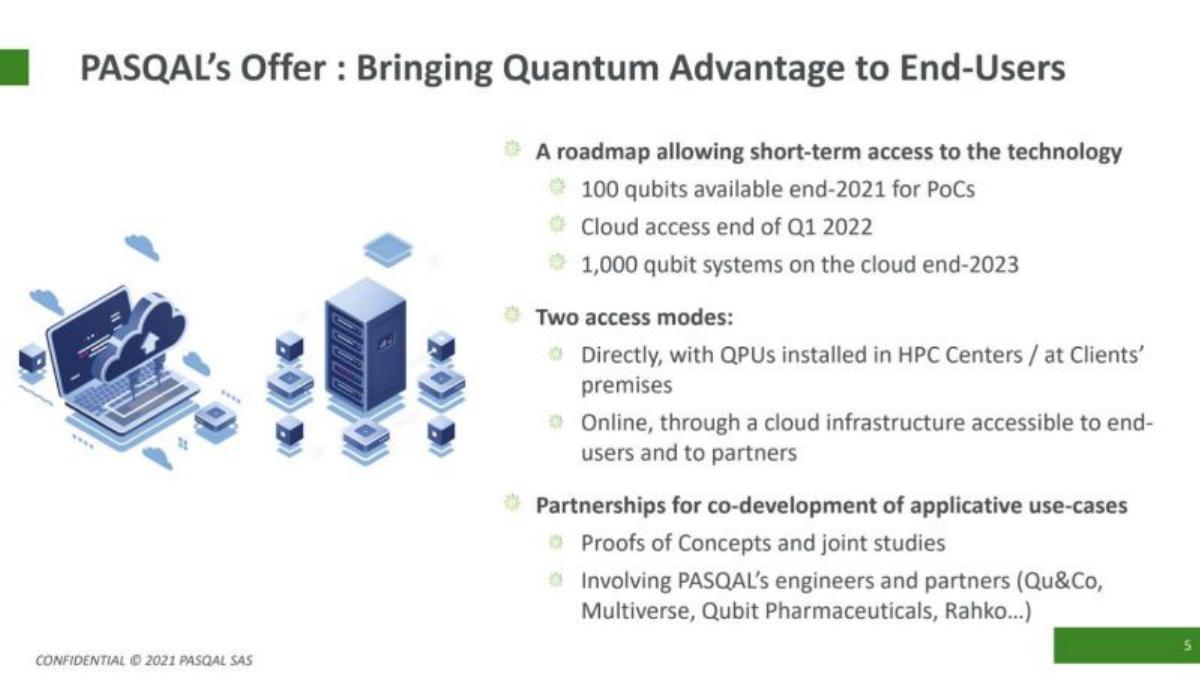
- The roadmap explicitly targets 100 qubits for PoCs by end-2021 and 1,000 qubit systems on the cloud by end-2023 (Slide 5).
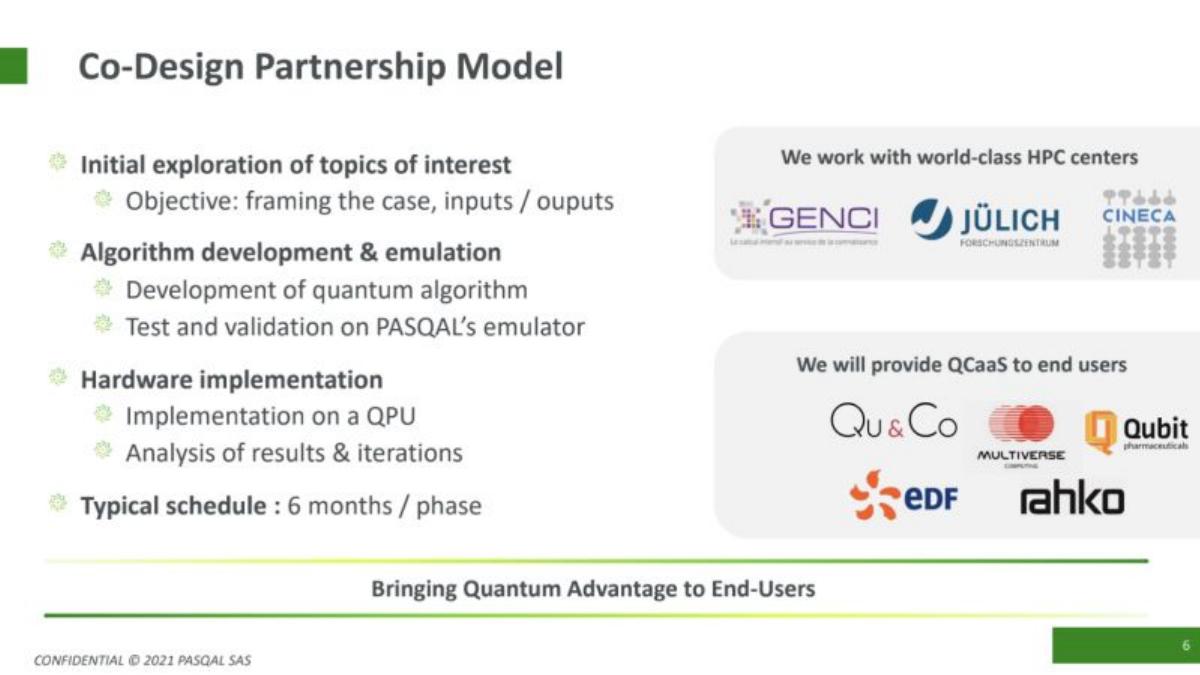
- A 'Co-Design Partnership Model' is used to validate the technology with partners like GENCI, Jülich, and EDF (Slide 6).
- Technical differentiation is highlighted through the ability to arrange atoms in 1D, 2D, or 3D geometries using optical tweezers (Slide 8).
- The company offers two control modes: Analogue for better near-term performance and Digital for universal computation (Slide 17).
- Physical specifications of the hardware are detailed, including a weight of < 750 kg and power consumption of < 10 kW (Slide 19).
- The deck omits a traditional team slide, financial projections, and a specific capital 'ask' amount.
Introduction: The DeepTech Narrative
Pasqal’s 2021 pitch deck is a clinical, highly technical document designed for an audience that already understands the stakes of the quantum race. As a spin-off from the Institut d'Optique, the company relies heavily on scientific credibility rather than marketing fluff. The deck, used during a period where they raised a $29.3M Series A and moved toward a €100M Series B, focuses on one primary theme: Scalability .
Slide 1: Title and Positioning
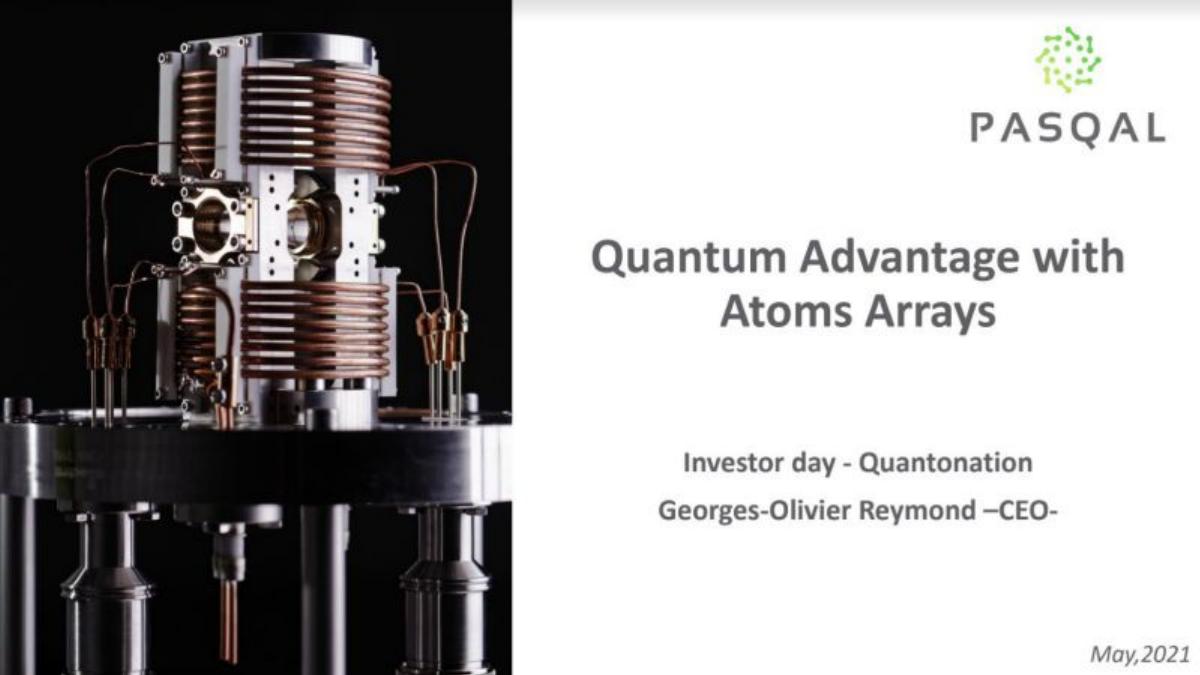
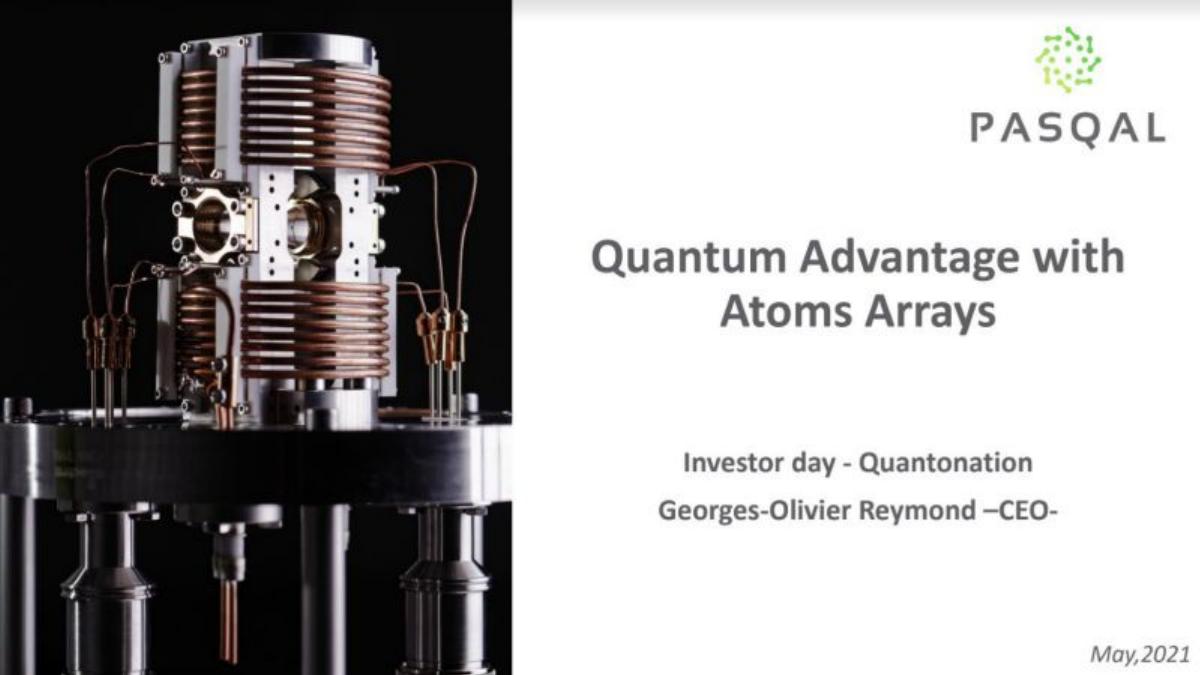
The cover slide features a high-resolution image of the quantum hardware, immediately grounding the 'Quantum Advantage' claim in physical reality. It identifies the presenter as Georges-Olivier Reymond, CEO, and notes the occasion as an 'Investor day' for Quantonation, a prominent quantum-focused VC firm. The subtitle 'Quantum Advantage with Atoms Arrays' defines their specific niche in the market.
Slides 2-4: The Macro Problem and Mission
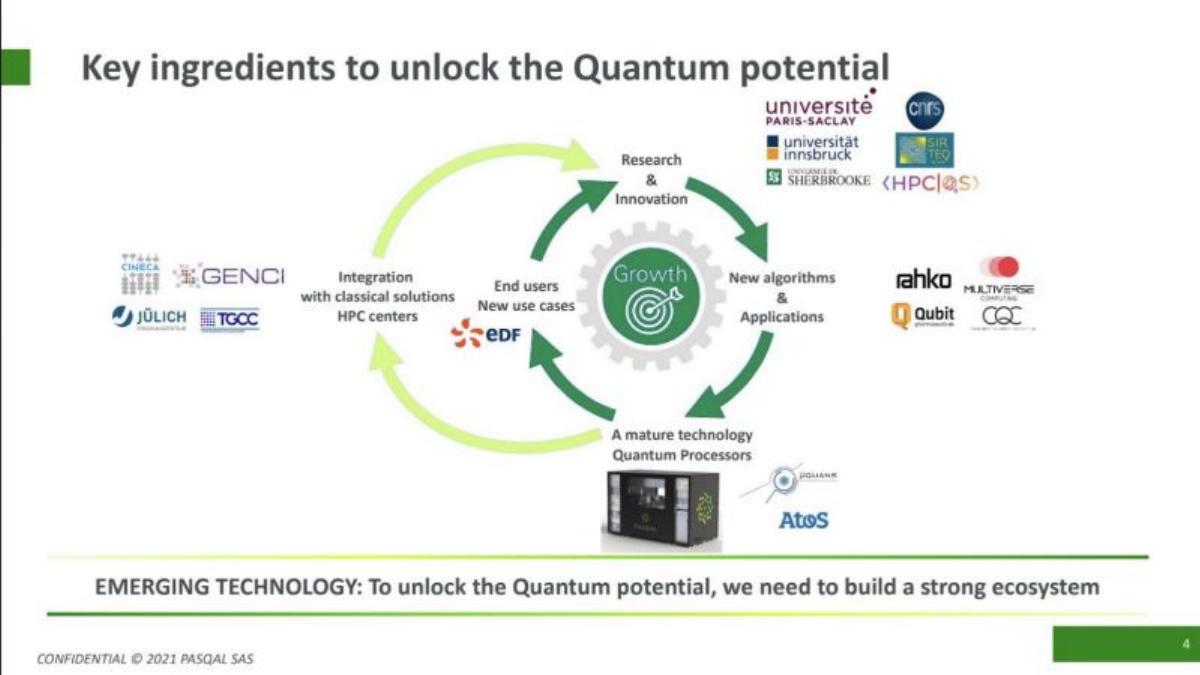
Slide 2 sets the stage by arguing that High-Performance Computing (HPC) is reaching its limits due to the slowing of Moore’s Law and unsustainable energy requirements. It identifies the 'Greatest Challenge' as the need to scale up quantum technology. Slide 3 introduces Pasqal as the solution, highlighting their 'Legacy' in the Paris-Saclay quantum hub and their 'Solution': multi-purpose, flexible QPUs with 100 to 1,000 qubits. Slide 4 emphasizes the 'Ecosystem,' showing a circular growth model involving research institutions (CNRS, University of Innsbruck), end-users (EDF), and software partners.
Slides 5-6: The Commercial Offer and Partnership Model
Slide 5 provides a concrete roadmap. It promises 100 qubits by end-2021 and 1,000 qubits by end-2023. This is a critical slide for investors because it attaches timelines to technical milestones. It also defines the two access modes: on-premise and cloud-based. Slide 6 details the 'Co-Design Partnership Model,' a three-phase approach (exploration, algorithm development, hardware implementation) with a typical schedule of 6 months per phase. This demonstrates a structured path to revenue and product-market fit.
Slides 7-9: Technical Deep Dive
Slide 8 is the heart of the technical pitch. It explains the use of trapped Rubidium atoms in optical tweezers. The slide includes diagrams of 1D, 2D, and 3D geometries, emphasizing the 'high flexibility' and 'high connectivity' of the platform. It cites a 2020 paper in Nature (Scholl et al.) to provide peer-reviewed validation. Slide 9 covers the 'Full-Stack Software Offer,' showing layers from hardware control to cloud services and end-user applications. This suggests that Pasqal is not just a hardware shop but a platform company.
Slides 10-14: Applications and Use Cases
After establishing the 'how,' the deck moves to the 'why.' Slide 11 lists applications in quantum simulation (physics, material science, chemistry) and hard computational problems (optimization, machine learning). Slides 12-14 focus on a specific use case: smart charging of electric vehicles (EVs) in partnership with EDF. Slide 14 shows 'Promising early results' with a graph indicating convergence towards large approximation ratios using a Quantum Approximate Optimization Algorithm (QAOA). This is a vital proof point, showing the technology working on real-world data provided by a major utility company.
Slides 15-16: Conclusion and Outlook
Slide 15 summarizes the value proposition: mature technology, established collaborations, and upcoming cloud/on-premise availability. Slide 16 is a simple 'Thank you' slide with the CEO’s email address. Notably, there is no slide detailing the amount of money being raised or the valuation, which is common for 'Investor Day' decks that serve as part of a broader fundraising process rather than a cold-outreach tool.
Slides 17-19: Technical Appendix
The deck includes three 'bonus' slides. Slide 17 explains the difference between Analogue and Digital control modes, positioning Pasqal as a versatile player that can offer better near-term performance via analogue while remaining universal via digital. Slide 18 provides further mathematical mapping for the MIS (Maximum Independent Set) problem. Slide 19 is perhaps the most practical slide in the deck, listing the physical specs of the QPU: 330cm width, The deck excels at technical substantiation . In a field as speculative as quantum computing, Pasqal avoids vague promises by citing specific academic papers and showing real data from their collaboration with EDF. The focus on 'Neutral Atoms' provides a clear differentiator from the 'Superconducting' (IBM/Google) or 'Ion Trap' (IonQ/Honeywell) approaches. By showing that their hardware can operate in a standard HPC environment without specialized cooling (Slide 19), they lower the perceived barrier to adoption for enterprise customers.
What is Missing
From a traditional venture capital perspective, the deck has several glaring omissions:
Team Slide: While the CEO is mentioned, the deck does not highlight the broader scientific team or their pedigree, which is usually a cornerstone of DeepTech pitches. · Competitive Landscape: There is no mention of how Pasqal’s 1,000-qubit roadmap compares to the roadmaps of competitors. · Financials: There are no projections for revenue, hardware costs, or burn rate. · The Ask: The deck does not state how much capital is being raised or how it will be allocated.
Founder Lessons
Founders in highly technical fields should take note of Pasqal’s 'Co-Design' narrative . Instead of claiming they have a finished product, they invite partners to build the use cases with them. This 'QCaaS' model (Slide 6) is a brilliant way to de-risk the technology while building a moat of proprietary algorithms. Furthermore, the inclusion of physical hardware specifications (Slide 19) is a powerful way to make 'spooky' technology feel like a manageable infrastructure asset for institutional investors.
Frequently asked questions
- What is Pasqal's core technological advantage according to the deck?
- Pasqal utilizes neutral atoms (specifically trapped Rubidium atoms) in arrays of optical tweezers. As shown on Slide 8, this allows for unique scalability and flexibility, enabling the arrangement of atoms in 1D, 2D, or 3D geometries. This approach is presented as superior for reaching high qubit counts (1,000+) with high connectivity compared to competing quantum modalities.
- How does Pasqal plan to generate revenue?
- The deck outlines two primary access modes on Slide 5: 'Directly,' where QPUs are installed at client premises or High-Performance Computing (HPC) centers, and 'Online,' through a cloud infrastructure. They refer to this as 'QCaaS' (Quantum Computing as a Service) on Slide 6, targeting end-users in sectors like pharmaceuticals, energy, and finance.
- Which major partners are mentioned in the deck?
- Pasqal highlights several high-profile collaborations to validate their use cases. Slide 6 and Slide 13 specifically mention EDF (Électricité de France) for smart-charging electric vehicle optimization. Other partners include world-class HPC centers like GENCI (France), Jülich (Germany), and CINECA (Italy), as well as software partners like Qu&Co and Multiverse Computing.
- What are the physical requirements for Pasqal's quantum computer?
- Unlike many quantum computers that require massive dilution refrigerators, Pasqal’s QPU has relatively modest requirements. Slide 19 specifies that the system requires 'None' for cooling requirements (beyond standard ambient conditions), consumes less than 10 kW of power, and fits within a footprint of 330 cm in width, weighing less than 750 kg.
- What is missing from this pitch deck?
- The deck is heavily focused on technology and roadmap. It notably lacks a dedicated 'Team' slide (though the CEO is named on the cover), a 'Competition' slide comparing them to IBM or IonQ, and any 'Financials' or 'Ask' slide. It functions more as a technical 'Investor Day' presentation than a traditional venture capital seed deck.