Particle's 13-slide deck is a highly effective later-stage fundraising tool that prioritizes social proof and operational efficiency over theoretical market sizing. The narrative begins by acknowledging a failed 2012 Kickstarter campaign, using it as a foundation for a story about building the world's largest IoT developer community. The deck excels at visualizing the 'digital chasm'—the complex stack of sensors, networks, and cloud infrastructure that causes 74% of IoT initiatives to fail. By showcasing how their 'full-stack' solution reduced time-to-market for enterprise clients like Jacuzz…
Key takeaways
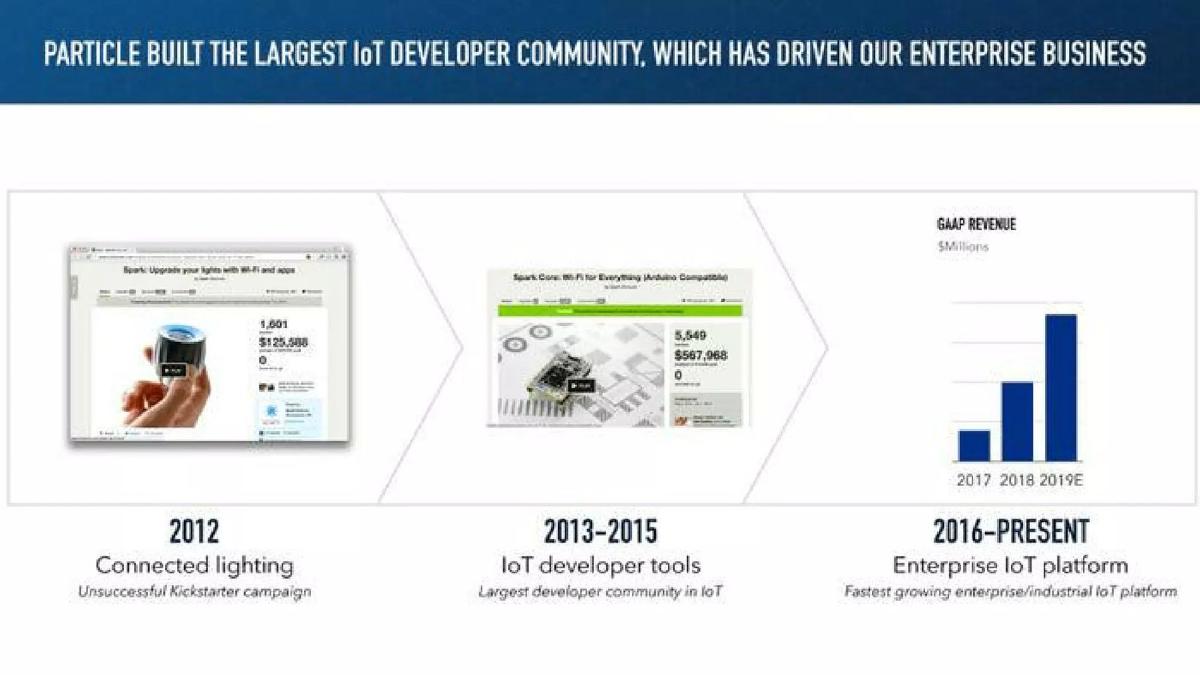
- The company transparently admits to an unsuccessful Kickstarter campaign in 2012 to highlight their pivot to developer tools (Slide 2).
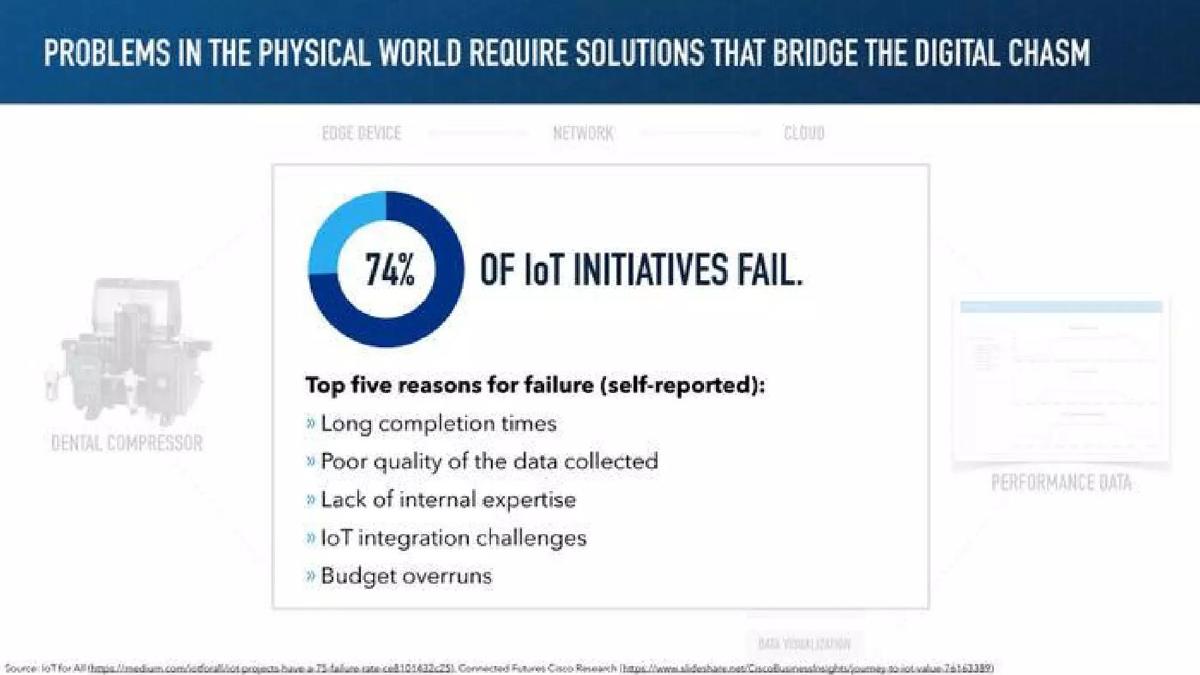
- Particle identifies that 74% of IoT initiatives fail due to integration challenges and lack of expertise (Slide 5).
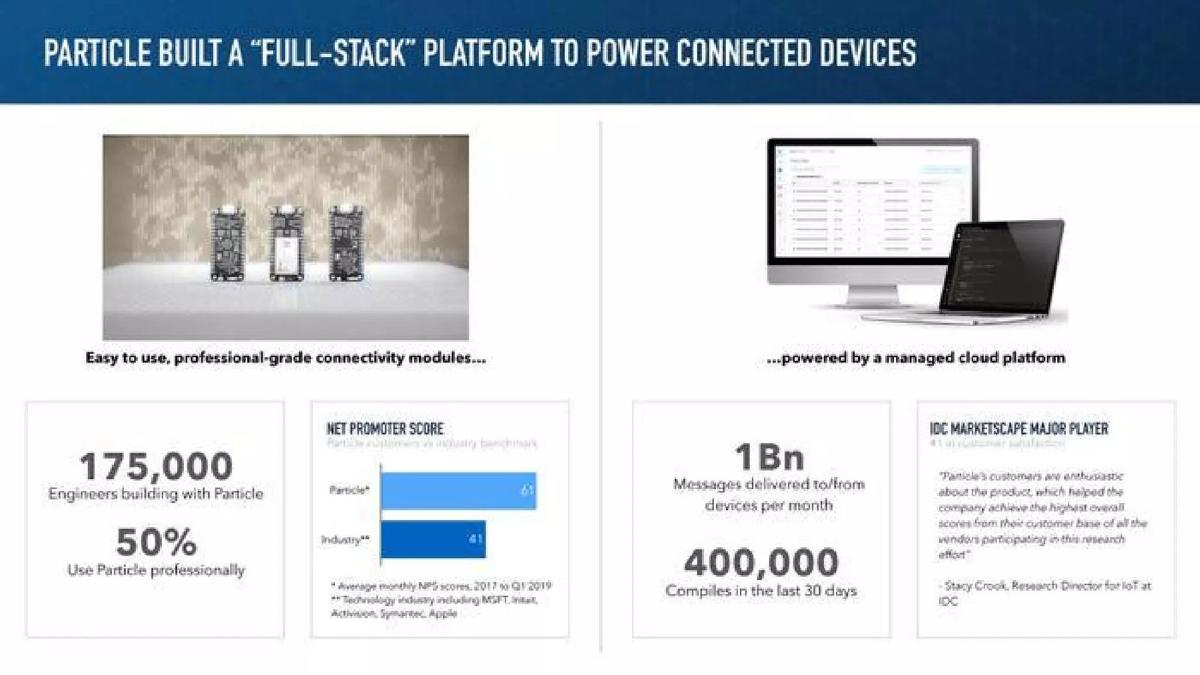
- The platform supports 175,000 engineers and delivers 1 billion messages per month (Slide 6).
- A detailed case study with Watsco illustrates a remote monitoring solution for HVAC systems that could be worth hundreds of millions (Slide 7).
- Particle claims their full-stack solution allows a product to reach market in six months with only two engineers (Slide 11).
- The Jacuzzi case study cites $2 million saved through predictive maintenance and a 6% increase in average sales price (Slide 12).
- Enterprise revenue contribution grew from 25% in 2017 to an estimated 80% in 2019 (Slide 13).
- The time to close enterprise deals was reduced from 15 months in 2017 to 4-6 months in 2019 (Slide 13).
The Evolution from Maker Tools to Enterprise Infrastructure
Particle’s pitch deck is a masterclass in narrative transition. Founded in 2012, the company began in the 'maker' space, providing hardware for hobbyists. This deck, used during their later-stage growth, successfully rebrands that history as a strategic advantage. It argues that by winning the hearts and minds of 175,000 developers, they created a Trojan horse for entering the enterprise market. The deck is less about 'what we might do' and entirely about 'what we are already doing at scale.'
Slides 1-2: The Origin Story and Pivot
Slide 1 is a minimalist title slide featuring the Particle logo and the tagline "Enabling the Internet of Things." It sets a professional, corporate tone that persists throughout the presentation.
Slide 2 is perhaps the most honest slide in the deck. It presents a timeline of the company’s history, starting with a 2012 'Unsuccessful Kickstarter campaign' for connected lighting. This vulnerability serves a purpose: it shows the transition from a failed consumer product to a successful developer toolset (2013-2015) and finally to an 'Enterprise IoT platform' (2016-Present). The slide includes a bar chart for GAAP Revenue showing significant growth from 2017 to a 2019 estimate. By acknowledging the early failure, Particle builds credibility for their current enterprise success.
Slides 3-5: The Problem and the Digital Chasm
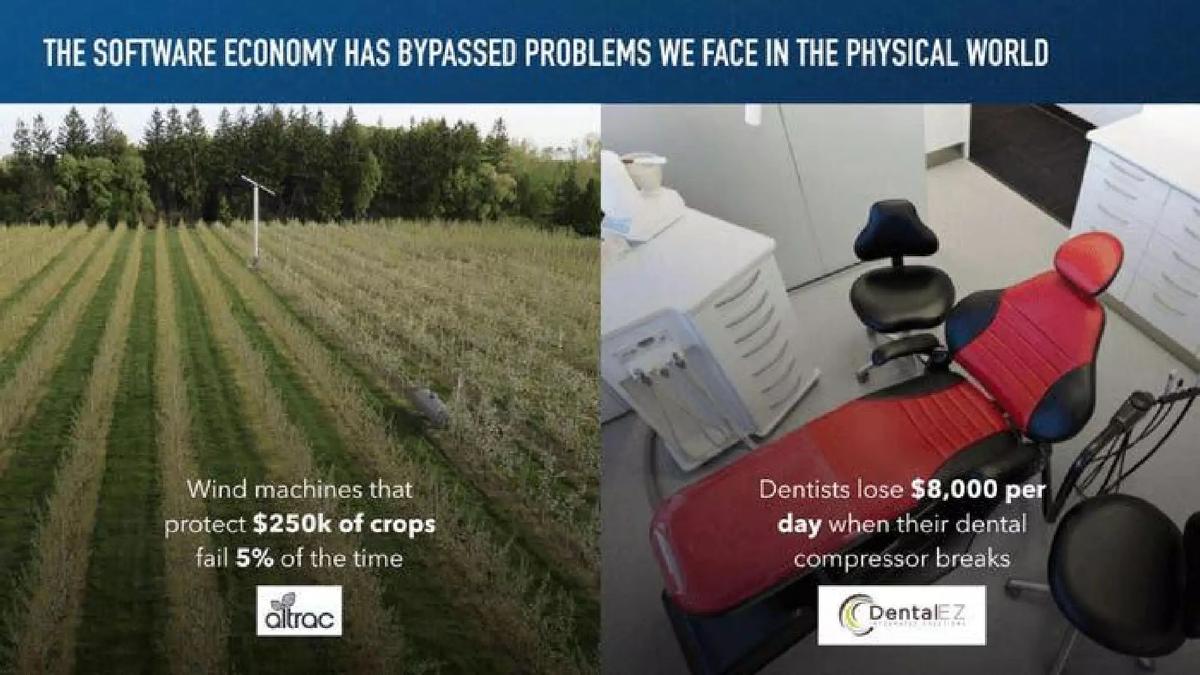
Slide 3 moves into the problem space, using high-impact imagery. It contrasts two physical world problems: wind machines protecting $250k of crops failing 5% of the time, and dentists losing $8,000 per day when compressors break. This grounds the abstract concept of IoT in real-world financial loss.
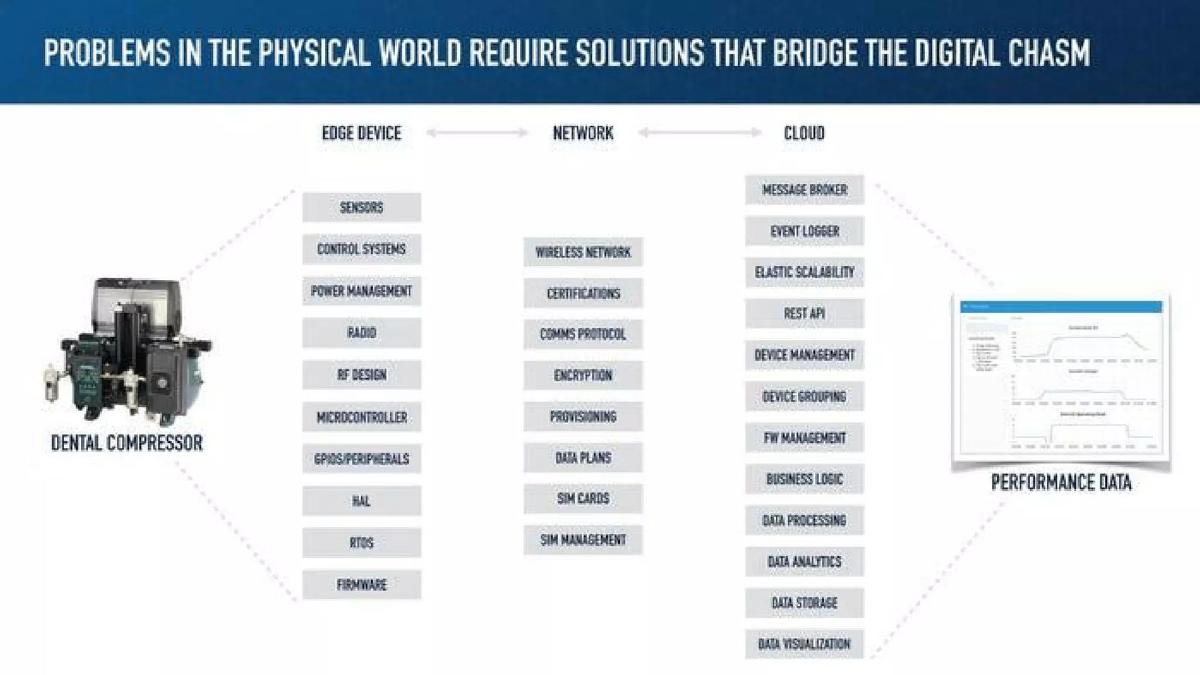
Slide 4 introduces the 'Digital Chasm.' It lists the overwhelming number of components required to bridge an edge device to the cloud. The list includes 25 distinct technical requirements across Compute, Network, and Cloud, such as 'HAL,' 'RTOS,' 'SIM Management,' and 'Elastic Scalability.' This slide is designed to make the audience feel the complexity of building an IoT solution from scratch.
Slide 5 provides the 'why' behind the complexity. It cites a statistic that 74% of IoT initiatives fail, listing the top five reasons: long completion times, poor data quality, lack of expertise, integration challenges, and budget overruns. This slide positions Particle not just as a vendor, but as an insurance policy against project failure.
Slides 6-8: The Solution and the Watsco Case Study
Slide 6 introduces the Particle 'Full-Stack' platform. It balances hardware (connectivity modules) with software (managed cloud). The metrics here are impressive: 175,000 engineers, 50% professional usage, 1 billion messages delivered per month, and 400,000 compiles in the last 30 days. It also highlights a Net Promoter Score (NPS) of 61, compared to an industry average of 41, citing companies like Microsoft and Apple as the benchmark.
Slide 7 begins a deep dive into Watsco, the largest HVAC distributor in North America with $4.5Bn in revenue. It identifies a specific opportunity: remote diagnostics for HVAC systems that could be worth 'hundreds of millions of dollars.' This is a crucial shift from general platform features to a specific vertical application.
Slide 8 shows the result of the Watsco partnership: 'Sentree,' a remote monitoring solution. The slide uses a simple 'before and after' visual, showing five sensors attached to an air conditioner connecting to a cloud analytics dashboard. It proves that Particle’s tech can be wrapped in a customer’s own branding to create a new revenue stream.
Slides 9-11: Technical Architecture and Value Proposition
Slide 9 provides a technical diagram of how Particle powers a product like Sentree. It maps the Particle E310 module through the Particle Communication Protocol and Particle Cloud into the customer’s existing ERP and CRM systems. This demonstrates that Particle is 'plug-and-play' with existing enterprise IT infrastructure.
Slide 10 reinforces the 'Full-Stack' message by overlaying the 25 technical challenges from Slide 4 onto their architecture. It claims to simplify implementation by handling everything from 'Power Management' to 'Over-the-air software updates' and 'End-to-end security.'
Slide 11 summarizes the value proposition in three columns: Compute, Connectivity, and Cloud. The key takeaway here is the claim that a customer can get a 'Product to market in six months with two engineers.' For an enterprise audience, this promise of speed and resource efficiency is the primary selling point.
Slides 12-13: The Jacuzzi Case Study and Financial Momentum
Slide 12 is a powerful case study of Jacuzzi’s digital transformation. It lists three specific KPIs: 6 months from concept to market, $2M saved via predictive maintenance, and a 6% increase in average sales price. It includes a quote from Larry Ovalle, Director of Marketing at Jacuzzi, stating that Particle’s 'x-factor' was their ability to understand the business strategy. This slide provides the 'social proof' necessary to close a large funding round.
Slide 13 concludes the deck with financial growth metrics. It shows GAAP Revenue and 3CV Bookings (Three-year contract value) both doubling year-over-year. The most important data point on this slide is the 'Time to close,' which dropped from 15 months in 2017 to 4-6 months in 2019. This indicates that Particle has figured out its sales motion and is ready to scale, which is exactly what later-stage investors want to see.
What Works in the Particle Deck
The 'Digital Chasm' Visual: Slide 4 and Slide 10 are excellent at visualizing the 'hidden' work of IoT. By listing all 25+ components required to build a connected product, Particle makes their subscription fee seem like a bargain compared to the cost of hiring a team to build those components manually.
Vertical-Specific ROI: The deck avoids the trap of being too horizontal. By spending four slides on Watsco and Jacuzzi, they prove that their platform works for heavy industry and consumer luxury goods alike. The specific mention of a 6% increase in sales price for Jacuzzi is a rare and highly effective metric to include in a pitch.
Developer-to-Enterprise Pipeline: The narrative that 175,000 developers are the 'top of the funnel' for enterprise sales is very compelling. It suggests a low customer acquisition cost (CAC) for the enterprise tier because the engineers at those companies are already using Particle for prototyping.
What is Missing from the Particle Deck
No Team Slide: There is no mention of the founders, their backgrounds, or the executive leadership team. While the company is established, investors still invest in people, especially when navigating the complex hardware supply chains mentioned in the catalogue facts (Shenzhen, China operations).
No Competition Slide: The IoT platform space is incredibly crowded, with giants like AWS IoT and Azure IoT, as well as smaller players. The deck doesn't explicitly state how Particle wins against the cloud giants, other than the 'full-stack' hardware-software integration argument.
No Unit Economics: While the deck shows revenue growth and bookings, it omits gross margins, churn rates, or LTV/CAC ratios. For a later-stage round, these are usually expected to justify the valuation.
No Specific Ask: The deck ends on a growth slide but does not state how much capital is being raised or how that capital will be deployed (e.g., R&D, sales expansion, or international growth).
What Founders Should Copy
The 'Failure to Success' Timeline: If your company has pivoted, don't hide it. Use it to show that you have learned from the market. Particle’s Slide 2 is a great example of how to frame a pivot as a strategic evolution rather than a desperate change of direction.
Quantifiable Case Studies: Don't just say 'our customers love us.' Say 'our customer saved $2M and increased their sales price by 6%.' The more specific the ROI, the more believable the pitch.
Sales Efficiency Metrics: Showing that your 'Time to Close' is decreasing is one of the strongest signals of product-market fit. It tells investors that your sales team is becoming more efficient and that the market is beginning to pull the product rather than the company having to push it.
Visualizing Complexity: If you are building infrastructure, create a 'complexity map' like Particle’s Slide 4. It helps non-technical investors understand exactly what problem you are solving and why it is difficult for others to replicate your solution.
Company: Particle · Sector: IoT / Hardware & Software · Stage: Later Stage · Year: 2012 (Founded), 2019 (Deck context) · Slides: 13 · Outcome: $105,800,000 total raised · HQ: San Francisco, CA and Shenzhen, China
Frequently asked questions
- Why does the deck start with a failed Kickstarter campaign?
- Slide 2 uses the 2012 failure as a narrative hook to show evolution. By contrasting the 'unsuccessful' lighting product with the subsequent 'largest developer community in IoT,' Particle demonstrates resilience and a data-driven pivot. It proves they didn't just stumble into success; they built a foundation of developer tools that eventually unlocked the enterprise market.
- How does Particle define its 'Full-Stack' offering?
- According to Slides 9 and 10, the full stack consists of three pillars: Compute (hardware modules and Device OS), Connectivity (Particle MVNO and communication protocols), and Cloud (Device Cloud, Console, and REST APIs). This visual breakdown argues that Particle handles the 'digital chasm'—the 20+ technical layers like encryption and firmware management—so customers don't have to.
- What specific metrics are used to prove enterprise traction?
- Slide 13 provides the most compelling data: GAAP revenue growth, 3CV (Three-year contract value) bookings, and a shift in revenue mix. Specifically, it shows enterprise contribution jumping from 25% to 80% over three years. Most importantly, it highlights sales efficiency by showing the 'Time to Close' dropping from 15 months to under 6 months.
- Is the lack of a team slide a red flag in this deck?
- For a company at this stage (having raised over $100M total), a team slide is less critical than for a Seed round. The deck relies on 'institutional credibility'—citing 175,000 developers and Fortune 500 clients. However, its absence is notable. Investors at this level usually know the founders, but for a cold deck, the omission of leadership expertise is a missed opportunity.
- How does Particle use case studies to sell the ROI?
- Slides 7, 8, and 12 focus on Watsco and Jacuzzi. Instead of vague benefits, they cite specific outcomes: Jacuzzi saved $2M in maintenance costs and increased sales prices by 6%. By showing the 'Sentree' HVAC solution, they move the conversation from 'what is IoT' to 'how IoT generates hundreds of millions in value.'