Pareto’s 2022 seed deck is a 12-slide presentation that eschews traditional graphic design for stark, text-heavy slides. The company addresses the friction in obtaining high-quality B2B data by combining GPT-3 and Codex with a human-in-the-loop expert review process. The deck is notably transparent about its traction, reporting $43,000 in monthly revenue and 38% month-over-month growth at the time of the raise. Despite the lack of visual flair, the deck effectively communicates a strong unit economic story (17x LTV/CAC) and a clear technological inflection point. The round ultimately closed a…
Key takeaways
- The company reported $43,000 in monthly revenue with an average month-over-month growth rate of 38% on slide 7.
- Pareto claims a highly efficient go-to-market strategy with an LTV/CAC ratio of 17, according to slide 8.
- The technical approach relies on a combination of OpenAI's GPT-3, Codex, and human expert review as detailed on slides 1 and 6.
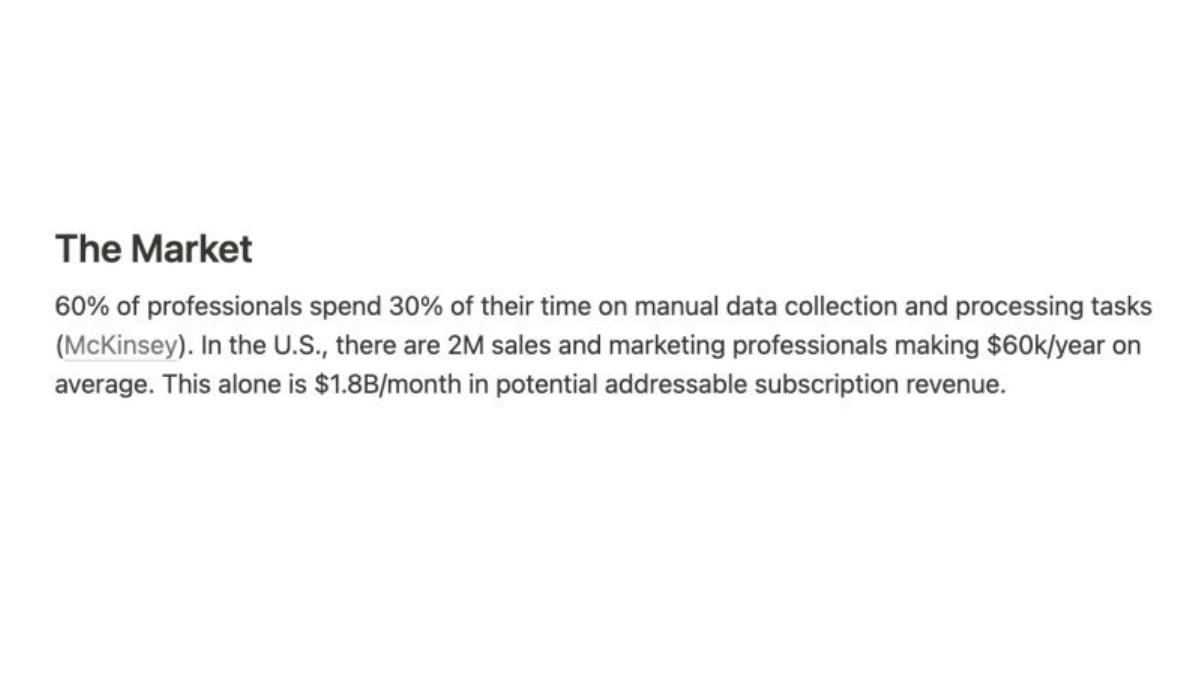
- The market opportunity is defined by 2 million U.S. sales and marketing professionals, representing a $1.8B monthly addressable revenue pool on slide 5.
- The business model includes both project-based and subscription pricing, with a focus on 'subscribe and save' recurring tasks on slide 9.
- The team slide highlights a 'majority women-led' workforce and founders with backgrounds from Stanford, Microsoft Research, and the Thiel Fellowship on slide 10.
- The deck discloses a previous $600,000 pre-seed round raised in November 2020 on slide 11.
- There is no specific 'Ask' slide detailing the exact valuation or dollar amount being sought in the current round, though the catalogue listing confirms a $5M raise.
The Anatomy of a Minimalist Seed Deck
Pareto’s pitch deck is an anomaly in the world of venture capital. In an era of high-fidelity prototypes and flashy motion graphics, Pareto raised $5M using a deck that looks like a series of clean, black-and-white text documents. This teardown examines how the strength of their metrics and the clarity of their AI-human hybrid model overcame the lack of traditional visual design.
Slides 1-2: The Vision and The Problem
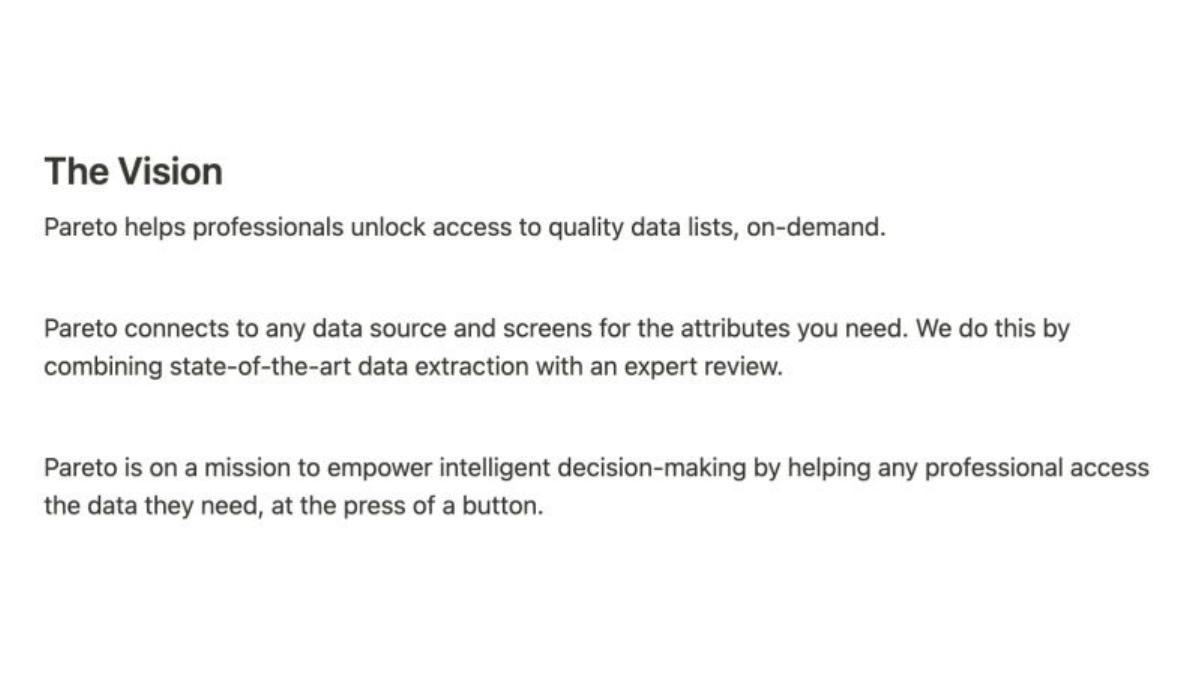
Slide 1 introduces the vision: unlocking access to quality data lists on-demand. The company positions itself as a bridge between 'state-of-the-art data extraction' and 'expert review.' This is a critical distinction; they are not claiming to be a pure AI play, but rather an augmented service that ensures quality through human oversight.
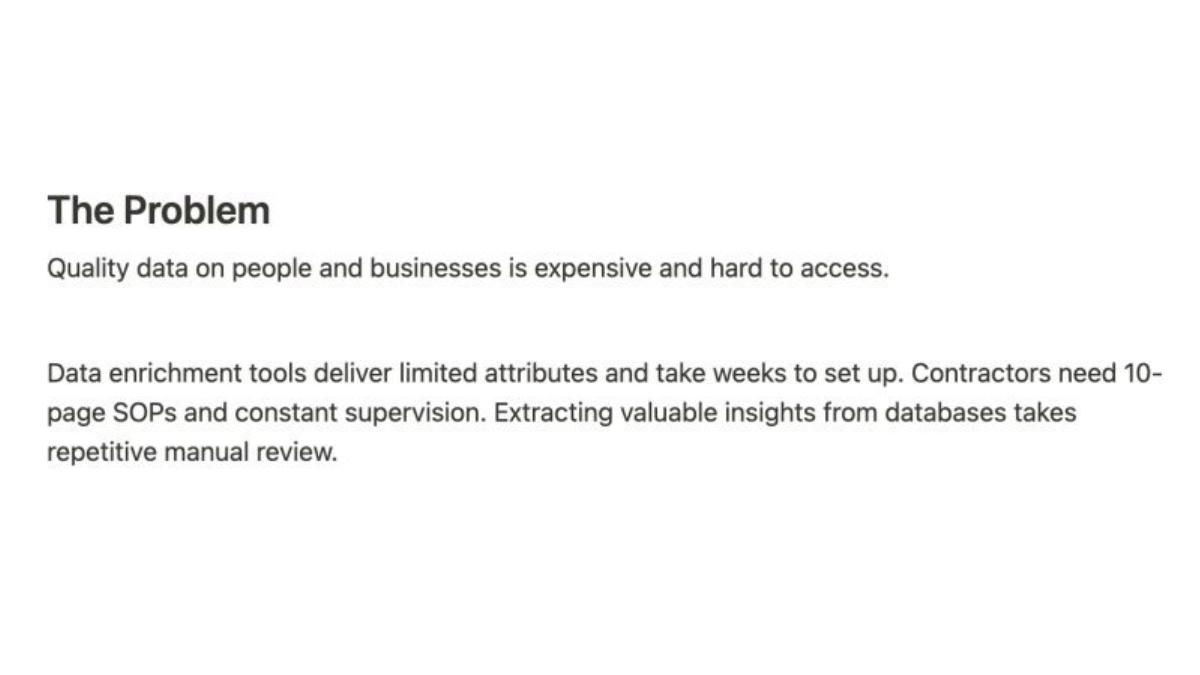
Slide 2 defines the problem space. It identifies two failed alternatives: data enrichment tools that deliver 'limited attributes' and take weeks to set up, and manual contractors who require '10-page SOPs and constant supervision.' By framing the problem this way, Pareto carves out a middle ground where they offer the scale of software with the nuance of human intelligence.
Slides 3-4: The Solution and Social Proof
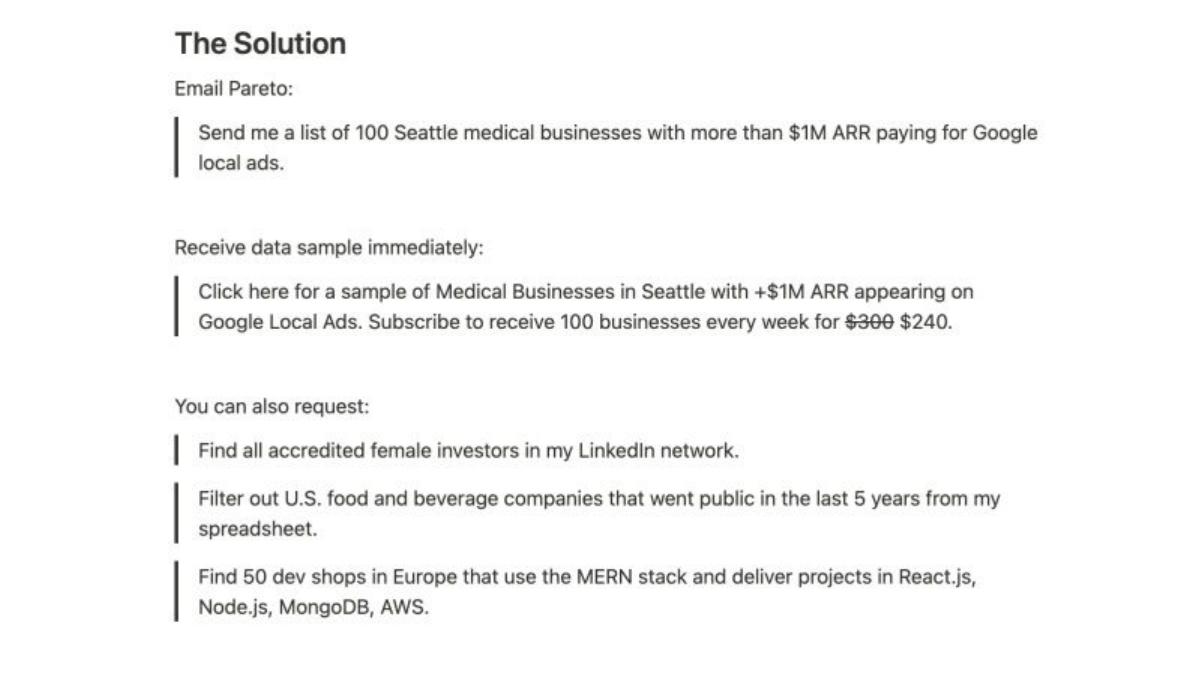
Slide 3 is the 'Solution' slide, but it functions more like a product demo. It uses a conversational format to show exactly how a customer interacts with the service. Examples include requests for 'accredited female investors in my LinkedIn network' or 'dev shops in Europe that use the MERN stack.' This slide effectively demonstrates the flexibility of their data gathering capabilities, which go far beyond standard B2B contact databases.
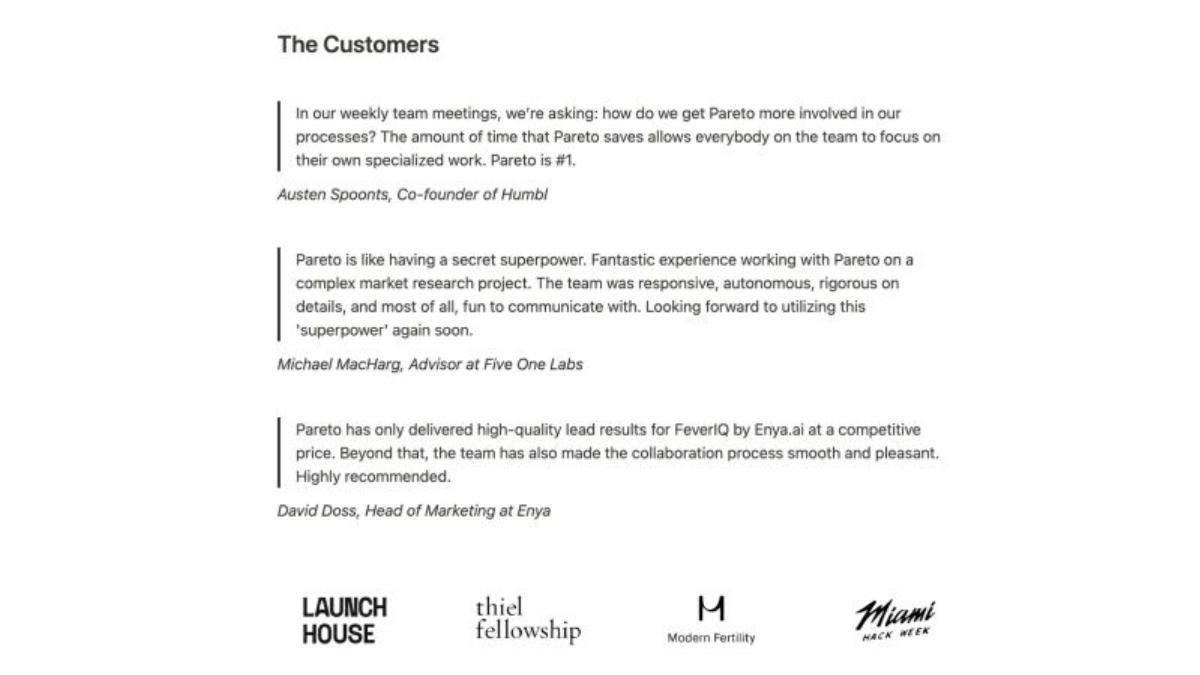
Slide 4 provides customer testimonials. Quotes from founders at Humbl, Five One Labs, and Enya.ai emphasize the 'superpower' aspect of the service. The slide also includes logos for Launch House, Thiel Fellowship, Modern Fertility, and Miami Hack Week, establishing immediate credibility within the startup ecosystem.
Slides 5-6: Market Size and Technical Inflection
Slide 5 tackles the market. Using McKinsey data, they state that 60% of professionals spend 30% of their time on manual data tasks. They narrow their focus to 2 million U.S. sales and marketing professionals earning an average of $60k/year, calculating a potential addressable subscription revenue of $1.8B per month. This is a bottom-up calculation that feels more grounded than a generic 'Trillion Dollar Market' claim.
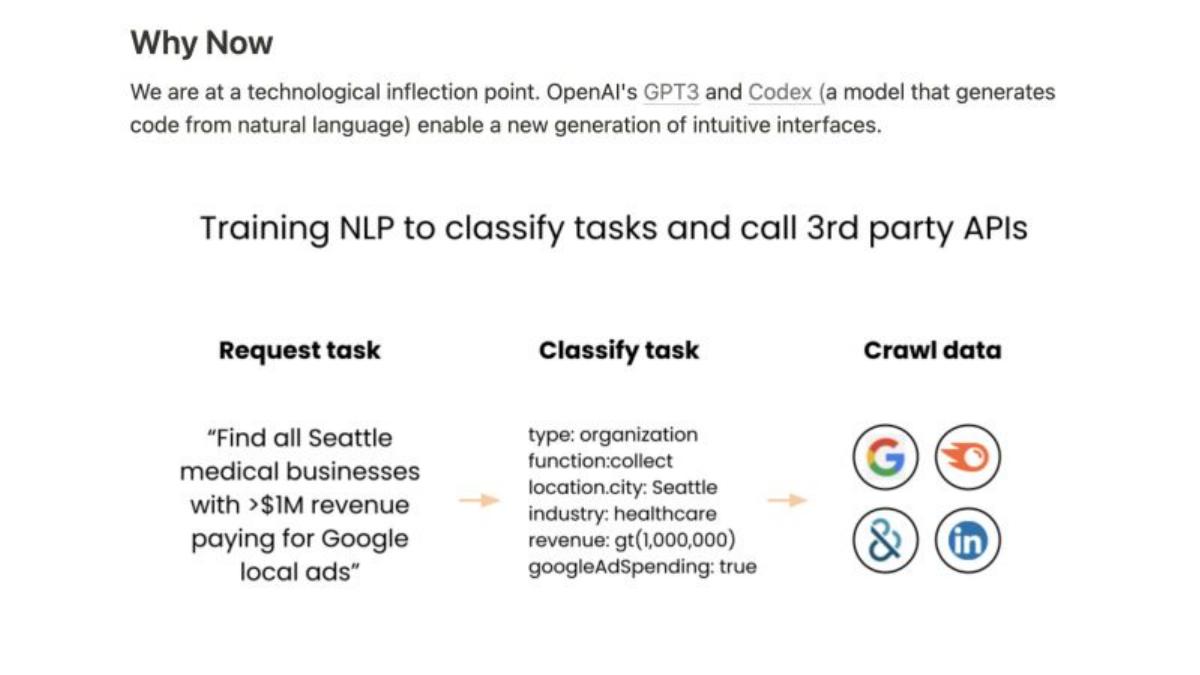
Slide 6 explains 'Why Now.' This is a staple of successful seed decks. Pareto points to the technological inflection point of OpenAI’s GPT-3 and Codex. They show a three-step workflow: Request task (Natural Language) -> Classify task (NLP training) -> Crawl data (API calls). This slide justifies their existence in 2022; this product could not have functioned as efficiently two years prior.
Slides 7-9: Traction, GTM, and Business Model
Slide 7 is the 'Traction' slide and is perhaps the most important in the deck. It contains a single sentence: 'Last month, we hit $43K in monthly revenue with 38% average MoM revenue growth.' For a seed round, these are exceptional numbers. The simplicity of the slide forces the investor to focus on the raw growth.
Slide 8 details the Go-to-Market (GTM) strategy. Interestingly, Pareto uses its own product to find leads, claiming an LTV/CAC of 17. They also note they have spent $0 on paid marketing, suggesting that the current growth is entirely organic or driven by highly efficient outbound efforts. This signals to investors that new capital will be used to pour gasoline on an already functional fire.
Slide 9 outlines the business model. They offer both project-based and subscription pricing. The mention of a head of growth needing to enrich 40,000 contacts shows they can handle 'surges' alongside their preferred 'subscribe and save' recurring model. This flexibility is key for capturing both one-off research projects and ongoing sales pipeline needs.
Slides 10-12: Team and Fundraising
Slide 10 introduces the team. Phoebe Yao (CEO) is highlighted as a Thiel Fellow and Stanford CS dropout, while Adrian Villa (VP of Engineering) brings CTO experience and a Stanford CS background. The slide also notes their workforce is 'majority women-led and operated,' adding a social impact dimension to their operational efficiency.
Slide 11 covers fundraising history. They raised $600k in November 2020 from Foothill Ventures, SoGal Ventures, and the founders of DoNotPay and Lime. The slide states they are now raising a 'larger seed round' but, notably, does not list the target amount or the terms. This is a common omission in decks intended for wide distribution to maintain negotiating leverage.
Slide 12 is a placeholder for bestpitchdeck.com and does not contain company information.
What Pareto Does Well
The strength of this deck lies in its brutal honesty and lack of filler . By using a minimalist text-based design, the founders signal that they are focused on execution rather than aesthetics. The inclusion of specific revenue figures ($43k) and growth rates (38%) provides the 'hard evidence' that many seed decks lack. Furthermore, the 'Why Now' slide (Slide 6) perfectly captures the zeitgeist of the 2022 AI boom, positioning Pareto as an early mover in the LLM-implementation space.
What is Missing
The most glaring omission is a Competitor Map . The data enrichment space is crowded with giants like ZoomInfo, Apollo, and Clearbit. While Slide 2 alludes to the failures of existing tools, a dedicated slide explaining how Pareto wins against specific incumbents would have strengthened the case. Additionally, the deck lacks Unit Economics beyond the LTV/CAC mention. Investors would likely want to see the gross margins of a 'human-in-the-loop' service, as human labor can often compress margins compared to pure software.
Founder's Playbook: What to Copy
The 'Dogfooding' GTM: Showing that you use your own product to acquire customers (Slide 8) is the ultimate proof of utility. · Specific Use Cases: Instead of saying 'we find data,' Slide 3 gives four hyper-specific examples. This helps investors visualize the actual customer journey. · The Inflection Point: Always answer 'Why Now?' Pareto’s link to GPT-3 and Codex (Slide 6) makes the business feel inevitable rather than just possible. · Direct Traction: If your numbers are good, don't hide them in a chart. Put them in large text in the center of the slide (Slide 7).
Frequently asked questions
- What is Pareto's core product offering?
- Pareto provides on-demand access to high-quality data lists. As described on slide 1, they combine automated data extraction with expert human review to ensure quality. Users can request specific, complex data sets—such as a list of medical businesses in a specific city with specific revenue and advertising criteria—and receive samples immediately before subscribing for recurring deliveries.
- How does Pareto use AI in its workflow?
- According to slide 6, Pareto leverages OpenAI's GPT-3 and Codex. They train Natural Language Processing (NLP) models to classify incoming user tasks and call third-party APIs. This allows the system to translate a natural language request (e.g., 'Find 50 dev shops in Europe') into a structured data crawl across platforms like Google, LinkedIn, and Crunchbase.
- What are the key financial metrics disclosed in the deck?
- The deck is remarkably open about its performance. Slide 7 notes that the company reached $43,000 in monthly revenue with 38% month-over-month growth. Furthermore, slide 8 highlights a very high LTV/CAC (Lifetime Value to Customer Acquisition Cost) ratio of 17, achieved primarily through using their own tool for outbound lead generation.
- Who is behind the company?
- The leadership team, shown on slide 10, includes CEO Phoebe Yao, a Thiel Fellow and Stanford CS dropout with experience at Microsoft Research, and VP of Engineering Adrian Villa, a former CTO and Stanford CS graduate. The slide also emphasizes that their workforce is majority women-led and operated, focusing on empowering disadvantaged communities.
- Is there a clear exit strategy or 'Ask' in the deck?
- No. Slide 11 mentions that they are 'raising a larger seed round' to invest in growth and hiring and are positioning for a Series A within 18 months. However, it does not specify the amount they are looking for or the valuation. The $5M figure is known from the external catalogue listing rather than the slides themselves.