"Diverse Team" on a Pitch Deck: Say What Kind, Show It
Many team slides call the team diverse without saying how. Four real decks show the difference between a specific.
"Diverse Team" on a Pitch Deck: Say What Kind, Show It, and Say Why It Matters
"Diverse" is a common word on team slides, and it can mean very different things: a mix of backgrounds in engineering, design and sales; a range of industries; founders from several countries; or the gender and ethnic make-up of the team. Each can be relevant to a business, but a reader can't tell which one the founder means from the word alone. This guide looks at four real pages that describe a team as diverse, from a page of measured percentages linked to the company's customers to a headline with nothing behind it, and sets out how to make the claim clear and useful.
TL;DR
Say which kind of diversity you mean, show it with something a reader can check, and connect it to how the business works. Schola, a school-enrolment company, does this most fully: it reports the share of its executive team and wider team who are women or Latino, and places those figures beside the share of its clients who serve Black and Brown communities. Pareto links a majority women-led workforce to its claim of better and cheaper data work. PhageLab and Wellspent use 'diverse' in the headline, but their pages show a mix of disciplines and employers, not a stated kind of diversity, so the reader is left to guess.
Four decks that call their team diverse
Each page is read at full size. Quotes are exact.
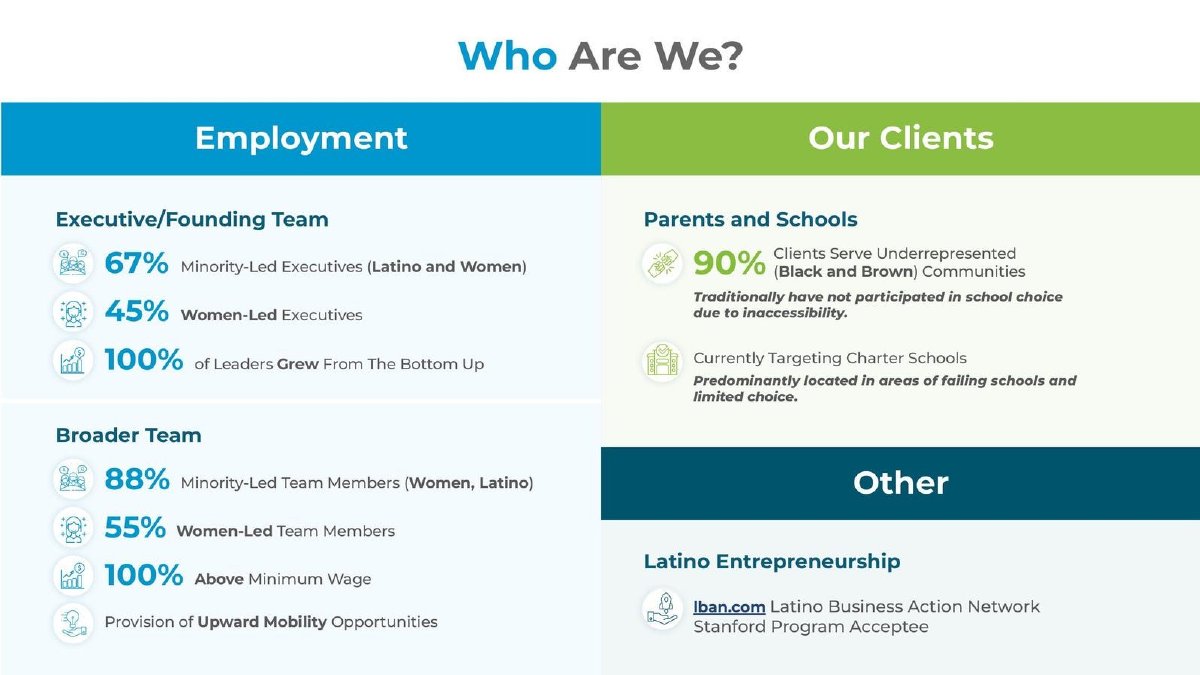
Schola team slide — slide 4
School search and enrolment. Team and client make-up.
Schola deck, slide 4. Exact stored slide matched to this analysis.
Our analysis: The most specific and business-linked claim of the four.
Evidence and limitation: Kinds named, percentages for leadership and wider team, placed beside client make-up; group sizes and stated link missing.
What a founder can adapt: Add group sizes and one sentence stating the link.
Supporting analysis
What the deck claims: "67% Minority-Led Executives (Latino and Women)"; "55% Women-Led Team Members"; "90% Clients Serve Underrepresented (Black and Brown) Communities".
Presentation choice: Shows a measured claim set beside the customers it relates to.
When it does not fit: 'Led' used to describe individual people.
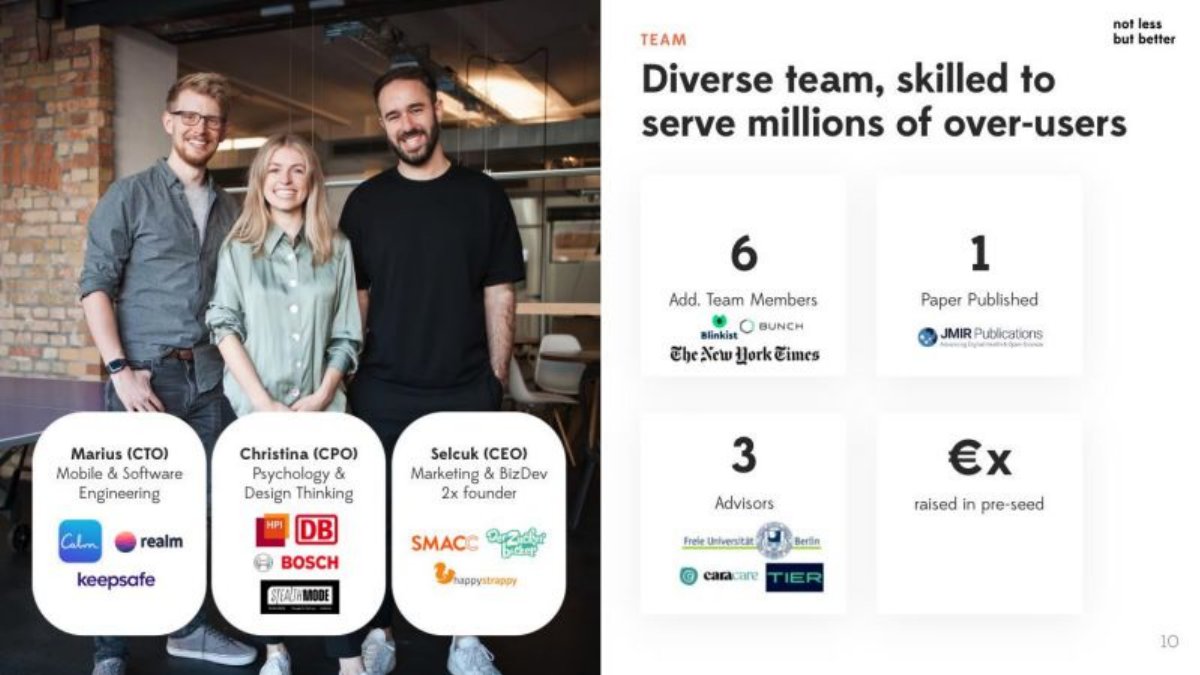
Consumer behaviour-change app. Founders and team tiles.
Wellspent deck, slide 10. Exact stored slide matched to this analysis.
Our analysis: Close to self-explaining; a plainer word would finish the job.
Evidence and limitation: Founder boxes imply mixed skills; headline ties team to users; placeholder left in.
What a founder can adapt: Say 'engineering, psychology and growth' instead of 'diverse'.
Supporting analysis
What the deck claims: "Diverse team, skilled to serve millions of over-users"; founders in "Mobile & Software Engineering", "Psychology & Design Thinking", "Marketing & BizDev"; "€x raised in pre-seed".
Presentation choice: Shows 'diverse' used to mean complementary skills.
When it does not fit: Unfilled template text such as '€x'.
Kind. Does the slide say which kind of diversity you mean?
Evidence. Is there a figure, group size or specific a reader can check?
Scope. Does it say whether it covers founders, leadership or all staff?
Link. Does one sentence say why it matters to the business?
Copyable framework: "[n] of [m] [group] are [description]. This matters because [link to customers or operations]."
Illustrative example 1 — written by us
Before: "A HIGHLY EXPERIENCED AND DIVERSE TEAM"
After: "Experienced team across biotechnology, data science and animal-health sales"
What improved: Our illustrative rewrite of PhageLab's headline, using disciplines listed on its own page.
The question this guide answers
This guide answers one founder question: if I describe my team as diverse on the deck, what should I say so that the claim is clear and relevant to an investor?
Our team slide guides cover how to present founders' experience, advisors, the board, the org chart, culture and remote teams. Our culture guide deals with values and ways of working. None takes the word 'diverse' itself as the subject: what it can mean, how to back it up, and when it belongs in an argument about the business. That is what this guide covers.
Some investors and funds have explicit interest in team composition; many founders also see it as part of their story. This guide takes no view on how much weight any investor should give it. It is about making whatever claim you choose to make precise.
How we chose and read the examples
We searched extracted text across the library for phrases such as 'diverse team', 'women-led', 'female-founded' and 'minority-led'. There were 22 matches. We set aside listed companies, investment funds describing their own partners, and pages where 'diverse' described products or markets rather than people. We kept four private-company pages that use the claim in different ways.
Each page was rendered from the source document and read at full size. Pareto's page is from a written document rather than a slide; we say so where it matters. We report only what each page states. We do not infer anyone's gender, ethnicity or background from names or photographs, and we did not check any figure against outside sources.
Why the word alone does little
It has several meanings. A reader may assume a different one from the one you intended. An investor who reads 'diverse team' over a photo of three founders may wonder whether you mean skills, nationalities or demographics, and won't usually ask.
It is easy to claim. Almost any team of more than two people differs in some way. Without specifics, the word adds little to what the names and job titles already show.
It reads as an add-on unless connected. When the page explains why the make-up of the team helps the company reach its customers, build its product or run its operations, the claim becomes part of the case for investing. When it doesn't, it reads as decoration.
Measured and linked to customers: Schola
Schola, a company helping families find and enrol in schools, titles its page 4 'Who Are We?'. The left half, headed 'Employment', reports for the 'Executive/Founding Team': '67% Minority-Led Executives (Latino and Women)', '45% Women-Led Executives' and '100% of Leaders Grew From The Bottom Up'. For the 'Broader Team': '88% Minority-Led Team Members (Women, Latino)', '55% Women-Led Team Members', '100% Above Minimum Wage' and 'Provision of Upward Mobility Opportunities'.
The right half, headed 'Our Clients', reads '90% Clients Serve Underrepresented (Black and Brown) Communities', with the note 'Traditionally have not participated in school choice due to inaccessibility', and 'Currently Targeting Charter Schools', 'Predominantly located in areas of failing schools and limited choice'. A third box mentions acceptance to a Stanford programme for Latino entrepreneurs.
This is the most specific claim of the four. It says which kinds of diversity it means, gives percentages for two groups, separates leadership from the wider team, and places the team beside the communities its customers serve. An investor can see the argument the founders are making: a team that reflects the families the schools want to reach.
Three things could be clearer. The labels use 'Minority-Led' and 'Women-Led' for individual executives and team members, where 'led' normally describes an organisation; 'executives who are women or Latino' would be plainer. The page doesn't give the size of either group, so a reader can't tell whether 67% means two of three people or twenty of thirty. And the link between team and clients is shown by placement rather than stated; one sentence on how the team's background helps it win or serve these schools would make the argument explicit.
Linked to operations: Pareto
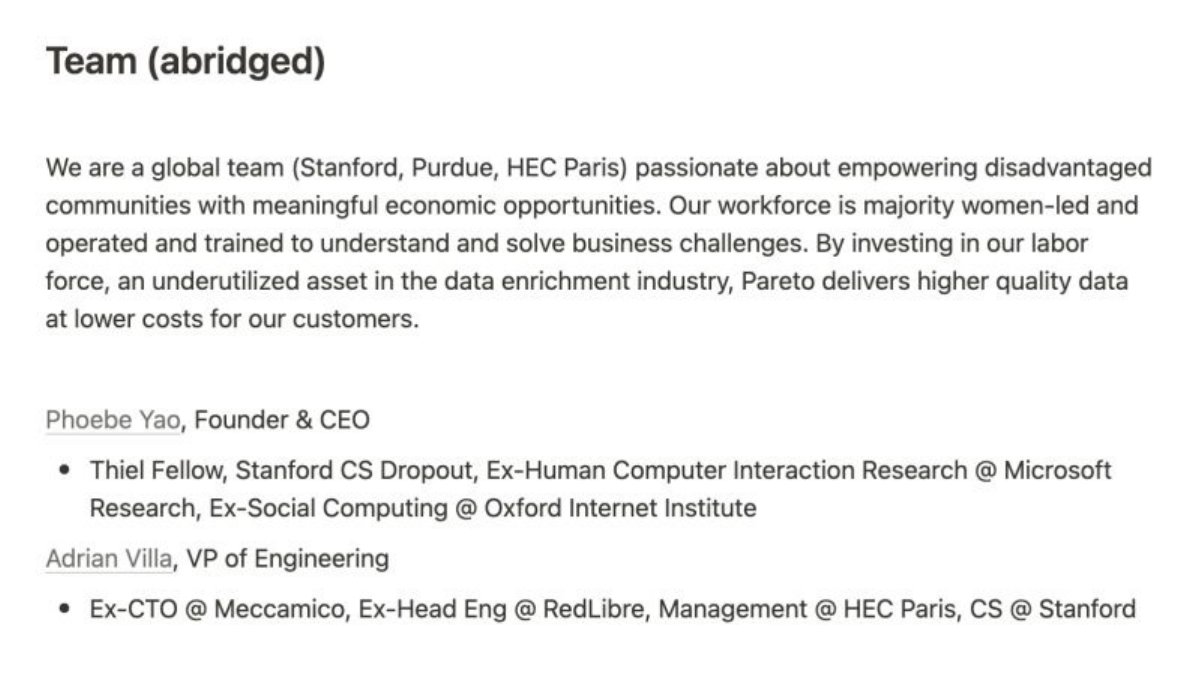
Pareto, a data-enrichment company, opens its 'Team (abridged)' page with a paragraph: 'We are a global team (Stanford, Purdue, HEC Paris) passionate about empowering disadvantaged communities with meaningful economic opportunities. Our workforce is majority women-led and operated and trained to understand and solve business challenges. By investing in our labor force, an underutilized asset in the data enrichment industry, Pareto delivers higher quality data at lower costs for our customers.' Founder and engineering-lead biographies follow.
The page is from a written document, not a slide, which gives it room for a full argument, and it uses that room well. It names a kind of diversity, the make-up of the workforce, and states why it matters commercially: the company says that training and investing in this workforce produces better data at lower cost. That turns the claim into part of the business model.
As evidence, it stops at assertion. 'Majority women-led and operated' has no figure or workforce size, and 'higher quality data at lower costs' has no measure on this page. The opening phrase 'a global team' is supported only by three university names, which describe education rather than geography. If figures for quality, cost or workforce exist elsewhere in the document, pointing to them would help.
A headline the page doesn't define: PhageLab
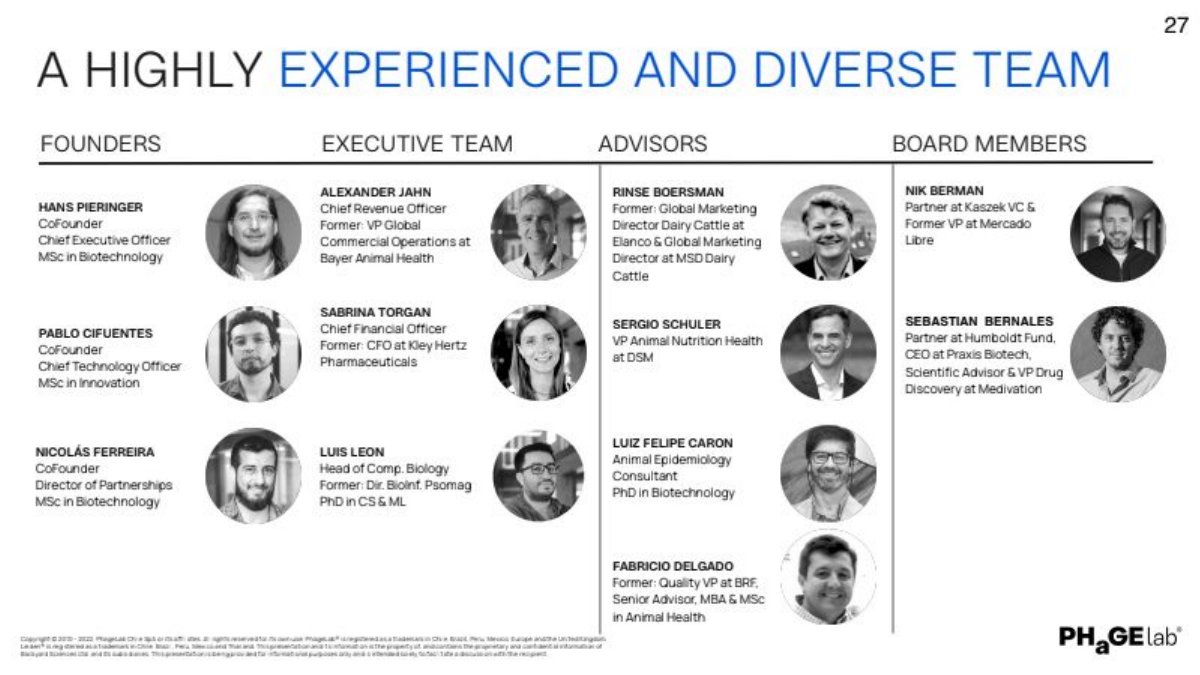
PhageLab, a biotechnology company working on animal health, titles its team page 'A HIGHLY EXPERIENCED AND DIVERSE TEAM'. Four columns follow: three founders, four executives, four advisors and two board members, each with a photo and a short line of roles and degrees, such as 'Chief Revenue Officer, Former: VP Global Commercial Operations at Bayer Animal Health' and 'Head of Comp. Biology, Former: Dir. Bioinf. Psomag, PhD in CS & ML'.
The 'experienced' half of the headline is well supported: the biographies give named former employers and senior roles. The 'diverse' half is not explained. A reader can see a range of disciplines on the page, including biotechnology, commercial operations, finance, computational biology and epidemiology, and that may be what the founders mean. The page doesn't say so, and we don't infer anything about the people from their photos.
The simplest fix is to name the kind: 'experienced team across biology, data science and animal-health commercial operations' says what 'diverse' was standing in for.
Diverse as mixed skills: Wellspent
Wellspent, a consumer app, titles its team page 'Diverse team, skilled to serve millions of over-users'. Three founders are shown with roles and former employers: 'Marius (CTO), Mobile & Software Engineering' with Calm, realm and keepsafe logos; 'Christina (CPO), Psychology & Design Thinking' with HPI, DB and Bosch; 'Selcuk (CEO), Marketing & BizDev, 2x founder'. Tiles add '6 Add. Team Members', '1 Paper Published', '3 Advisors' and '€x raised in pre-seed'.
Here the page itself suggests what 'diverse' means: the three founder boxes cover engineering, psychology and design, and marketing. That is a reasonable meaning for a product that mixes behaviour change with a mobile app, and the headline ties the team to the user it wants to serve. Of the two headline-only examples, this one comes closer to explaining itself.
Still, the word is doing the work that a plainer phrase would do better, such as 'engineering, psychology and growth in one founding team'. Separately, the '€x' tile is an unfilled placeholder in this copy of the deck; a reader will notice it, and it is worth checking every deck for leftover template text before sending.
What to put on the slide
Name the kind. Skills and disciplines, industries, countries and languages, or demographic make-up. If you mean more than one, list them.
Show it. For skills, the biographies can do the work if the headline points to them. For demographic claims, give a figure and the size of the group ('4 of 6 leadership team members are women'), and say whom you are counting: founders, leadership or all staff.
Use plain labels. 'Executives who are women' is clearer than 'women-led executives'. Define any grouping you use.
Connect it to the business. One sentence on why it matters for customers, product, hiring or operations. Schola places team and clients side by side; Pareto states the operating effect. Say it outright.
Keep it honest in scope. If the claim applies to the wider team but not the founders, or the other way round, say which.
Don't rely on photos. Readers should not have to infer a claim from faces or names, and you should not invite them to.
Templates
Skills: 'Founding team across [discipline], [discipline] and [discipline], covering [what the product needs].'
Demographic: '[n] of [m] [founders/leadership/staff] are [group]. Why it matters: [one line linked to customers or operations].'
Market fit: 'Our team reflects the [customers] we serve: [figure for team] alongside [figure for customers].'
What these examples can and cannot show
These four pages show how founders word and support a diversity claim, and what a reader can verify from the page. They cannot show whether any claim helped a round, how investors weighed it, or whether the stated business effects, such as Pareto's quality and cost, were real.
The set is small and chosen to show a range of approaches. It is not a measure of how often decks make this claim. We report only what the pages state and make no inference about any person's identity.
Common mistakes
Undefined word. 'Diverse' with no indication of what kind.
No numbers or size. Percentages without the size of the group.
Unclear labels. Terms like 'women-led team members' that blur people and organisations.
No link. A claim that isn't connected to customers, product or operations.
Inferred from photos. Leaving readers to read the claim from faces or names.
Placeholders left in. Template text such as '€x' still on the page.
Diagnostic checklist
Kind of diversity named.
Figure and group size, or specific evidence, given.
Scope stated: founders, leadership or all staff.
One sentence links it to the business.
Labels plain and defined.
No placeholder text left.
Frequently asked questions
Should I include team diversity on my deck at all?
That is your choice. If you include it, be specific and say why it matters to the business. If you don't, nothing about this guide suggests you must.
Is mixed skills a legitimate meaning of diverse?
Yes, but say it in plain words. 'Engineering, design and sales' tells the reader more than 'diverse'.
How we chose these examples
Corpus: published pitch deck teardowns on StartupFundraising.com. Founder-uploaded private decks are excluded.
Selection (2026-10-01): we searched extracted text for 'diverse team', 'women-led', 'female-founded', 'minority-led' and similar phrases (22 matches), set aside listed companies, investment funds and non-team uses of 'diverse', and kept four private-company pages that use the claim differently.
Review: the four pages were rendered from the source documents on 2026-10-01 and read in full at full size against company, document and page number (editorial model review, with AI assistance in drafting; not human-reviewed). We report only what each page states and make no inference about any person's identity. No figure was checked against outside sources.