PhageLab raised $11M in a 2023 Series A round led by investors including Nazca and Collaborative Fund. Their 27-slide deck (14 slides analyzed) positions the company at the intersection of AI and biotechnology, specifically targeting the livestock industry's reliance on antibiotics. The narrative is built on a 'global health catastrophe' framework, supported by data showing meat production's increasing antibiotic dependency. PhageLab’s core value proposition is LEIDEN, an epidemiological analysis algorithm backed by over 10 years of experimentation data and a massive industrial bacteria repos…
Key takeaways
- The deck opens with a high-stakes problem statement, citing that antibacterial resistance will be the main cause of death in humans by 2050 (Slide 8).
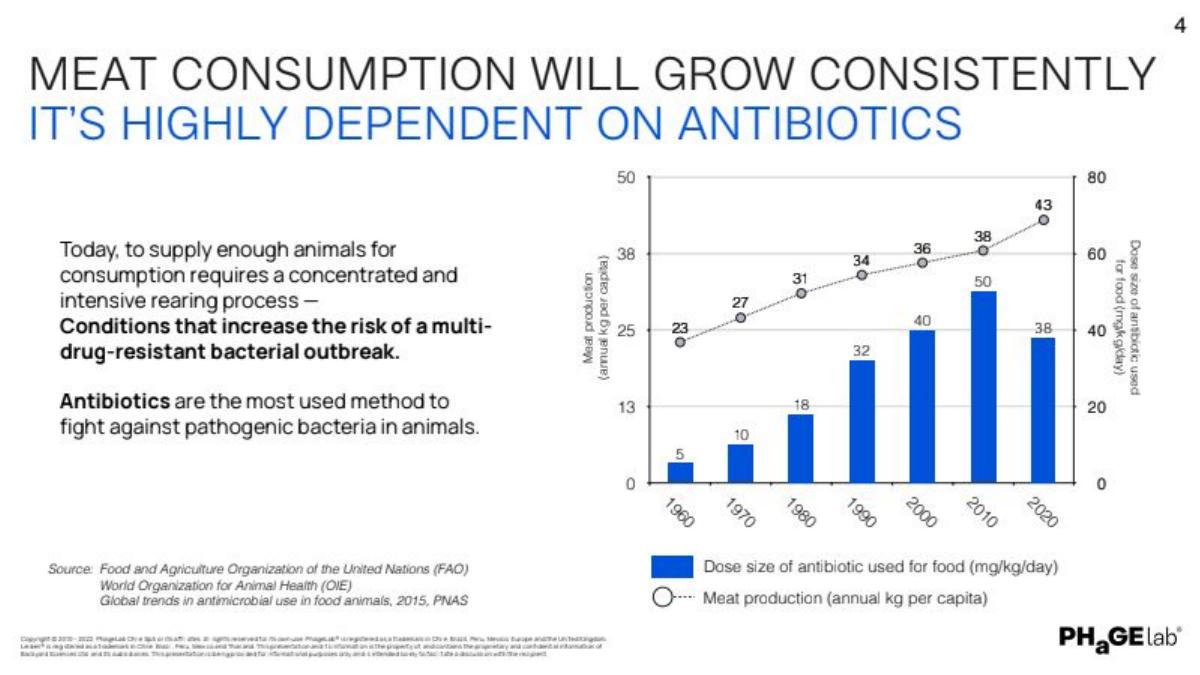
- PhageLab targets the livestock industry, noting that meat production is highly dependent on antibiotics, with usage increasing from 5 mg/kg/day in 1960 to 38 mg/kg/day in 2020 (Slide 4).
- The company’s proprietary platform, LEIDEN, is protected by US Patent pending US18/006,453 (Slide 14).
- Technical moats include 10+ years of experimentation data and what they claim is the world’s largest industrial bacteria repository (Slide 14).
- The product efficacy is demonstrated through field trials showing the elimination of up to 100% of Salmonella presence (Slide 22).
- The team is highly specialized, featuring founders with MScs in Biotechnology and Innovation, and an executive team with experience from Bayer Animal Health and Merck (Slide 27).
- The company has a significant operational footprint with nearly 100 people across three countries (Slide 25).
- The deck uses a clear 'Seek, Colonize, Destroy' framework to explain the complex biological mechanism of phages to non-technical investors (Slide 12).
The Narrative Arc: From Catastrophe to Cure
PhageLab’s pitch deck is a masterclass in 'Problem-First' storytelling. In the biotechnology sector, where technical jargon often obscures the business case, PhageLab uses the first third of their deck to establish a sense of global urgency. They don't just pitch a product; they pitch a solution to an 'imminent' global health catastrophe. This approach is designed to align the investor's interests with a mission of global importance before diving into the complexities of microbiology.
Slides 1-2: The Hook and the Warning
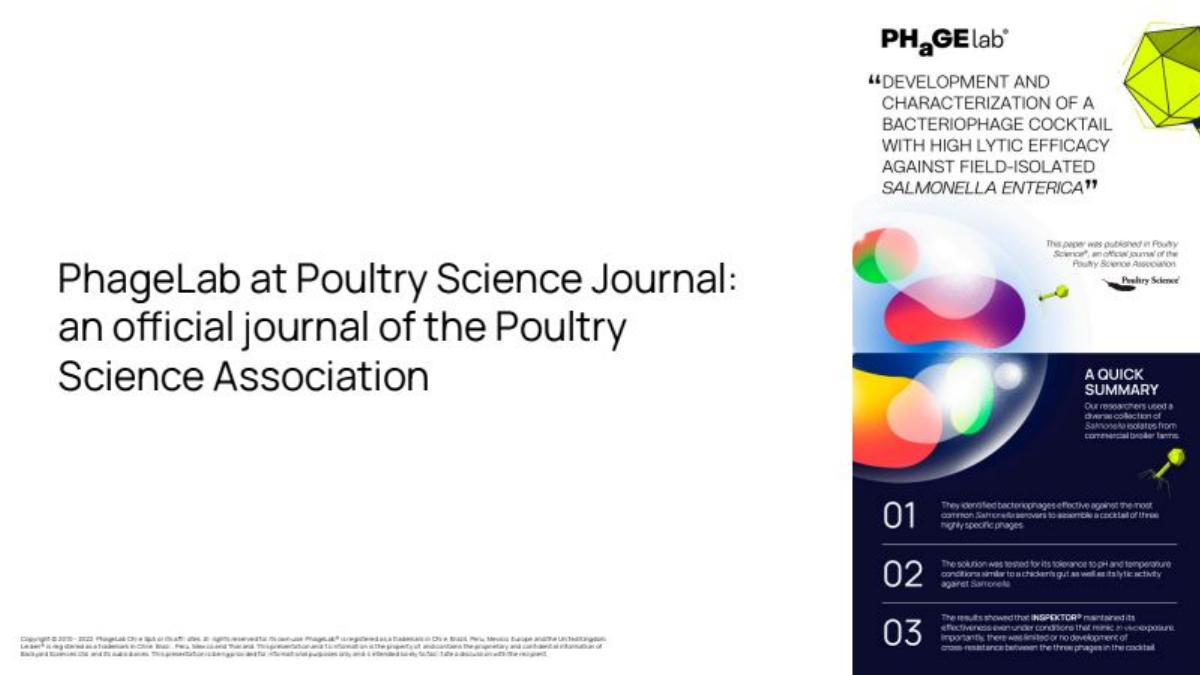
The title slide (Slide 1) establishes PhageLab as an 'AI-powered biotech platform.' This is a strategic positioning choice. By leading with AI, they signal scalability and a data-driven approach, moving away from the perception of biotech as a slow, 'wet-lab-only' endeavor. The subtitle, 'solving the global bacterial threat,' sets the stakes immediately.
Slide 2 is a stark, minimalist transition: 'A GLOBAL HEALTH CATASTROPHE IS IMMINENT.' This is a classic high-stakes opening. It forces the reader to ask 'Why?' and 'How?', creating an emotional hook that the subsequent data-heavy slides will satisfy.
Slide 4: The Economic and Biological Link
Slide 4 provides the data to back up the warning. It features a dual-axis chart showing the correlation between meat production (annual kg per capita) and the dose size of antibiotics used for food (mg/kg/day). The figures are specific: antibiotic use has climbed from 5 mg/kg/day in 1960 to a peak of 50 in 2010, settling at 38 in 2020. This slide identifies the livestock industry as the primary battleground for bacterial resistance, narrowing the company's focus from 'global health' to a specific, addressable market: intensive animal rearing.
Slides 6-8: Escalating the Problem
Slide 6 uses bold, stylized illustration to announce that 'THE CRISIS HAS JUST BEGUN.' This leads into Slide 8, which delivers a staggering statistic attributed to the WHO (2018): 'BY 2050, ANTIBACTERIAL RESISTANCE WILL BECOME THE MAIN CAUSE OF DEATH IN HUMANS.' By linking livestock practices to human mortality, PhageLab justifies a high valuation based on the sheer necessity of their solution.
Slides 10-12: The Biological Solution
Slide 10 acts as a bridge to the solution: 'NOW, THIS IS HOW WE DO IT.' Slide 12 introduces 'Phages' as 'natural-born killers of bacteria.' For an investor who may not be a biologist, this slide is essential. It defines phages as viruses that infect bacteria with high specificity. The 'How They Work' section breaks the process down into three simple steps: 1. Seek (identify bacteria), 2. Colonize (replicate within the target), and 3. Destroy (kill via enzymatic mechanism). This simplification of a complex biological process is a key strength of the deck.
Slide 14: The Technical Moat (LEIDEN)
This is arguably the most important slide for a Series A investor. It introduces 'LEIDEN,' their epidemiological analysis algorithm. PhageLab claims a significant intellectual property advantage here, citing US Patent pending US18/006,453. The slide lists four 'unique sources of data' that constitute their moat:
10+ years of experimentation data. · The world’s largest industrial bacteria repository. · A huge and tested Phage repository. · The application of genomics and bioinformatics.
This slide moves the conversation from 'what we do' to 'why no one else can do it as well as we can.'
Slide 22: Proof of Efficacy
In biotech, data is king. Slide 22 presents the results of field trials with a bold claim: 'PHAGELAB ELIMINATES UP TO 100% OF SALMONELLA PRESENCE.' The background image of a commercial poultry farm reminds the investor of the real-world application. This 100% figure is a powerful 'mic drop' moment in the deck, providing the empirical evidence needed to support the earlier theoretical claims.
Slides 25-27: Scale and Expertise
Slide 25 highlights the company's growth, stating they are 'nearly 100 people in 3 countries.' This demonstrates that PhageLab is no longer a small lab project but a scaling international operation. Slide 27 introduces the team, which is divided into Founders, Executive Team, Advisors, and Board Members. The credentials are high-caliber, including MScs in Biotechnology and Innovation, and former executives from major industry players like Bayer Animal Health, MSD, and DSM. Having partners from Kaszek VC and Humboldt Fund on the board further validates their institutional backing.
Slides 29-31: The Conclusion and Appendix
Slide 29 reiterates the core message: 'SCIENCE WORKS AND WE CAN PROVE IT.' This serves as a final reassurance to the investor. Slide 31 marks the beginning of the Appendix, suggesting that the 13 slides following this point likely contain the deeper technical data, financial tables, and regulatory pathways that a serious due diligence process would require.
What Works in the PhageLab Deck
Clarity of Mission: The deck never loses sight of the 'Global Health Catastrophe.' Every technical detail is framed as a necessary tool to avert this crisis. · Visual Identity: The use of custom, high-quality illustrations (like the 'phage' characters) makes the deck memorable and professional, which is important for a Series A round. · IP Protection: Explicitly citing a patent number (Slide 14) provides immediate comfort to investors regarding the company's defensibility. · Simplified Science: The 'Seek, Colonize, Destroy' framework (Slide 12) is an excellent way to explain a complex product to a generalist VC.
What is Missing
The Ask: While we know from the catalogue that they raised $11M, the provided slides do not show the 'Ask' or the 'Use of Funds.' This is a critical component for understanding how the capital will drive the next phase of growth. · Business Model Details: The catalogue mentions a SaaS and B2C model, but the slides themselves do not explain the pricing structure or how they integrate with the livestock producers' existing workflows. · Competitive Landscape: There is no slide comparing PhageLab to other phage companies or traditional antibiotic manufacturers. Investors need to know why PhageLab’s AI-first approach is superior to competitors. · Financial Projections: There are no charts showing projected revenue growth, burn rate, or path to profitability in the main body of the deck.
What Founders Should Copy
The 'Problem-Solution' Bridge: Use a transition slide like Slide 10 ('Now, this is how we do it') to clearly separate the market pain from your specific remedy. · Data-Backed Urgency: If your industry has a macro trend (like the 2050 WHO death projection on Slide 8), use it to frame your company as an inevitability rather than just an option. · Highlighting the Moat: Don't just say you have data; quantify it. '10+ years of experimentation data' (Slide 14) is much more compelling than 'extensive research.' · Team Categorization: Grouping the team into Founders, Executives, and Advisors (Slide 27) helps investors quickly understand the balance of visionary leadership and industry experience.
Frequently asked questions
- What is PhageLab's core technology?
- PhageLab utilizes bacteriophages—viruses that naturally infect and kill specific bacteria. Their proprietary 'LEIDEN' platform uses AI and genomics to identify the correct phages for specific bacterial strains found in livestock. This allows for a tailor-made antibacterial solution that avoids the broad-spectrum resistance issues associated with traditional antibiotics.
- How does PhageLab prove its product works?
- The deck highlights field trials where their solutions eliminated up to 100% of Salmonella in poultry environments. This real-world validation is critical for biotech companies moving from the lab to commercial application, especially in the cost-sensitive livestock industry.
- What is the market opportunity identified in the deck?
- The opportunity is driven by the global increase in meat consumption and the resulting 'intensive rearing process' that requires antibiotics. As bacteria become resistant to traditional drugs, livestock producers face catastrophic risks. PhageLab positions itself as the essential alternative to maintain global food security.
- Who are the key investors in this round?
- The $11M Series A was supported by a mix of venture capital firms and prominent angels, including Nazca, Collaborative Fund, Water Lemon Ventures, and Kevin Efrusy. This diverse cap table suggests interest from both impact-focused and traditional tech investors.
- What is missing from the PhageLab pitch deck?
- While the deck is strong on science and problem-solution fit, the provided slides lack a clear 'Ask' slide detailing the specific allocation of the $11M. It also omits detailed unit economics, revenue projections, and a competitive landscape analysis, which are usually expected in a Series A presentation.