Persefoni’s Series B deck is a masterclass in category creation, framing carbon accounting not as a niche sustainability tool, but as a fundamental financial-grade requirement for the modern enterprise. With only 11 slides, the deck relies heavily on the 'inevitability' of its market, citing $35 trillion in assets under management committed to climate action (Slide 2) and a logo wall of global giants already making public commitments (Slide 3). The presentation is remarkably light on technical jargon, focusing instead on the 'ERP-level capability' of its platform (Slide 7) and a straightforwa…
Key takeaways
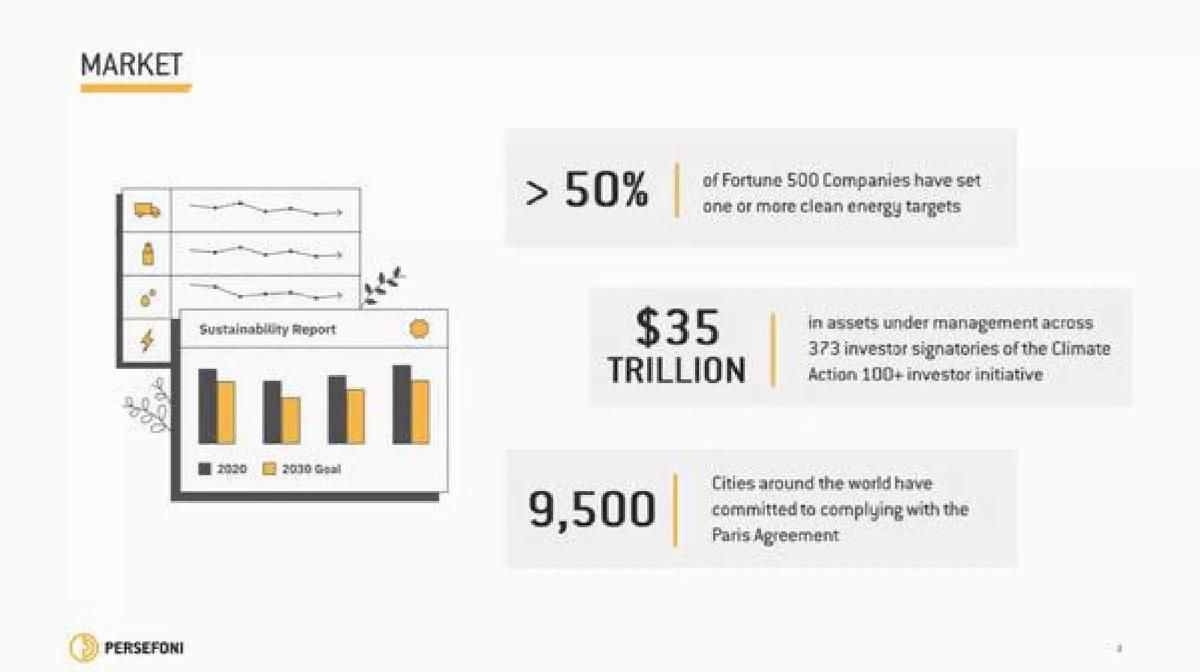
- The deck identifies a massive market opportunity driven by 373 investor signatories representing $35 trillion in assets under management (Slide 2).
- It uses a powerful logo wall of global corporations, including Apple, Amazon, and Walmart, to demonstrate the scale of existing climate commitments (Slide 3).
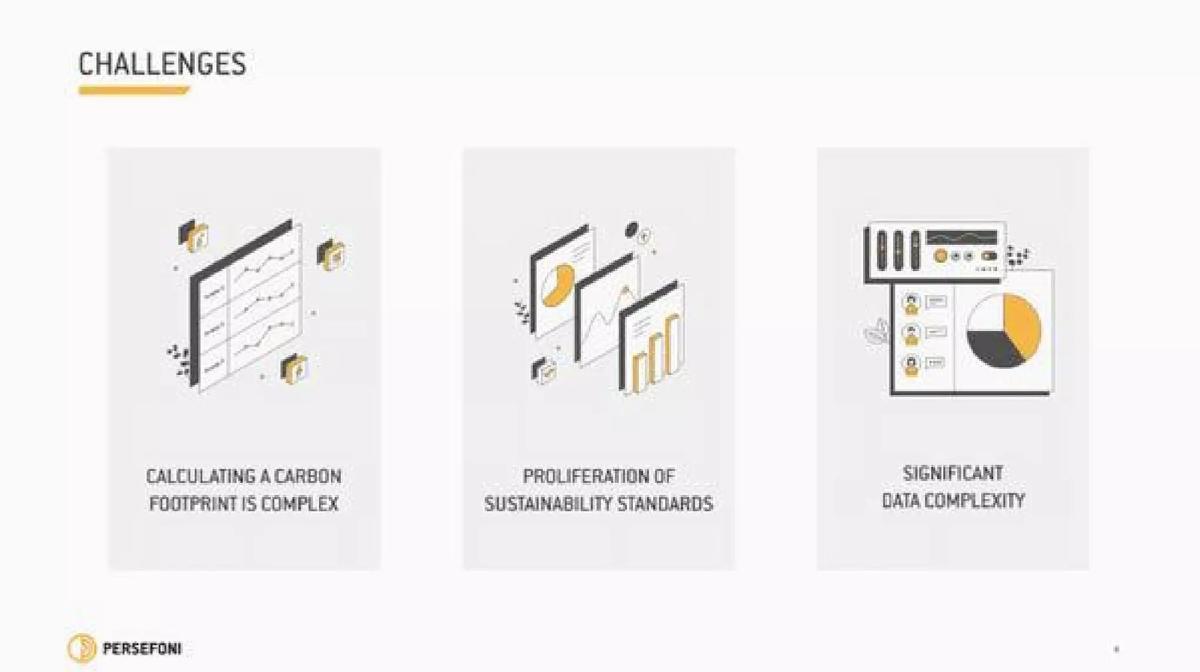
- The problem is framed through three pillars: calculation complexity, proliferating standards, and data complexity (Slide 4).
- Persefoni positions itself as an 'ERP-level' solution, implying it is as essential to a business as SAP or Oracle (Slide 7).
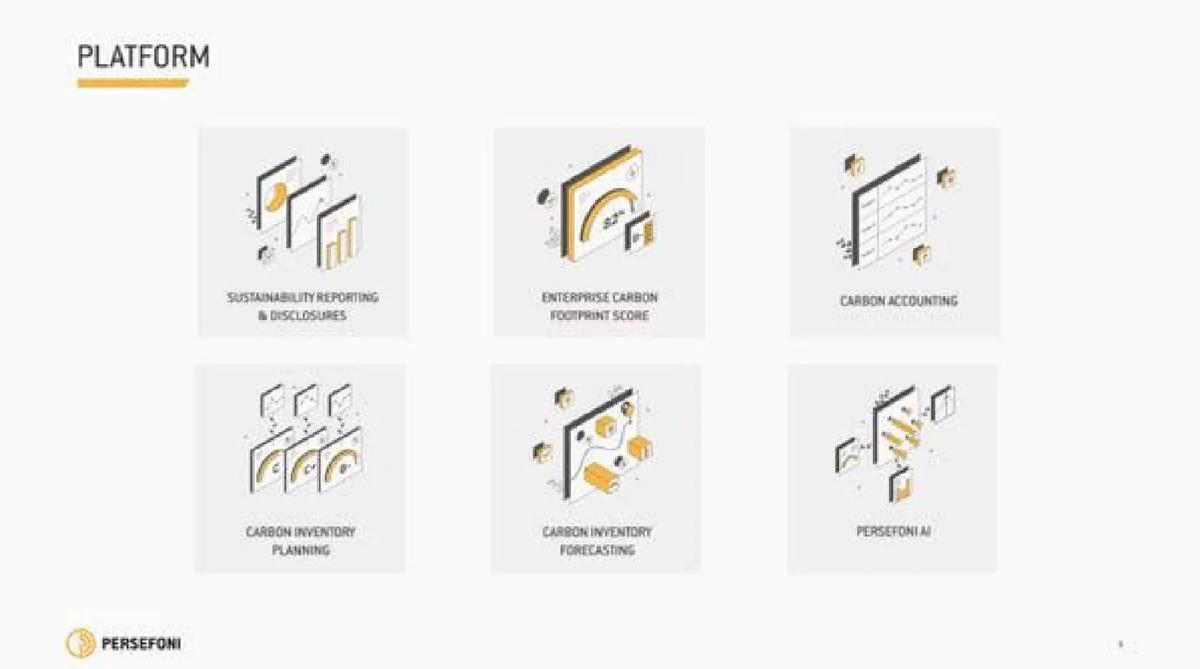
- The product offering includes specialized modules like Carbon Inventory Planning, Forecasting, and 'Persefoni AI' (Slide 6).
- The business model is a pure-play SaaS subscription with 12, 24, or 36-month contract options (Slide 9).
- The target customer base is broad, spanning enterprises, institutional investors, and governmental organizations (Slide 8).
- The deck omits specific revenue figures, growth metrics, or a detailed competitive analysis within the 11 slides provided.
The Vision of Carbon as a Financial Metric
Persefoni’s pitch deck is a concise, 11-slide document that focuses on the macro-economic shift toward climate accountability. Rather than getting bogged down in the scientific minutiae of carbon sequestration or atmospheric chemistry, the deck treats carbon as a data problem. By framing their solution as a Climate Management & Accounting Platform (CMAP), they align themselves with the highly lucrative world of enterprise SaaS and financial technology.
Slides 1-3: The Market and the Mandate
Slide 1: Title Slide The deck opens with a clean, professional image of a modern building with a vertical garden, immediately signaling the intersection of corporate infrastructure and environmental sustainability. It identifies Kentaro Kawamori as the CEO and Co-Founder and titles the product as an "Intelligent Carbon Footprint Management Platform."
Slide 2: Market This slide establishes the 'Why Now?' through three massive statistics. It notes that >50% of Fortune 500 companies have set clean energy targets. More importantly, it highlights $35 Trillion in assets under management across 373 investor signatories of the Climate Action 100+ initiative. Finally, it mentions 9,500 cities committed to the Paris Agreement. This slide isn't just about market size; it's about the inevitability of regulation and investor pressure.
Slide 3: Climate Commitments This is a classic 'Logo Wall,' but with a twist. These aren't Persefoni's customers; they are companies that have made public climate commitments. By showing logos like Apple, Microsoft, Walmart, and Chase, Persefoni is illustrating the sheer scale of the potential customer base. Every logo on this slide represents a massive organization that now has a reporting requirement they likely cannot fulfill with spreadsheets alone.
Slides 4-7: The Problem and the Platform
Slide 4: Challenges The deck identifies three core pain points: "Calculating a carbon footprint is complex," "Proliferation of sustainability standards," and "Significant data complexity." The use of isometric icons keeps the aesthetic consistent and professional, framing the problem as a logistical and data-processing hurdle rather than a moral one.
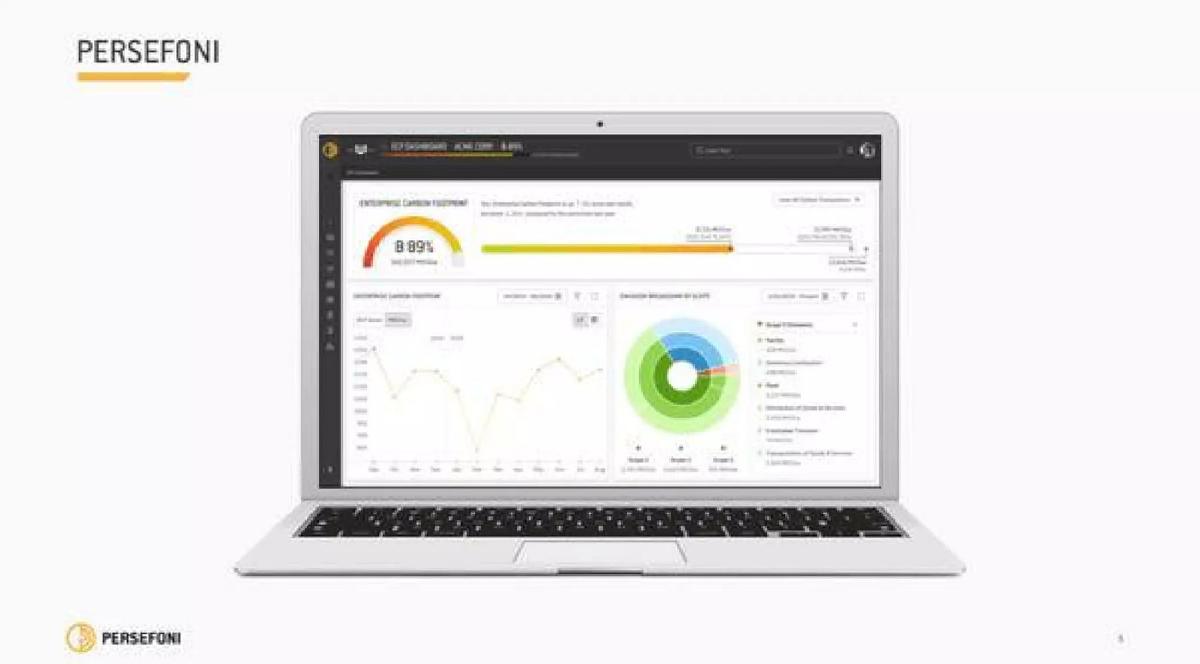
Slide 5: Persefoni (Product Showcase) This slide provides a visual of the platform. The dashboard shown includes an "Enterprise Carbon Footprint" score (showing a 'B- 82%' in the mockup) and a breakdown of emissions. It visually confirms that the product is a functional, modern SaaS application capable of aggregating complex data into digestible executive views.
Slide 6: Platform Here, the company breaks down the platform into six functional modules: Sustainability Reporting & Disclosures, Enterprise Carbon Footprint Score, Carbon Accounting, Carbon Inventory Planning, Carbon Inventory Forecasting, and Persefoni AI. This suggests a modular, extensible product architecture that can grow with a customer's needs.
Slide 7: Solutions This slide summarizes the value proposition. It explicitly uses the phrase "ERP-level capability," which is a strategic positioning move. By comparing themselves to ERP (Enterprise Resource Planning) systems, they are telling investors that Persefoni is a 'must-have' foundational layer of the corporate tech stack, not a 'nice-to-have' CSR tool. They also highlight AI-driven recommendations and automated reporting.
Slides 8-11: Business Model and Team
Slide 8: Customers The deck identifies three primary customer archetypes: Enterprises, Institutional Investors, and Governmental Organizations. This multi-pronged approach explains how Persefoni can achieve massive scale by serving both the companies reporting the data and the investors/regulators consuming it.
Slide 9: Business Model The business model is refreshingly simple: "SaaS Platform Subscription." It lists contract lengths of 12, 24, or 36 months. While it doesn't provide specific pricing tiers, the focus on multi-year contracts suggests a high-retention, enterprise-grade sales motion.
Slide 10: Founders The team slide features Kentaro Kawamori (CEO), Kim Stroh (VP, Product), and Jason Offerman (COO). The slide is minimal, lacking the usual 'ex-Google' or 'ex-Goldman' logos often seen in Series B decks, though the catalogue facts confirm their success in raising significant capital.
Slide 11: Contact The deck concludes with the company logo and the CEO’s email address. It is a standard, professional closing to a high-level presentation.
What Works in the Persefoni Deck
1. Strategic Positioning: The most successful element of this deck is the "ERP of Carbon" framing. By positioning carbon accounting as a financial-grade necessity, Persefoni moves the conversation away from 'charity' or 'compliance' and into the realm of core business operations. This justifies enterprise-level pricing and long-term contracts.
2. Visual Consistency: The deck uses a consistent color palette of yellow, grey, and white with clean isometric illustrations. It looks like a product built for the C-suite of a Fortune 500 company, which matches their target audience perfectly.
3. Market Urgency: Slide 2 and Slide 3 do an excellent job of creating a sense of urgency. By citing $35 trillion in committed assets, they make it clear that the market isn't just growing—it has already arrived, and the demand for a solution is immediate.
What is Missing from the Persefoni Deck
1. Traction Metrics: For a Series B deck, the lack of actual performance data is notable. There are no mentions of Annual Recurring Revenue (ARR), customer count, Net Revenue Retention (NRR), or growth rates. While these may have been shared in a separate data room, their absence from the primary pitch deck is unusual for this stage.
2. Competitive Landscape: The deck does not address other players in the carbon accounting space. Investors at the Series B level typically want to know how a company differentiates itself from both legacy incumbents (consultancies) and other well-funded startups.
3. The 'Ask': There is no slide detailing how much money is being raised or how it will be used. While the catalogue facts state they raised $114.2M, the deck itself doesn't outline the milestones this capital is intended to hit.
What a Founder Should Copy
1. The 'Logo Wall' Strategy: If you are in a new category, use Slide 3's approach. Don't just show who uses your product; show the scale of the organizations that need a product like yours. It validates the market size more effectively than a generic TAM/SAM/SOM chart.
2. Simplify the Business Model: Slide 9 is a great example of how to present a business model without overcomplicating it. If you are a SaaS company, say you are a SaaS company. Focus on the contract terms that imply stability (like 24-36 month options).
3. Focus on Outcomes, Not Features: Throughout the deck, Persefoni focuses on what the platform enables (trust, transparency, ease, and regulatory compliance) rather than the specific technical details of how the carbon is calculated. This is the correct approach for an executive-level pitch.
Frequently asked questions
- How much did Persefoni raise with this deck?
- According to the catalogue facts, Persefoni raised $114,200,000 in a Series B round in 2020. This significant capital injection reflects the high investor interest in the Climate Management & Accounting Platform (CMAP) space during that period.
- What is the 'ERP of Carbon' concept mentioned in the deck?
- Persefoni uses the term 'ERP-level capability' on Slide 7 to describe its platform. This suggests that carbon accounting should be managed with the same level of rigor, integration, and organizational importance as traditional financial accounting and resource planning systems like SAP.
- Who are the target customers for Persefoni?
- As shown on Slide 8, the company targets three distinct segments: Enterprises with sustainability targets, Institutional Investors (including funds, asset managers, and LPs), and Governmental Organizations. This broad reach allows them to capture value across the entire financial ecosystem.
- Does the deck show the actual software interface?
- Yes, Slide 5 features a high-fidelity mockup of the Persefoni dashboard on a laptop. It displays various data visualizations, including an 'Enterprise Carbon Footprint' gauge and a breakdown of emissions by scope, giving investors a sense of the product's UI/UX.
- What is missing from the Persefoni pitch deck?
- The 11-slide deck is quite lean. It lacks a detailed competitive landscape, specific financial traction (like ARR or growth rates), a clear 'Ask' slide detailing how the $114M would be spent, and a deep dive into the underlying technology or data integrations.