Perform’s pre-seed deck is a lean, high-impact presentation that successfully raised $1.2M in 2024. The company addresses the 'accountability gap' in the consumer running market by pairing human coaches with AI-driven training plans. The deck stands out for its immediate display of traction, showing six months of consistent month-over-month revenue and customer growth, even while obscuring specific dollar amounts. By leading with a strong team slide featuring deep consumer tech and athletic expertise, Perform establishes credibility early. While the deck lacks a formal 'Ask' slide and detaile…
Key takeaways
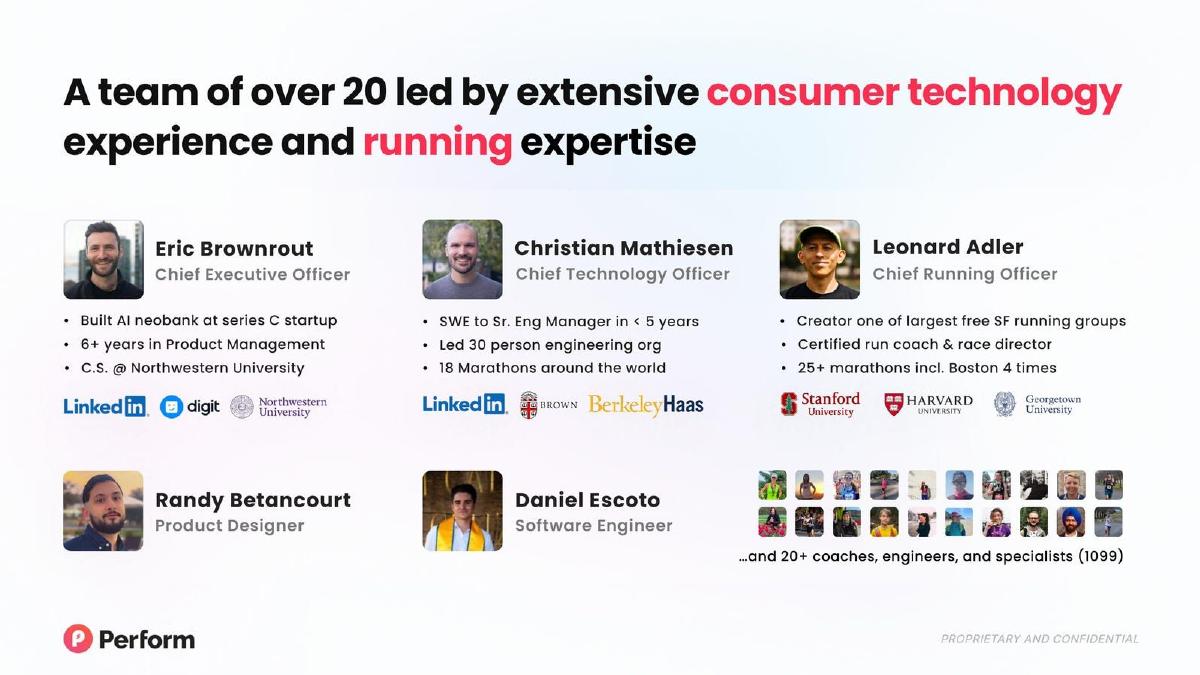
- The deck leads with a strong team slide (Slide 2) featuring founders with backgrounds at Digit, LinkedIn, and elite athletic experience.
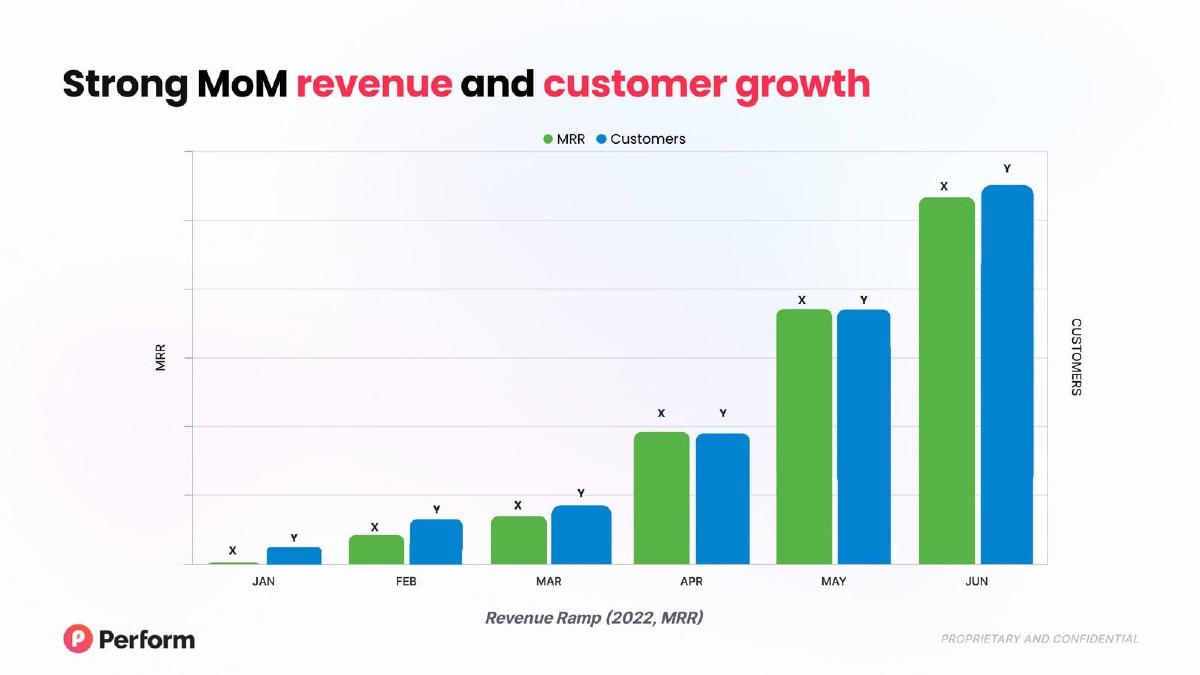
- Traction is prioritized early, showing six months of 'Strong MoM revenue and customer growth' on Slide 3.
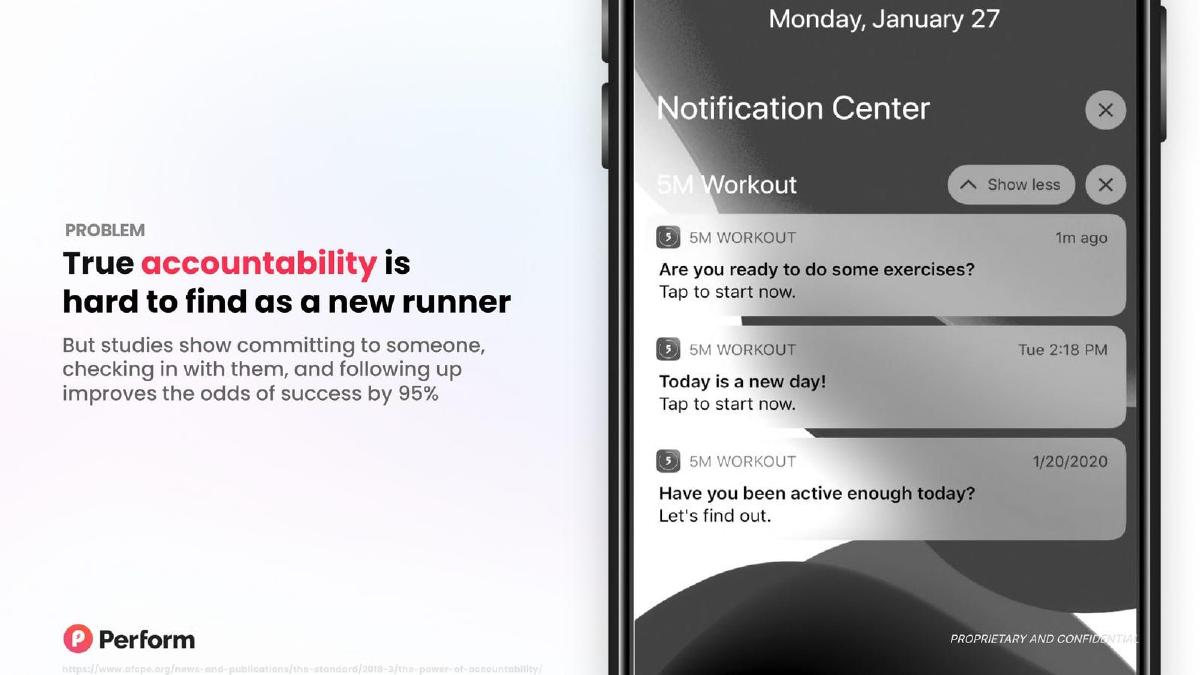
- The problem is framed as a two-stage challenge: accountability for new runners (Slide 4) and performance plateaus for habitual runners (Slide 5).
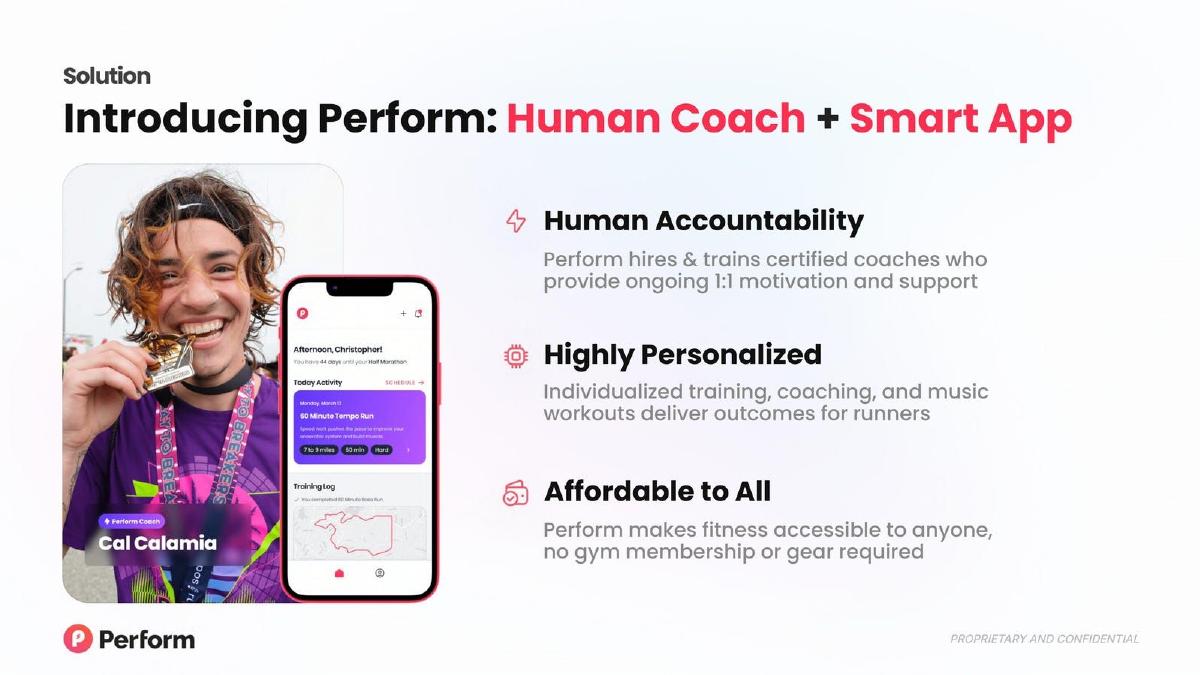
- The solution (Slide 6) utilizes a hybrid model of 'Human Coach + Smart App' to provide 1:1 motivation at scale.
- Market size is quantified at 75 million US runners and joggers, a figure that has grown 50% since 2020 (Slide 7).
- The product integrates with major fitness ecosystems including Strava, Garmin, and Fitbit (Slide 8).
- Perform raised $1.2M in a 2024 pre-seed round as reported by Business Insider.
- The deck omits a specific financial 'Ask' and detailed breakdown of how the $1.2M will be deployed.
Perform Pitch Deck Teardown
Perform is a consumer fitness startup that successfully navigated the 2024 fundraising environment to secure $1.2M in pre-seed funding. Their 9-slide deck is a study in brevity, focusing heavily on team pedigree and early traction to validate their hybrid human-AI coaching model. In an era where 'AI-only' solutions are common, Perform makes a deliberate bet on human accountability as their primary differentiator.
Slide 1: Title and Mission
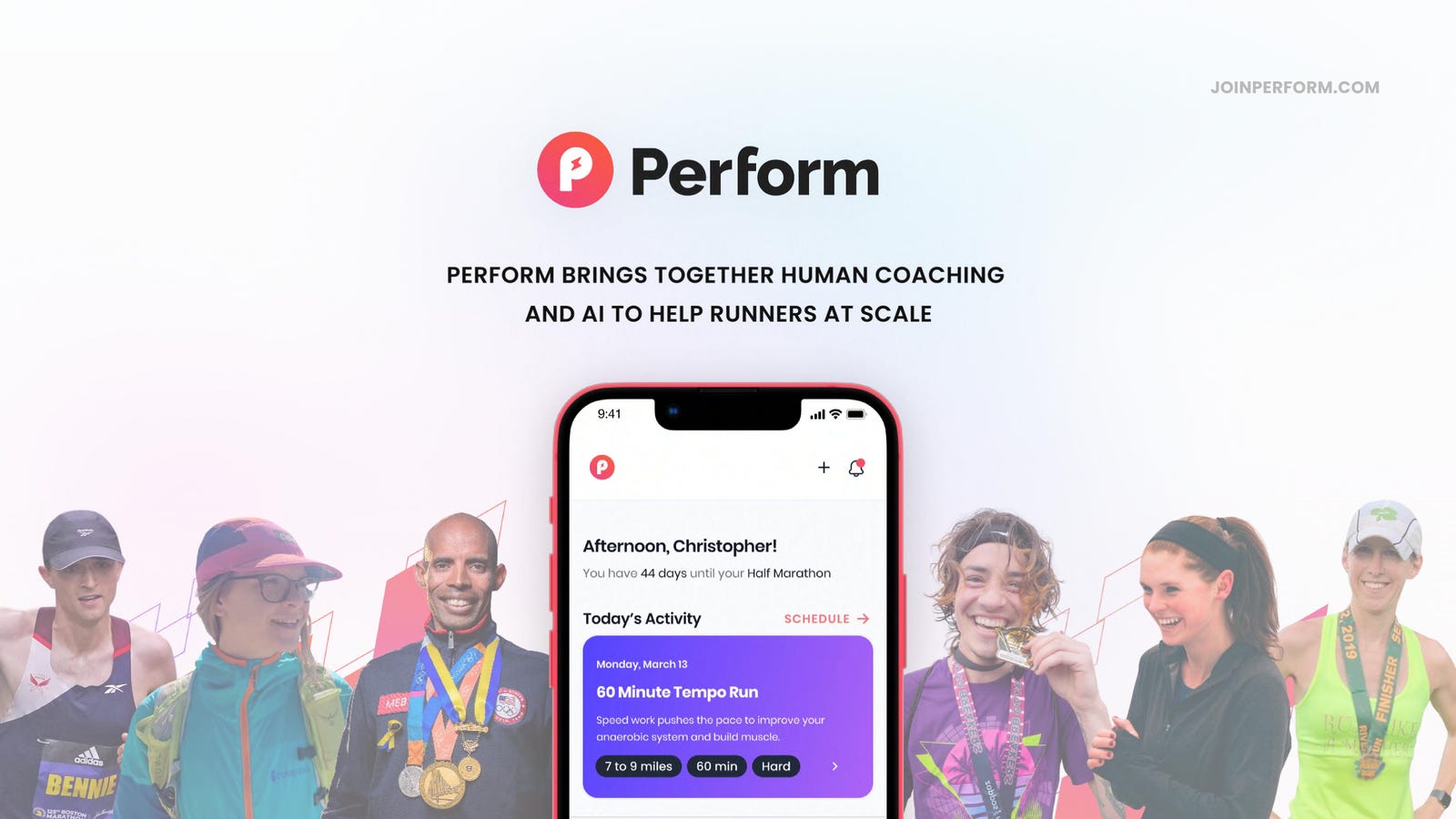
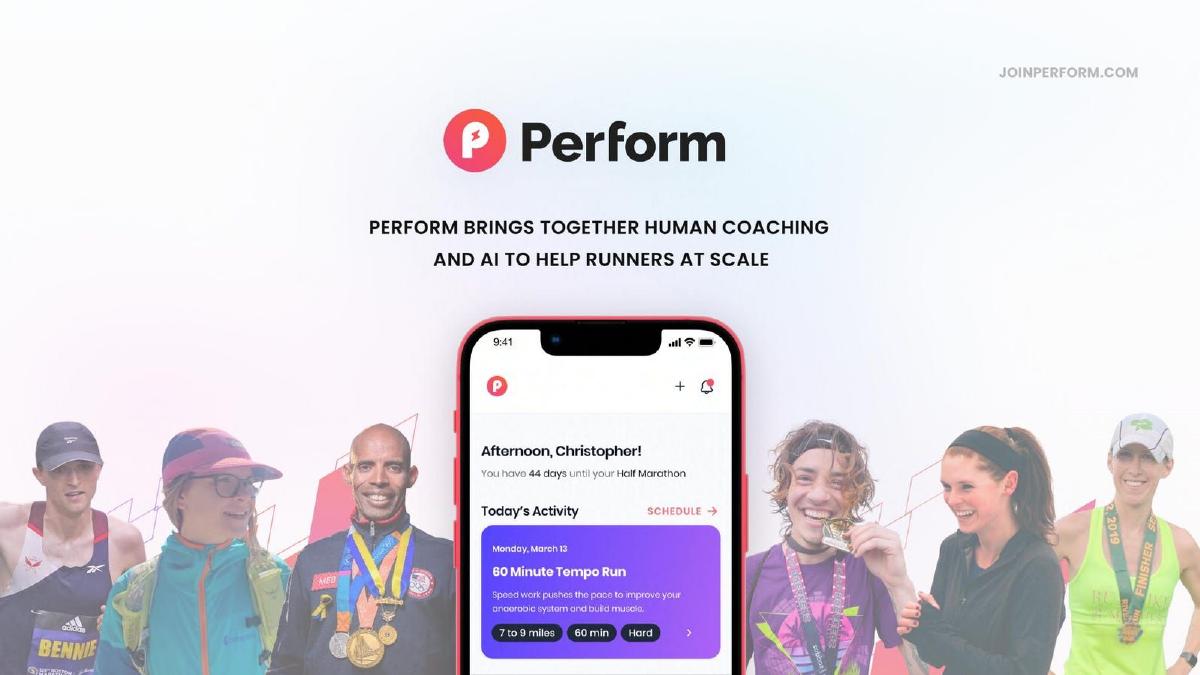
The cover slide introduces the brand and its core value proposition: 'Perform brings together human coaching and AI to help runners at scale.' The visual features a smartphone interface showing a '60 Minute Tempo Run' scheduled for a user, flanked by images of diverse runners. This immediately signals that the product is a mobile-first consumer application targeting the running community.
Slide 2: The Team
Perform places its team slide second, a strategic move for pre-seed companies where the 'who' is often more important than the 'what.' The leadership trio presents a balance of technical, product, and domain expertise. CEO Eric Brownrout highlights his experience building an AI neobank at a Series C startup (Digit). CTO Christian Mathiesen brings engineering management experience from LinkedIn. Crucially, Chief Running Officer Leonard Adler provides the 'running expertise,' citing his status as a certified coach and finisher of 25+ marathons. The slide also notes a supporting team of over 20 1099 contractors, suggesting a scalable labor model for the coaching side of the business.
Slide 3: Traction
Traction is the third slide, reinforcing the 'show, don't just tell' philosophy. The chart, titled 'Revenue Ramp (2022, MRR),' tracks growth from January to June. While the specific dollar amounts are obscured with 'X' and 'Y' labels, the visual trend is clear: consistent, significant month-over-month growth in both Monthly Recurring Revenue (MRR) and total customers. For a pre-seed investor, this chart serves as proof of concept and initial product-market fit.
Slide 4: The First Problem - Accountability
The deck breaks the 'Problem' into two distinct slides. Slide 4 focuses on the 'new runner.' It claims that 'True accountability is hard to find' and cites a study suggesting that committing to a person and checking in improves success odds by 95%. The visual is a phone lock screen filled with '5M Workout' notifications, illustrating the current (and often ignored) automated status quo.
Slide 5: The Second Problem - Leveling Up
Slide 5 addresses the 'habitual runner.' The problem here isn't just starting; it's 'leveling up'—running faster, going farther, or avoiding injury. This slide ensures investors understand that Perform isn't just a 'Couch to 5K' app; it has a long-term utility for serious athletes who eventually hit performance plateaus.
Slide 6: The Solution
The solution slide introduces the 'Human Coach + Smart App' hybrid. It lists three pillars: Human Accountability (certified coaches), Highly Personalized (individualized training and music), and Affordable to All (no gym required). By emphasizing that Perform hires and trains its own coaches, the company positions itself as a premium service that remains accessible compared to traditional private coaching which can cost hundreds of dollars per month.
Slide 7: Market Size
Perform quantifies the opportunity on Slide 7. They cite 75 million US runners and joggers, noting a 50% increase since 2020. The slide is crowded with logos of incumbents like Nike, Strava, and Garmin. While this could be seen as a crowded market, Perform uses these logos to illustrate the 'large and quickly growing' nature of the sector, implying there is plenty of room for a specialized coaching layer on top of these existing tracking platforms.
Slide 8: Product Features and Integrations
This slide provides a deeper look at the user experience, mentioning 'White Glove Onboarding,' 'Adaptive Training Plans,' and 'AI-Music Workouts.' Most importantly for the technical due diligence, it shows integrations with Strava, Garmin, and Fitbit. This indicates that Perform is designed to sit within the runner's existing hardware and software ecosystem rather than trying to replace it.
Slide 9: Closing Slide
The final slide is a simple 'Let's talk!' with a photo of runners celebrating at a finish line. Notably, this deck does not include a 'The Ask' slide detailing the $1.2M raise or the specific use of funds. In many cases, these slides are removed from versions of the deck that are shared publicly or with the press after the round has closed.
What Perform Does Well
Traction Front-Loading: By putting the revenue growth chart on Slide 3, Perform answers the most important investor question—'Does anyone want this?'—before they even explain how the product works. · Domain Authority: The inclusion of a 'Chief Running Officer' with 25+ marathons under his belt gives the company immediate credibility in a niche market where 'authenticity' is a major selling point. · Clear Differentiation: The deck clearly articulates why an app alone isn't enough (lack of accountability) and why a human coach alone isn't enough (lack of scale/affordability). The 'Human + AI' narrative is very timely.
What is Missing from the Deck
Unit Economics: There is no mention of Customer Acquisition Cost (CAC), Lifetime Value (LTV), or the margins associated with the 1099 coaching model. Investors will want to know how much of that MRR is eaten up by coach payouts. · The Ask: As mentioned, the specific funding requirements and milestones are absent. For a live pitch, a slide detailing how the $1.2M will be spent (e.g., 50% engineering, 30% marketing) is essential. · Competitive Matrix: While Slide 7 shows many logos, it doesn't explain how Perform wins against a feature-rich incumbent like Nike Run Club or a specialized platform like TrainingPeaks.
Founder Takeaways
Founders should look at Perform's deck as a blueprint for a 'Traction-First' pre-seed pitch. If you have growth, show it early. Don't bury your best metrics on Slide 12. Additionally, the way Perform frames its team—combining high-level tech experience with deep 'hobbyist' expertise—is an excellent way to build trust in consumer-facing industries. Finally, the use of a two-part problem slide (New vs. Habitual users) is a smart way to demonstrate a large Total Addressable Market (TAM) without relying solely on generic industry reports.
Frequently asked questions
- How much did Perform raise with this deck?
- According to reports from Business Insider, Perform raised $1.2M in a pre-seed round in 2024. The deck itself does not state the amount or the terms of the round, which is common for decks shared publicly after a close.
- What is Perform's core business model?
- Perform operates a consumer app that combines human coaching with AI. As shown on Slide 6, they hire and train certified coaches to provide 1:1 accountability, while the app handles adaptive training plans and music-synced workouts.
- Who are the founders of Perform?
- The leadership team includes CEO Eric Brownrout (ex-Digit), CTO Christian Mathiesen (ex-LinkedIn), and Chief Running Officer Leonard Adler, a certified coach who has run over 25 marathons (Slide 2).
- What traction did Perform show to investors?
- Slide 3 displays a bar chart titled 'Revenue Ramp (2022, MRR).' It shows six consecutive months of growth in both MRR and customer count from January to June, though the Y-axis values are replaced with 'X' and 'Y' placeholders.
- Does the deck mention competitors?
- Slide 7 includes logos of major players in the fitness space like Nike, Strava, Garmin, and Peloton, but it frames them as part of a 'large and quickly growing market' rather than direct competitors to be defeated.