Personetics’ 2022 pitch deck is a masterclass in growth-stage validation. Rather than selling a theoretical product, the company leans heavily on its massive footprint, citing partnerships with 6 of the top 12 banks in North America and Europe (Slide 3). The narrative centers on 'Self-Driving Finance,' a transition from basic data views to autonomous financial actions taken on behalf of the customer. With $85M raised in this round, the deck succeeds by connecting high-level AI concepts to granular business outcomes, such as a 15-20% increase in new accounts and a 35% boost in customer engagem…
Key takeaways
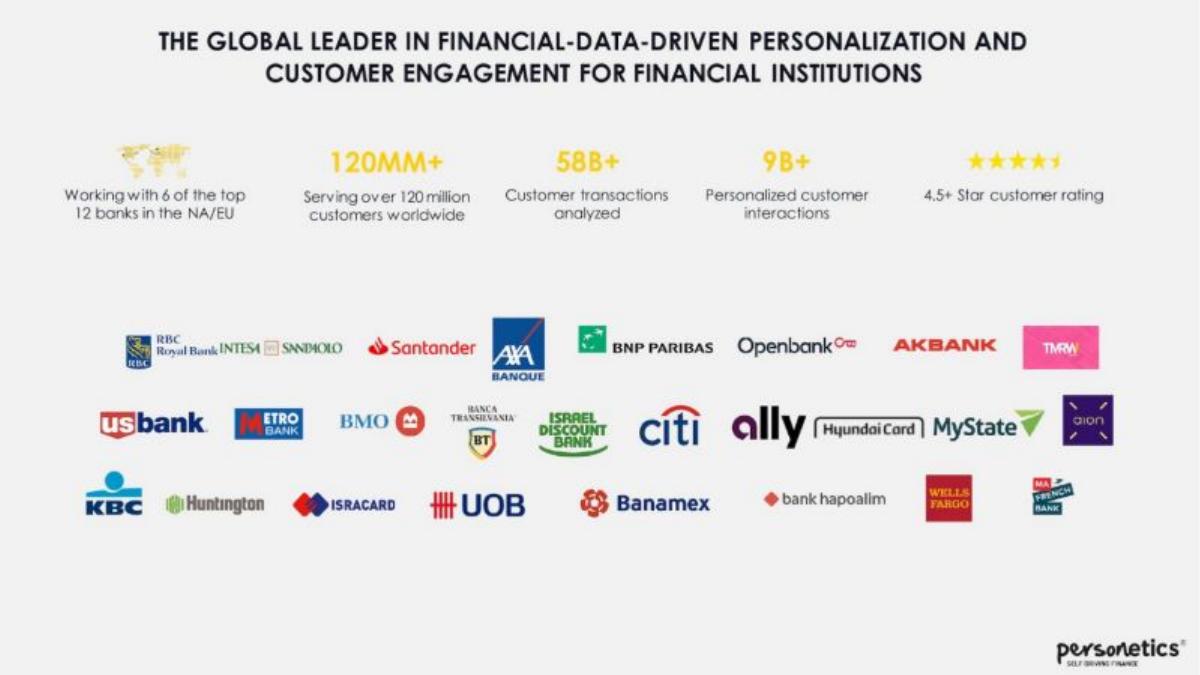
- The company claims a massive scale of 120 million customers served and 58 billion transactions analyzed (Slide 3).
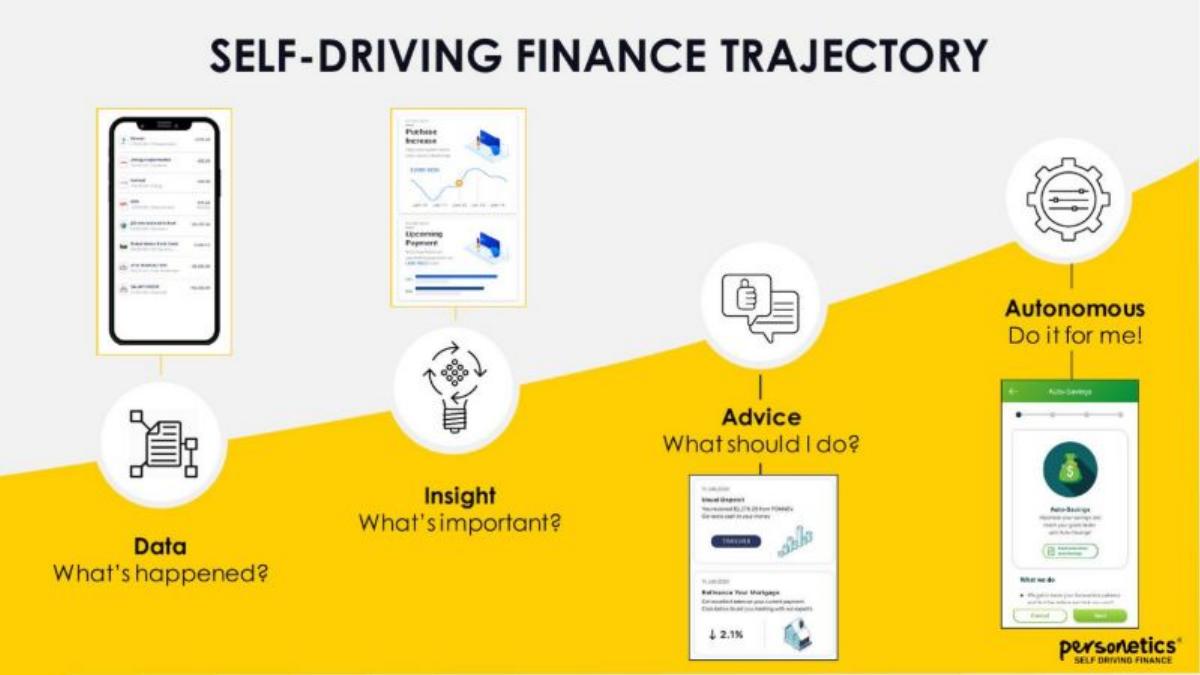
- Personetics defines its category as 'Self-Driving Finance,' moving from 'Data' to 'Autonomous' actions (Slide 6).
- The platform is presented as a four-part suite: Data Enrichment, Customer Engagement, Financial Wellness Automation, and Open Finance (Slide 7).
- The deck utilizes heavy social proof, displaying logos from major institutions like Citibank, Santander, US Bank, and RBC (Slide 3).
- Business impact is quantified with specific metrics, including a 17% click-through rate on advice and product recommendations (Slide 13).
- The 'Personalization Layer' is positioned as the critical bridge between a bank's core processor and its digital interface (Slide 8).
- The deck omits a traditional 'Team' slide, focusing instead on corporate scale and institutional backing (Slide 2).
- There is no explicit 'Ask' slide or use of funds breakdown within the 16-slide sequence.
The Growth Stage Masterclass: Personetics
Personetics’ 2022 deck is a clear example of how a growth-stage company shifts its narrative from 'we might work' to 'we are the standard.' At this stage, investors are looking for proof of scale, defensibility, and a clear path to becoming a category-defining platform. Personetics delivers this by framing the entire banking industry’s future around their proprietary concept: Self-Driving Finance.
Slide 1: Title and Positioning
The cover slide establishes the company as a "Financial Data-Driven Engagement Platform." It is clean, professional, and includes the contact information for Dorel Blitz, VP Strategy & Business Development. The date, January 2022, marks a period of significant expansion for the firm.
Slide 2: Personetics at a Glance
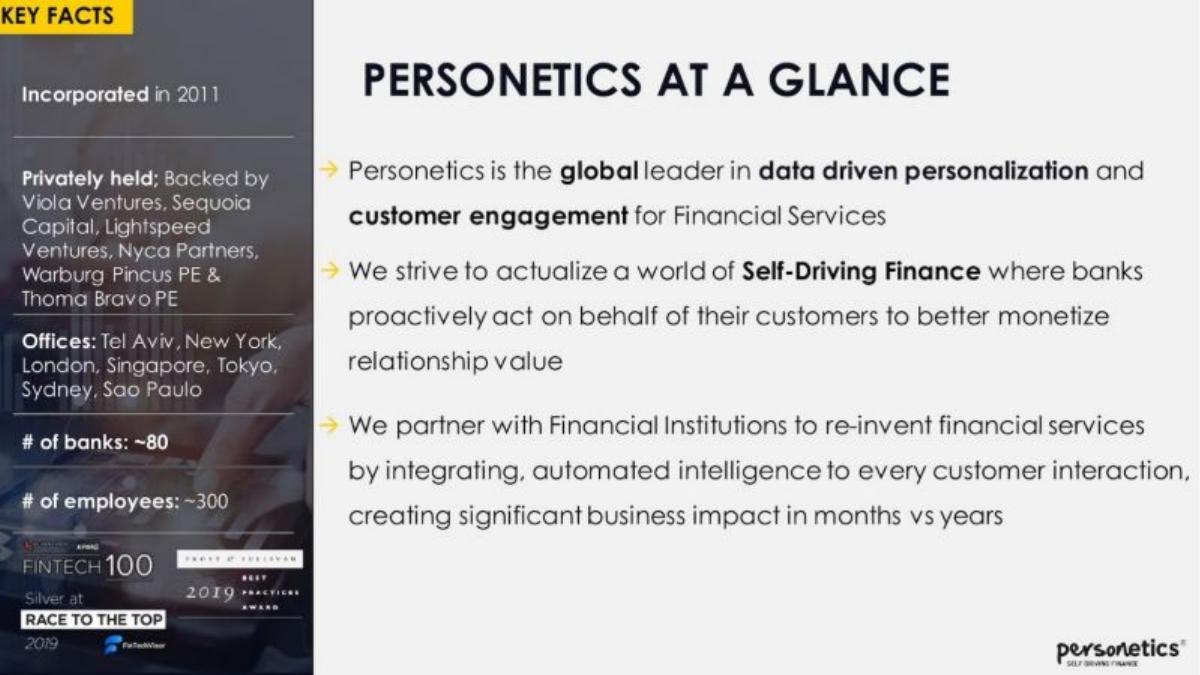
This is the 'credibility' slide. It lists incorporation in 2011, indicating a decade of maturity. Key facts include 80 banks as clients and approximately 300 employees. Most importantly, it lists a 'who's who' of venture capital and private equity: Sequoia, Lightspeed, Warburg Pincus, and Thoma Bravo. This slide tells an investor that the 'smart money' has already de-risked the venture.
Slide 3: The Global Leader
Slide 3 is a 'logo wall' on steroids. By stating they work with "6 of the top 12 banks in the NA/EU," Personetics moves beyond being a startup to being an enterprise infrastructure provider. The metrics are staggering: 120M+ customers, 58B+ transactions analyzed, and 9B+ personalized interactions. This level of data gravity is a significant moat.
Slide 4: The New Battleground
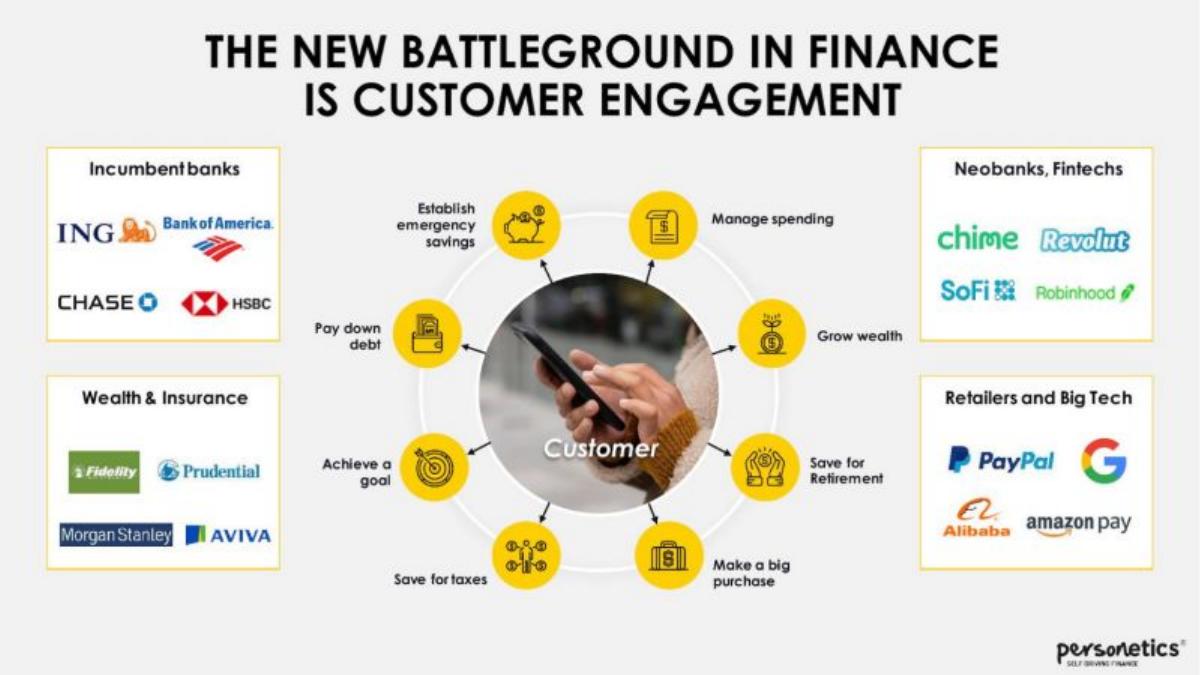
This slide sets the competitive context. It places incumbent banks in the middle of a pincer movement between Neobanks (Chime, Revolut), Wealth/Insurance (Fidelity, Morgan Stanley), and Big Tech (PayPal, Google, Amazon). The message is clear: banks are losing the engagement war, and they need a weapon to fight back.
Slide 5: Tidal Wave of Transformation
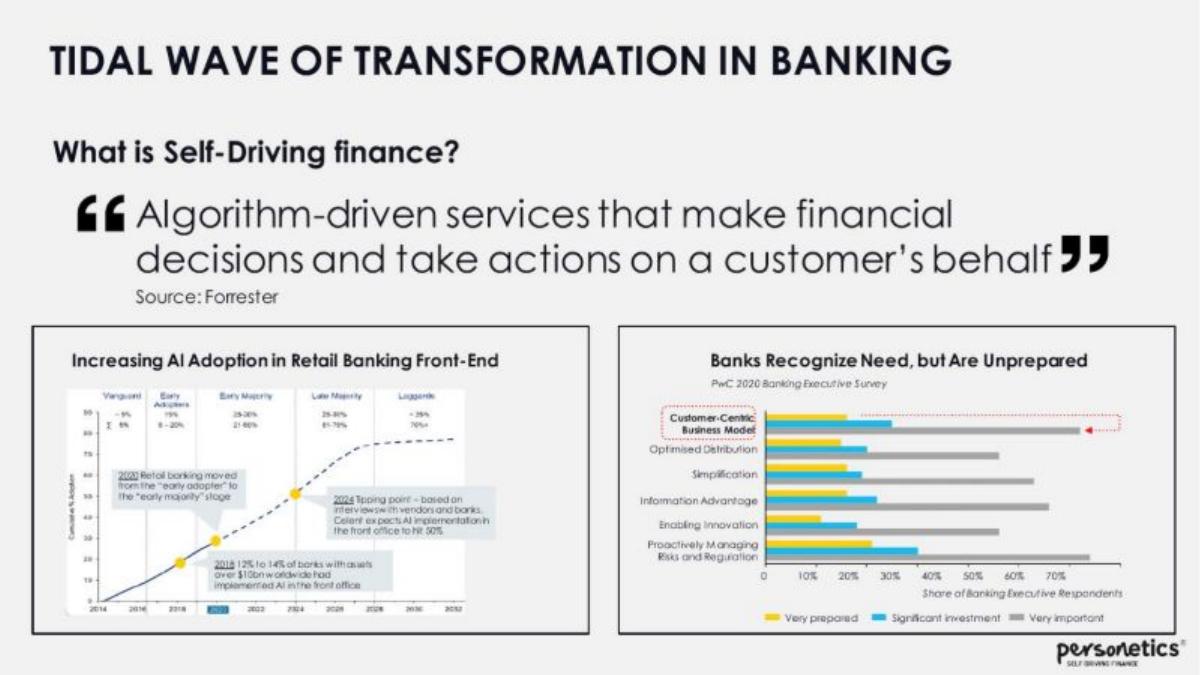
Using a quote from Forrester, the deck defines "Self-Driving Finance" as algorithm-driven services that take actions on a customer's behalf. It uses PwC and Celent data to show that while banks recognize the need for a customer-centric model, they are largely unprepared. This creates the 'urgency' required for a high-valuation investment.
Slide 6: Self-Driving Finance Trajectory
This is a crucial conceptual slide. It maps the evolution of banking from "Data" (What happened?) to "Insight" (What's important?) to "Advice" (What should I do?) and finally to "Autonomous" (Do it for me!). Personetics positions itself as the engine that moves banks up this value chain.
Slide 7: The Comprehensive Platform
Here, the product is broken down into four pillars: 1. Data Enrichment Services (making sense of messy transaction data), 2. Customer Engagement (the 'Insights Library'), 3. Financial Wellness Automation (automated savings programs), and 4. Open Finance (connecting to external data). This shows the breadth of their offering—it's not just a feature; it's a suite.
Slide 8: The Obvious Choice
This slide uses a pyramid diagram to show where Personetics sits in the bank's tech stack. They are the "Personalization Layer" that sits between the legacy "Core Processor" and the "Digital Interface." This is a classic 'middleware' play—hard to build, and even harder to rip out once integrated.
Slide 9: From Transactional to Hyper-Personalized
Visual proof. This slide shows the 'Before and After.' The 'Before' is a boring list of transactions. The 'After' is a rich, widget-based interface showing cash flow, mortgage refinancing advice, and subscription management. It makes the abstract concept of 'engagement' feel tangible.
Slide 10: Deployment Options
This circular graphic shows the various entry points for a bank. Whether a bank wants to start with Wealth Management, Small Business, or simple Data Enrichment, Personetics has a module for it. This suggests a 'land and expand' sales strategy.
Slide 11: The Virtuous Customer Flywheel
The deck explains how their product creates a 'flywheel' effect: personalized insights lead to higher NPS, which leads to better cross-selling, which leads to automated savings, which ultimately increases 'Relationship Depth' and bank balances. This is the economic engine of the pitch.
Slide 12: Open Finance Roadmap
Looking toward the future, this slide discusses how Personetics will drive usage in the 'Open Finance' era. It lists future applications in Insurance, Mortgages, and Pensions. It signals to investors that the TAM (Total Addressable Market) is expanding beyond simple checking accounts.
Slide 13: Key Business Outcomes
This is arguably the most important slide for a growth-stage investor. It provides the 'hard' ROI that justifies the bank's spend: 35% increase in engagement, 15-20% growth in new accounts, and 17% click-through rate on recommendations. These are the numbers that prove the product works at scale.
Slide 14-16: Legal and Closing
The deck ends with a standard confidentiality notice and a 'Thank You' slide. Notably, there is no 'Team' slide or 'Ask' slide in this version of the deck.
What Personetics Does Exceptionally Well
1. Data Gravity as a Moat: By highlighting the 58 billion transactions analyzed, Personetics signals that their AI is trained on a dataset that is virtually impossible for a newcomer to replicate. In AI-driven businesses, the data is the moat, and Personetics puts that front and center.
2. Defining the Category: They don't just call themselves 'fintech.' They own the term "Self-Driving Finance." By creating a new category, they set the rules for how that category is measured, making it harder for competitors to compare themselves directly.
3. Institutional Social Proof: For a company selling to banks, trust is everything. Listing 50% of the top 12 banks as clients is the ultimate 'nobody ever got fired for buying IBM' argument. It removes the 'will it work in a complex environment?' doubt from the investor's mind.
What is Missing from the Deck
1. The Team: While the company is established, growth-stage investors still want to see the bench strength of the executive team. The absence of a team slide suggests this deck might be used more for business development or that the team's pedigree is already well-known to the target audience.
2. Unit Economics: There is no mention of LTV (Lifetime Value), CAC (Customer Acquisition Cost), or churn rates. While they show the ROI for the banks, they don't show the internal economics of the Personetics business model.
3. The Competitive Landscape: Slide 4 shows the 'threats' to banks, but it doesn't show who Personetics competes with for the bank's budget (e.g., internal build teams or other fintech vendors like Meniga or Yolt). A 'competitor matrix' is missing.
What Founders Should Copy
1. The 'Before and After' Visuals: Slide 9 is a perfect example of how to show product value. Don't just talk about 'personalization'; show what a boring app looks like versus a 'Personetics-powered' app.
2. The ROI Slide: If you are selling B2B, you must have a slide like Slide 13. Every bullet point should be a metric that a CFO or a Head of Digital Banking cares about. If you can't quantify your impact, you don't have a growth-stage business.
3. The Evolution Narrative: Slide 6 (The Trajectory) is a brilliant way to show a roadmap without listing features. It shows a logical progression of value that makes the 'Autonomous' future feel inevitable.
Frequently asked questions
- What is the core value proposition of Personetics?
- Personetics positions itself as a 'Financial Data-Driven Engagement Platform.' Its primary value is enabling banks to transition from a transactional view of customers to 'Self-Driving Finance,' where AI proactively manages a customer's financial life through personalized insights, advice, and automated wellness programs.
- How does Personetics demonstrate market traction?
- The deck uses massive numbers to prove market dominance: 80+ bank partners, 120 million customers served, and 58 billion transactions analyzed. They specifically highlight that they work with 50% of the top 12 banks in North America and Europe, providing immediate institutional credibility.
- What are the specific business outcomes mentioned in the deck?
- On slide 13, the company lists six key drivers: 35% increase in customer engagement, 15-20% growth in new accounts/balances, 10% YoY digital sales growth, +7 points NPS improvement, 17% CTR on recommendations, and a 5-8% improvement in customer retention.
- Who are the investors backing Personetics?
- According to slide 2, the company is backed by a high-profile list of investors including Viola Ventures, Sequoia Capital, Lightspeed Ventures, Nyca Partners, Warburg Pincus PE, and Thoma Bravo PE.
- What is missing from the Personetics pitch deck?
- The deck lacks a dedicated team slide featuring the founders or executive leadership. It also omits a 'The Ask' slide, which is common in growth-stage decks that may be used for general business development or where the specific terms of a round are handled in a separate document.