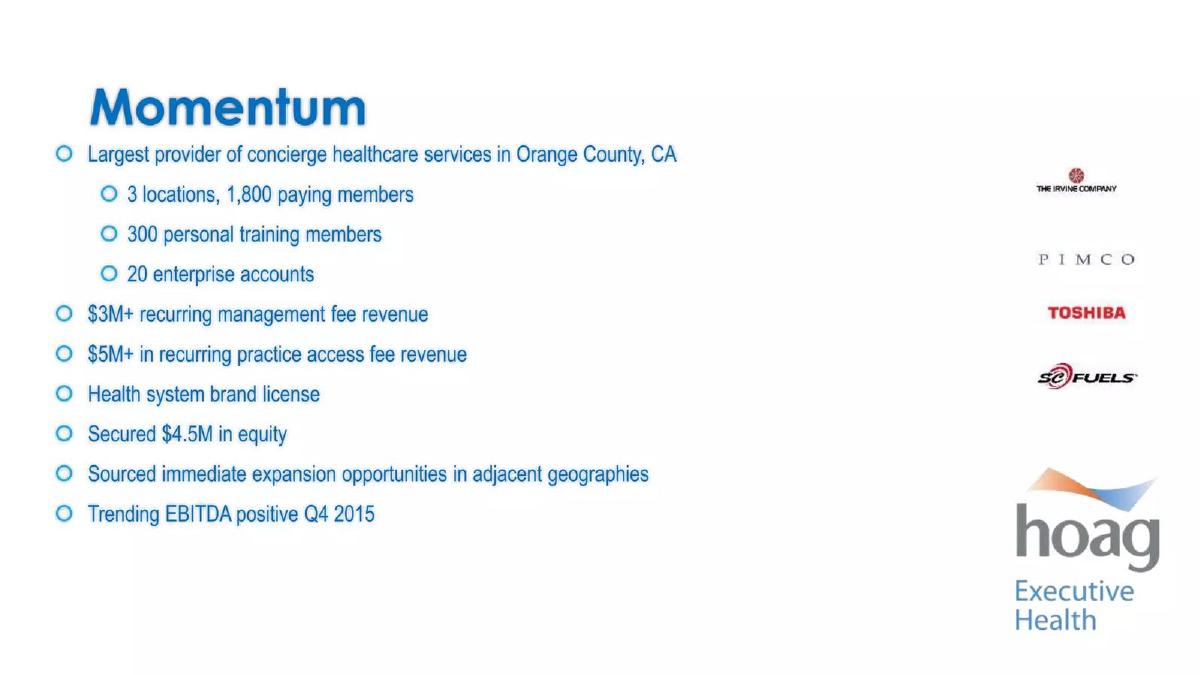
PersonalCare is a management services organization (MSO) for concierge medicine, specifically targeting the '1%' in Southern California. The deck outlines a strategy to acquire 3% of the 280,000 households in the region earning over $250,000 annually. Their business model relies on management fees, either as a percentage of practice revenue (averaging 55%) or a cost-plus markup (approximately 20%). The presentation highlights a highly fragmented $5 billion industry growing at a 34% CAGR. Seeking $1 million of an authorized $2 million Series B at a $25 million post-money valuation, the company…
Key takeaways
- The company targets households with annual incomes of $250,000 or greater, specifically aiming for 21,000 members in Southern California (Slide 4).
- Management fees in existing practices average 55% of practice revenue, with physicians generating approximately $625k in fee revenue at a 380-member capacity (Slide 5).
- Concierge medicine is identified as a $5 billion industry with a 34% CAGR over the last three years (Slide 3).
- The financial forecast predicts revenue growing from $3.6 million in 2015 to $8.0 million in 2018 for the current practice footprint (Slide 8).
- The Series B ask is for $1 million for 4% of the company, implying a $25 million valuation (Slide 10).
- Investment terms include an 8% accruing preferred distribution and an LLC liquidation preference (Slide 10).
- The competitive analysis positions PersonalCare as high-end, specifically contrasting it with 'low-price' competitors like One Medical (Slide 3 and 9).
- The management team includes Troy Medley (CEO), Dr. Jim Lindberg (CMO), and Kevin Davidson (CSO), all holding advanced degrees like MBAs or MDs (Slide 7).
Executive Summary and Value Proposition
Slides 1-2: The Hook and Mission
The PersonalCare deck opens with a high-contrast visual of an individual in a transit hub, immediately establishing a tone of exclusivity. The tagline, "It's not for everyone. It's healthcare for you," reinforces the boutique nature of the service. Slide 1 also introduces the core market thesis: a $5 billion industry growing at a 34% CAGR, citing The Concierge Medicine Research Collective. This sets the stage for a high-growth opportunity in a fragmented market.
Slide 2 provides a blunt mission statement: "PersonalCare helps doctors, health systems, and companies provide optimal health solutions to the 1%." By explicitly naming the 1% as their target, the company avoids the ambiguity often found in healthcare pitches. They are not solving for universal access; they are solving for premium service delivery to high-net-worth individuals.
Market Dynamics and Competitive Landscape
Slide 3: Industry Growth
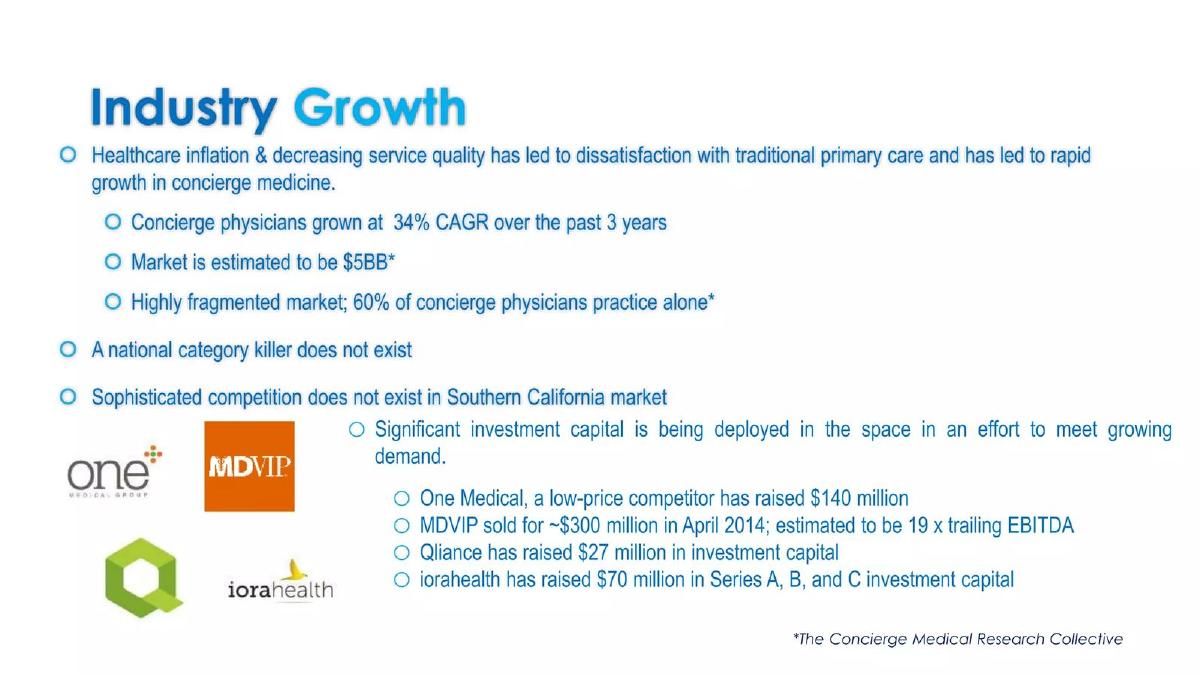
Slide 3 elaborates on the macro environment. It attributes the growth of concierge medicine to "healthcare inflation & decreasing service quality" in traditional primary care. The slide notes that 60% of concierge physicians practice alone, highlighting a lack of consolidation. PersonalCare positions itself as a potential "category killer" in a market where sophisticated competition is allegedly absent in Southern California.
The slide also uses social proof by listing capital raises from other players: One Medical ($140 million), Qliance ($27 million), and Iora Health ($70 million). It specifically mentions the sale of MDVIP for ~$300 million in April 2014 at an estimated 19x trailing EBITDA. This provides a clear exit benchmark for investors, though it notes One Medical is a "low-price competitor," further distancing PersonalCare from the mass market.
Slide 9: Competitive Mapping
The competition slide uses a multi-axis line graph to compare PersonalCare against Iora, MDVIP, Qliance, and MD^2. The categories include Pricing, Integration of Fitness & Nutrition, Scalability, Technology, Delivery Platform, Range of Solutions, Health System Positioning, and Mass Market Focus. PersonalCare places itself at the top of almost every premium category while intentionally scoring low on "Mass Market Focus." This visualizes their strategy of being the most comprehensive, high-end provider compared to the more specialized or lower-cost alternatives.
Geographic and Demographic Focus
Slide 4: Geographic Scope
PersonalCare focuses its initial efforts on Southern California. Slide 4 provides a map with circles around Los Angeles, Orange County, and San Diego. The data is granular: they identify 280,000 households with incomes over $250,000. Their goal is a 3% market share, which equates to 21,000 members. By defining the "prototypical member" as an executive earning $250k+, they provide a clear profile for their sales and marketing efforts.
Operations and Business Model
Slide 5: Revenue Mechanics
The business model slide explains how PersonalCare makes money as a Management Services Organization (MSO). They manage practices for a fee, which is either a percentage of revenue or a cost-plus markup. In existing practices, this fee averages 55% of total practice revenue. The slide provides a specific unit economic milestone: once a physician's membership panel hits 380 members, they generate approximately $625k in management fee revenue. Practice margins at capacity are stated to be approximately 40%.
For new developments in LA and San Diego, they utilize a "cost + mark up" model (approximately 20%). While these have lower margins than the percentage-of-revenue model, the deck claims these locations are "immediately profitable," allowing for lower-risk scaling into new territories.
Slide 6: Distribution Channels
The distribution strategy is presented as four overlapping circles: Direct Sales, Hospital Partnerships, Benefits Brokers, and Strategic Partnerships. This suggests a B2B2C approach, where they leverage existing professional networks (brokers and hospitals) to reach the high-income individuals who are already within those ecosystems. However, the slide lacks detail on the current status or success rate of these specific channels.
Team and Financials
Slide 7: Senior Management
The management team is presented with photos and credentials. The leadership includes Troy Medley (CEO, MBA), Dr. Jim Lindberg (CMO, MD, MBA), and Kevin Davidson (CSO, MHA). The inclusion of both medical and business degrees (MD/MBA) is a common signal in healthcare startups to demonstrate the ability to bridge the gap between clinical quality and operational efficiency. The background image of a high-rise office reinforces the corporate, high-end branding.
Slide 8: Financial Forecast
The "Steady State" forecast covers 2015 through 2018. It is important to note that this forecast is for the "current practice footprint" (3 practices) rather than the entire projected expansion.
2015: 2,360 members, $3.6M revenue, $(660)k EBITDA loss. · 2016: 3,700 members, $5.4M revenue, $1.1M EBITDA. · 2017: 4,400 members, $7.3M revenue, $2.9M EBITDA. · 2018: 4,550 members, $8.0M revenue, $3.5M EBITDA.
The forecast shows a rapid move to profitability and significant margin expansion as the member count approaches the capacity of the three practices.
The Investment Ask
Slide 10: Series B Terms
The final slide in the provided set outlines the investment opportunity. They are seeking $1 million of an authorized $2 million Series B Preferred growth equity round, which represents 4% of the company. This implies a post-money valuation of $25 million. Current investors include Management, a Silicon Valley VC firm, and Hoag Hospital, which provides significant institutional credibility.
The terms are specific: an 8% accruing preferred distribution and an LLC liquidation preference. The use of capital is earmarked for adding business development personnel, underwriting legal costs for new management agreements, working capital, and general corporate needs. The slide sets a hard deadline for closing: April 15th, 2014.
What Works and What is Missing
What Works
Extreme Focus: The deck does not try to be everything to everyone. By explicitly targeting the top 1% and a specific geography (Southern California), the founders demonstrate a clear understanding of their niche. · Unit Economics: Slide 5 provides very specific numbers regarding panel sizes (380 members) and management fees ($625k). This allows investors to model the business easily. · Institutional Backing: Mentioning Hoag Hospital as a current investor on Slide 10 provides a "stamp of approval" from a major healthcare player. · Clear Exit Benchmarks: Citing the MDVIP sale and its EBITDA multiple gives investors a clear picture of what a successful outcome looks like in this sector.
What is Missing
Historical Performance: While the deck provides a 2015-2018 forecast, it does not show audited historical financials for 2013 or earlier, which would be expected for a Series B. · Technology Detail: Slide 9 mentions "Technology Enabled" as a competitive differentiator, but there is no slide explaining what that technology actually is (e.g., a patient portal, proprietary EHR, or telemedicine platform). · Marketing Spend: The distribution slide (Slide 6) is very high-level. It does not disclose the Customer Acquisition Cost (CAC) or the efficiency of the direct sales vs. broker channels. · Risk Factors: There is no mention of regulatory risks, which are significant in concierge medicine (e.g., compliance with Medicare "double-billing" rules or state-specific insurance regulations).
Founder Takeaways
Own your niche. PersonalCare's willingness to say "It's not for everyone" is a powerful positioning tool. Founders should not be afraid to define their market narrowly if the economics of that niche are superior. Be specific about management fees. For MSO models, the breakdown of how fees are calculated (percentage vs. cost-plus) is vital information that this deck handles well. Use industry benchmarks. By citing the MDVIP acquisition, the founders framed their valuation and exit potential within the context of a real-world transaction, making their $25 million valuation ask feel more grounded.
Frequently asked questions
- What is the specific business model of PersonalCare?
- PersonalCare operates as a management entity for concierge medical practices. According to slide 5, they generate revenue through two fee structures: a percentage of revenue (averaging 55% in existing practices) or a cost-plus markup (approximately 20% for new developments). They provide the operational infrastructure, allowing physicians to focus on patient care while the company captures a significant portion of the practice's gross revenue.
- How does the company define its target market?
- The company is hyper-focused on the '1%'. Slide 4 defines the prototypical member as an executive with a household income of $250,000 or more. They identify 280,000 such households in Southern California, representing 900,000 prospects. Their stated goal is to capture 3% of this specific demographic to reach 21,000 managed members.
- What are the terms of the Series B investment mentioned in the deck?
- Slide 10 details a request for $1 million out of an authorized $2 million Series B Preferred growth equity round. This $1 million represents 4% of the company. The investment includes an 8% accruing preferred distribution and a liquidation preference designed to enhance tax shields and IRR. The slide notes a closing date target before April 15th, 2014.
- Who are the primary competitors identified by PersonalCare?
- Slide 3 and slide 9 identify several competitors in the concierge and primary care space, including One Medical (described as low-price), MDVIP (sold for ~$300M), Qliance, Iora Health, and MD^2. PersonalCare differentiates itself by focusing on the high-end market and 'full range of solutions' rather than mass-market appeal.
- What is the projected financial performance for the company?
- Slide 8 provides a 'Steady State' forecast for the current practice footprint. It projects revenue increasing from $3.6 million in 2015 to $8.0 million in 2018. While the company expected an EBITDA loss of $(660)k in 2015, they forecasted becoming profitable in 2016 with $1.1 million in EBITDA, scaling to $3.5 million by 2018.