Phanatiq is a music technology startup positioning itself as a bridge between artists and superfans. The deck proposes a web and mobile application that tracks fan activity—such as buying albums, attending concerts, and purchasing merchandise—to generate a 'fan score.' This score allows fans to compete on local and global leaderboards for bragging rights and exclusive perks. For artists and labels, the value proposition lies in the collection of granular fan data and buying history. The company seeks $550,000 in seed funding to cover development, design, and early marketing. While the deck pr…
Key takeaways
- The core product is a gamified fan loyalty platform where users earn points for supporting artists (Slide 2).
- Fans are ranked by a 'fan score' across city, state, country, and global leaderboards (Slide 4).
- The platform aims to provide artists and labels with specific data on their top fans and their buying history (Slide 6).
- Market adoption strategy relies heavily on partnerships with artists, labels, and event organizers (Slide 5).
- The company is seeking a $550,000 seed round to fund development, design, and marketing (Slide 7).
- The deck includes a mobile interface mockup, though it notes that the design is not final (Slide 4).
- Phanatiq claims a 'First to Market' competitive advantage for this specific type of application (Slide 6).
- The deck is dated 2018 and identifies Phanatiq as an Eyma Tech, Inc. company (Slide 1).
Introduction and Vision
Phanatiq enters the music technology space with a focus on the 'superfan' economy. The title slide (Slide 1) establishes the core value proposition: "Get Rewarded and Recognized for Supporting Your Favorite Artists." The deck, dated 2018, identifies the entity as an Eyma Tech, Inc. company. The branding is clean and mobile-centric, signaling a consumer-facing application intended for a younger, digitally native audience.
The Solution: Gamifying Loyalty
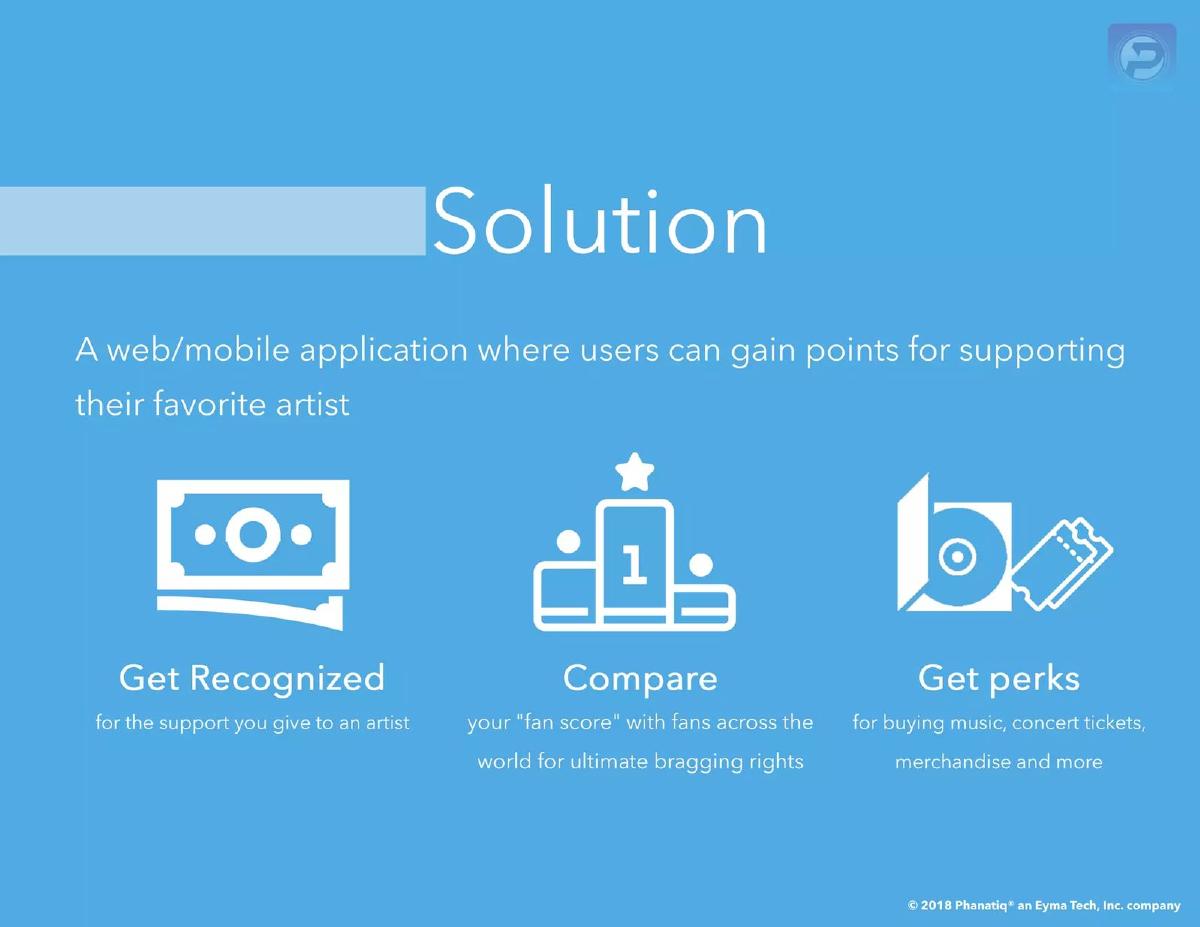
Slide 2 introduces the 'Solution' as a web and mobile application where users gain points for supporting artists. The slide breaks the solution into three pillars: Get Recognized , Compare , and Get perks . The focus here is on the emotional and social drivers of fandom. By quantifying support through a 'fan score,' Phanatiq attempts to turn passive listening and purchasing into a competitive social activity. The mention of 'perks' for buying music and tickets suggests a loyalty program structure similar to those found in the airline or hospitality industries, but tailored for the music world.
Product Deep Dive: The Artist Profile
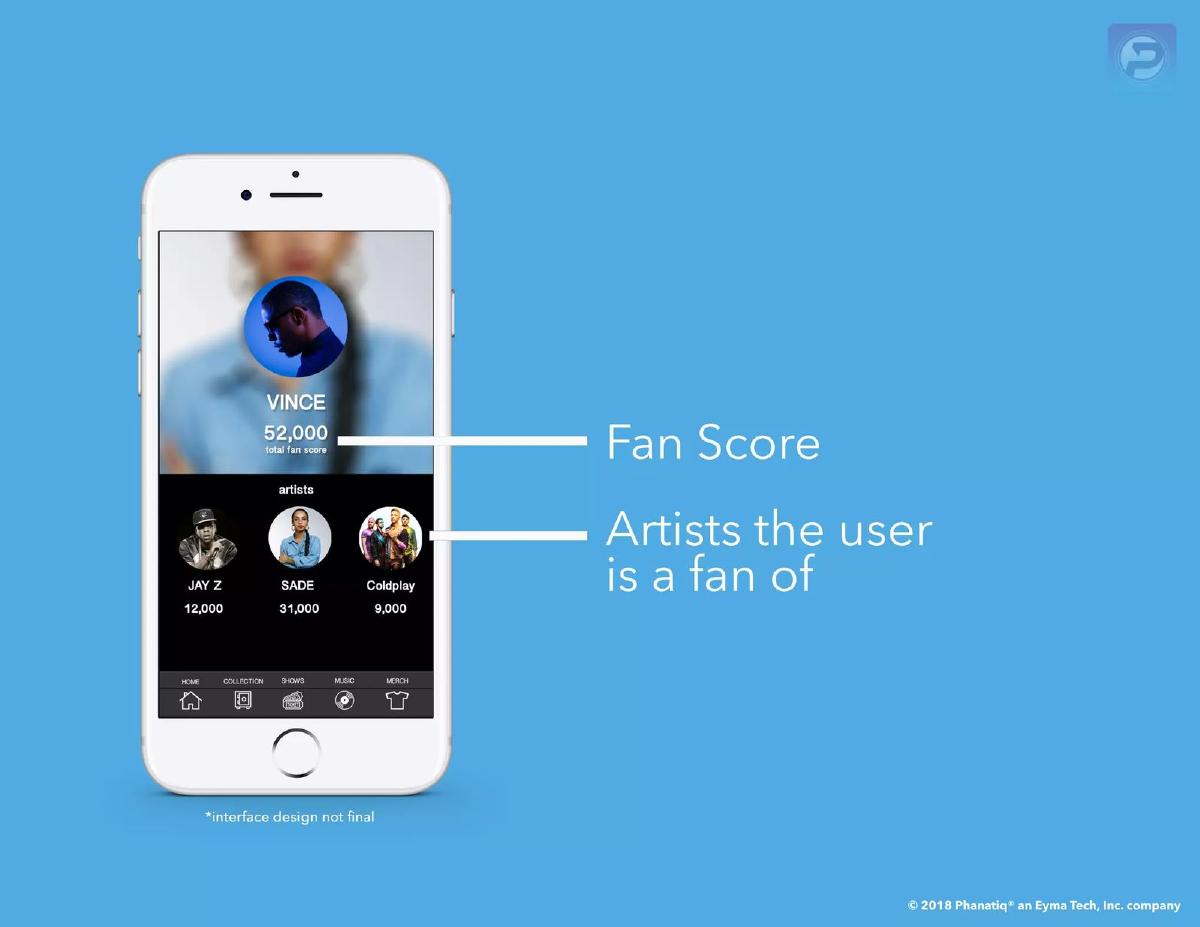
Slide 3 serves as a transition to the 'Product' section, which is detailed in Slide 4. This slide is one of the most informative in the deck, featuring a mobile interface mockup using Jay-Z as the example artist. The mockup displays a 'Score' of 12,000 and tracks specific metrics: 9 albums owned, 13 shows attended, and 34 pieces of merch owned. It also shows a 'World Rank' and a 'Florida Rank,' reinforcing the leaderboard concept. The bullet points clarify that the platform allows artists and labels to connect directly with these top-tier fans. Features like liner notes and album bundles are mentioned, suggesting the app aims to be a secondary destination for content beyond just a tracking tool. Notably, a disclaimer at the bottom states 'interface design not final,' indicating the product was likely in an early development or prototyping stage at the time of the pitch.
Market Adoption and Growth Strategy
Slide 5, titled 'Market Adoption,' lists the channels through which Phanatiq intends to grow. The strategy is heavily reliant on B2B2C (Business-to-Business-to-Consumer) partnerships. By partnering with labels and artists during 'Album/Single Rollouts,' Phanatiq can tap into existing marketing budgets and fan bases. The mention of 'Custom bundles exclusive to Phanatiq' suggests a strategy to drive user acquisition through scarcity and exclusivity. Finally, 'Events/festivals' represent a high-density environment for capturing their target demographic in a live setting.
Competitive Advantage and Data Play
Slide 6 outlines the 'Competitive Advantage.' The company claims to be 'First to Market,' a bold assertion in the crowded music tech space, though they qualify it as being for an 'application of this kind.' The most compelling point on this slide for an investor is likely the 'Data' section. It states that 'Artists and labels will know who their top fans are and their buying history.' In an era where streaming services often obfuscate individual fan data from the artists themselves, a platform that can provide a verified list of high-value customers is a significant value add for the industry. The 'Ease of daily use' and 'Leaderboard' points reiterate the gamification aspects mentioned earlier.
The Ask: Seed Funding
The final slide in the provided set (Slide 7) is the 'Financial' slide. Phanatiq is seeking $550K in a Seed Round . The intended use of funds is clearly stated: 'Costs for development, design and early marketing efforts.' This is a relatively modest seed ask for a mobile-first platform, suggesting the company is looking to reach a specific milestone—likely a full version launch or a set number of artist partnerships—before seeking a larger Series A round.
What Works in This Deck
The Phanatiq deck succeeds in its clarity of purpose. Within seven slides, the reader understands exactly what the app does, who it is for, and why an artist might want to participate. The use of a high-profile example (Jay-Z) in the product mockup helps visualize the scale and potential impact of the platform. The focus on 'bragging rights' and 'leaderboards' shows a good understanding of fan psychology. Furthermore, the explicit mention of providing data to labels addresses a well-known pain point in the music industry, giving the product a clear B2B utility beyond its consumer appeal.
What Is Missing
Despite the clear product vision, the deck has several critical gaps that would be immediate red flags for a professional investor:
Team Slide: There is no information on who is building this. In a seed round, the team is often more important than the idea. Investors need to see industry experience, technical capability, or previous successful exits. · Traction: The deck does not mention any current users, waitlist numbers, or signed letters of intent (LOIs) from labels or artists. Without traction, the 'First to Market' claim carries less weight. · Business Model: While the deck explains how fans get points, it doesn't explain how Phanatiq makes money. Is there a commission on merch sales? A SaaS fee for labels? An ad-supported model? · Market Size (TAM/SAM/SOM): There is no analysis of the total addressable market. Investors need to know if the superfan economy is large enough to support a venture-scale business. · Competition: Claiming to be 'First to Market' is rarely enough. A slide acknowledging existing fan clubs, social media platforms, and other music loyalty startups would have shown a more mature understanding of the landscape.
Founder Takeaways
Founders can learn from Phanatiq's ability to condense a complex gamification idea into simple, digestible icons and bullet points. The 'Solution' slide is a great example of how to use iconography to communicate three distinct value propositions quickly. However, the primary lesson here is the importance of the 'Why Us' and 'Why Now' components. A pitch deck is not just a product manual; it is a business case. To improve this deck, a founder should ensure that the product mockups are supported by a robust plan for monetization and a team slide that proves they are the right people to execute the vision. Additionally, always include a slide that addresses the competitive landscape honestly; investors will do the research anyway, so it is better to define the narrative yourself.
Frequently asked questions
- What is the primary problem Phanatiq aims to solve?
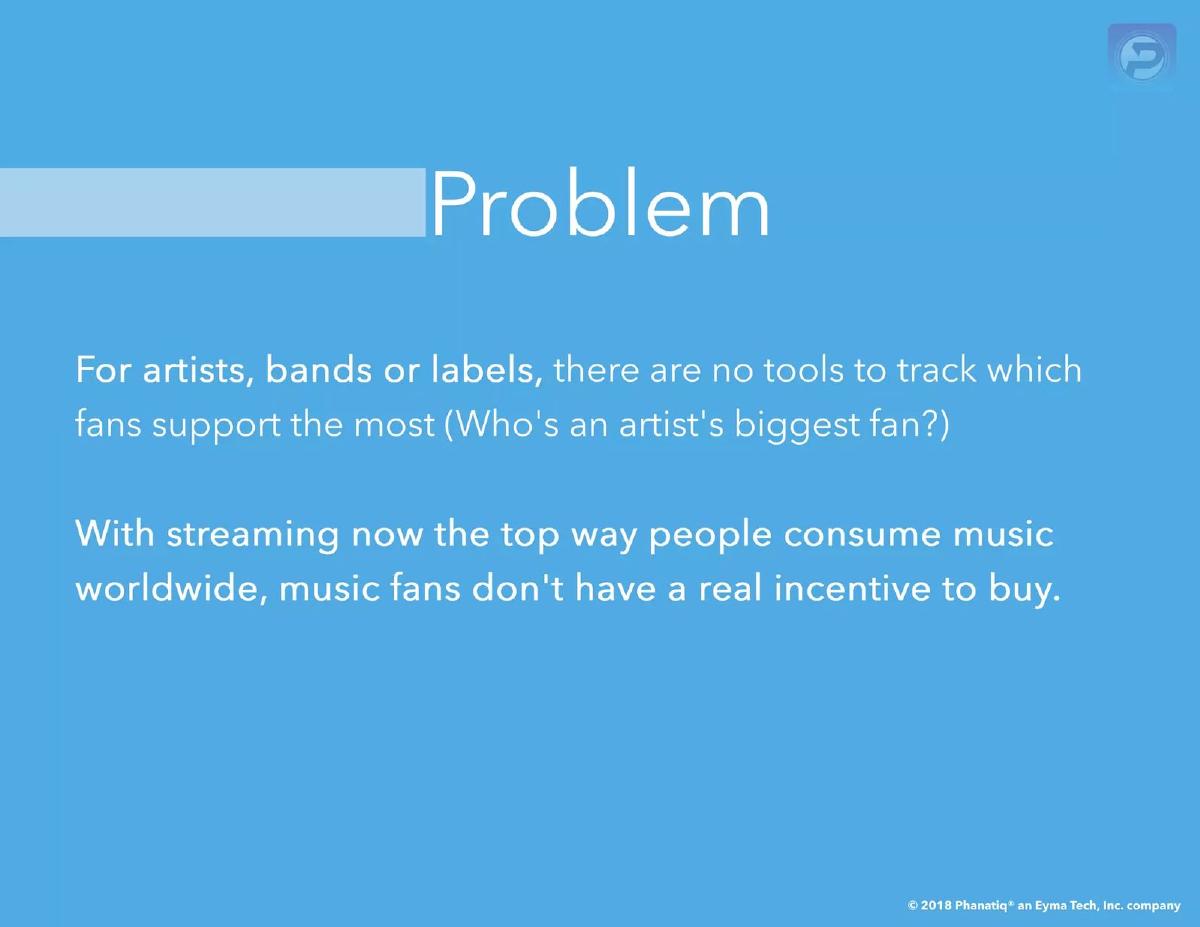
- While a specific 'Problem' slide is not included in the provided sequence, the 'Solution' and 'Product' slides suggest the company is addressing the lack of recognition and rewards for superfans. It also addresses the data gap for artists and labels who may not know who their most loyal, high-spending supporters are across different channels like merch, tickets, and digital music.
- How does the gamification element work in the app?
- According to Slide 4, the app tracks 'albums owned, concerts attended and more' to calculate a 'total fan score.' This score is then used to rank fans on leaderboards ranging from the city level to a global scale. This creates a competitive environment where fans vie for 'ultimate bragging rights' and potential rewards from the artists.
- What is the business model for Phanatiq?
- The deck does not explicitly detail a revenue model, such as transaction fees or subscription costs. However, Slide 5 mentions 'custom bundles exclusive to Phanatiq' and 'Artist/Label partnerships,' suggesting potential revenue streams through e-commerce, affiliate sales of merch and tickets, or B2B data services for labels.
- What are the biggest omissions in this pitch deck?
- The most significant omissions are the Team slide and the Traction slide. There is no information about the founders' backgrounds or their expertise in the music industry. Additionally, there are no metrics regarding current user numbers, signed partnerships, or pilot programs, making it difficult to assess the startup's current momentum.
- How does Phanatiq plan to acquire users?
- Slide 5 outlines a 'Market Adoption' strategy focused on the supply side of the music industry. They plan to use artist and label partnerships, align with album or single rollouts, offer exclusive bundles, and maintain a presence at events and festivals to drive fan downloads and engagement.