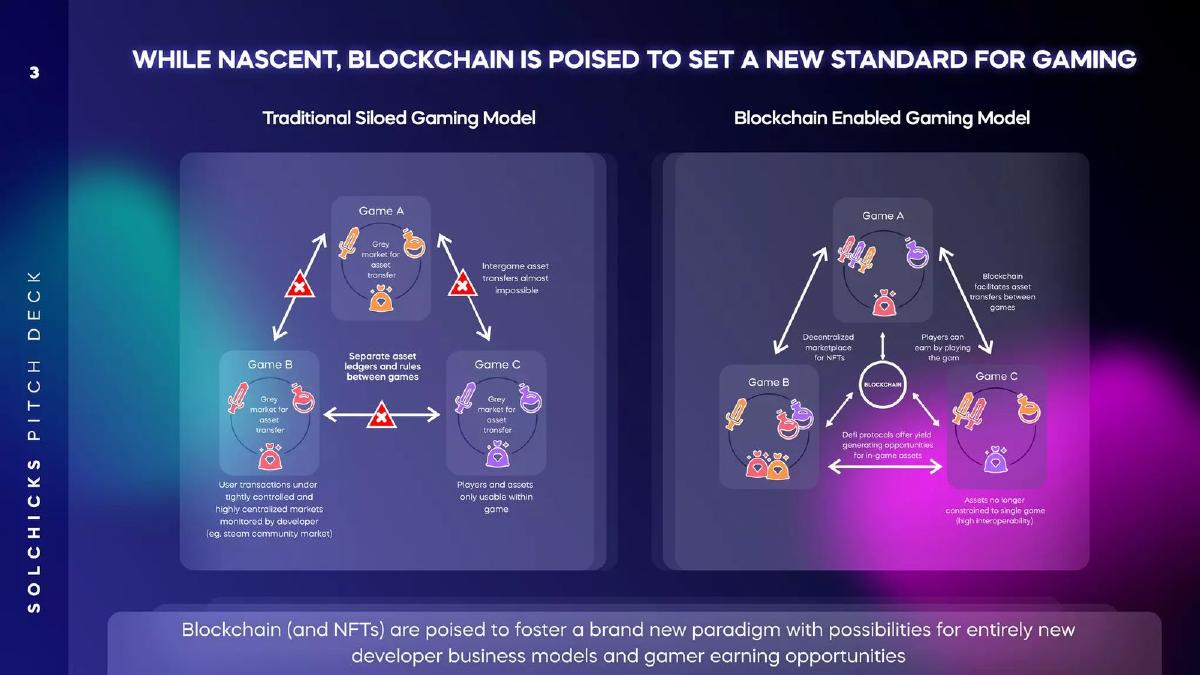
SolChicks raised $57M in 2022 by positioning themselves as the premier Play-to-Earn (P2E) title on the Solana blockchain. The deck relies heavily on the 'Axie Infinity' benchmark, arguing that while Axie proved the model, a massive untapped market of traditional gamers remains. By citing the 200M+ followers of franchises like League of Legends and DOTA 2, SolChicks frames their project as the bridge between high-quality gameplay and financial incentives. The deck is notable for its extensive list of over 100 institutional investors and 35+ launchpad partners, signaling massive industry buy-in…
Key takeaways
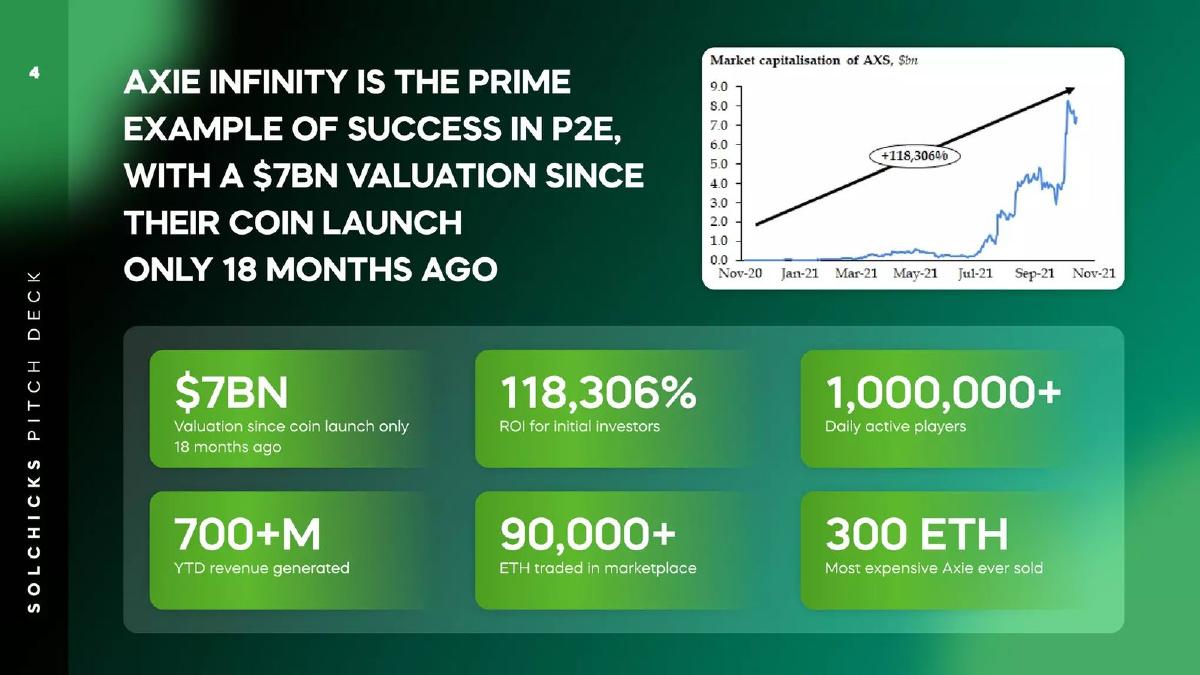
- The deck uses Axie Infinity's $7BN valuation and 118,306% ROI to anchor investor expectations (Slide 4).
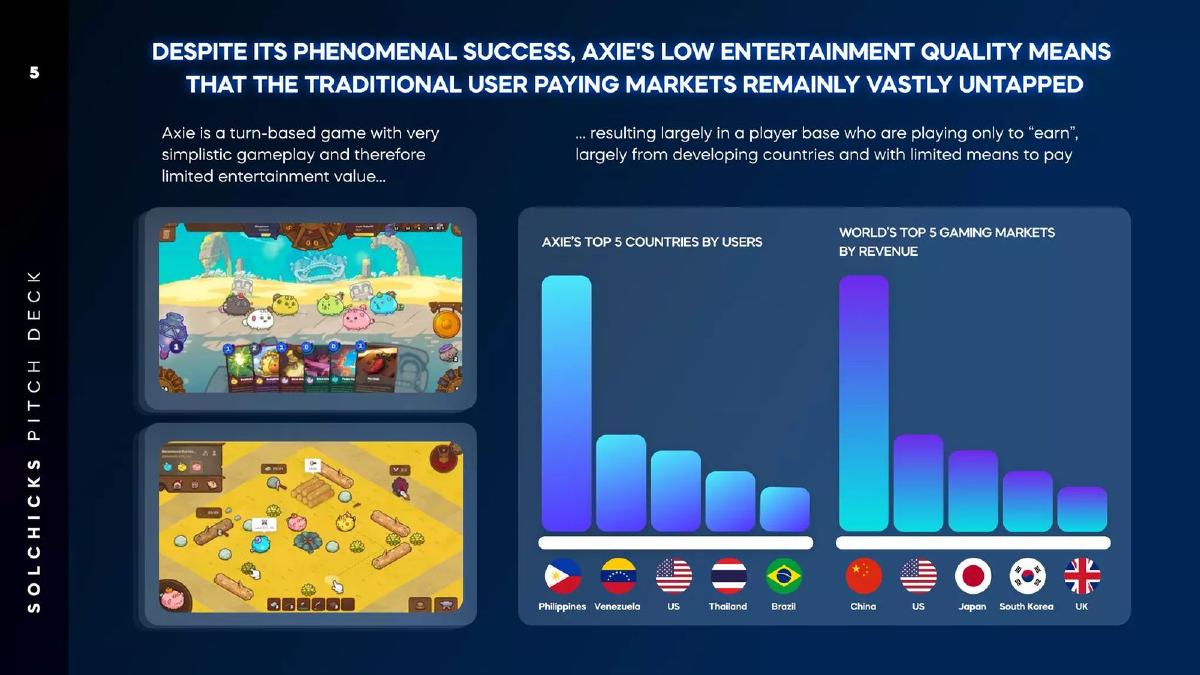
- A core market thesis is that 70% of Axie users had never played a game before, suggesting P2E expands the total addressable market (Slide 6).
- SolChicks positions itself as a first-mover on Solana, contrasting the crowded Ethereum gaming ecosystem with the nascent Solana landscape (Slide 8).
- The product is structured as a limited collection of 10,000 Gen 1 NFTs with five rarity tiers, ranging from Common (>60%) to Legendary (>0.1%) (Slide 12).
- The revenue model for players involves a four-pronged approach: SolCoins, tradable rewards, $CHICKS governance tokens, and breeding (Slide 14).
- Social proof is a primary driver, with Slide 16 showcasing over 100 investor logos and Slide 18 listing 35+ launchpad partners.
- The roadmap outlines a rapid transition from NFT minting to a playable alpha and mini-game within a single quarter (Slide 20).
- The deck includes a detailed token vesting schedule, showing a 24-month linear vest for the team and a 36-month vest for treasury and advisors (Slide 22).
The Macro Thesis: Blockchain Gaming as an Inevitability
The SolChicks deck begins not with the game itself, but with a high-level education on the blockchain gaming landscape. This is a classic Series A tactic: sell the category before you sell the company. By the time this deck was circulating in 2022, the 'Play-to-Earn' (P2E) phenomenon was at its peak, and the founders leaned heavily into this momentum.
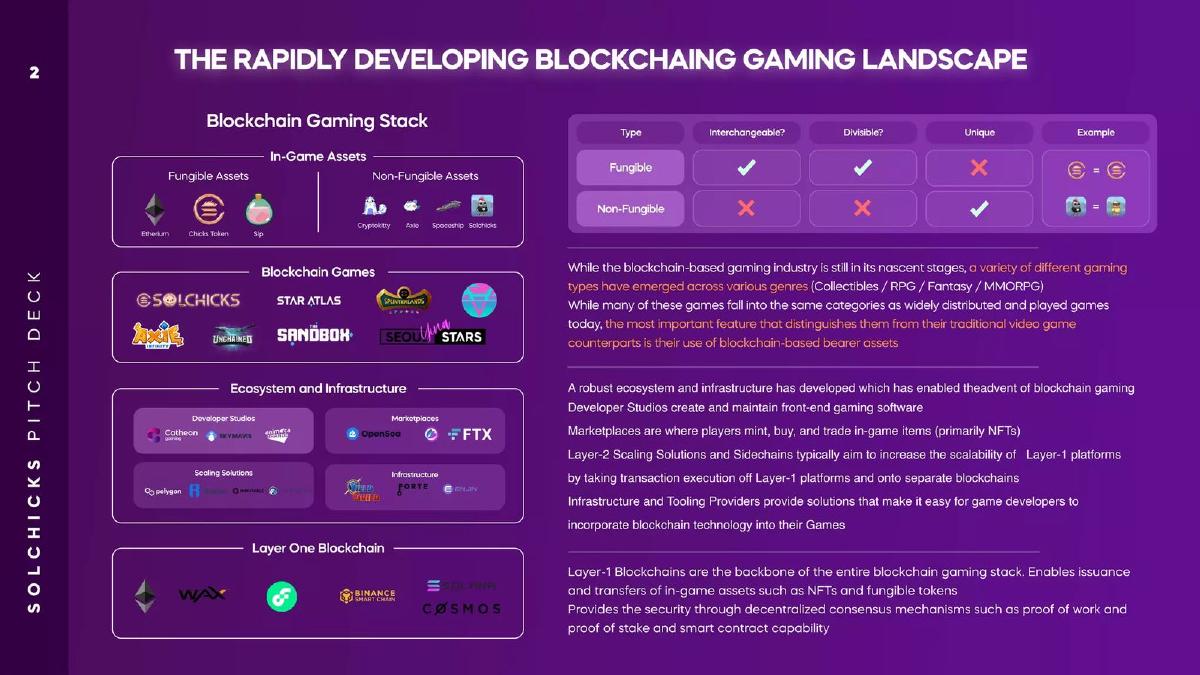
Slide 2: The Blockchain Gaming Stack
Slide 2 serves as a primer for investors who may be new to the space. It categorizes the industry into four distinct layers: In-Game Assets (Fungible vs. Non-Fungible), Blockchain Games, Ecosystem and Infrastructure, and Layer One Blockchains. SolChicks places itself in the 'Blockchain Games' category alongside titles like Star Atlas and The Sandbox. The slide defines the 'most important feature' of these games as the use of 'blockchain-based bearer assets.' This establishes the technical foundation for the financial incentives discussed later in the deck.
Slide 4: The Axie Infinity Benchmark
Slide 4 is the 'FOMO' slide. It focuses entirely on Axie Infinity, citing a $7BN valuation and a staggering 118,306% ROI for initial investors. By highlighting 1,000,000+ daily active players and $700M+ in YTD revenue, SolChicks is telling investors: 'This is what success looks like in this category, and we are the next iteration.' This slide is a masterclass in using a competitor's success to validate a market opportunity rather than viewing them as a threat.
Slide 6: Expanding the Addressable Market
On Slide 6, the deck moves from crypto-native success to traditional gaming dominance. It lists Diablo (3M MAU), League of Legends (180M MAU), and DOTA 2 (11M MAU) as proven models. The core argument here is that P2E will introduce a 'new generation of users' who are attracted by economic incentives. They cite a statistic that 70% of Axie users had never played a game before, suggesting that the P2E model doesn't just steal market share from traditional games—it expands the total number of gamers globally.
Slide 8: The Solana Advantage
Slide 8 addresses the 'Why Solana?' question. It visualizes the Ethereum ecosystem as crowded with dozens of logos (including Decentraland and CryptoKitties), while the Solana side is relatively empty, featuring only Star Atlas, Aurory, Defi-Land, and SolChicks. This 'infancy' argument suggests that SolChicks has a first-mover advantage on a blockchain known for higher transaction speeds and lower costs than Ethereum.
Slide 10: Lore and World-Building
Slide 10 takes a sharp turn into the game's narrative. It describes the SolChicks as a 'proud race' from the planet Chicco who live in a 'spartan like fashion.' The text-heavy slide details their battle against an intergalactic threat called the 'SolFox.' While lore is important for community building in gaming, this slide is an outlier in an otherwise data-driven deck. It serves to show that the team has thought through the intellectual property and 'flavor' of the game, which is crucial for long-term player retention.
Slide 12: NFT Rarity and Scarcity
Slide 12 introduces the primary product: 10,000 unique Gen 1 SolChicks NFTs. The deck outlines five rarity tiers: Common, Uncommon, Rare, Mythical, and Legendary. Each tier is accompanied by a probability (e.g., Legendary at >0.1% chance). This slide communicates the 'collectible' aspect of the business model, which drives the secondary market trading volume mentioned in the Axie Infinity slide.
Slide 14: The Four-Way Earning Model
Slide 14 explains the 'Earn' in 'Play-to-Earn.' It lists four methods for players to generate value: 1) Earning SolCoins (in-game currency), 2) Earning tradable rewards, 3) Earning $CHICKS governance tokens through leaderboards, and 4) Breeding new SolChicks to sell. This multi-token economy is a standard feature of 2021-2022 era P2E games, aimed at balancing utility and governance while providing constant 'sinks' for the tokens to prevent hyperinflation.
Slide 16 & 18: Massive Institutional Validation
Slides 16 and 18 are arguably the most impressive from a pure fundraising perspective. Slide 16 contains over 100 investor logos, including Blocore, AU21 Capital, and Master Ventures. Slide 18 lists over 35 launchpad partners and claims 60,000 sign-ups within seconds of launch. For a Series A investor, this level of industry-wide syndication suggests that the project has already passed the 'sniff test' of dozens of other professional evaluators.
Slide 20: The Execution Roadmap
The roadmap on Slide 20 shows a very aggressive development cycle. Having already accomplished NFT minting and a playable demo, the team projected the release of a mini-game, the $SHARDS token, and breeding mechanics for March/April 2022. The 'Third Update' in Q3/Q4 2022 was slated to include 'flocks, buildings and weapons,' indicating a move toward a more complex 4X or strategy-style game beyond simple combat.
Slide 22: Vesting and Tokenomics
Slide 22 provides the 'Vesting Schedule,' a critical slide for crypto investors. It shows that the Team has a 0% unlock at the Token Generation Event (TGE), followed by a cliff and a 24-month linear vest. This is designed to align the team's incentives with long-term project success. Conversely, the Public Presale had a 25% TGE unlock and a short 3-month vest, which is typical for providing early liquidity to the community.
What SolChicks Does Well
The SolChicks deck is a masterclass in market positioning . By framing themselves as the 'Axie of Solana,' they simplified the investment thesis for VCs who were looking for a way to play the Solana ecosystem growth. The use of competitive benchmarking (Slide 4 and Slide 6) is particularly effective because it uses real-world revenue and valuation data to justify their own potential.
Furthermore, the social proof in this deck is overwhelming. Most startups struggle to fill a single slide with reputable investors; SolChicks filled two slides with nearly 150 logos. This creates a 'herd mentality' effect where an investor feels that passing on the deal would mean disagreeing with the entire crypto-VC industry.
What is Missing from the Deck
Despite its length, the deck has several notable omissions. First, there is no detailed team slide in the 13 slides provided. While the catalogue facts mention a specialized team of over 70, the absence of founder bios, previous exits, or specific gaming industry experience (e.g., former Riot or Blizzard employees) is a gap. In gaming, the 'pedigree' of the developers is often as important as the mechanics.
Second, the deck lacks economic sustainability modeling . The P2E model, as popularized by Axie Infinity, faced significant criticism for being 'ponzi-nominal'—requiring a constant influx of new players to maintain token value. SolChicks describes how to earn, but it does not provide a detailed breakdown of the 'token sinks' or how the economy remains stable once user growth plateaus.
Finally, there is no specific 'Ask' slide . While we know from catalogue facts they raised $57M, the deck does not explicitly state the amount being raised, the valuation, or the specific allocation of those funds (e.g., % to marketing vs. % to engineering).
The Founder's Playbook: What to Copy
Founders should emulate the visual clarity of the market landscape on Slide 8. Showing your startup as a big fish in a small pond (Solana) versus a small fish in a crowded pond (Ethereum) is a highly persuasive way to justify your choice of platform or niche.
Another takeaway is the Categorization of Users on Slide 6. If you are building in a new category, don't just show the current market size; show how your product creates new market participants. The argument that P2E turns non-gamers into gamers is a 'venture-scale' insight that changes the TAM (Total Addressable Market) calculation from linear to exponential.
Lastly, the Vesting Schedule on Slide 22 is a model of transparency. In the crypto space, 'rug pulls' and team dumps are a major concern. Proactively showing a long-term vesting schedule for the team and advisors builds immediate trust with institutional investors who are looking for builders, not speculators.
Frequently asked questions
- How much did SolChicks raise and at what stage?
- According to the catalogue facts, SolChicks raised $57M in a Series A round in 2022. The investor pool was primarily composed of Venture Capital firms, as evidenced by the extensive logo wall on Slide 16 of the deck.
- What is the core gameplay model proposed by SolChicks?
- SolChicks aims to replicate the proven entertainment models of MOBA and MMORPG franchises like League of Legends, DOTA 2, and Diablo. Slide 6 highlights that these franchises have over 200M followers, and SolChicks intends to add a Play-to-Earn layer to this established genre.
- How does the tokenomics work in the SolChicks ecosystem?
- The ecosystem utilizes multiple assets: $CHICKS is the governance token earned through rankings, SolCoins are the in-game currency, and $SHARDS are used for breeding new NFTs. Slide 14 and Slide 22 detail these assets and their respective vesting schedules for different stakeholders.
- Why did SolChicks choose the Solana blockchain?
- Slide 8 explicitly compares the 'infancy' of the Solana P2E ecosystem to the crowded Ethereum market. By positioning themselves alongside only a few other titles like Star Atlas and Aurory, they argue for a 'blue ocean' opportunity on a faster, lower-cost blockchain.
- What is the rarity distribution of the SolChicks NFTs?
- The Gen 1 collection consists of 10,000 NFTs. Slide 12 breaks down the rarity: Common (>60%), Uncommon (>40%), Rare (>15%), Mythical (>2%), and Legendary (>0.1%). Note: The percentages provided on the slide exceed 100% when summed, likely representing the probability of a specific tier during the minting process.