The Sofy.ai pitch deck is a 12-slide presentation that prioritizes narrative flow over data density. It successfully leverages the 'Founder-Market Fit' card by highlighting CEO Syed Hamid’s 18-year tenure at Microsoft, where he managed a $10M+ test budget. The deck identifies a massive, growing market—projected to reach $54B by 2021—and positions its 'Trainable BOT' as the solution to the inefficiencies of manual testing and complex coding tools. While the deck is light on technical architecture and competitive analysis, it compensates with strong traction metrics, including 8,000+ developers…
Key takeaways
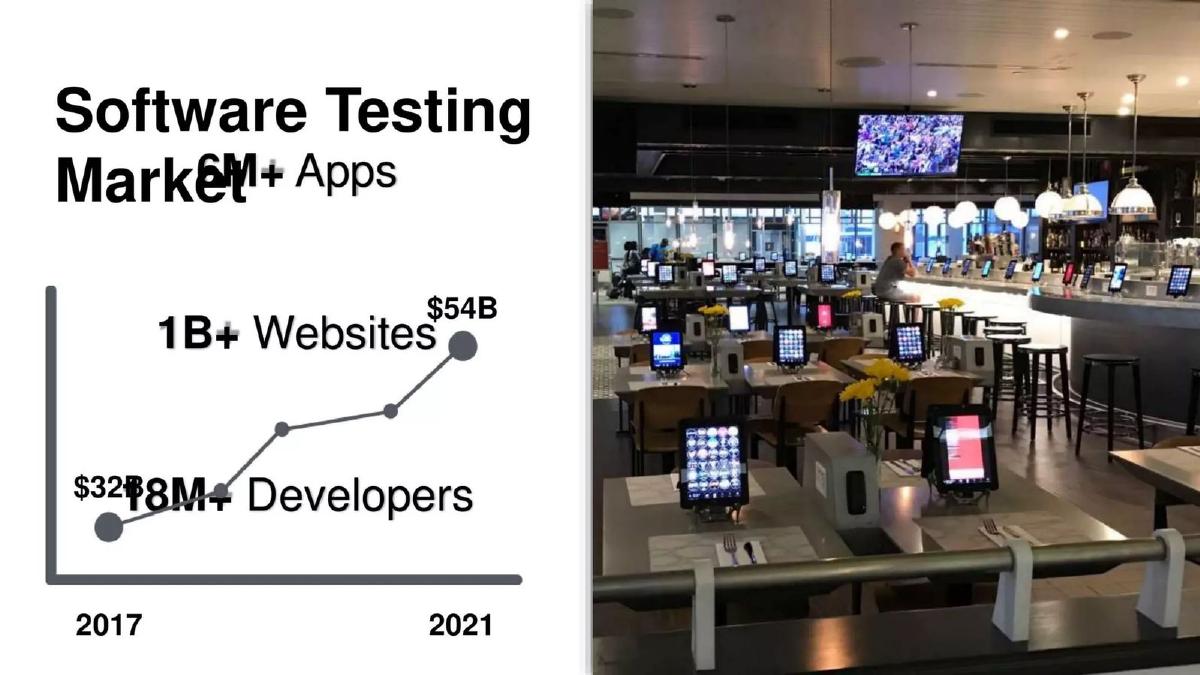
- The software testing market is projected to grow from $32B in 2017 to $54B in 2021, driven by 1B+ websites and 6M+ apps (Slide 2).
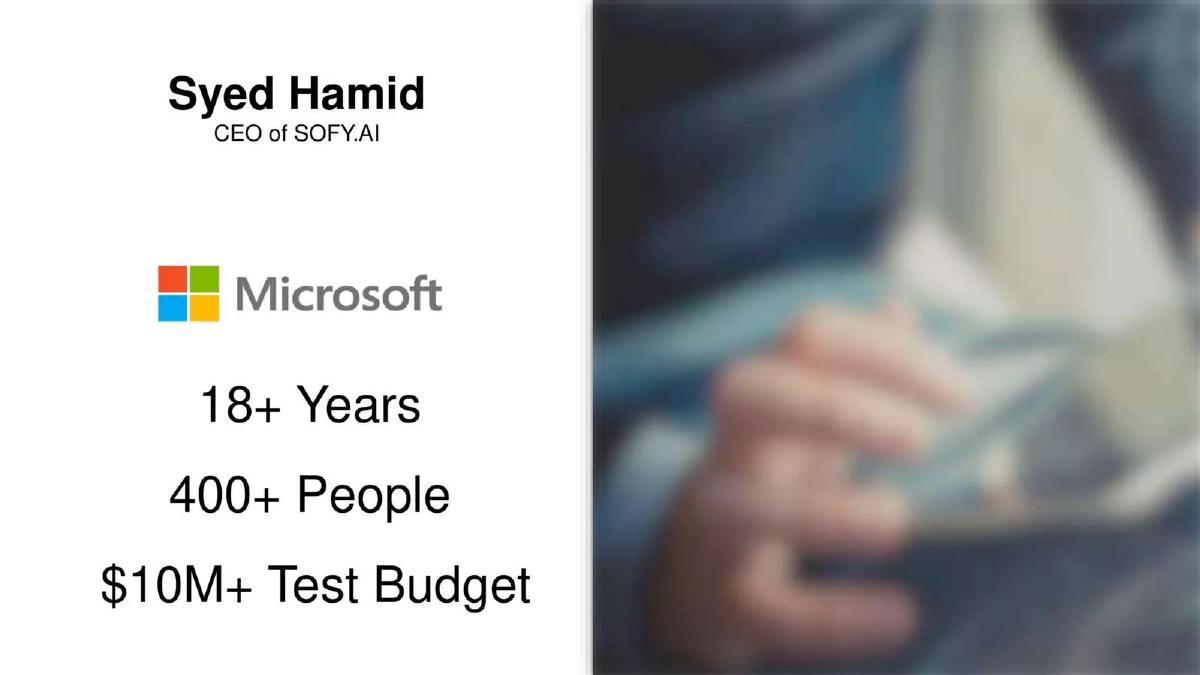
- CEO Syed Hamid brings significant domain authority, having spent 18+ years at Microsoft managing 400+ people and a $10M+ test budget (Slide 5).
- The product is positioned as a 'Trainable BOT for software teams,' emphasizing a shift away from manual labor (Slide 6).
- Sofy.ai claims to deliver 5x faster testing and 10x cost savings, specifically citing a use case with Microsoft Office 365 (Slide 10).
- The platform had achieved early traction with 8,000+ developers and 200 companies (Slide 11).
- Early revenue was reported at $100K, demonstrating a validated willingness to pay (Slide 11).
- The deck lacks a formal 'Ask' slide, omitting the specific funding amount or use of proceeds within the visual presentation.
- Competitive landscape and detailed unit economics are entirely absent from the 12-slide deck.
The Narrative of Domain Authority
The Sofy.ai pitch deck is an exercise in restraint. In an industry—software testing—that is often bogged down by technical jargon and complex architectural diagrams, Sofy.ai chooses a high-level, almost consumer-like aesthetic. The deck is 12 slides long, and many of those slides contain fewer than ten words. This approach suggests a high level of confidence in the 'Problem' and the 'Founder.' By the time an investor reaches the traction slide, the deck has already established that the market is huge and the person leading the charge is a global expert in the field.
Slides 1-2: Market Opportunity and Scale
Slide 1 is a standard title slide featuring the Sofy.ai logo, the CEO's email, and links to their AngelList and website. The background is a blurred image of what appears to be a device testing lab, setting the scene for the hardware-software intersection the company occupies.
Slide 2 dives immediately into the market size. It presents a growth chart showing the 'Software Testing Market' rising from $32B in 2017 to $54B in 2021. To provide context for this spending, the slide lists '6M+ Apps,' '1B+ Websites,' and '18M+ Developers.' This slide does the heavy lifting of proving that the 'Total Addressable Market' (TAM) is not just large, but expanding rapidly alongside the digital economy.
Slides 3-5: The Problem and the Pedigree
Slide 3 and Slide 4 are minimalist 'Problem' slides. Slide 3 shows a hand interacting with a mobile device with the text 'Manual Testing.' Slide 4 shows a laptop screen full of code with the text 'Testing Tools.' Together, these slides represent the two ends of the current, flawed spectrum: slow, expensive manual labor versus complex, code-heavy automation tools that require specialized engineering talent.
Slide 5 is arguably the most important slide in the deck. It introduces Syed Hamid, CEO of SOFY.AI. Instead of a standard bio, it uses four powerful bullet points: 'Microsoft,' '18+ Years,' '400+ People,' and '$10M+ Test Budget.' This slide establishes 'Founder-Market Fit' instantly. It tells the investor that the person building this solution has lived the problem at the highest possible level (Microsoft) and has managed the exact budgets that Sofy.ai intends to capture.
Slides 6-9: The Solution and Product Vision
Slide 6 introduces the 'Solution' as a 'Trainable BOT for software teams.' This is a strategic choice of words; 'BOT' implies automation and intelligence, while 'Trainable' suggests a no-code interface where manual testers can 'teach' the bot without writing scripts.
Slides 7, 8, and 9 use a progressive reveal format to explain the product's three pillars: 1. Part of Your Team , 2. Deep Learning , and 3. Actionable Feedback .
Slide 7 shows a blurred image of a team working together. · Slide 8 replaces the image with a neural network brain graphic to emphasize the 'Deep Learning' aspect. · Slide 9 shows the actual mobile interface of Sofy.ai on two iPhones. The UI displays clear, actionable items like 'App Crash,' 'CPU Usage Too High,' and 'UI Too Slow,' alongside performance graphs. This transition from abstract concepts to a concrete UI helps investors visualize the 'Actionable Feedback' promise.
Slides 10-12: Proof Points and Traction
Slide 10 provides the 'Value Proposition' through a case study. It features the Microsoft Office 365 logo and claims the platform is '5X FASTER' and provides '10X SAVINGS.' Using a brand as recognizable as Office 365 as a primary case study serves as a massive validation of the technology's enterprise-readiness.
Slide 11 is the 'Traction' slide. It uses three simple icons to report:
For a Seed-stage company in 2015, these numbers represented a strong start, particularly the developer count, which suggests a successful 'land and expand' or community-led growth strategy.
Slide 12 is a repeat of the title slide, serving as a contact page for the end of the presentation.
What Works in the Sofy.ai Deck
The most successful element of this deck is its clarity of purpose . It doesn't try to explain the underlying machine learning algorithms or the specifics of the CI/CD integration. Instead, it focuses on the economic outcome for the customer. By stating '10X Savings' and '5X Faster,' the founders speak the language of the CFO and the VP of Engineering simultaneously.
Furthermore, the Founder-Market Fit is presented with surgical precision. Slide 5 is a masterclass in how to present a resume to an investor. It doesn't list degrees or hobbies; it lists the specific metrics (years, people managed, budget size) that prove the founder understands the enterprise pain point better than anyone else.
What is Missing from the Sofy.ai Deck
While the deck is effective, it leaves several critical questions unanswered for a sophisticated investor:
The Competitive Landscape: There is no mention of existing players like Appium, Selenium, or newer AI-testing competitors. Investors need to know why Sofy.ai will win against incumbents. · The Technology Deep-Dive: For a product claiming to use 'Deep Learning' in 2015, a slide explaining the data moat or how the bot actually 'learns' would have added technical credibility. · The Business Model: The deck mentions $100K in revenue but doesn't explain the pricing structure. Is it per device, per test, or a flat SaaS fee? · The Ask: The deck completely omits how much money they are looking to raise and what they plan to do with it. While this might have been handled in the verbal pitch, its absence in the deck makes the presentation feel like a product teaser rather than a full investment proposal. · The Full Team: Only the CEO is highlighted. Investors generally prefer to see a balanced founding team (e.g., a CTO or Head of Product) to ensure there isn't a single point of failure.
What Other Founders Should Copy
Founders should emulate the visual hierarchy used here. Notice how the most important numbers (Slide 2, Slide 5, Slide 11) are the largest elements on the page. There is no squinting required to find the traction or the market size.
The progressive reveal of the product pillars (Slides 7-9) is also a smart tactic. It keeps the audience focused on one concept at a time rather than overwhelming them with a single slide containing three paragraphs of text. Finally, the use of high-authority logos (Microsoft, Office 365) creates a 'halo effect' that makes the startup appear more established and reliable than its 'Seed' stage might suggest. If you have a pilot with a major brand, make it a focal point of your deck, just as Sofy.ai did on Slide 10.
Frequently asked questions
- How much did Sofy.ai raise with this deck?
- According to catalogue facts, Sofy.ai raised a total of $7,800,000. While the deck itself does not state the 'Ask' on any of its 12 slides, the narrative was sufficient to secure significant Seed-stage capital.
- What is the core value proposition of Sofy.ai?
- The core value proposition is efficiency and cost reduction in software testing. Slide 10 explicitly highlights that the platform is '5X Faster' and provides '10X Savings,' using Microsoft Office 365 as a proof point for these metrics.
- Who is the target user for Sofy.ai?
- The deck targets software developers and enterprise teams. Slide 11 shows they had already reached over 8,000 developers and 200 companies, suggesting a bottom-up adoption strategy combined with enterprise utility.
- How does the deck handle the 'Problem' section?
- The deck uses a visual contrast method. Slides 3 and 4 highlight 'Manual Testing' and 'Testing Tools' (which typically require heavy coding) as the legacy hurdles that Sofy.ai's no-code, AI-driven bot is designed to overcome.
- Is there a team slide in the Sofy.ai deck?
- There is a founder-focused slide (Slide 5) for CEO Syed Hamid, but the deck does not include a traditional multi-person team slide or an advisory board slide. It relies heavily on Hamid's personal pedigree at Microsoft.