Soldo’s 10-slide deck, dated April 2021, functions more as a narrative framework than a data-heavy investor presentation. At the Series C stage, the company moves beyond simple expense tracking to position itself as a 'cloud native payment and software platform.' The deck relies heavily on conceptual diagrams—such as the 'Islands of Management, Payments, and Accounting'—to illustrate the systemic fragmentation in corporate finance. While it successfully establishes a mission to 'liberate businesses from spending chaos,' the deck is notably devoid of the hard metrics typically expected at this…
Key takeaways
- The company positions itself as a cloud-native platform rather than just a tool, as stated on Slide 2.
- Soldo identifies a massive total addressable market by mapping 16 different spend categories, from payroll to online advertising, on Slide 3.
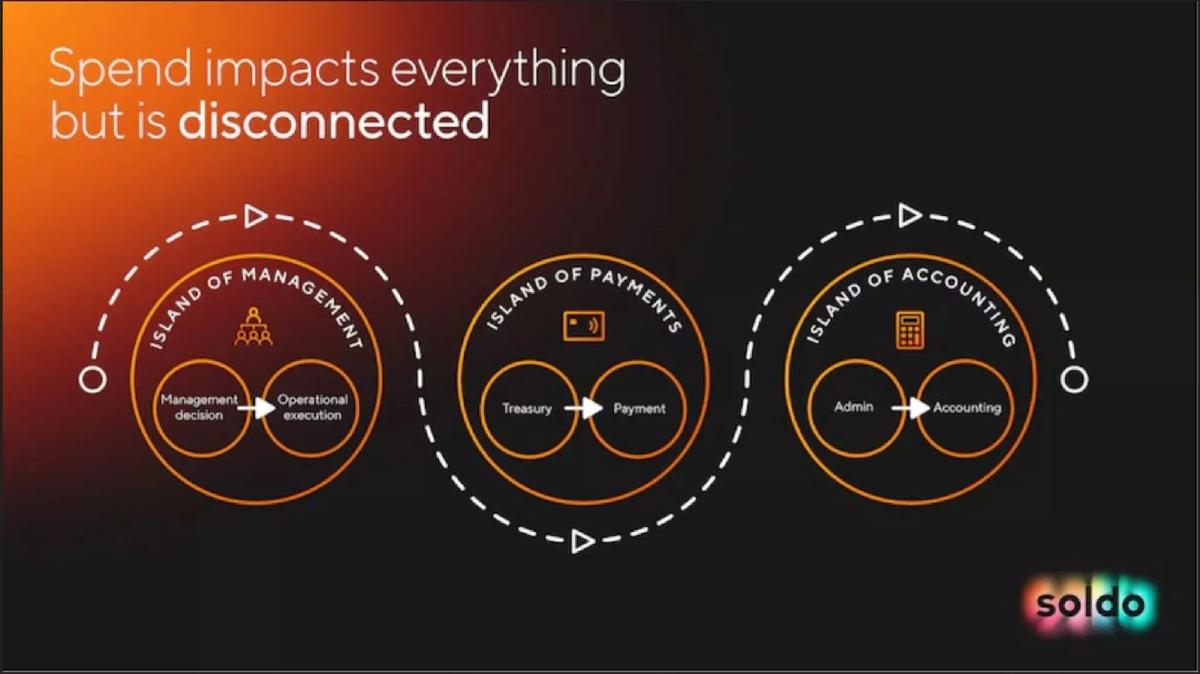
- The core problem is defined as 'disconnected' spend across three distinct silos: Management, Payments, and Accounting (Slide 4).
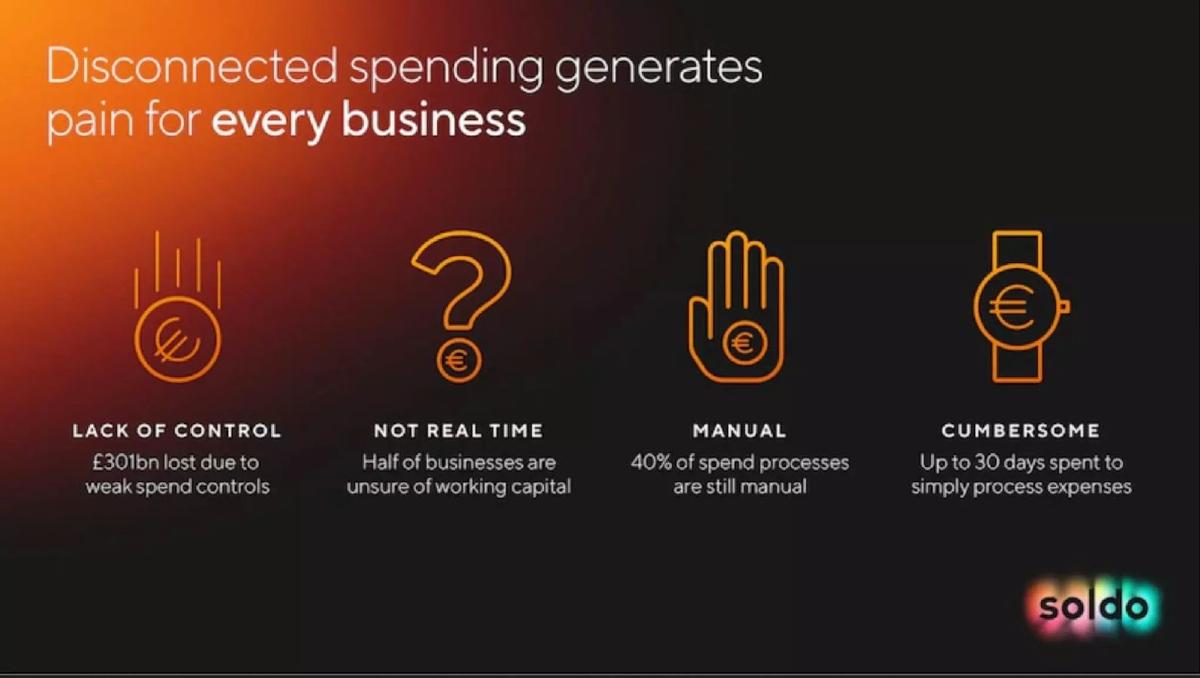
- The deck cites a specific figure of £301bn lost due to weak spend controls to quantify the lack of control (Slide 5).
- Operational inefficiency is highlighted by the fact that 40% of spend processes remain manual (Slide 5).
- The platform's technical moat is described as running their own 'banking' platform and having full control of the tech stack (Slide 9).
- The deck omits all financial performance data, team biographies, and the specific investment 'ask' (Slides 1-10).
- Secular trends like the shift toward digital payments and increased focus on cost control are used to provide market tailwinds (Slide 7).
The Narrative of Infrastructure: Soldo's Series C Approach
The Soldo management presentation from April 2021 is a concise, 10-slide deck that prioritizes high-level strategy over granular data. For a company at the Series C stage, the goal of such a deck is often to align potential investors on the 'macro' vision before diving into the 'micro' data of the due diligence room. Soldo positions itself not as a utility, but as a fundamental piece of financial infrastructure.
Slide 1: Title Slide
The deck opens with a minimalist title slide: "Management Presentation" dated "April 2021" . The branding is prominent, featuring the Soldo logo with its characteristic multi-colored glow. This sets a professional, corporate tone suitable for late-stage discussions.
Slide 2: The Value Proposition
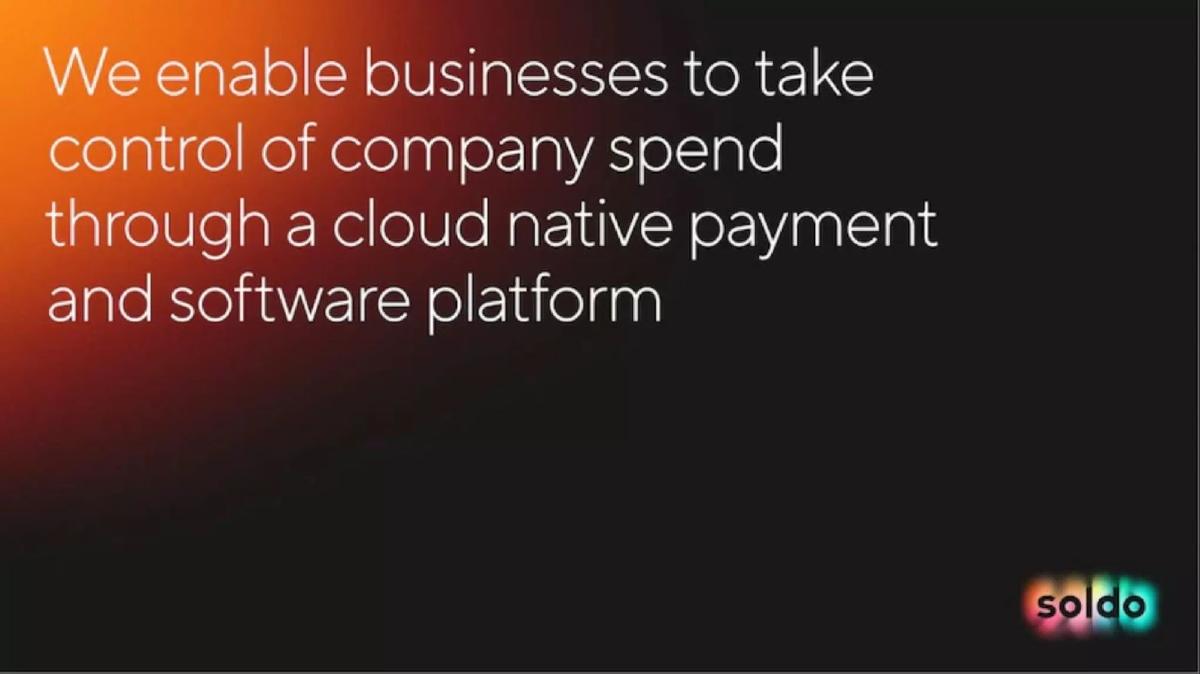
Slide 2 delivers a single, clear mission statement: "We enable businesses to take control of company spend through a cloud native payment and software platform." By combining "payment" and "software" into one phrase, Soldo immediately signals that they are more than just a SaaS dashboard; they are involved in the actual flow of funds.
Slide 3: The Universe of Spend
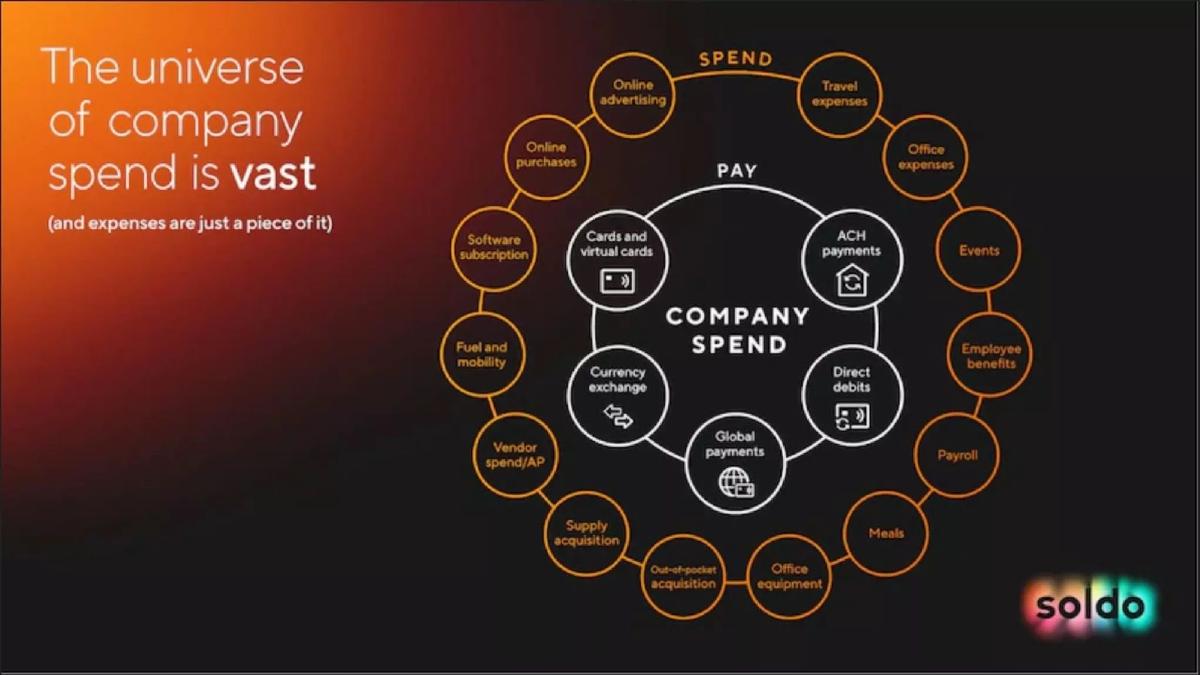
This slide uses a circular diagram to visualize the "universe of company spend." It lists 16 distinct nodes including "Online advertising," "Software subscription," "Fuel and mobility," "Payroll," and "Employee benefits." The subtitle, "(and expenses are just a piece of it)," is a strategic move to expand their perceived Total Addressable Market (TAM). It tells investors that Soldo isn't just competing for travel and entertainment (T&E) receipts; they are targeting the entire corporate outflow.
Slide 4: The Disconnected Islands
Slide 4 introduces the core friction point: "Spend impacts everything but is disconnected." The visual depicts three "Islands": "Island of Management," "Island of Payments," and "Island of Accounting." This diagram illustrates the lack of communication between management decisions, treasury execution, and accounting reconciliation. It frames the current market state as a series of broken loops.
Slide 5: Quantifying the Pain
Soldo moves from conceptual problems to quantified pain points on Slide 5. They cite four major issues:
Lack of Control: £301bn lost due to weak spend controls. · Not Real Time: Half of businesses are unsure of working capital. · Manual: 40% of spend processes are still manual. · Cumbersome: Up to 30 days spent to simply process expenses.
These figures provide the economic justification for the platform's existence.
Slide 6: The Mission
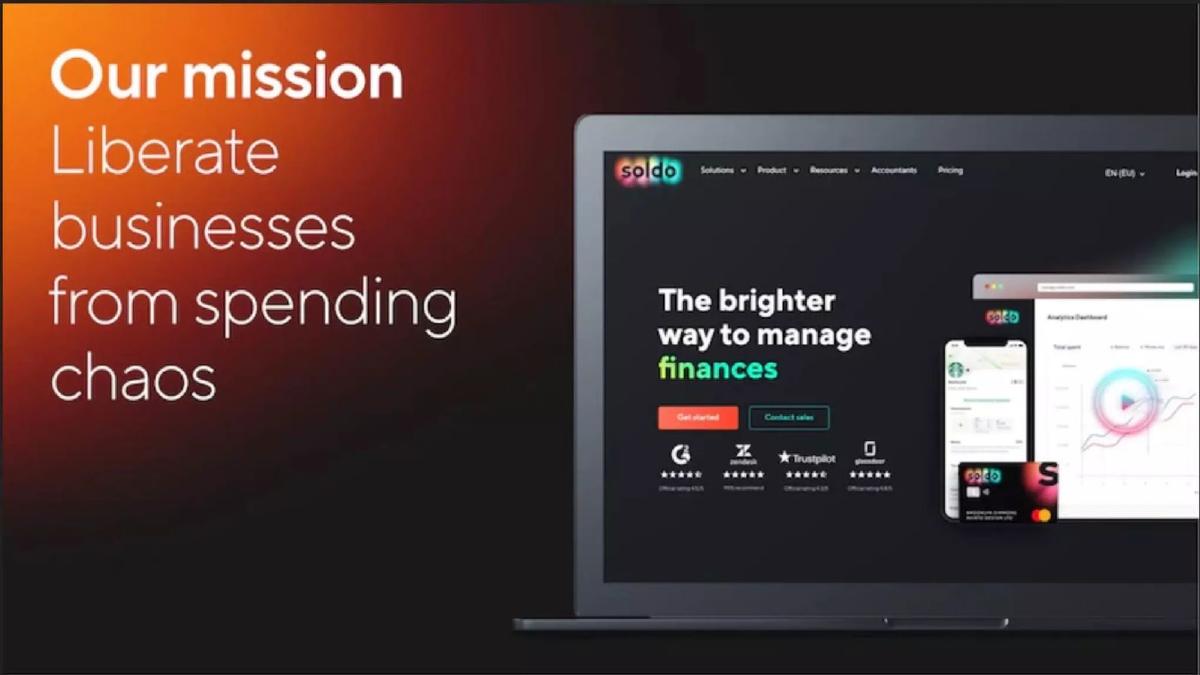
"Our mission: Liberate businesses from spending chaos." Slide 6 features a product mockup showing the Soldo web interface, mobile app, and physical Mastercard. It also displays social proof through logos and ratings from G2, Zendesk, Trustpilot, and Glassdoor . This is the first time the actual product UI is shown, grounding the previous abstract concepts in a tangible tool.
Slide 7: Secular Trends
To explain why now is the time for Soldo to scale, Slide 7 points to "powerful secular trends." These include:
Cloud and Fintech raising customer expectations. · Increasing focus on cost control. · Accelerating shift toward digital payments.
These trends suggest that Soldo is riding a wave of inevitable market evolution rather than trying to force a new behavior.
Slide 8: The Automation Platform
Slide 8 reinforces the product's scope, stating, "We have built an End to End Pay and Spend Automation Platform." The visuals show a collage of the interface, highlighting features like "Company wallets," "Latest transactions," and "Product Department" groupings. It emphasizes the "End to End" nature of the solution, connecting back to the "Islands" mentioned on Slide 4.
Slide 9: Distinctive Capabilities
This is perhaps the most important slide for a Series C investor. It outlines the technical moat through three points:
A: One single solution for all company spend. · B: Full control of Fintech and SaaS technology stack. · C: Running our own "banking" platform.
By claiming to run their own banking platform, Soldo differentiates itself from "wrapper" startups that rely entirely on third-party BaaS (Banking-as-a-Service) providers. This implies better margins, more control over the user experience, and higher barriers to entry for competitors.
Slide 10: Closing
The deck ends on a simple logo slide. There is no contact information, no "thank you," and no specific call to action or funding amount requested. This is typical of a management presentation used as a visual aid during a live pitch rather than a standalone document sent via email.
What Works in This Deck
Strong Narrative Arc: The deck follows a logical progression: Market Size (Slide 3) -> The Problem (Slide 4) -> Economic Impact (Slide 5) -> The Solution (Slide 6) -> Technical Moat (Slide 9). It tells a story of fragmentation being solved by integration.
Visual Clarity: The use of the "Islands" metaphor is an effective way to communicate a complex enterprise problem. It makes the abstract concept of "financial silos" immediately understandable to an investor.
Strategic Positioning: By explicitly mentioning that they run their own banking platform, Soldo moves itself out of the crowded "expense app" category and into the more valuable "fintech infrastructure" category.
What Is Missing From This Deck
Financial Performance: There is a total absence of company-specific data. Investors at the Series C level require detailed looks at ARR, Net Revenue Retention (NRR), and Gross Merchandise Volume (GMV). None of these are present.
Competitive Landscape: The deck does not mention competitors like Revolut Business, Pleo, or Spendesk. In a highly competitive FinTech sub-sector, failing to address how Soldo wins against specific rivals is a significant omission for a standalone deck.
Team: There is no slide dedicated to the founders or the executive leadership team. While Soldo's leadership may be well-known in the European FinTech scene, a pitch deck usually benefits from highlighting the pedigree of the people executing the vision.
The Ask: The deck does not state how much capital is being raised or how that capital will be deployed (e.g., geographic expansion, R&D, sales hiring).
What a Founder Should Copy
The "Universe of Spend" Visual: Founders should copy the way Soldo expands their market definition. Instead of saying "we do expenses," they show 16 different types of spend, making the opportunity look much larger than a single software category.
The Silo Identification: Identifying the "Islands" of a customer's workflow is a great way to build empathy for the user's pain. If you can visualize the customer's current fragmented process, your solution's value becomes self-evident.
Focus on Infrastructure: If your startup has built its own core technology (like Soldo's banking platform) rather than just white-labeling someone else's, make that a centerpiece of your "capabilities" slide. It is the strongest argument for a long-term competitive advantage.
Frequently asked questions
- What stage of funding was this deck used for?
- According to the catalogue listing, this deck was associated with Soldo's Series C round. The presentation itself is titled 'Management Presentation' and is dated April 2021. At this stage, investors typically look for scale and infrastructure, which explains the deck's focus on its proprietary 'banking' platform and end-to-end automation rather than early-stage product-market fit.
- Does the deck include any financial metrics or KPIs?
- No. The 10 slides provided contain zero internal company metrics. There is no mention of Annual Recurring Revenue (ARR), number of customers, transaction volume, or growth rates. It uses external market data—such as the £301bn lost to weak controls—to justify the problem, but it does not disclose Soldo's specific performance data within the slides.
- How does Soldo differentiate itself from other expense management tools?
- Soldo differentiates through vertical integration. On Slide 9, it highlights three 'distinctive capabilities': being a single solution for all spend, having full control of the Fintech/SaaS stack, and running its own 'banking' platform. This suggests they are not just a software layer on top of another bank, but a primary infrastructure provider.
- What is the primary 'problem' Soldo claims to solve?
- The deck identifies 'spending chaos' caused by fragmentation. Slide 4 illustrates this through 'Islands' of Management, Payments, and Accounting. The argument is that because these functions don't talk to each other, businesses suffer from a lack of real-time visibility and spend up to 30 days simply processing expenses (Slide 5).
- Is there a team slide in the Soldo deck?
- No, there is no team slide in this 10-slide deck. For a Series C company, the leadership team is usually well-known or detailed in supplemental documentation. However, its absence in this specific presentation means the focus remains entirely on the market problem and the platform's architectural solution.