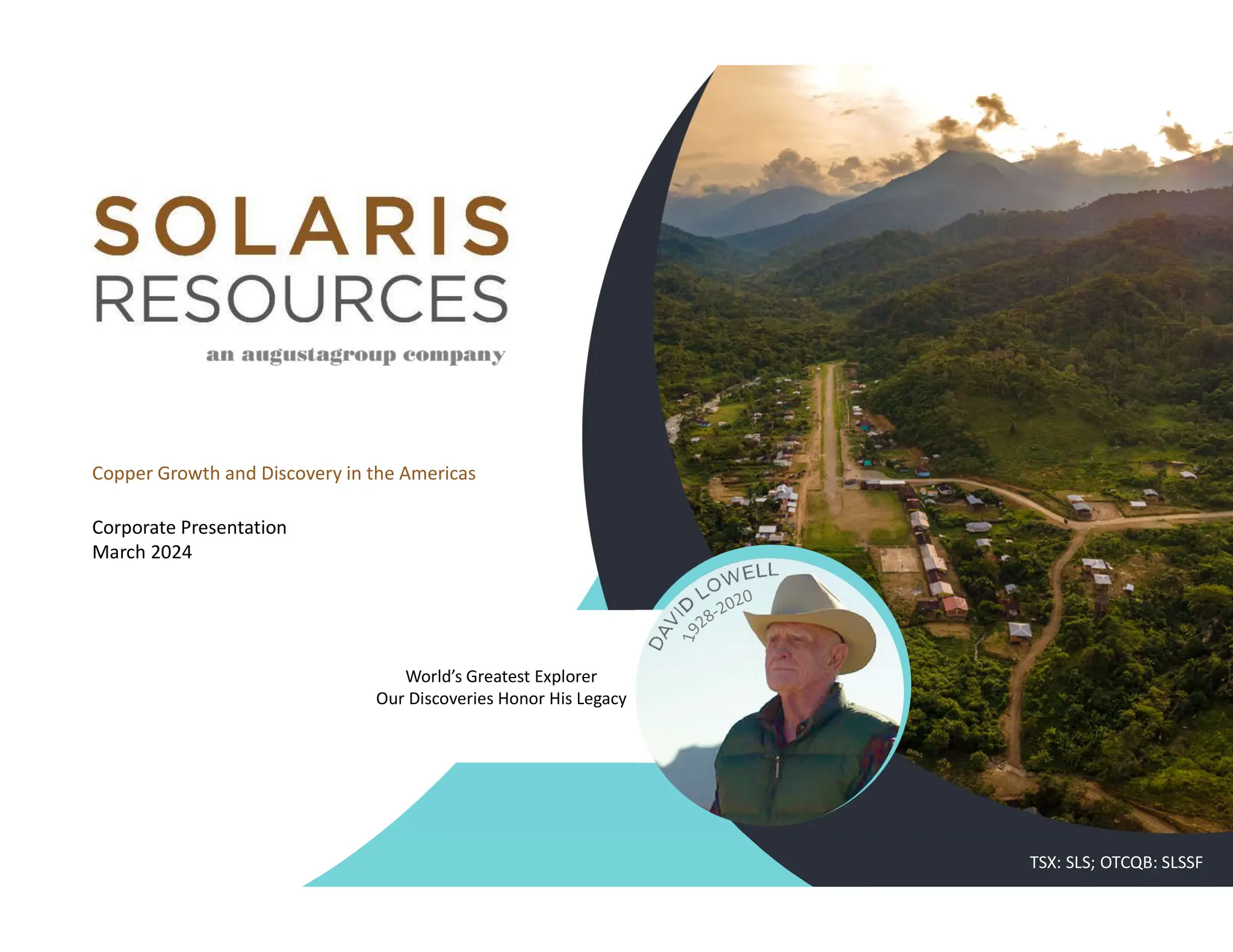
Solaris Resources, an Augusta Group company, utilizes this 29-slide presentation to position itself as a premier copper explorer in the Americas. The deck heavily leans on the 'Augusta Group' track record, citing $4.5B in historical exit transactions across companies like Ventana Gold and Arizona Mining (Slide 4). The primary focus is the Warintza Project in Ecuador, which the company claims benefits from low-cost hydropower and existing infrastructure compared to peers in Peru and Chile (Slide 13). While the deck provides extensive geological data and community engagement success stories, it…
Key takeaways
- The management group claims a track record of over $4.5B in exit transactions, including the $2.1B sale of Arizona Mining in 2018 (Slide 4).
- Solaris highlights a 'New Model for Ecuador' based on a strategic alliance with the Shuar Nations, aiming to de-risk the Warintza Project through social acceptance (Slide 10).
- The Warintza Project is positioned as a low-cost leader, with capital intensity significantly lower than projects in Chile or the USA due to low-cost hydropower and elevation (Slide 13).
- A Mineral Resource Estimate (MRE) update for the Warintza Cluster is scheduled for Q2 2024, serving as a primary near-term catalyst (Slide 19).
- The company is expanding its footprint into Peru with options to earn up to 75% in the Capricho and Paco Orco projects (Slide 22).
- Macro justification for copper exploration is built on a 'dearth of discoveries,' noting only 4.1 Mt of copper discovered in the past 5 years compared to 70.6 Mt between 2013-2017 (Slide 25).
- The deck argues that EV sales growth remains robust, projecting 16.7 million units in 2024, to support long-term copper demand (Slide 28).
- Solaris plans a strategic spin-out of 'Solaris Exploration' to preserve value for shareholders (Slide 19).
Solaris Resources: A Masterclass in Pedigree-Driven Resource Exploration
The March 2024 corporate presentation for Solaris Resources (TSX: SLS) is a sophisticated example of how a publicly-traded exploration company communicates value to institutional and retail investors. Unlike a tech startup deck that focuses on user growth or ARR, this deck focuses on geological potential, infrastructure advantages, and, most importantly, the 'Augusta Group' pedigree. The narrative is built on the premise that the team has done this before and is currently sitting on a world-class copper deposit in a jurisdiction (Ecuador) that is becoming increasingly mining-friendly.
Slide 1: The Legacy of David Lowell
The cover slide sets a somber but prestigious tone by honoring David Lowell (1928-2020), described as the "World's Greatest Explorer." By associating the company's discoveries with Lowell's legacy, Solaris immediately establishes geological credibility. The subtitle "Copper Growth and Discovery in the Americas" clearly defines the sector and geographic focus.
Slide 4: The Augusta Group Track Record
This is arguably the most important slide for establishing investor confidence. It details the "Track Record of Value Creation" by the Augusta Group. It lists four major successes: Ventana Gold Corp (sold for $1.6B, 12,960% return), Augusta Resource Corporation (sold for $667M, 3,300% return), Arizona Mining (sold for $2.1B, 6,100% return), and Equinox Gold (co-founded in 2017, >$2.0B market cap). By citing over $4.5B in exit transactions, the company shifts the conversation from "if" they can succeed to "when" the next exit will occur.
Slide 7: Leadership and Strategic Partners
The leadership slide reinforces the pedigree mentioned on Slide 4. It lists the executive team and board, specifically highlighting their roles in the previously mentioned exits. A notable addition is the mention of the Lundin Group as a strategic partner. The Lundin Group is a legendary name in mining, and their inclusion—alongside their own record of $7.1B and $3.3B transactions—serves as a powerful secondary endorsement of Solaris.
Slide 10: The Social License to Operate
Mining in South America often faces significant social and environmental opposition. Solaris addresses this head-on with the "Warintza Success Story." The slide outlines an "inclusive development model" based on a Strategic Alliance with the Shuar Nations. It features quotes from local officials like Vinicio Cóndor (Governor of Morona Santiago) and Froilan Juank (President of Yawi Center). This slide is designed to de-risk the project in the eyes of investors who fear political or social instability.
Slide 13: Infrastructure and Cost Advantages
This slide provides a technical comparison of the Warintza Project against other regional copper projects. It highlights that Warintza is 100% owned, has access to a highway, and is adjacent to a grid power source (the Santiago Hydroelectric Project). The bar chart compares "Capital Intensity" ($/tpa CuEq), showing that Ecuador (specifically Warintza) has significantly lower costs (>$11,000) compared to Peru (>$25,000), Chile (>$34,000), and the USA (>$35,000). The slide attributes this to low elevation, low-cost labor, and low-cost hydropower.
Slide 16: District Potential and Geological Upside
Slide 16 focuses on the "Warintza Cluster." It provides a map of the 2022 Mineral Resource Estimate (MRE) and outlines the targets for the 2024 MRE update. The slide lists specific discovery intercepts, such as 686m of 0.46% CuEq at Warintza West. This slide is intended for technical analysts, demonstrating that the project is not just a single deposit but a cluster of integrated targets with significant growth potential.
Slide 19: The Roadmap of Catalysts
Every investor presentation needs a timeline. Solaris provides a clear list of catalysts for 2024 and 2025. These include:
Resource Drilling Complete (Q1/24) · Mineral Resource Estimate Update (Q2/24) · EIA Completion (H2/24) · PFS Completion (2025) · Expected Spin-out of Solaris Exploration
This slide gives investors specific dates to watch, which helps drive liquidity and interest around those milestones.
Slide 22: Expansion into Peru
While Warintza is the flagship, Solaris shows it is not a one-trick pony. Slide 22 introduces the Capricho and Paco Orco projects in Peru. Solaris has the option to earn up to 75% in these projects. The slide uses photos of outcropping mineralization and surface samples (up to 3% Cu at Capricho) to suggest that the company's exploration success could be replicated in the world's second-largest copper-producing nation.
Slide 25: The Macro Case for Copper
This slide addresses the "Why now?" question. It shows a chart from S&P Global Market Intelligence illustrating a "Dearth of Discoveries." It notes that only 4.1 Mt of copper has been discovered in the past 5 years, a massive decline from the 70.6 Mt discovered between 2013-2017. By showing that exploration budgets are staying steady while discoveries are falling, Solaris positions its existing, proven resource as an increasingly rare and valuable asset.
Slide 28: The EV Demand Narrative
The final technical slide tackles the skepticism surrounding the electric vehicle (EV) market. It argues that the "EV Sales Slowing Narrative" is misleading, citing a 21% projected increase in sales for 2024. It also mentions falling battery prices and technological advancements (like the CATL Qilin battery). This slide links the success of the mining project directly to the global energy transition, ensuring the project feels relevant to modern ESG-focused portfolios.
What Works in This Deck
1. Pedigree as a Proxy for Risk Mitigation: The deck spends a significant amount of time on the Augusta Group and Lundin Group. In high-risk exploration, the "who" is often more important than the "what." By showing billions in past exits, they prove they know how to take a project from discovery to sale.
2. Comparative Economics: Slide 13 is a standout. Instead of just saying their project is good, they show exactly why it is cheaper to build than projects in Chile or the USA. Using specific dollar figures for capital intensity makes the argument tangible.
3. Addressing the Elephant in the Room: Many investors are wary of Ecuador. By dedicating an entire slide to the Shuar Nations and local government support, Solaris proactively answers the most likely objection regarding social license and political risk.
What Is Missing
1. The Financial Ask: As a public company presentation, this deck does not have a "we are raising $X" slide. While this is standard for TSX-listed companies, a private investor would want to see the current cash position and burn rate to understand how much runway the company has before the next dilutive event.
2. Detailed Unit Economics: While capital intensity is mentioned, the deck lacks a detailed breakdown of projected OpEx (Operating Expenses). We see the "low-cost hydropower" argument, but not the projected cash cost per pound of copper produced.
3. Competitor Landscape: The deck compares Warintza to general country averages but does not name specific competing projects or companies currently exploring in the same region of Ecuador. This would help investors understand where Solaris sits in the local pecking order.
What Other Founders Should Copy
1. The 'Catalyst' Slide: Every founder should have a slide like Slide 19. It tells the investor exactly what to expect over the next 12-18 months. It turns a vague "we are growing" statement into a series of measurable hurdles.
2. Visualizing the Macro: Slide 25 is a perfect example of how to use industry-wide data to make your specific company feel like a necessity. By showing that the industry is failing to find new copper, Solaris makes their own discovery look like a lifeboat in a storm.
3. Social Proof via Testimonials: If your business relies on a specific community or partnership, don't just say they like you. Use photos and direct quotes from the leaders of those communities, as Solaris did on Slide 10. It is much harder to argue with a named official than a bullet point.
Frequently asked questions
- What is the primary asset discussed in the Solaris Resources deck?
- The primary asset is the Warintza Project in Ecuador. It is a 268-square-kilometer property that is 100% owned by Solaris. The deck emphasizes its location 40km north of the Mirador mine and its access to low-cost hydropower and highway infrastructure, which Solaris claims gives it a competitive advantage over higher-elevation projects in the Andes.
- Who are the key people behind Solaris Resources?
- The company is led by Executive Chairman Richard Warke and President & CEO Daniel Earle. Warke is highlighted for his involvement in several multi-billion dollar mining exits. The leadership team also includes Javier Toro as COO and Federico Velasquez as President of Latin America, drawing experience from majors like Anglo American and Newmont.
- How does Solaris address the social risks of mining in Ecuador?
- Solaris dedicates Slide 10 to its 'Responsible Mining' model. It highlights a 'Strategic Alliance' governed by a Board of Directors from host Shuar Centres. The slide includes testimonials from local governors and indigenous leaders to demonstrate community support and legal compliance, aiming to contrast their approach with 'foreign NGOs' that oppose the project.
- What are the upcoming milestones for the company?
- According to Slide 19, the key catalysts include a Mineral Resource Estimate (MRE) update in Q2 2024, the completion of an Environmental Impact Assessment (EIA) in H2 2024, and a Pre-Feasibility Study (PFS) completion in 2025. There is also an expected spin-out of Solaris Exploration to separate earlier-stage assets from the core Warintza project.
- What is the macro-economic argument for investing in copper right now?
- Solaris argues that the global copper pipeline is empty due to a lack of major discoveries over the last decade. Slide 25 shows a massive drop-off in discovered copper tonnage despite steady exploration budgets. Furthermore, Slide 28 counters the narrative that EV sales are slowing, suggesting that the transition to green energy will continue to drive aggressive copper demand.