SolChicks presents a case for a second-generation play-to-earn (P2E) game built on the Solana blockchain. The deck identifies a specific market gap: while early P2E games like Axie Infinity saw massive user growth, their revenue primarily came from developing nations due to 'low entertainment quality.' SolChicks aims to bridge this by offering better graphics and gameplay to attract high-revenue markets like China, the US, and Japan. The deck highlights a massive partnership network of over 40 institutions and a detailed tokenomics structure, including a 36-month vesting schedule for ecosyste…
Key takeaways
- The company identifies Axie Infinity's 'low entertainment quality' as a barrier to high-revenue gaming markets (Slide 2).
- SolChicks positions itself within a relatively uncrowded Solana P2E ecosystem compared to the saturated Ethereum market (Slide 3).
- The game utilizes a dual-token/asset system involving SolCoins for in-game use and $CHICKS for governance and revenue rights (Slide 5).
- The project claims an extensive network of over 40 partners and investors, including Solana, Chainlink, and Magic Eden (Slide 6).
- The core team includes 13 listed members with backgrounds from McKinsey, Wharton, Bain Capital, and major game studios like Nexon and NCSoft (Slide 7).
- A structured vesting schedule is in place, with public presale participants receiving 25% at TGE and a 3-month linear vest (Slide 8).
- The team and game development allocations are subject to significant cliffs and long-term vesting periods of up to 36 months (Slide 8).
Executive Summary: The Push for 'Triple-A' Play-to-Earn
SolChicks enters the market during the height of the 2021 play-to-earn boom, but its pitch is built on a critique of the very sector it inhabits. The deck focuses heavily on the transition from 'earn-first' gaming to 'play-and-earn' gaming, where the quality of the product is meant to drive sustainable demand from high-spending markets. By building on Solana, the project seeks to bypass the high gas fees and congestion issues that plagued Ethereum-based games at the time.
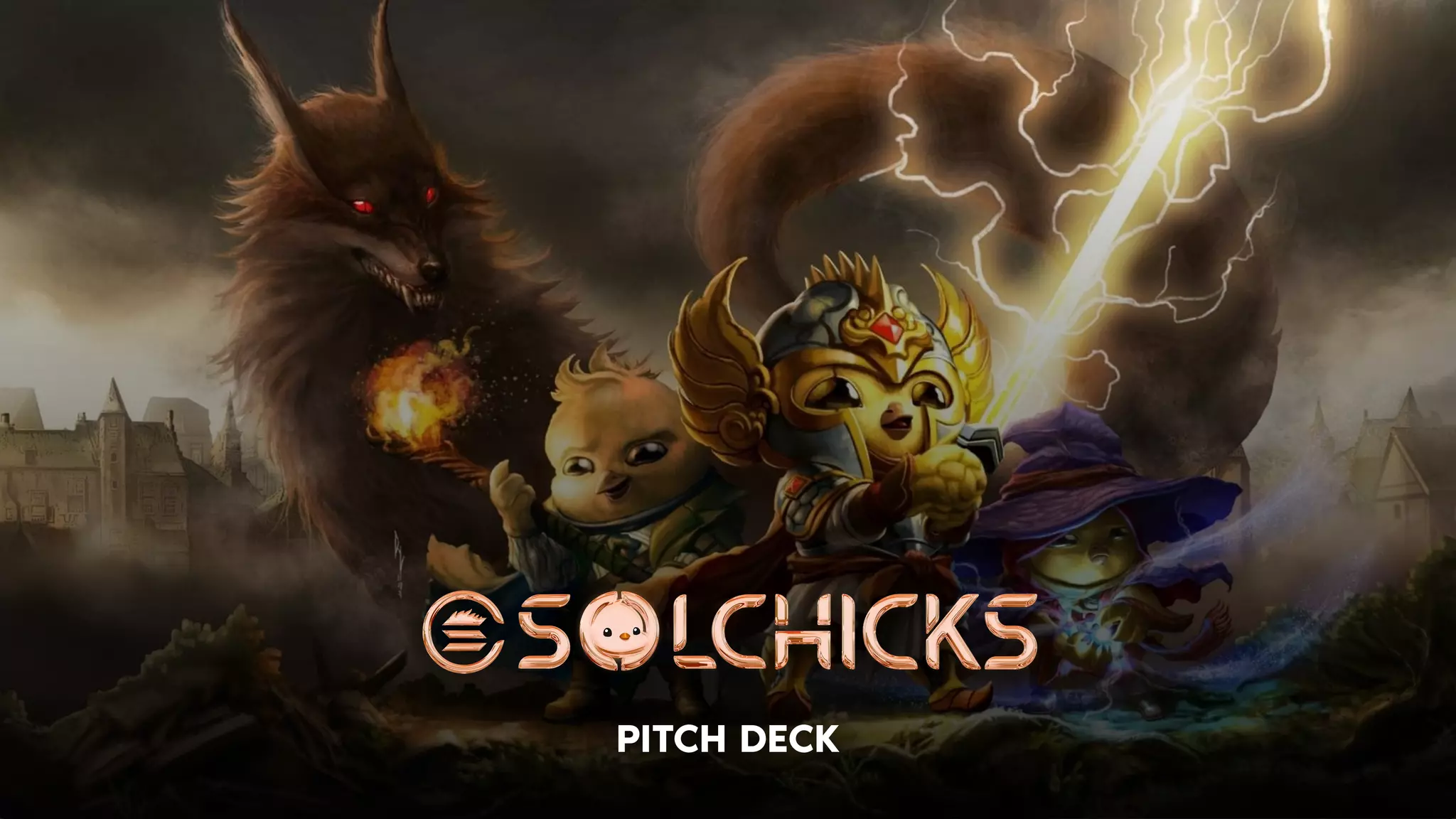
Slide 1: Title and Visual Identity
The cover slide establishes the game's aesthetic: a high-fantasy setting featuring the 'SolChicks' characters. The artwork is polished, featuring a central warrior chick flanked by a mage and a rogue, facing off against a large, menacing wolf character. This immediately signals a departure from the 2D, simplistic art styles common in early blockchain titles. The logo incorporates the Solana 'S' symbol, firmly rooting the brand in its chosen ecosystem.
Slide 2: The Market Opportunity and Critique of Axie Infinity
This is the 'Problem' slide, though it frames the problem as a market inefficiency. It explicitly names Axie Infinity, noting its 'phenomenal success' but criticizing its 'low entertainment quality.' The slide uses two bar charts to make a compelling point: Axie's top users are in the Philippines and Venezuela (developing markets), while the world's top gaming markets by revenue are China, the US, and Japan. The implication is that Axie has failed to capture the 'traditional user paying markets' because the game isn't fun enough. SolChicks positions itself as the solution to this quality gap.
Slide 3: Ecosystem Positioning
Slide 3 visualizes the competitive landscape by blockchain. It shows a massive cluster of logos under the Ethereum banner, including heavyweights like The Sandbox and CryptoKitties. In contrast, the Solana box is sparsely populated, containing only Star Atlas, Aurory, and Defi-Land. SolChicks is highlighted in a dashed red box. The message is clear: Ethereum is saturated and expensive, while Solana is an 'infant' ecosystem with high growth potential and less competition for dominant market share.
Slide 4: Lore and Narrative
This slide focuses on the 'SolChicks' backstory. It describes a peaceful race that fled a 'blockchain galaxy' to rebuild on Solana after an attack by the 'SolFox.' While lore is rarely a deciding factor for VCs, in the context of a gaming pitch, it demonstrates that the team is thinking about IP development and world-building, rather than just a financialized token loop. The text invites the player to 'bond with them, train them, and eventually fulfill your combined destinies.'
Slide 5: The Earning Mechanics
This slide breaks down the 'How Players Earn' component, which is critical for any P2E pitch. It identifies four pillars: 1. SolCoins: The in-game currency for utility. 2. $CHICKS Tokens: The governance token which also grants rights to game revenues, distributed via leaderboards. 3. In-game rewards: Tradable on external exchanges. 4. Breeding: A mechanic where players spend tokens to create new NFT characters to sell. This mirrors the successful (if controversial) economic loops of early P2E games but adds a layer of 'revenue rights' to the governance token.
Slide 6: Partnerships and Social Proof
This is a 'logo soup' slide, but it is exceptionally dense. It lists over 40 partners, including infrastructure providers (Solana, Chainlink), marketplaces (Magic Eden, Solanart), and a long list of venture funds (Solar Eco Fund, Blockchain Founders Fund, Kangaroo Capital). The sheer volume of logos is intended to overwhelm the reader with the sense that SolChicks is the 'consensus' bet for Solana gaming. It also mentions 'Key Opinion Leaders' (KOLs), indicating a heavy focus on crypto-native marketing.
Slide 7: The Core Team
The team slide is strong on pedigree. CEO William is noted as a Wharton and McKinsey alumnus. COO Lewis comes from Bain Capital and Houlihan Lokey. Crucially, the 'Head of Game Development' (David) and several directors (Ryan, Tony, Brian) are credited with experience at Nexon and NCSoft—two of the largest traditional gaming companies in Asia. This supports the slide 2 claim that the team has the expertise to build a 'high quality' game that can compete with traditional titles.
Slide 8: Tokenomics and Vesting
This slide provides a detailed vesting schedule, which is a standard requirement for crypto-fundraising. It shows a 36-month horizon. Notable data points include: Public Presale: 25% unlock at TGE, 3-month vest. Team: 0% at TGE, a 9-month cliff, and an 18-month linear vest. Ecosystem Rewards: A 36-month linear vest. The long vesting for the team and ecosystem rewards is designed to signal long-term commitment and prevent a 'rug pull' or immediate sell-off by the developers.
Slide 9: Closing and Contact
The deck ends with a simple logo and the website URL. There is no 'Ask' slide in this selection, though the source listing indicates a $20M figure. The omission of a specific 'Use of Funds' or 'Roadmap' slide in this 9-slide subset is notable, as these are usually critical for evaluating the execution plan.
What SolChicks Does Well
The deck is highly effective at identifying a specific, timely market gap. By criticizing the market leader (Axie Infinity) for its lack of 'fun,' SolChicks aligns itself with the growing sentiment in 2021 that P2E needed to evolve. The team slide is excellent; it balances 'suits' (McKinsey/Bain) with 'creatives' (Nexon/NCSoft), which is the ideal mix for a blockchain gaming project. The partnership slide provides massive social proof, suggesting that the project has already cleared the due diligence hurdles of dozens of other investors.
What is Missing from the Deck
The most glaring omission is a detailed roadmap. While the lore and team are well-defined, there is no timeline for the Alpha, Beta, or full launch of the game. Furthermore, there are no unit economics for the game's internal economy. P2E games live or die by their inflation rates and sink/source balance; the deck mentions breeding and earning but doesn't explain how they will prevent the hyper-inflation that eventually crippled Axie Infinity. Finally, the 'Ask' is missing—we don't know the valuation, the specific amount being raised in this round, or how that $20M will be allocated between development, marketing, and liquidity.
Founder's Guide: What to Copy
The 'Quality Gap' Argument: If you are building in a crowded space, don't just say you are 'better.' Identify a specific demographic that the incumbent is failing to serve (in this case, high-revenue traditional gamers) and explain why your tech/design choices specifically target them. · Visual Consistency: The deck uses high-quality game assets throughout. For a gaming company, the deck is the first 'demo' of the product's visual bar. · Transparency in Vesting: Providing a clear, color-coded vesting table (Slide 8) builds trust with investors by showing that the team is not looking for a quick exit. · Strategic Ecosystem Choice: Slide 3 is a masterclass in 'Why Now' and 'Why Here.' It justifies the choice of blockchain not just through technical specs, but through competitive positioning.
Frequently asked questions
- What is the primary problem SolChicks aims to solve?
- According to slide 2, the primary problem is the 'low entertainment quality' of existing P2E games like Axie Infinity. SolChicks argues that current games attract users primarily from developing countries who play only to 'earn.' By improving gameplay and graphics, SolChicks intends to tap into the world's top gaming markets by revenue, such as the US and Japan, which remain largely untapped by blockchain games.
- How does the SolChicks tokenomics model work?
- Slide 5 outlines a multi-faceted earning model. Players earn SolCoins (in-game currency) and $CHICKS tokens (governance and revenue rights) through gameplay and leaderboard rankings. Additionally, players can earn rewards tradable on real-world exchanges and participate in a breeding mechanic where they spend $SLC and $CHICKS to create and sell new SolChicks NFTs.
- What is the competitive landscape for SolChicks?
- Slide 3 compares the Ethereum and Solana gaming ecosystems. It shows a highly crowded Ethereum space featuring titles like Axie Infinity, Decentraland, and The Sandbox. In contrast, the Solana ecosystem is depicted as being in its 'infancy,' with only a few competitors listed, such as Star Atlas, Aurory, and Defi-Land, positioning SolChicks as an early mover on the faster blockchain.
- Who are the key members of the SolChicks team?
- The team (Slide 7) is led by CEO William, a Wharton graduate and former McKinsey consultant, and COO Lewis, formerly of Bain Capital and Houlihan Lokey. The technical and creative side features leads from major gaming companies including Nexon (David and Brian) and NCSoft (Ryan), suggesting a blend of traditional finance, consulting, and professional game development experience.
- What are the terms for early investors in SolChicks?
- Slide 8 details the vesting schedule. Private Seed investors get a 5% unlock at the Token Generation Event (TGE), followed by a cliff and a 15-month linear vest. Private Presale investors get a 10% TGE unlock and a 12-month vest. Public Presale participants have the most immediate liquidity, with a 25% TGE unlock and a short 3-month linear vesting period.