Solidarium’s 2015 Seed deck is a lean, metric-heavy presentation that focuses on the massive untapped potential of the Brazilian artisan market. With only 9 slides, the company manages to communicate a powerful narrative of rapid growth (65% MoM) and institutional validation through a closed $250k accelerator round with 500 Startups and Polaris. The deck’s centerpiece is a strategic partnership with Walmart.com, which provides an exclusive 10% commission stream and a significant distribution advantage. While the deck lacks a traditional competitor slide and detailed unit economics, it compens…
Key takeaways
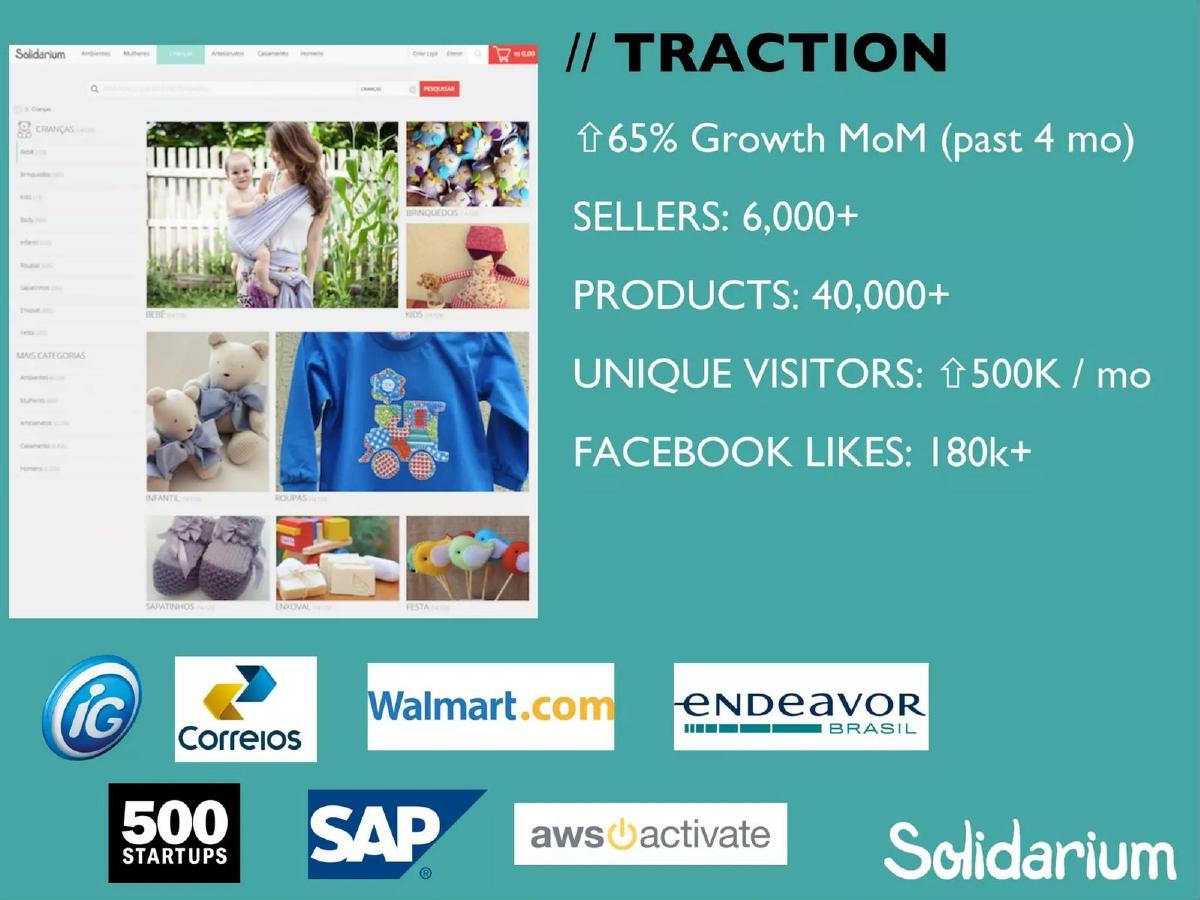
- The company reported a 65% month-over-month growth rate over the four months preceding the deck (Slide 2).
- Solidarium established a significant supply side with over 6,000 sellers and 40,000 products (Slide 2).
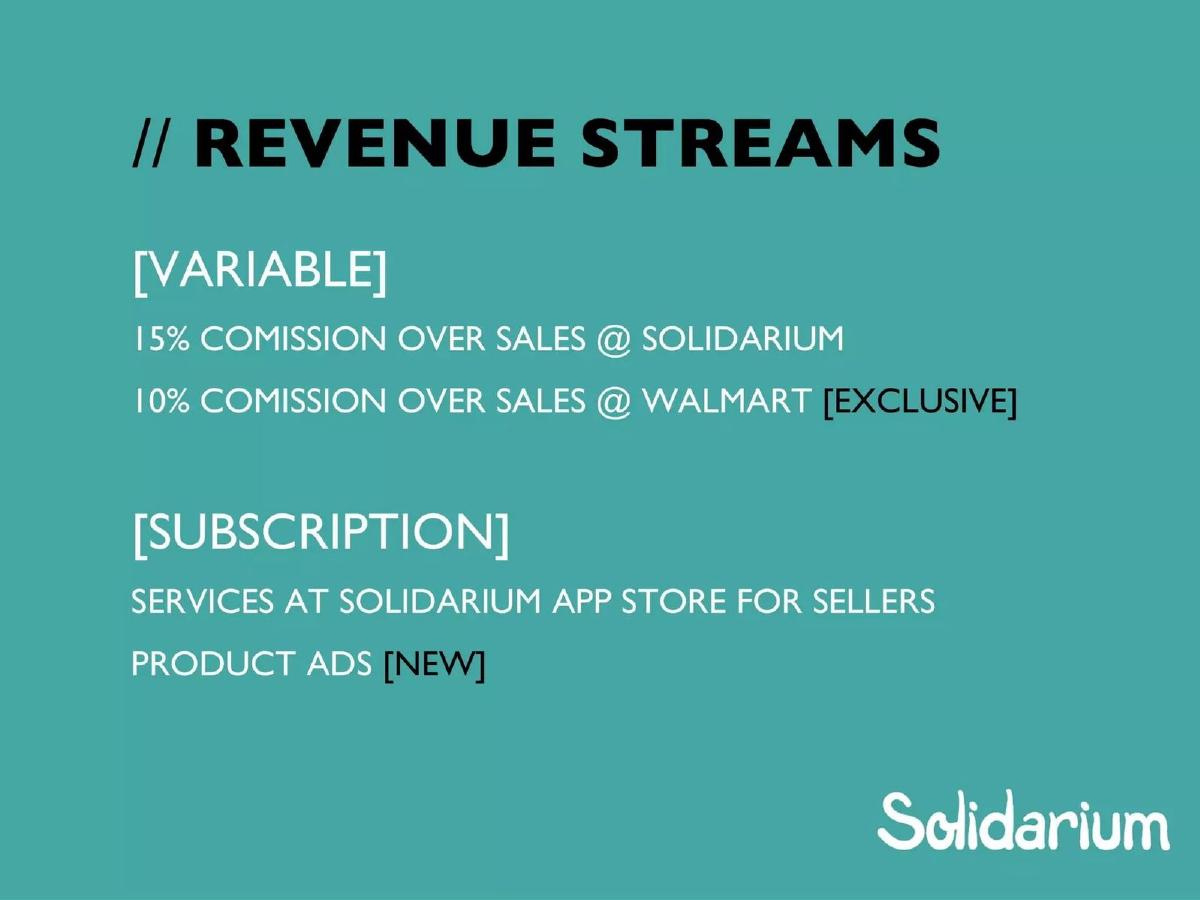
- A strategic partnership with Walmart.com provides an exclusive 10% commission on sales, diversifying revenue beyond the core 15% marketplace fee (Slide 5).
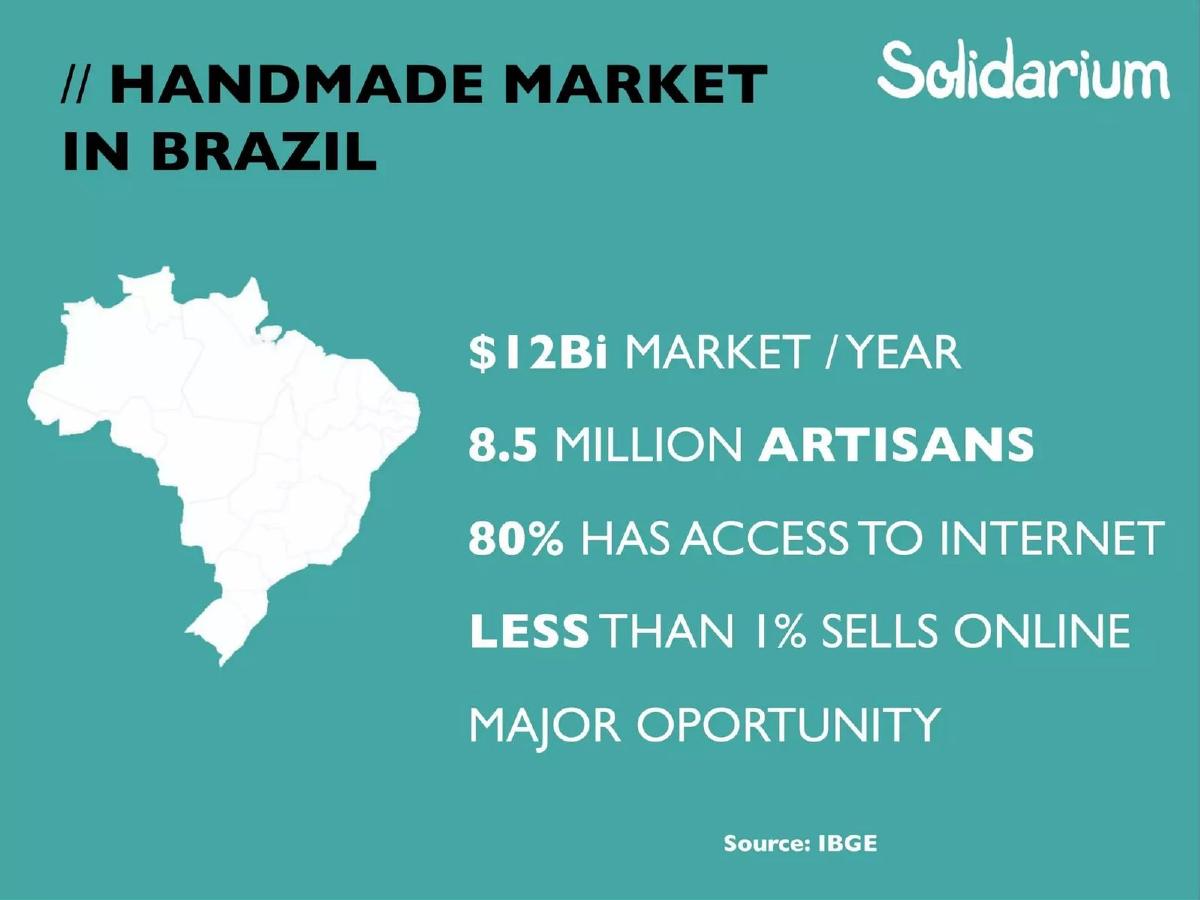
- The Brazilian handmade market is valued at $12 billion annually, yet less than 1% of the 8.5 million artisans sell online (Slide 6).
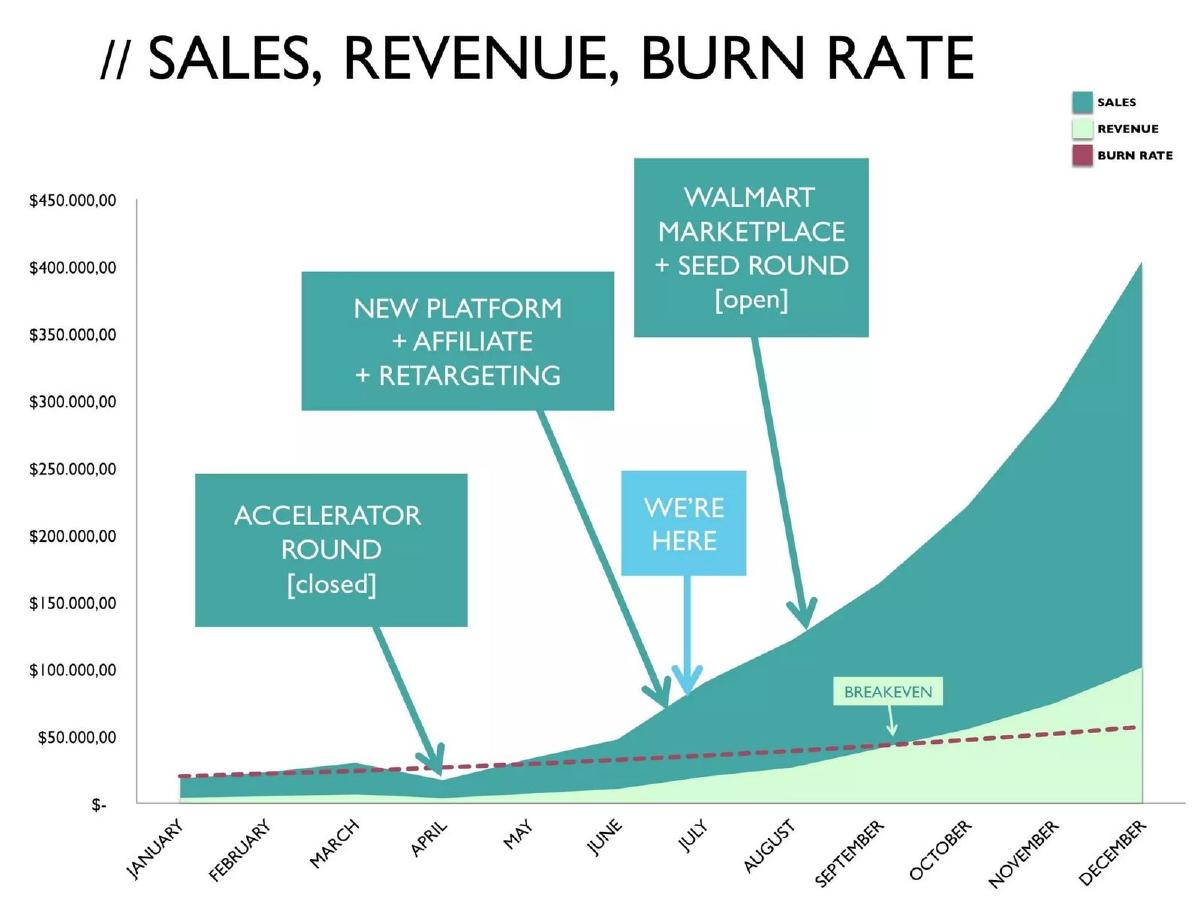
- The deck projects reaching breakeven by September, supported by a sales trajectory aiming for $400,000 by December (Slide 4).
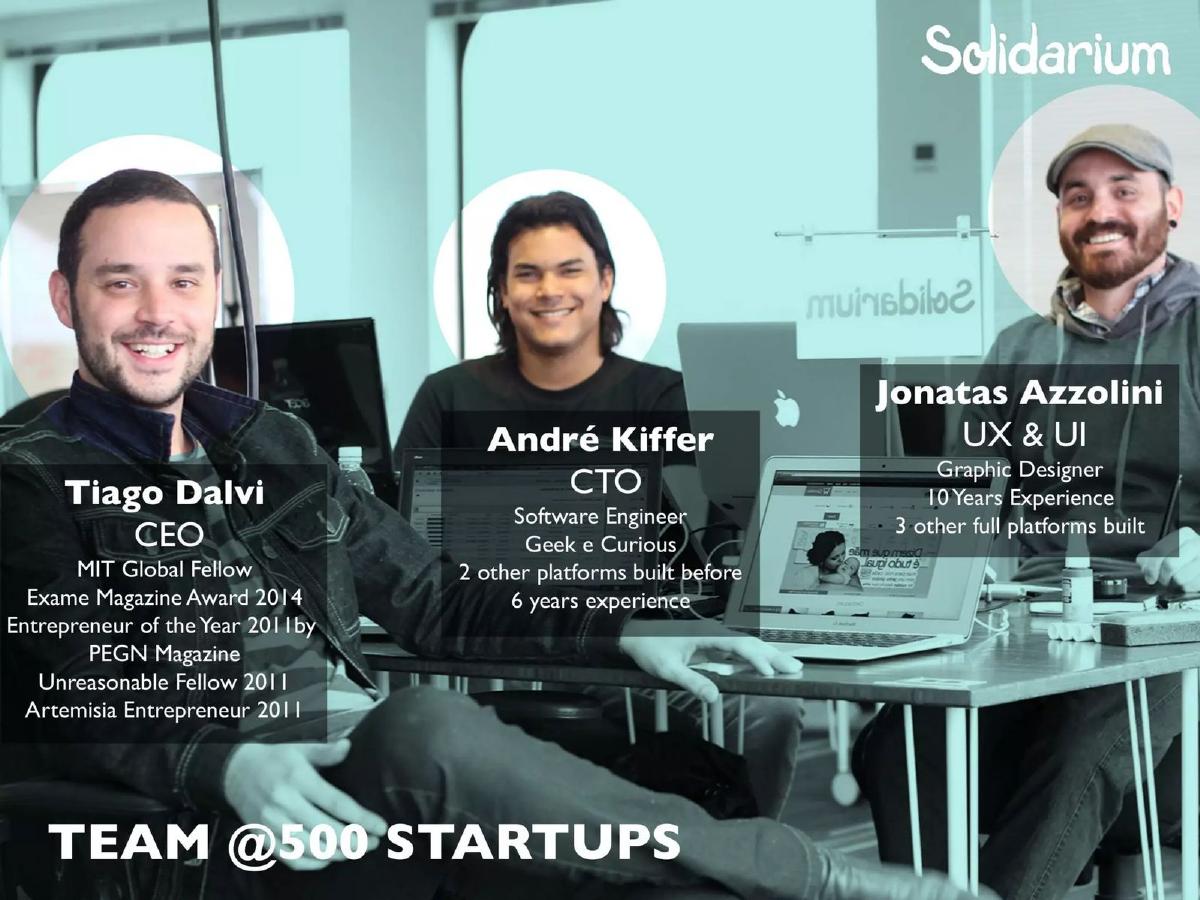
- The founding team is highly decorated, with CEO Tiago Dalvi holding titles such as MIT Global Fellow and 2011 Entrepreneur of the Year (Slide 3).
- The Seed round ask was $1.5 million, following a closed $250,000 accelerator round from 500 Startups and Polaris (Slide 9).
- The business model emphasizes a 'zero inventory' P2P logistics approach to maintain low working capital and high scalability (Slide 8).
Solidarium: Scaling the Brazilian Artisan Economy
Solidarium’s 2015 pitch deck is a concise 9-slide document that focuses on the transition from a niche marketplace to a major e-commerce player in Brazil. The company, which later evolved into the no-code testing platform Sofy.ai according to catalogue data, was at this time focused entirely on the $12 billion handmade goods market. The deck is characterized by its teal color palette and a heavy reliance on traction metrics to tell its story.
The Hook and Immediate Traction
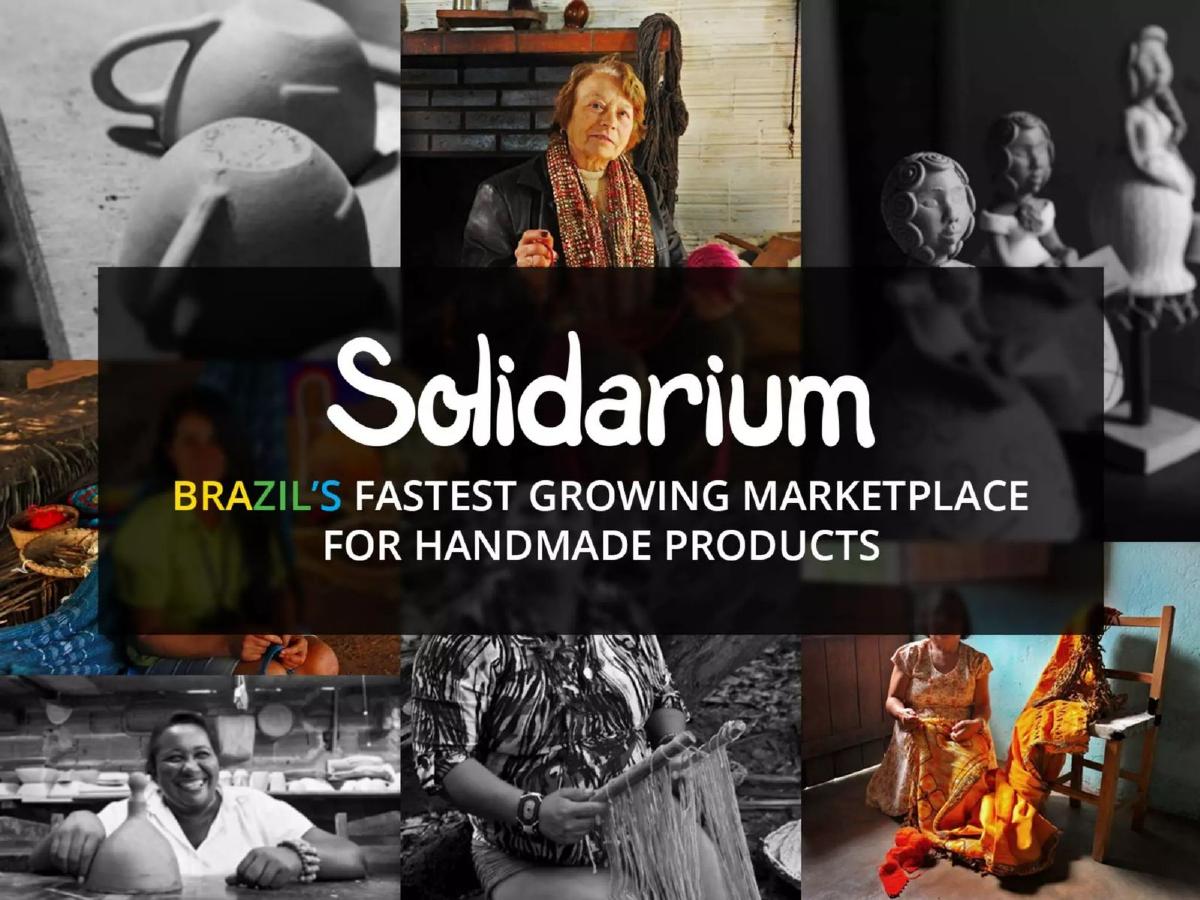
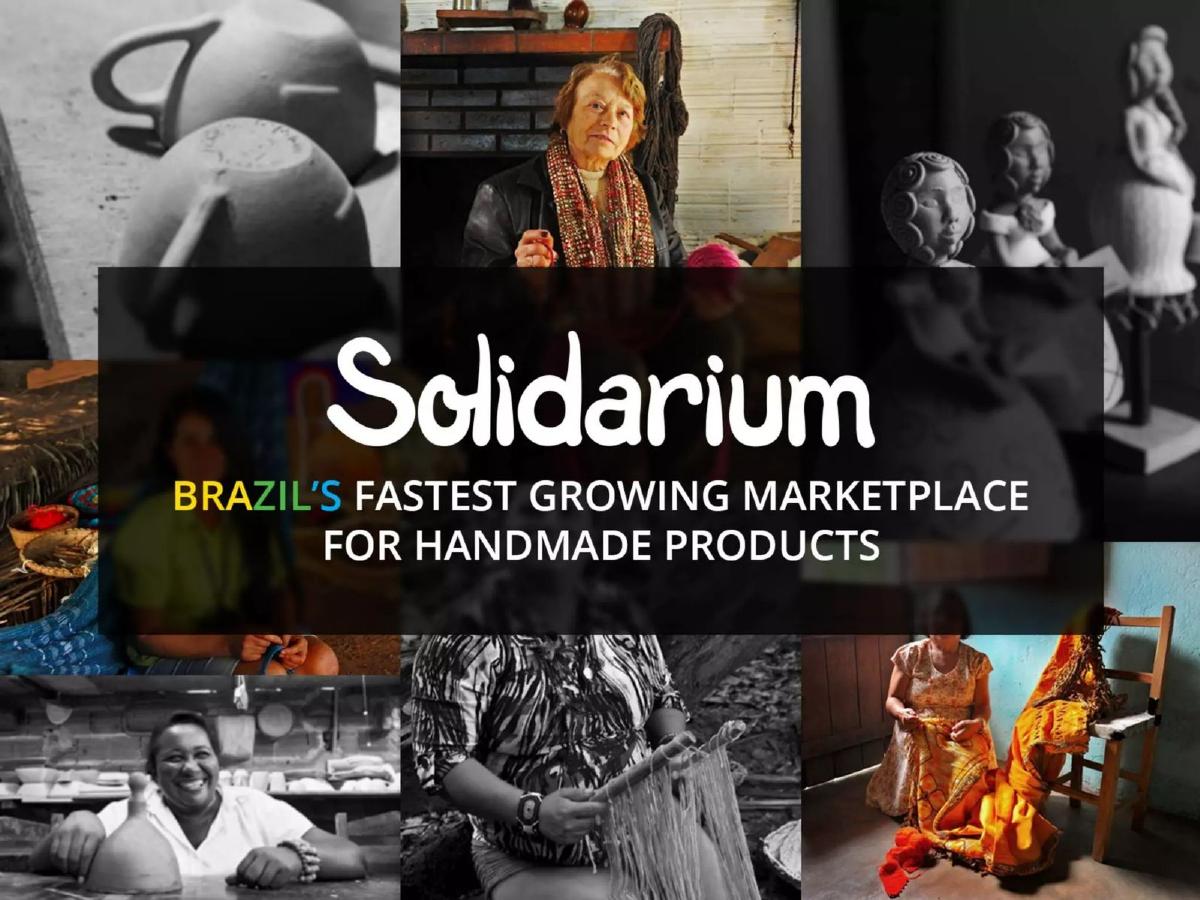
Slide 1: Title Slide The deck opens with a collage of Brazilian artisans at work, immediately grounding the business in its social and cultural context. The tagline is bold: "Brazil's fastest growing marketplace for handmade products." This sets a high bar for the traction slide that follows.
Slide 2: Traction This is arguably the most important slide in the deck. It lists five key metrics that demonstrate explosive growth: 65% MoM growth over the last four months, 6,000+ sellers, 40,000+ products, 500k+ unique visitors per month, and 180k+ Facebook likes. By placing this slide second, Solidarium proves they have found product-market fit before explaining the business model. The bottom of the slide features logos for Walmart.com, 500 Startups, SAP, and AWS, providing instant institutional credibility.
The Team and Financial Trajectory
Slide 3: Team The team slide highlights three core members: Tiago Dalvi (CEO), André Kiffer (CTO), and Jonatas Azzolini (UX & UI). The slide emphasizes their pedigree, specifically Dalvi’s accolades as an MIT Global Fellow and Entrepreneur of the Year. The mention of "Team @500 Startups" reinforces their recent acceleration and Silicon Valley backing.
Slide 4: Sales, Revenue, Burn Rate This slide uses a stacked area chart to show the relationship between total sales (GMV), revenue (take rate), and burn rate. The chart shows a clear inflection point in June, coinciding with the launch of a new platform and affiliate programs. Crucially, it points to a "Breakeven" point in September, with sales projected to hit $400,000 by December. This visualizes a path to sustainability that is highly attractive to Seed-stage investors.
Business Model and Market Opportunity
Slide 5: Revenue Streams Solidarium breaks down its income into two categories: Variable and Subscription. The variable side includes a 15% commission on their own site and a 10% exclusive commission on Walmart.com. The subscription side includes seller services and a new product ads feature. This diversified model shows that the company isn't just relying on transaction fees but is building an ecosystem of tools for its sellers.
Slide 6: Handmade Market in Brazil This slide defines the Total Addressable Market (TAM). Using IBGE as a source, it identifies a $12 billion annual market with 8.5 million artisans. The "killer stat" here is that while 80% of these artisans have internet access, less than 1% sell online. This frames Solidarium not just as a store, but as the infrastructure for an entire sector's digital transformation.
Validation and Strategy
Slide 7: Forbes Quote A full slide is dedicated to a quote from Forbes, calling Solidarium "industry transformation at its best." While some might see this as filler, in a cross-border investment context (Brazilian startup pitching to global investors), international press validation is a powerful de-risking tool.
Slide 8: Business Concept This slide summarizes the operational philosophy: 100% handmade, curated, and P2P logistics. The emphasis on "Zero Inventory" and "Low Working Capital" is a direct message to investors that this is a high-margin, scalable software play, not a capital-intensive retail business.
The Ask
Slide 9: Next Steps The final slide is the call to action. It transparently lists the closed $250k accelerator round and opens the $1.5 million Seed round. By including a specific closing date (August 20th), the founders create a "fear of missing out" (FOMO) for investors who might otherwise delay their decision.
What Works in This Deck
The deck’s greatest strength is its clarity of traction . By leading with 65% MoM growth and a massive seller count, the founders make it difficult for an investor to dismiss the business. The strategic partnership with Walmart is another major win; it demonstrates that a global retail giant has already vetted their supply chain and technology. Furthermore, the market gap analysis (80% online access vs. 1% online sales) creates a logical inevitability for the company's success.
What is Missing
Despite its strengths, the deck has notable omissions. There is no competitor analysis . In the handmade space, platforms like Etsy (global) or Elo7 (local to Brazil) would have been obvious comparisons that investors would want to see addressed. There is also a lack of unit economics ; while the 15% commission is stated, we don't see the Customer Acquisition Cost (CAC) or Lifetime Value (LTV), which are critical for marketplace sustainability. Finally, the product demo is limited to a single screenshot on Slide 2, leaving the actual user experience of the "new platform" largely to the imagination.
What a Founder Should Copy
Founders should emulate the visual financial roadmap on Slide 4. Instead of just showing a table of numbers, the area chart clearly shows how specific milestones (like the Walmart launch) impact the gap between burn and revenue. The use of social proof is also exemplary; combining accelerator logos, major partner logos, and a high-tier press quote creates a "halo effect" that makes the startup seem larger and more established than its Seed stage might suggest. Lastly, the urgency in the ask on Slide 9—specifically naming a closing date—is a tactical move that can help move investors through the funnel faster.
Summary of the Solidarium Opportunity
Solidarium presented itself as the definitive gateway to the Brazilian artisan economy. By focusing on a low-overhead, zero-inventory model and leveraging a massive distribution partner in Walmart, they positioned themselves as a scalable technology platform rather than a simple craft shop. The deck successfully balances the social mission of helping "good people" with the hard-nosed financial metrics required to close a $1.5 million round.
Frequently asked questions
- What is the primary revenue model for Solidarium?
- Solidarium employs a multi-stream revenue model. The core is a variable 15% commission on sales made directly through the Solidarium platform. Additionally, they earn a 10% exclusive commission on sales through Walmart.com. The company also generates subscription revenue through its 'App Store for Sellers' and a newly introduced product advertising service, as detailed on Slide 5.
- How does Solidarium handle logistics and inventory?
- According to Slide 8, Solidarium operates a 'zero inventory' model. It utilizes peer-to-peer (P2P) logistics, meaning the company does not hold stock. This approach is designed to keep working capital requirements low and allow the marketplace to scale rapidly without the overhead of traditional retail warehousing.
- What is the size of the market opportunity in Brazil?
- Slide 6 identifies a $12 billion annual market for handmade goods in Brazil. There are approximately 8.5 million artisans in the country. Crucially, while 80% of these artisans have internet access, less than 1% currently sell their products online, representing a massive digital migration opportunity.
- Who are the key members of the founding team?
- The team consists of Tiago Dalvi (CEO), an MIT Global Fellow and award-winning entrepreneur; André Kiffer (CTO), a software engineer with experience building two previous platforms; and Jonatas Azzolini (UX & UI), a graphic designer with 10 years of experience and three previous platforms built. The team is noted as being part of the 500 Startups program on Slide 3.
- What was the specific funding goal mentioned in the deck?
- Slide 9 states that Solidarium was seeking a $1.5 million Seed round from advisors and strategic investors. This followed a successfully closed $250,000 accelerator round from 500 Startups and Polaris. The deck even specified a closing window between June 16th and August 20th to drive investor urgency.