The Top Doctors pitch deck from 2013 is a lean, 12-slide presentation that focuses heavily on the logistical friction of medical tourism. By identifying hospitals as the primary bottleneck in a process that typically requires over 30 emails and a month of lead time, the company positioned itself as a CRM and travel solution rather than just a patient-facing marketplace. With $300k in ARR from just three hospitals at the time of the pitch, the deck demonstrates strong early monetization and a clear B2B value proposition. However, the deck is notably light on product specifics, competition, and…
Key takeaways
- The deck identifies a massive total addressable market of $563B with a 22% CAGR on slide 5.
- It highlights a significant operational pain point: the existing process takes 1 month and over 30 emails (slide 7).
- Hospitals are explicitly identified as the 'bottleneck' in the medical tourism value chain on slide 8.
- The solution is framed as a 'CRM and Travel Solution' rather than a simple booking site (slide 9).
- The team slide features logos from Microsoft, Standard Chartered, and Bumrungrad International to build authority (slide 10).
- The company reported $300K ARR from 3 hospitals with a pipeline of 42 more on slide 11.
- The deck lacks a specific funding ask, valuation, or use-of-funds breakdown.
- There is no mention of competitors or a traditional 'Why Now' slide beyond general market growth.
The Vision: Automating a Fragmented Global Market
Top Doctors launched in 2013 with a clear mission: to bring order to the chaotic world of medical tourism. At the time, medical travel was often viewed through a narrow lens of cosmetic surgery or discount dentistry. This deck attempts to reframe the industry as a massive, high-stakes infrastructure play. By focusing on the 'automation' of the journey, the company moved away from being a simple directory and toward becoming a critical piece of B2B software for hospitals.
Slides 1-4: The Reframing of Medical Tourism
The deck opens with a minimalist title slide (Slide 1) that sets the tone: "Automating Medical Tourism." The use of the word 'automating' is a deliberate choice to signal a technology-first approach to a service-heavy industry.
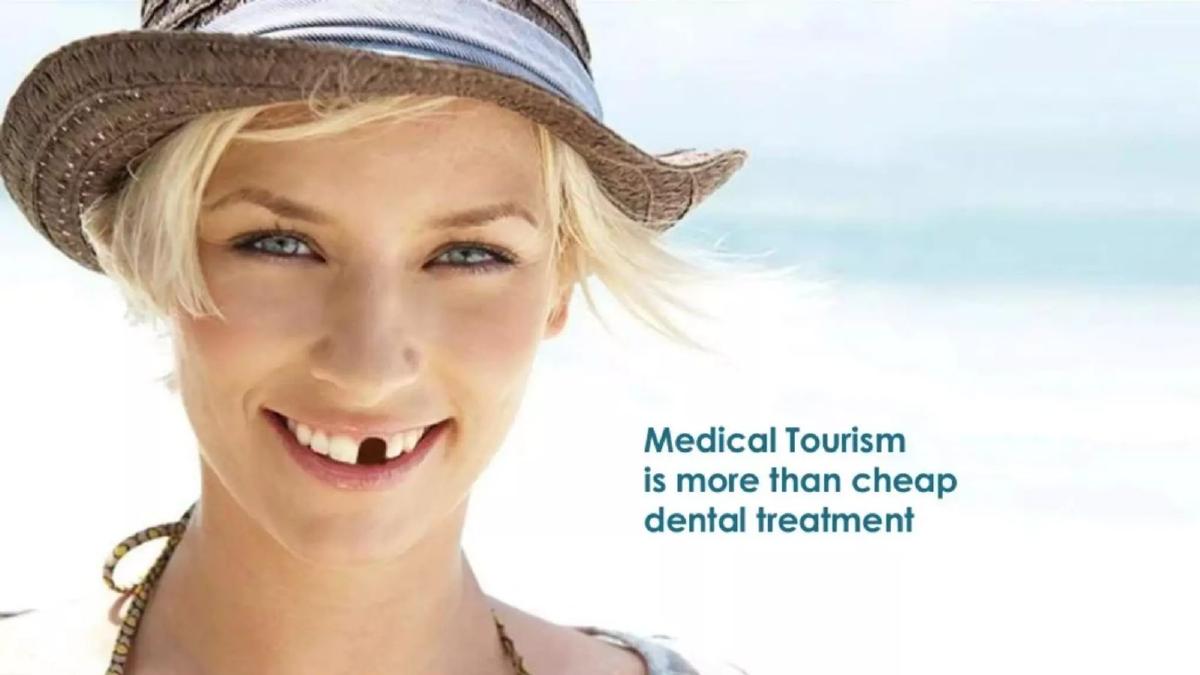
Slides 2, 3, and 4 function as a narrative hook. They use high-impact imagery to challenge the investor's preconceived notions of the market. Slide 2 states, "Medical Tourism is more than cheap dental treatment," while Slide 3 notes, "It's bigger than breast augmentation." Slide 4 completes the transition by focusing on the necessity of the service: "Travel to get access to higher quality healthcare." This sequence successfully moves the conversation from elective 'vanity' procedures to essential healthcare, which inherently carries higher margins and greater urgency.
Slide 5: The Macro Opportunity
Slide 5 provides the 'Big Number.' It claims a "$563B Industry" with a "22% CAGR." While the source of this data isn't cited on the slide, the sheer scale is intended to justify the venture-scale potential of the business. In 2013, these figures were particularly aggressive, positioning medical tourism not as a niche travel segment but as a significant portion of global healthcare spend.
Slide 6: Founder Credibility and Social Proof
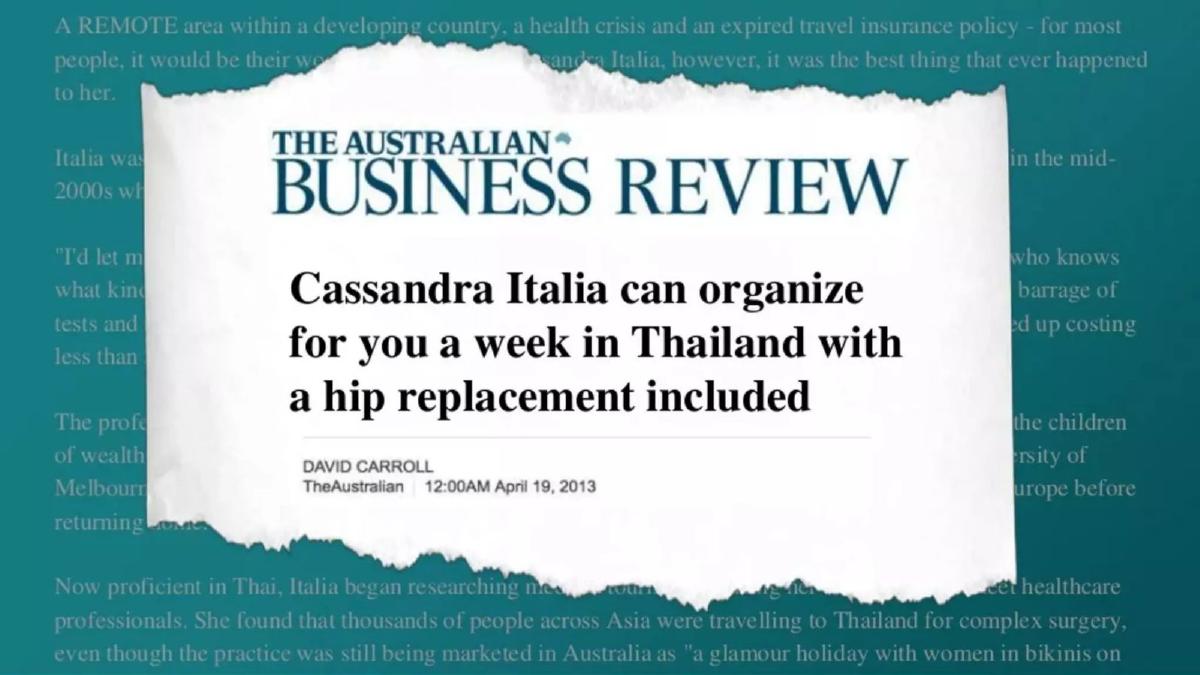
Instead of a standard 'Problem' slide, Slide 6 uses a press clipping from The Australian Business Review dated April 19, 2013. The headline, "Cassandra Italia can organize for you a week in Thailand with a hip replacement included," serves two purposes. First, it validates the CEO's expertise in the field. Second, it provides a concrete example of the complex logistics the company handles. Using third-party journalism as social proof is a strong tactic for early-stage startups that may not yet have massive user data.
Slides 7-8: Identifying the Bottleneck
Slide 7, titled "Existing Process," is the most important slide for understanding the company's value proposition. It maps out the communication flow between Patient, Agent, Hospital, and Doctor. The slide notes that this manual process takes "1 month" and involves "> 30 emails."
Slide 8 follows up by explicitly stating, "Hospitals are the Bottleneck." By narrowing the problem down to the hospital's inability to manage these inquiries efficiently, Top Doctors justifies its pivot toward a B2B solution. This is a classic 'pain point' identification that sets the stage for the product reveal.
Slide 9: The Solution
Slide 9 introduces the "CRM and Travel Solution powering medical tourism." The visual uses icons to represent the various components of the platform: medical records, flight booking, accommodation, and support. This slide suggests that Top Doctors is building a full-stack operating system for medical travel, rather than just a lead-generation tool. However, the deck lacks a screenshot of the actual software, which is a missed opportunity to prove product readiness.
Slide 10: The Team
The team slide (Slide 10) lists five key members: Cassandra Italia (CEO), Brendon Matheson (CTO), Ruben Toral (CMO), Yannick Bestastian (VP Engineering), and Nichapart Ark (VP Sales). The bottom of the slide features logos for Microsoft, Bumrungrad International, Ozna, and Standard Chartered. The presence of Bumrungrad International—one of the world's largest medical tourism destinations—is particularly significant, as it suggests the team has deep domain expertise from within the industry's most successful institutions.
Slide 11: Traction and Pipeline
Slide 11 provides the hard metrics. The company reports having "3 Hospitals" as active clients, generating "$300K ARR." This is a very healthy revenue-to-customer ratio for a seed-stage company, implying a high contract value. The slide also mentions a "Pipeline 42 Hospitals," which gives investors a clear view of the immediate growth potential. This slide effectively proves that the 'bottleneck' identified earlier is a problem hospitals are willing to pay significant money to solve.
Slide 12: Contact Information
The final slide is a standard contact page, providing the CEO's email and an AngelList link. Notably, the deck ends without a formal 'Ask' slide. There is no mention of how much money is being raised, the terms of the round, or what the capital will be used for.
What Works in This Deck
Clear Problem Definition: The '30 emails and 1 month' metric on Slide 7 is a visceral way to describe inefficiency. It makes the need for automation obvious. · B2B Focus: By identifying hospitals as the bottleneck, the company avoids the high customer acquisition costs (CAC) of a pure B2C play and focuses on a high-value B2B SaaS model. · Strong Revenue Per User: $300k ARR from only 3 hospitals (Slide 11) is an impressive signal of product-market fit and pricing power. · Social Proof: Leveraging a major newspaper feature (Slide 6) early in the deck builds immediate trust in the founder's ability to execute.
What is Missing
The Ask: A pitch deck is a fundraising tool. Omitting the amount of capital sought and the milestones it will fund is a major oversight. · Competitive Landscape: The deck assumes Top Doctors is the only player in the space. Investors would want to know how they differ from other medical travel facilitators or existing hospital CRM modules. · Product Visuals: For a company claiming to 'automate' a process, the lack of a dashboard or interface screenshot makes the solution feel abstract. · Unit Economics: While ARR is mentioned, there is no data on the cost to acquire a hospital or the lifetime value (LTV) of these contracts.
What a Founder Should Copy
The 'Reframing' Sequence: Use the first few slides to dismantle industry stereotypes. If your market is misunderstood, address it head-on like Slides 2-4. · The Bottleneck Strategy: Don't just say a process is 'slow.' Identify exactly who in the value chain is causing the delay (Slide 8). It makes your solution feel targeted. · Logo Association: If your team has worked at industry leaders, put those logos front and center (Slide 10). It transfers the credibility of those giants to your startup. · Quantified Pain: Use specific numbers to describe the problem (e.g., "30 emails") rather than vague adjectives like "inefficient."
Frequently asked questions
- What is the primary problem Top Doctors is solving?
- Top Doctors addresses the inefficiency of the medical tourism booking process. According to slide 7, the current manual workflow involving patients, agents, hospitals, and doctors takes over a month and requires more than 30 emails. Slide 8 identifies hospitals as the core bottleneck, suggesting that their internal administrative processes are the primary hurdle to scaling medical tourism.
- How does Top Doctors generate revenue?
- While the deck doesn't explicitly detail the pricing model, slide 11 shows that the company had already achieved $300K in Annual Recurring Revenue (ARR) from three hospitals. This suggests a B2B SaaS or licensing model where hospitals pay for the 'CRM and Travel Solution' mentioned on slide 9 to manage their international patient flow.
- What is the scale of the market opportunity presented?
- Slide 5 cites a $563 billion industry valuation with a 22% Compound Annual Growth Rate (CAGR). The deck argues that medical tourism is expanding beyond 'cheap dental treatment' (slide 2) and 'breast augmentation' (slide 3) toward high-quality healthcare access for complex procedures like hip replacements (slide 6).
- Who is on the founding team and what is their background?
- The team is led by CEO Cassandra Italia, who received significant press coverage in The Australian Business Review (slide 6). The team includes CTO Brendon Matheson, CMO Ruben Toral, and VPs for Engineering and Sales. Slide 10 highlights their collective experience at major institutions like Microsoft, Bumrungrad International, and Standard Chartered.
- What is missing from this pitch deck?
- The deck is missing several standard components: a specific 'Ask' slide detailing how much capital they are raising, a 'Competition' slide comparing them to other medical travel platforms, and a detailed 'Product' slide showing the actual software interface. It also lacks a clear roadmap or financial projections beyond the current pipeline.