The Tonies pitch deck is a sophisticated presentation designed for a Series C or late-stage audience, specifically tailored for their 2021 SPAC merger. It moves quickly past the 'what' of the product to focus on the 'how' of the business model—specifically the 'razor-blade' strategy where the Toniebox acts as a gateway to high-margin, recurring figurine sales. With ~EUR 137m in 2020 revenue and a clear path to EUR 703m by 2025, the deck emphasizes market creation rather than competition. By positioning themselves at the intersection of gaming, toys, and streaming, Tonies successfully argues t…
Key takeaways
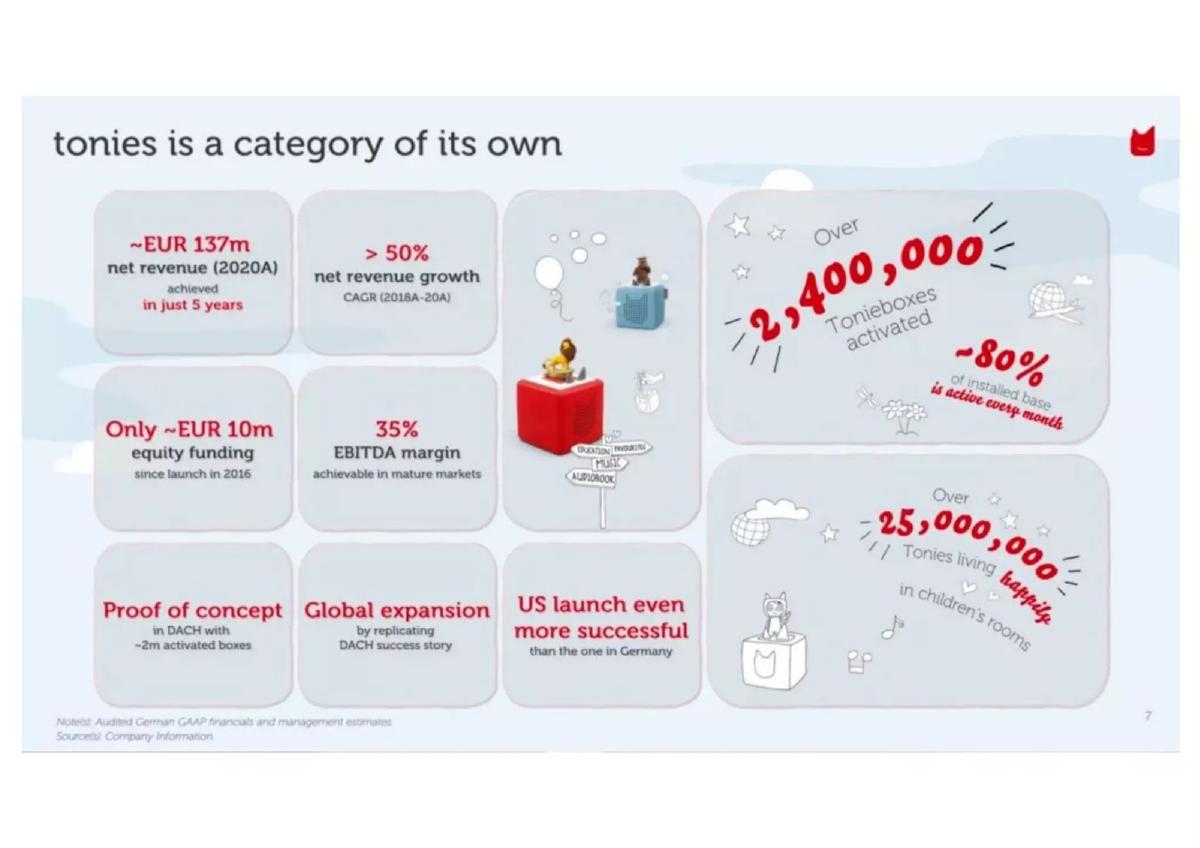
- The company achieved ~EUR 137m net revenue in 2020 with only ~EUR 10m in equity funding since its 2016 launch (Slide 7).
- The business model follows a 'razor-blade' strategy, where the Toniebox anchors a proprietary ecosystem of over 300 characters (Slide 5).
- Customer loyalty is exceptionally high, with an average customer purchasing ~20 Tonies figurines within 4.5 years (Slide 21).
- Mature markets like the DACH region show a 35% EBITDA margin potential, providing a blueprint for international scaling (Slide 7).
- Revenue is projected to grow from EUR 172m in 2021E to EUR 703m in 2025E, a 38% CAGR (Slide 18).
- The US market is highlighted as a critical growth lever, projected to represent 42% of total revenue by 2025 (Slide 19).
- The deck emphasizes a 'screen-free' value proposition, positioning the product as a safe alternative in a digital-heavy world (Slide 5).
- Data is a core pillar, with the platform tracking what, where, and how long users listen to content to drive production (Slide 15).
The Tonies Pitch Deck: Building a Global Audio Category
The Tonies presentation from August 2021 is a comprehensive look at a company transitioning from a regional success to a global platform. At 18 slides, this version of the deck (likely an excerpt from a larger investor presentation for their SPAC merger with 468 SPAC I) focuses heavily on financial proof points, the scalability of their 'razor-blade' business model, and the massive whitespace in international markets. It is a deck that prioritizes execution and unit economics over abstract vision.
Introduction and Team
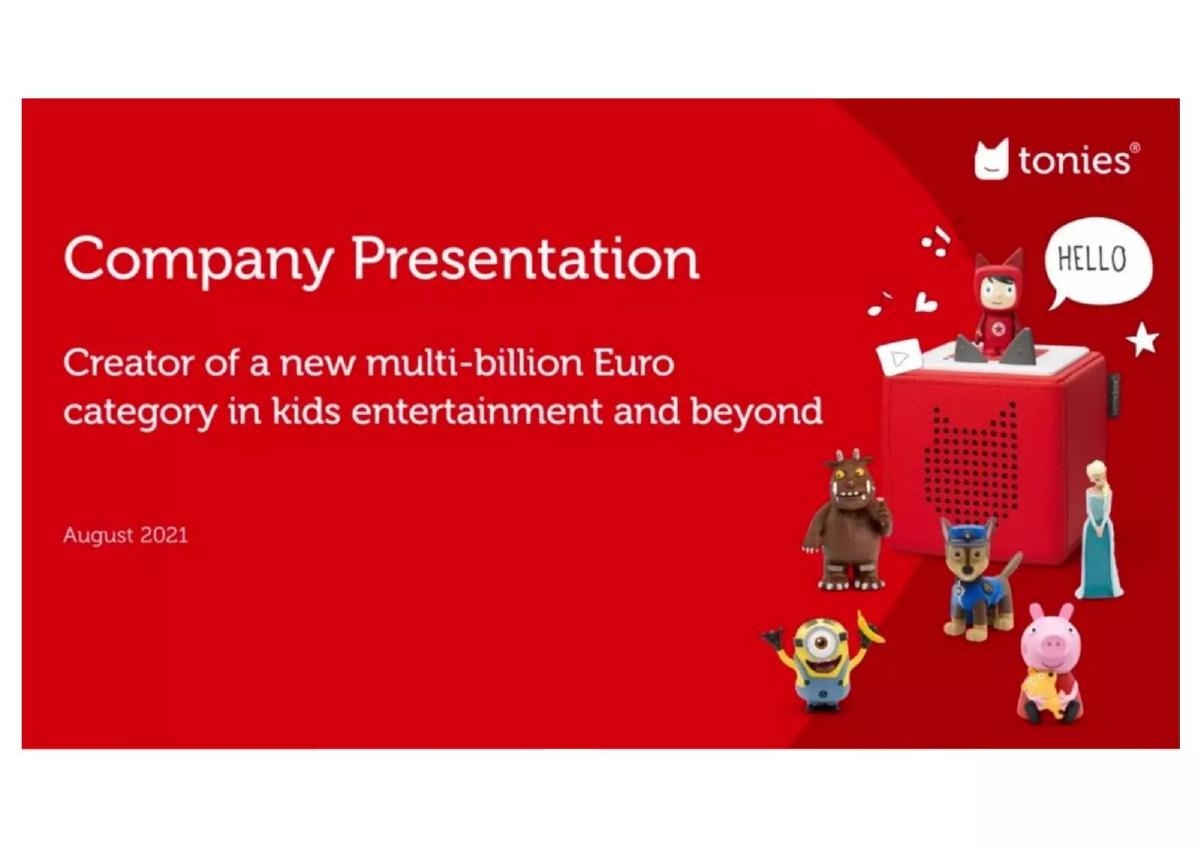
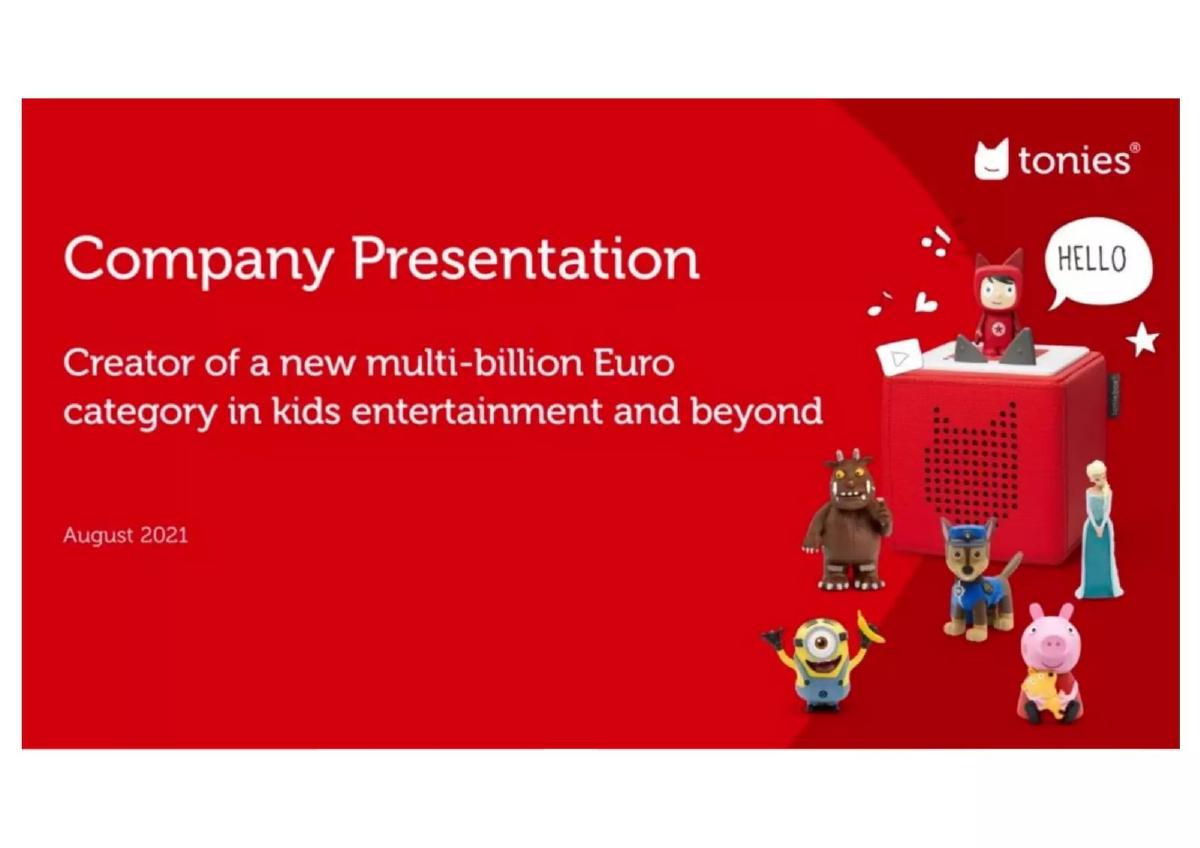
Slide 1: Title Slide The deck opens with a bold claim: "Creator of a new multi-billion Euro category in kids entertainment and beyond." It features the iconic red Toniebox and various licensed characters (Minions, Peppa Pig, Frozen), immediately establishing the product's physical nature and its high-profile partnerships.
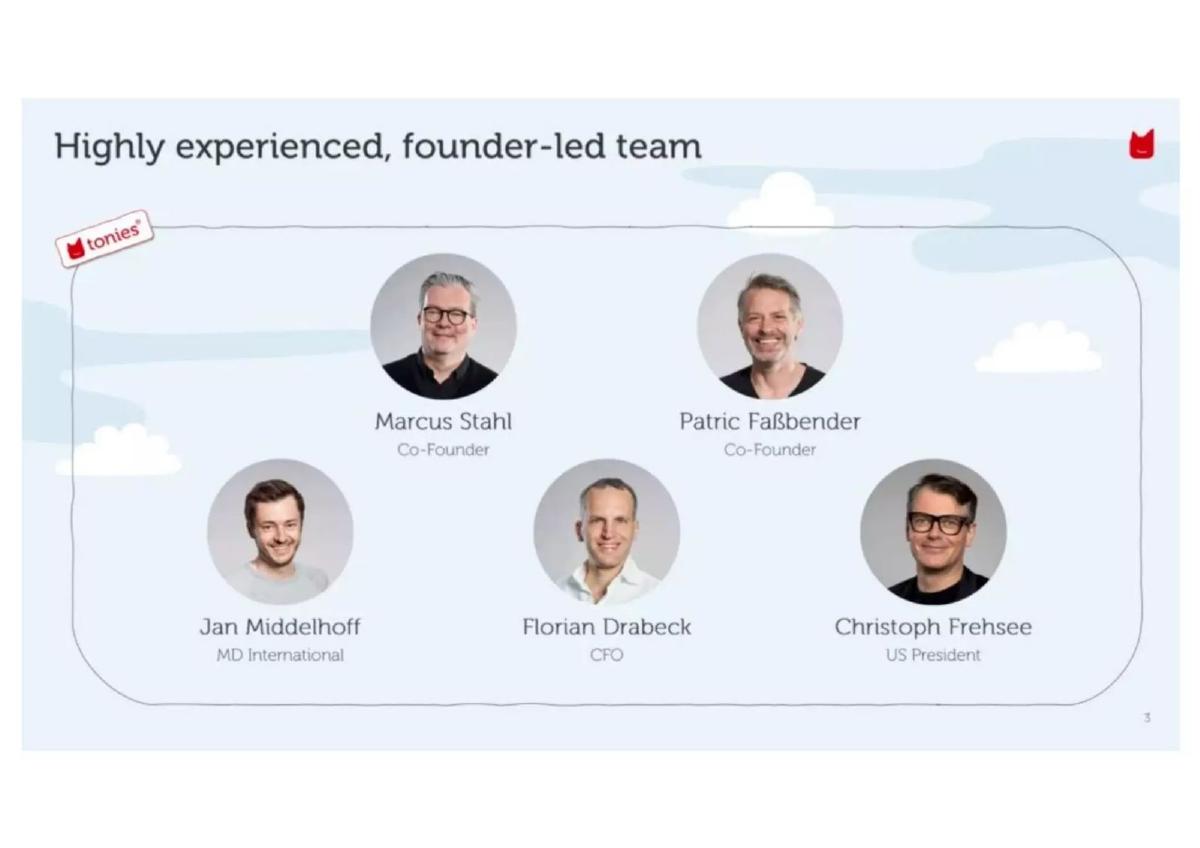
Slide 3: The Core Team The team slide features founders Marcus Stahl and Patric Faßbender alongside three key executives: Jan Middelhoff (MD International), Florian Drabeck (CFO), and Christoph Frehsee (US President). The inclusion of a dedicated US President at this stage signals the company's aggressive focus on North American expansion.
Slide 46: The Extended Team and Pedigree Later in the deck, Slide 46 provides a more detailed look at the leadership's background, showcasing logos from McKinsey & Company, HelloFresh, Bain & Company, Nokia, and GoPro. This 'logo soup' is intended to reassure late-stage investors that the company is managed by seasoned professionals with experience in scaling consumer brands.
The Product and Ecosystem
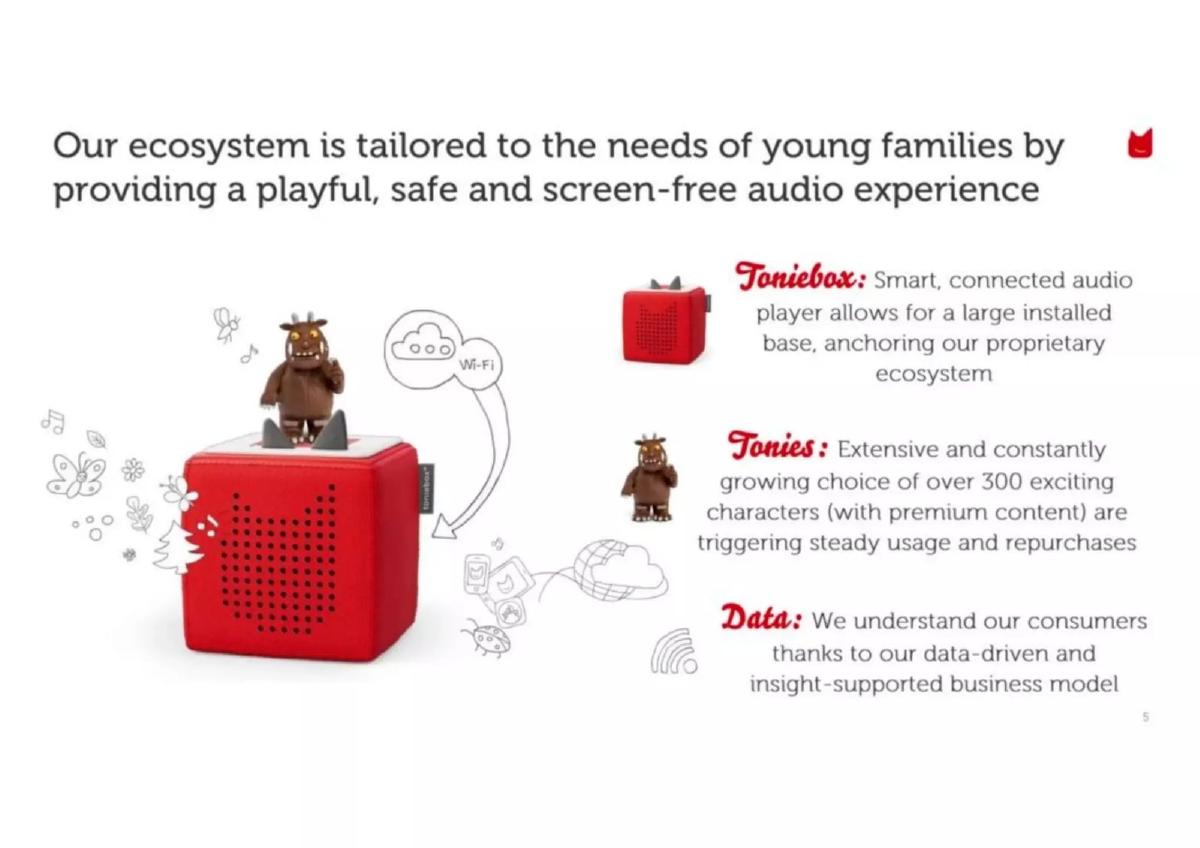
Slide 5: The Ecosystem This slide defines the three pillars of the business: the Toniebox (the smart, connected hardware), the Tonies (the figurines/content), and Data. It emphasizes a "screen-free audio experience," a key selling point for modern parents. Crucially, it mentions a library of over 300 characters, which triggers "steady usage and repurchases."
Slide 12: Proven Business Model This slide breaks down the value chain into Hardware, Content Production, and Distribution. It highlights "Contract manufacturing" for hardware and a mix of "Third party licensing" (Disney, Universal, Warner Bros, Pixar) and "Proprietary content creation." The distribution section shows a strong omnichannel approach, listing retailers like Target, Amazon, and Harrods alongside their D2C channel.
Slide 15: The Content-Driven Flywheel Tonies explains how they use data to fuel growth. Because the boxes are connected, they track "what they listen for, where and when," "how often," and "how many users share a box." This data informs the creation of new content, which leads to repurchases, creating a closed-loop system.
Market Opportunity and Positioning
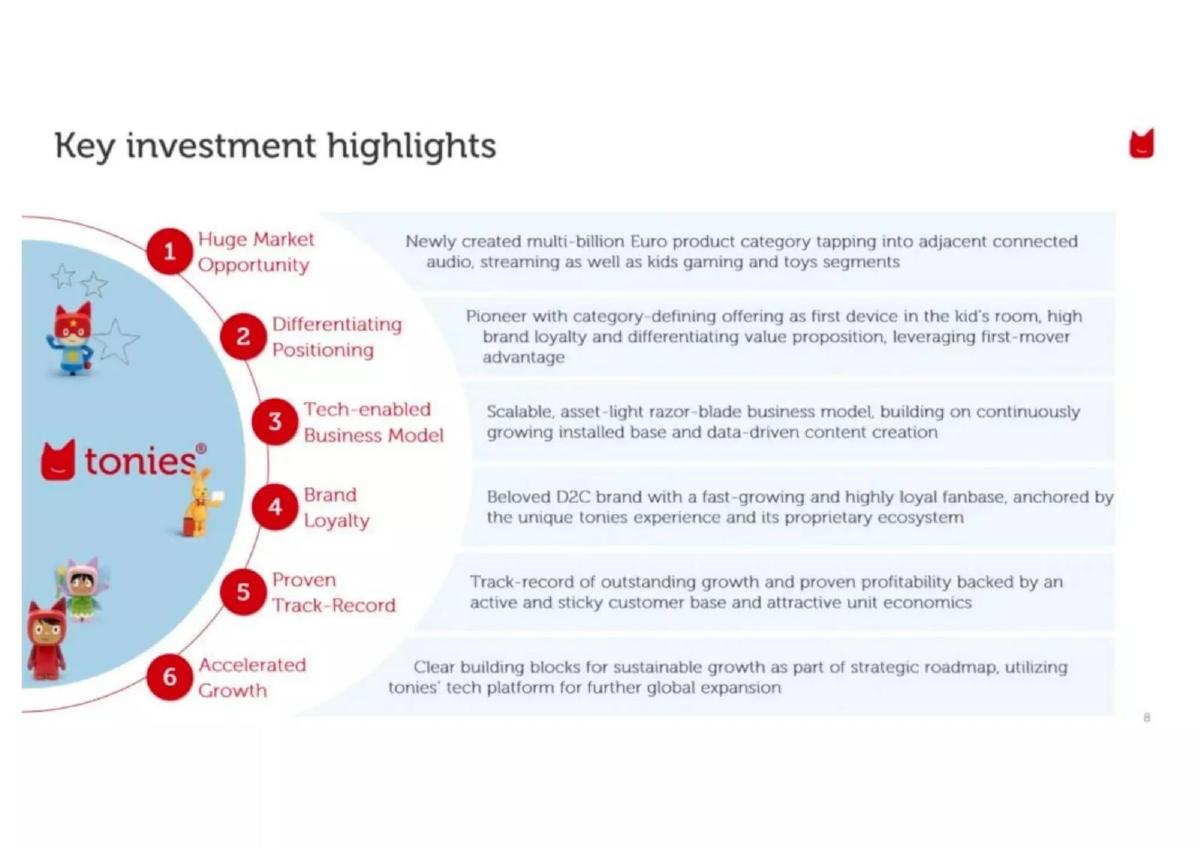
Slide 8: Key Investment Highlights This acts as an executive summary, listing six pillars: Huge Market Opportunity, Differentiating Positioning, Tech-enabled Business Model, Brand Loyalty, Proven Track-Record, and Accelerated Growth. It explicitly mentions an "asset-light razor-blade business model."
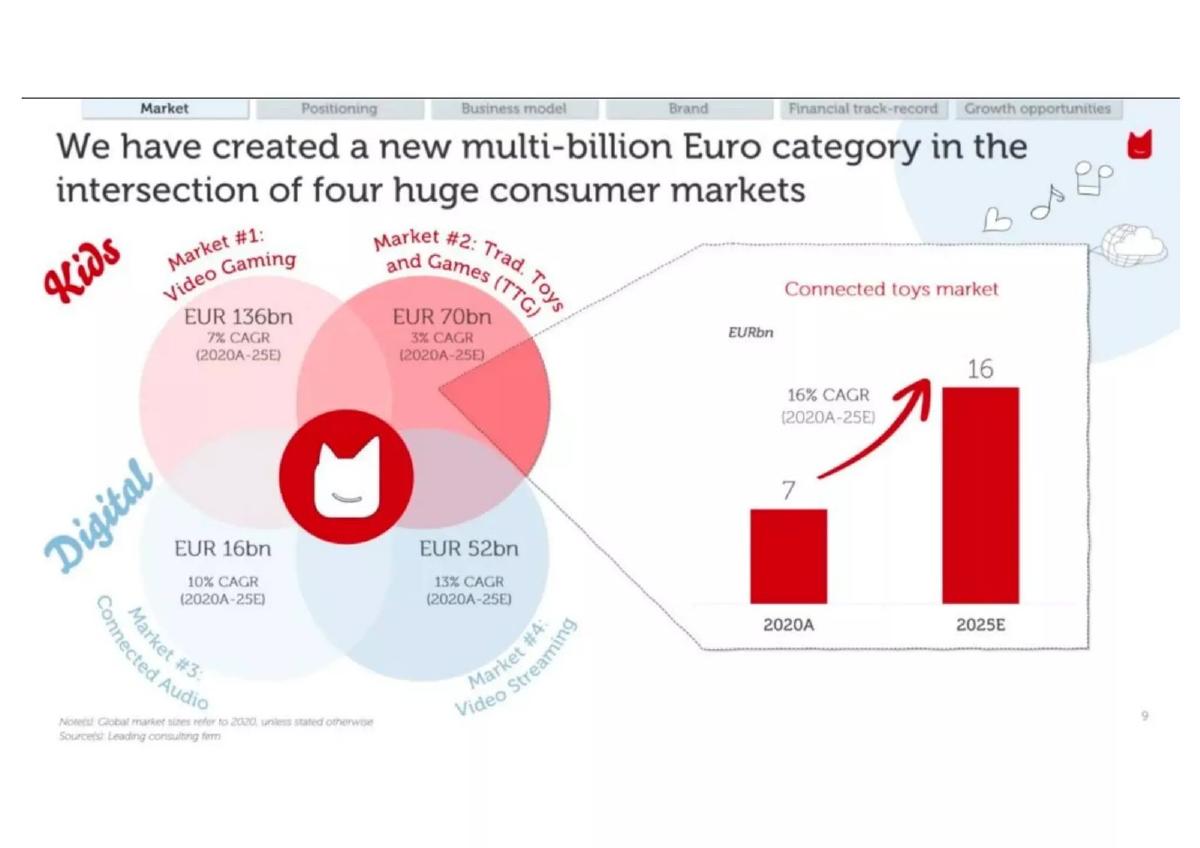
Slide 9: Market Intersection Tonies positions itself at the intersection of four markets: Video Gaming (EUR 136bn), Trad. Toys and Games (EUR 70bn), Connected Audio (EUR 16bn), and Video Streaming (EUR 52bn). They project the "Connected toys market" specifically to grow at a 16% CAGR, reaching EUR 16bn by 2025.
Slide 38: Peer Comparison To justify its valuation, Tonies compares its growth and margins against a diverse set of peers including Nintendo, Disney, Netflix, Chegg, and Peloton. The slide claims Tonies shows "significantly stronger growth" (43.6% guidance) compared to the peer average of 14.2%, with comparable gross margins (~58%).
Financial Performance and Growth
Slide 7: A Category of Its Own (Traction) This is the 'money slide.' It lists ~EUR 137m net revenue for 2020, achieved in just 5 years with only ~EUR 10m in equity funding. It notes over 2.4 million Tonieboxes activated and over 25 million Tonies sold. Perhaps most importantly for investors, it claims a 35% EBITDA margin is achievable in mature markets.
Slide 18: Revenue Projections The deck forecasts a 38% CAGR from 2019 to 2025, with revenue growing from EUR 102m to EUR 703m. The chart shows the revenue mix shifting slightly more toward "Tonies products" (figurines) over time, which typically carry higher margins than the hardware.
Slide 19: International Replication This slide visualizes the shift from a DACH-centric business (98% of revenue in 2019) to a global one. By 2025, they project the DACH region will only account for 25% of revenue, with the US becoming the largest single market at 42%.
Slide 21: Cohort Analysis The strength of the 'razor-blade' model is proven here. The average customer buys ~20 Tonies figurines within 4.5 years. The chart shows a steady, predictable upward curve in cumulative purchases per Toniebox, which is the holy grail for hardware investors.
Slide 24: Financial Targets Overview This table provides granular detail on margins. It shows Gross Margin before licenses improving from 44.6% in 2019 to a medium-term target of ~70%. It also targets an Adjusted EBITDA margin of ~16% for the group, and ~35% for the mature DACH region.
Future Roadmap and Sponsorship
Slide 27: Internationalization Roadmap A timeline shows the rollout strategy. Core markets (with full local teams) include Germany, USA, UK, and France. "Non-core" markets use a D2C-first, light-touch model. It lists China as being in preparation for 2023.
Slide 34: Strategic Roadmap The company plans to grow by innovating the Toniebox (next generation), using alternative materials for figurines, creating "Tonie Originals" (proprietary IP), and expanding into accessories and merchandise.
Slide 43: The SPAC Sponsors Since this deck was used for a SPAC merger, it highlights the "Highly regarded sponsor team of 468 SPAC I," including Alexander Kudlich, Ludwig Ensthaler, and Florian Leibert. It features a massive wall of logos of companies these sponsors have been involved with, such as HelloFresh, Delivery Hero, and Slack.
What Works in This Deck
The Razor-Blade Proof: Slide 21 is the most important slide in the deck. By showing that customers buy 20+ figurines over four years, they transform a 'toy' company into a 'recurring revenue' company in the eyes of an investor. · Capital Efficiency: Highlighting that they reached EUR 137m in revenue on only EUR 10m of equity funding (Slide 7) is an incredible testament to the product-market fit and operational efficiency. · Clear Path to Profitability: By separating the DACH region (mature) from the rest of the group (expanding), they prove that the business model works at scale (35% EBITDA) even if the consolidated group is still spending to grow. · Data Integration: They successfully argue that they are a tech company, not just a toy company, by showing how Wi-Fi connectivity creates a data feedback loop (Slide 15).
What Is Missing
The 'Ask' and Use of Funds: Because this is a SPAC/Series C level presentation, the specific 'ask' is often handled in separate legal documents or verbal discussions. However, a slide detailing exactly how the next EUR 100m+ would be allocated (e.g., % to US marketing vs. % to R&D) is missing. · Competitive Landscape (Direct): While they compare themselves to Disney and Netflix, they omit direct competitors in the screen-free audio space (like Yoto). Investors would want to know why Tonies wins against similar hardware. · Unit Economics (CAC/LTV): While they show the 'LTV' side (20 figurines), they don't explicitly state the Customer Acquisition Cost (CAC). For a D2C-heavy brand, this is a critical metric.
What a Founder Should Copy
The 'Mature Market' Proxy: If you are expanding geographically, use your first market as a 'proof of concept' for what the rest of the business will look like once it matures. Tonies does this brilliantly with the DACH vs. Group margin comparison. · Visualizing the Flywheel: Don't just say you have a flywheel; draw it. Slide 15 clearly shows how hardware leads to data, which leads to better content, which leads to more sales. · Category Creation: If you don't fit into a standard bucket, create your own. Tonies positions itself at the 'intersection' of four massive markets rather than fighting for a small slice of one. · Cohort Charts: If you have a physical product with repeat purchases, a cumulative purchase chart (Slide 21) is the most persuasive way to show long-term value.
Conclusion
The Tonies deck is a masterclass in late-stage fundraising. It moves past the 'novelty' of the product and focuses entirely on the 'machinery' of the business. By the end of the deck, an investor isn't thinking about a cute speaker for kids; they are thinking about a high-margin content platform with a locked-in audience and a proven ability to replicate its success across borders. It is a clinical, data-driven argument for a multi-billion Euro valuation.
Frequently asked questions
- What is the primary business model for Tonies?
- Tonies utilizes a classic 'razor-blade' model. They sell the Toniebox (the hardware) to establish an installed base, which then drives high-margin, recurring revenue through the sale of Tonies figurines (the content). Slide 18 shows that while Tonieboxes represent the initial entry, 'Tonies products' (figurines and accessories) are projected to grow from 68% of revenue in 2020 to 71% by 2025.
- How does Tonies defend its market position against competitors?
- The deck argues that Tonies has created a 'category of its own' (Slide 7). Their defense rests on a proprietary ecosystem, deep licensing relationships with giants like Disney and Pixar (Slide 12), and a 'lock-in effect' created by the hardware. Once a family owns a Toniebox, they are incentivized to continue buying compatible figurines rather than switching to a different audio system.
- What are the key financial metrics disclosed in the deck?
- Tonies discloses a net revenue of ~EUR 137m for 2020 with a 35% EBITDA margin achievable in mature markets (Slide 7). They also highlight a 50% net revenue CAGR from 2018 to 2020. By 2025, they target a group-level contribution margin of ~40% and an adjusted EBITDA margin of ~16% (Slide 24).
- What is the role of data in a physical toy company?
- Slide 15 explains their 'content-driven flywheel.' Because the Toniebox is Wi-Fi connected, the company collects data on listening habits, frequency, and duration. This 'data-driven approach' informs their content creation and licensing strategy, allowing them to understand exactly what characters and stories resonate with their audience, thereby reducing the risk of new product launches.
- How does the company plan to use the funds from this round?
- While a specific 'Use of Funds' slide is absent, the deck clearly outlines an 'internationalization roadmap' (Slide 27). The focus is on replicating the DACH success story in the US, UK, and France, as well as preparing for entries into China and other European markets. They also mention investing in 'Toniebox Next Gen' and 'Tonie Originals' content (Slide 34).