TomoCredit's 2021 Series A deck is a masterclass in identifying a specific, underserved market segment—the 'Hidden Prime.' By focusing on high-earning individuals with limited credit history, such as international students and immigrant workers, TomoCredit positioned itself as a lower-risk alternative to traditional subprime lenders. The deck highlights a remarkably low Customer Acquisition Cost (CAC) of $2 and strong early traction, claiming a 15x increase in transaction volume over six months. While the deck is light on technical underwriting details and lacks a formal team slide, its clear…
Key takeaways
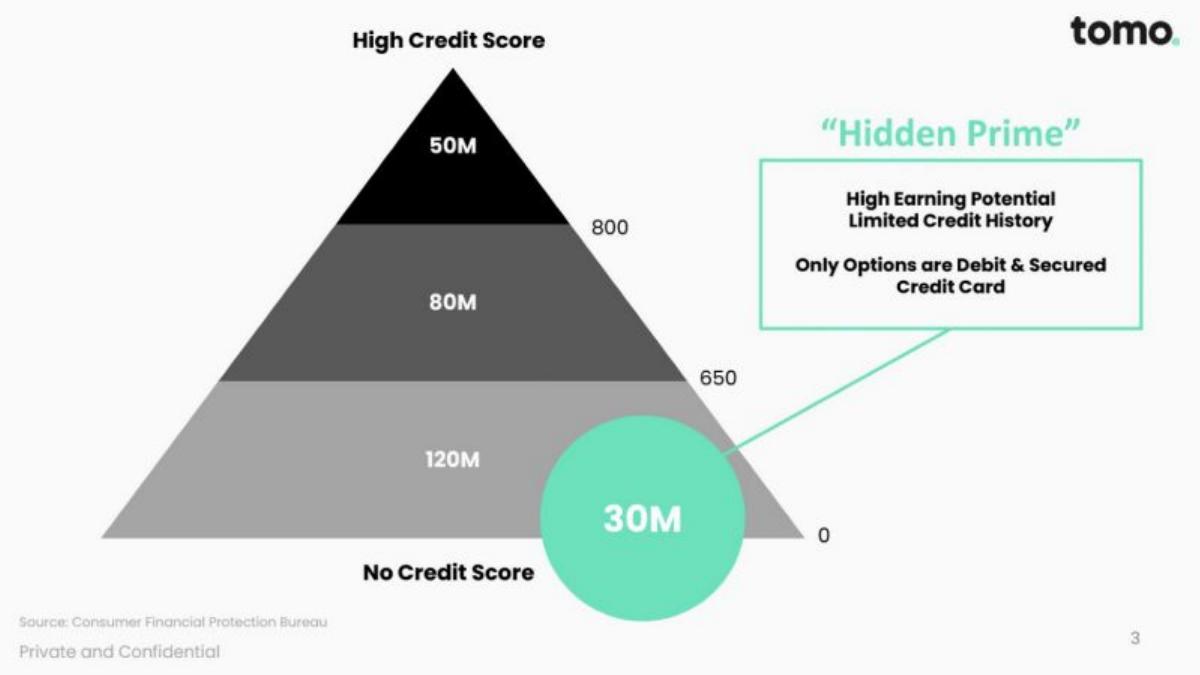
- The company targets a 30M person 'Hidden Prime' segment characterized by high earning potential but limited credit history (Slide 3).
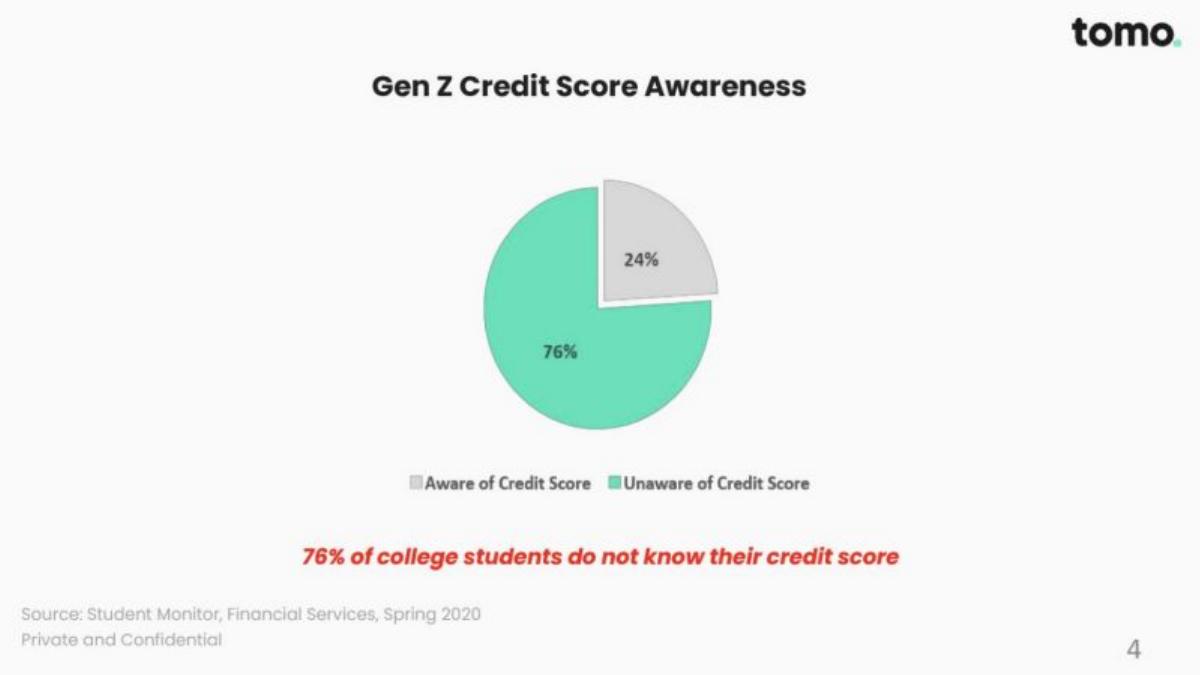
- A significant market gap is identified among Gen Z, with 76% of college students reportedly unaware of their credit score (Slide 4).
- TomoCredit utilizes a non-traditional underwriting model that requires no credit score, 0% APR, and no hidden fees (Slide 8).
- The startup reports an extremely low Customer Acquisition Cost (CAC) of $2 (Slide 11).
- User quality is emphasized by a metric of $1,000 in monthly spend per user (Slide 12).
- Revenue is generated through interchange fees paid by merchants rather than interest or fees from customers (Slide 13).
- Transaction volume saw a 15x increase between July 2020 and January 2021 (Slide 14).
- The deck omits a dedicated team slide, specific financial figures in the projections table, and a clear 'ask' for the round amount.
Executive Summary: The 'Hidden Prime' Opportunity
TomoCredit’s 2021 Series A pitch deck is a focused narrative on market inefficiency. The company identifies a massive segment of the population—young professionals, international students, and immigrants—who are financially responsible but invisible to the traditional FICO-based credit system. By offering a credit card with 0% APR and no credit check, TomoCredit positions itself not as a lender of last resort, but as a gateway for the next generation of high-value consumers. The deck successfully raised $10M by emphasizing low acquisition costs and high user quality.
Slide 1-2: The Hook and the Core Promise
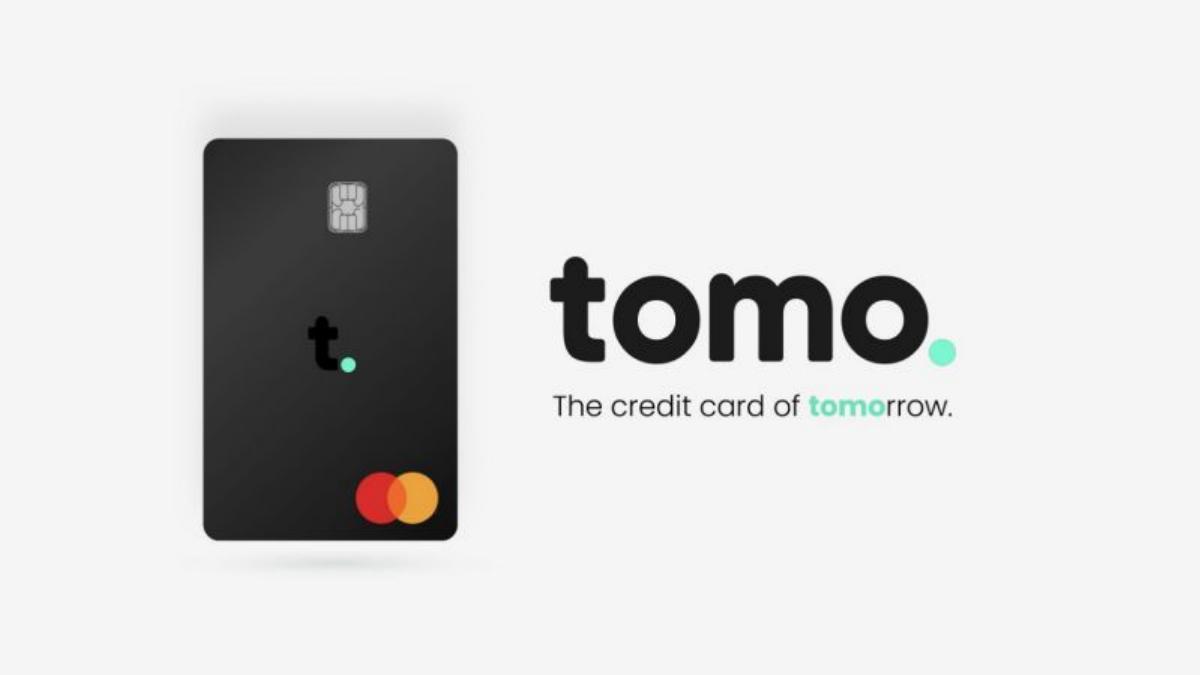
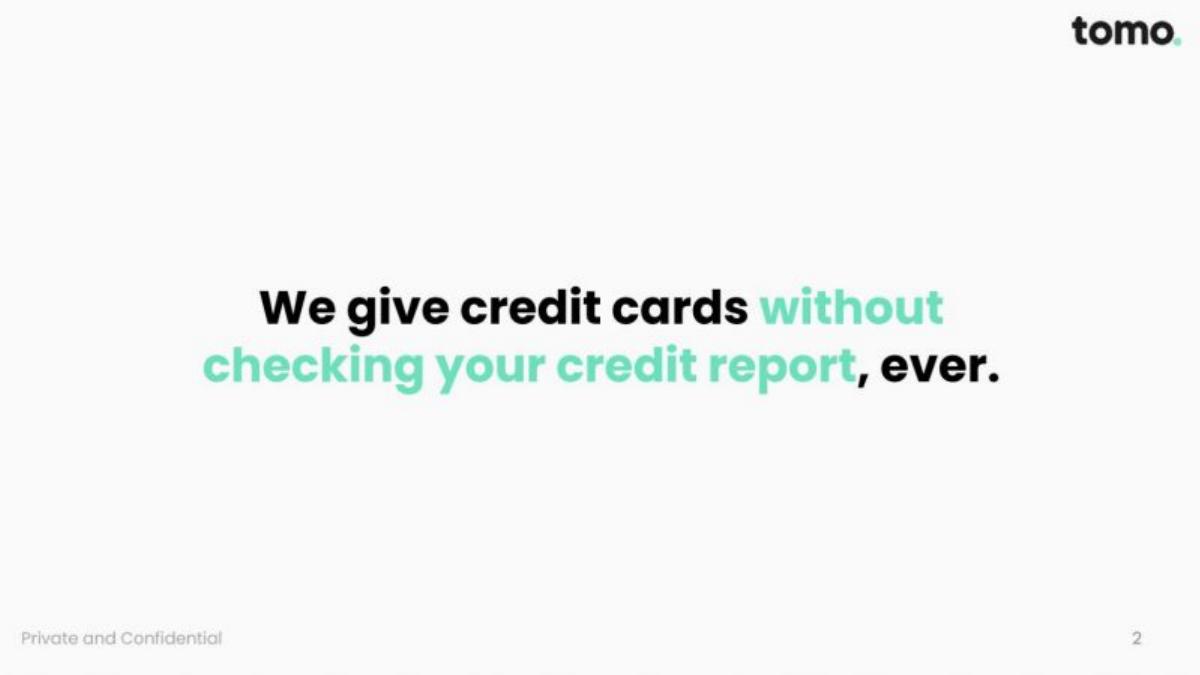
The deck opens with a clean visual of the Tomo card, a sleek black Mastercard, and the tagline "The credit card of tomorrow." Slide 2 immediately delivers the company's primary differentiator in a single sentence: "We give credit cards without checking your credit report, ever." This is a bold claim in the fintech space, where credit checks are the industry standard for risk mitigation. It sets the stage for the rest of the deck to explain how they manage risk without that data point.
Slide 3-4: Defining the Market Gap
Slide 3 uses a pyramid to visualize the credit landscape. While 50M people have high credit scores (800+) and 80M have scores above 650, there is a base of 120M with no credit score. TomoCredit highlights a 30M person subset of this base as the "Hidden Prime." These are individuals with "High Earning Potential" but "Limited Credit History." Slide 4 adds a demographic layer, noting that 76% of college students do not know their credit score, citing Student Monitor (Spring 2020). This suggests a massive, untapped, and somewhat financially naive market that is ripe for a new type of financial product.
Slide 5-6: The Founder's Journey
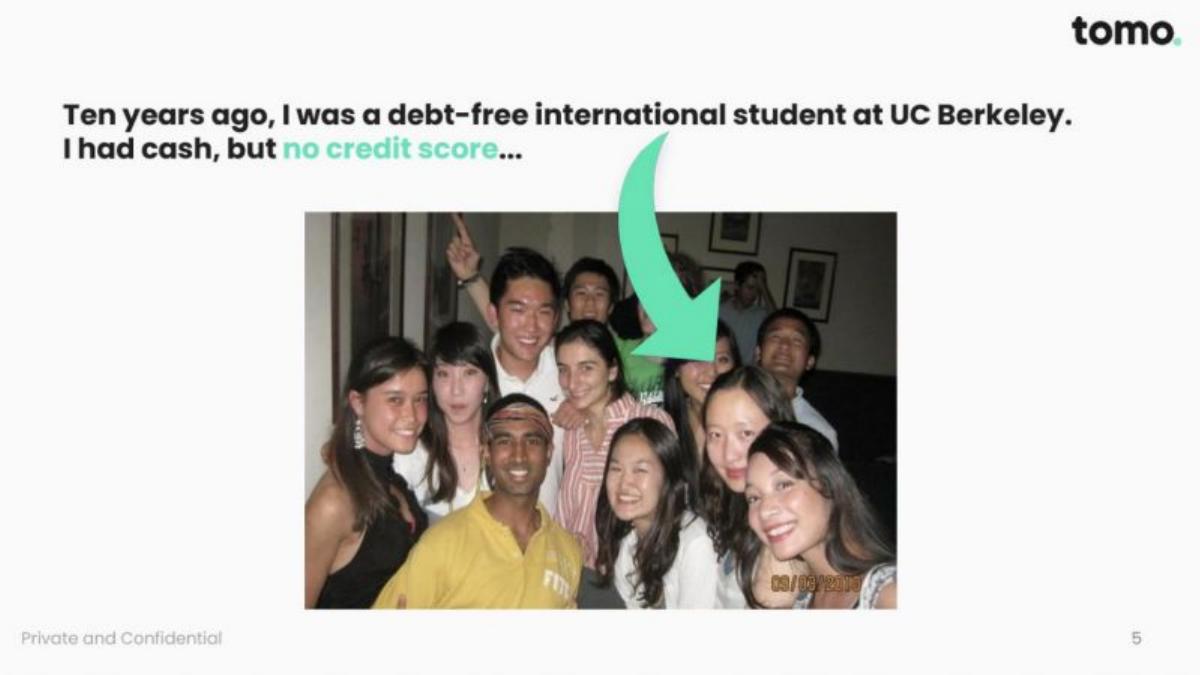
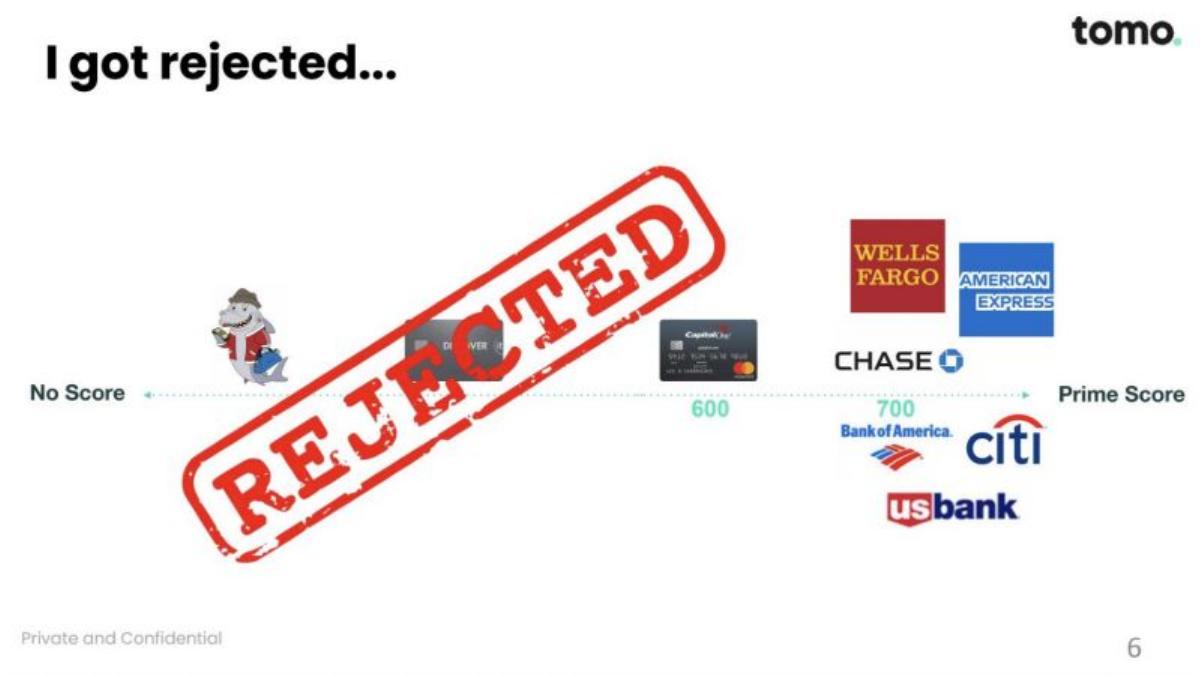
Slide 5 introduces a personal narrative, showing a photo of the founder as an international student at UC Berkeley ten years ago. The text notes she was "debt-free" and "had cash, but no credit score." Slide 6 illustrates the consequence: a large "REJECTED" stamp over a timeline of credit scores. It shows that while traditional banks like Chase, Amex, and Citi cater to those with 700+ scores, and Capital One might go down to 600, those with no score are left with predatory "loan sharks." This personalizes the problem and establishes founder-market fit.
Slide 7-9: Market Segmentation and Solution
Slide 7 breaks down the market into three buckets: 20M Students, 27M Immigrant Workers, and 170M First-time cardholders. Slide 8 presents "The Solution": a card with no credit score needed, 0% APR, and no hidden fees. Slide 9 lists the value proposition for the user: building a credit score quickly, qualifying for future mortgages or car loans, and saving money. The focus here is on the card as a tool for upward mobility rather than just a spending vehicle.
Slide 10-12: Go-To-Market and Unit Economics
Slide 10 showcases a modern acquisition strategy focused on "Growth Hacking" via TikTok and YouTube, featuring influencers like Austin Hankwitz. This strategy appears highly effective, as Slide 11 claims an "Extremely low CAC" of only $2. This is a staggering figure for the fintech industry, where CAC often exceeds $100. Slide 12 reinforces the quality of these low-cost users, stating they spend an average of $1,000 monthly per user. The implication is clear: TomoCredit acquires high-spending users for almost nothing because traditional banks are ignoring them.
Slide 13-14: The Business Model and Traction
Slide 13 explains the revenue model: Interchange Revenue. The deck emphasizes that this is "Paid by merchants, not by customers," which supports their brand as a consumer-friendly alternative to high-interest cards. Slide 14 provides a traction chart showing transaction volume. The chart shows near-zero activity in mid-2020, followed by a vertical spike starting in October 2020. The slide claims volume is "Up 15x times in the past 6 months," providing the necessary momentum for a Series A round.
Slide 15-16: Projections and Competition
Slide 15 is a projection table for 2020-2022. Interestingly, the version of the deck shared uses placeholders ("xxM" and "$yym") for transaction volume and revenue, though it does show a headcount growth plan from 10 to 500 employees. Slide 16 is a standard 2x2 competitive matrix. TomoCredit places itself in the top-right quadrant: "High Income" and "No Credit Requirement." They position Chime as "Low Income / No Credit Requirement" and traditional banks like Chase and Amex as "High Income / Credit Requirement," effectively carving out a unique space for themselves.
Slide 17-18: The Close
Slide 17 is a simple contact slide with the founder's email and the repeating tagline "The credit card of tomorrow." Slide 18 is a promotional slide for the platform where the deck was hosted and is not part of the TomoCredit presentation.
What TomoCredit Does Well
The deck is exceptionally strong at identifying a specific market inefficiency . By naming the "Hidden Prime," they give investors a mental model for why this business should exist. The use of a personal founder story (Slide 5) creates immediate empathy and explains the "why" behind the product. Furthermore, the unit economics presented—specifically the $2 CAC (Slide 11) and $1,000 monthly spend (Slide 12)—are powerful metrics that suggest a highly scalable and profitable business model if the underwriting holds up.
What is Missing from the Deck
The most notable omission is a Team Slide . While the founder's story is mentioned, there is no information on the broader team's experience in risk management, compliance, or banking technology—all of which are critical for a credit card startup. Additionally, the deck is very light on Underwriting Mechanics . It states they don't use credit scores, but it doesn't explain what they do use (e.g., cash-flow underwriting via Plaid). Finally, the Financial Projections on Slide 15 are redacted or use placeholders, and there is no Ask Slide detailing the round size or use of funds, which are standard for a fundraising deck.
Founder Takeaways: What to Copy
Focus on a Niche: Don't just say you are a credit card for everyone. TomoCredit’s focus on the "Hidden Prime" (Slide 3) makes their market entry strategy much more believable. · Highlight Unorthodox Metrics: If your CAC is significantly lower than the industry average, make it a centerpiece of your deck (Slide 11). · Use Social Proof: Showing actual TikTok and YouTube screenshots (Slide 10) proves that your go-to-market strategy isn't just theoretical—it's already working. · Simple Revenue Model: Clearly stating that merchants pay, not customers (Slide 13), helps differentiate the brand from "predatory" lenders.
Frequently asked questions
- How does TomoCredit make money if they offer 0% APR?
- According to slide 13, TomoCredit generates revenue exclusively through interchange fees. These are fees paid by merchants every time a customer swipes their card. By positioning the product as 'paid by merchants, not by customers,' they align their business model with the financial health of their users, avoiding the debt-trap associations of traditional high-interest credit cards.
- Who is the primary target audience for TomoCredit?
- The deck segments the market into three primary groups: 20M students (international and domestic), 27M immigrant workers with proven financial responsibility, and 170M first-time cardholders (Slide 7). They specifically focus on the 'Hidden Prime'—individuals with high earning potential who are currently forced to use debit or secured cards due to a lack of FICO history.
- What is the 'Hidden Prime' mentioned in the deck?
- As defined on slide 3, the 'Hidden Prime' refers to a 30-million-person segment of the population that has a credit score of 0 (or no score) but possesses high earning potential. Traditional banks typically reject these individuals or offer them inferior products, despite their low actual risk profile.
- What are the key growth metrics shared in the deck?
- TomoCredit highlights three main growth indicators: a 15x increase in transaction volume over a six-month period (Slide 14), a very low CAC of $2 (Slide 11), and a high engagement rate with users spending an average of $1,000 per month on their cards (Slide 12).
- What is missing from the TomoCredit pitch deck?
- The deck is missing several standard components: a team slide detailing the founders' backgrounds, a specific 'Ask' slide stating how much they are raising and the terms, and a detailed breakdown of their proprietary underwriting technology. Additionally, the projections slide (Slide 15) uses placeholders like '$yym' and 'xxM' instead of actual forecasted numbers.