Toddle’s pitch deck is a masterclass in social proof and narrative-driven fundraising. Eschewing traditional slides like revenue charts, CAC/LTV, or a formal 'Ask' slide, the deck relies on the premise that the future of web development is visual. The founders leverage their deep engineering backgrounds and a vibrant community to prove that Toddle isn't just another website builder, but a professional-grade tool capable of building SaaS applications. With 90% of support questions answered by the community (Slide 10) and testimonials from agencies and startups alike, the deck successfully argu…
Key takeaways
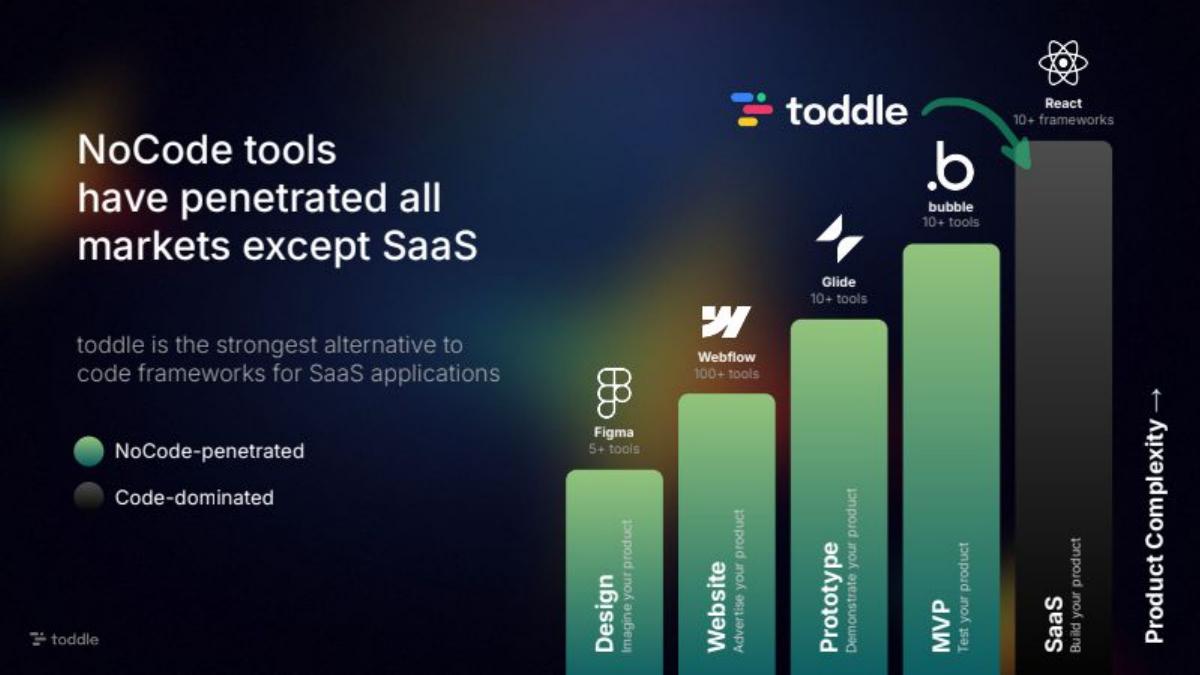
- The deck positions Toddle as the bridge between low-complexity no-code tools like Webflow and high-complexity code frameworks like React (Slide 6).
- A significant portion of the deck—6 out of 15 slides—is dedicated to social proof, including community engagement and customer testimonials (Slides 4, 9, 10, 11, 12, 13, 14).
- The founders emphasize their technical pedigree, citing a $130M exit and roles at Google and Typeform (Slide 3).
- Toddle claims that 90% of support questions are answered by the community before the team can reply, highlighting extreme user engagement (Slide 10).
- The product is 'dogfooded,' with the editor itself being built using Toddle (Slide 7).
- The deck completely omits financial projections, current revenue, user growth numbers, and a specific funding request.
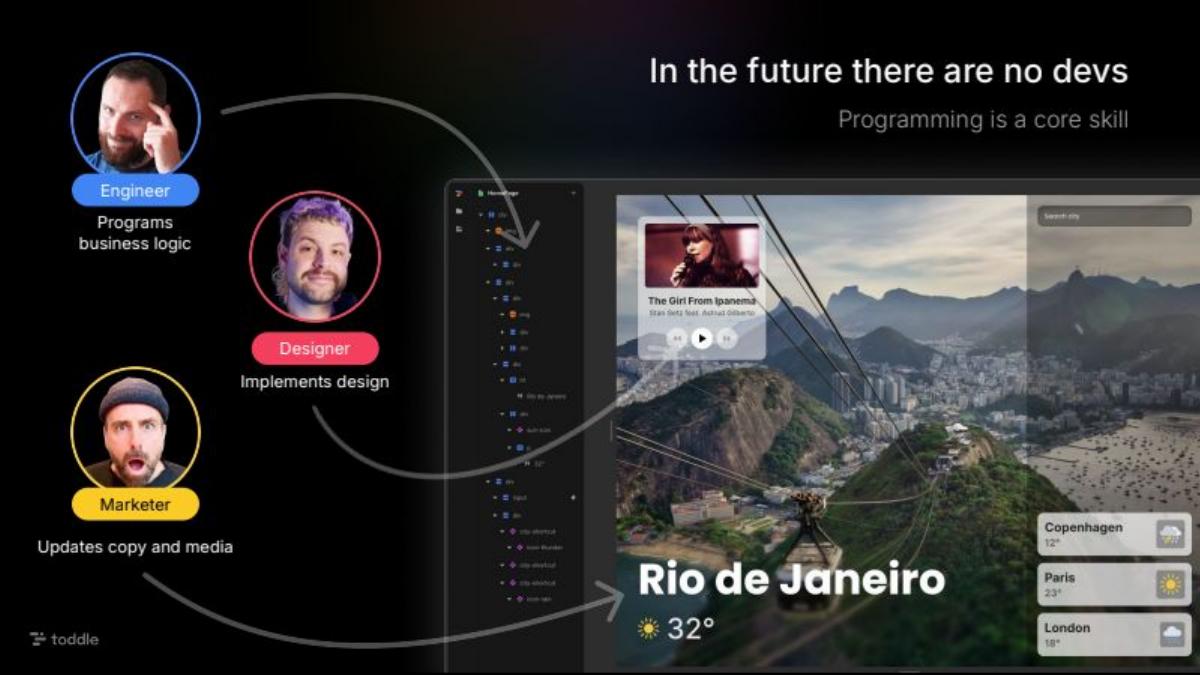
- The market thesis is built on the idea that 'programming is a core skill' and that in the future, 'there are no devs' in the traditional sense (Slide 5).
The Narrative: Visual Development as the Future
Toddle’s pitch deck is built on a singular, provocative thesis: "In the future there are no devs" (Slide 1). This isn't a claim that software will stop being built, but rather that the medium of construction will shift from text-based editors to visual frameworks. The deck is designed to convince investors that the current paradigm of web development is an anachronism and that Toddle is the tool to lead the transition.
Slide 1: The Vision
The title slide is minimalist, featuring the Toddle logo and the tagline "In the future there are no devs." This sets a high-stakes, visionary tone immediately. It suggests a massive market shift rather than an incremental improvement on existing tools.
Slide 2: The Problem Statement
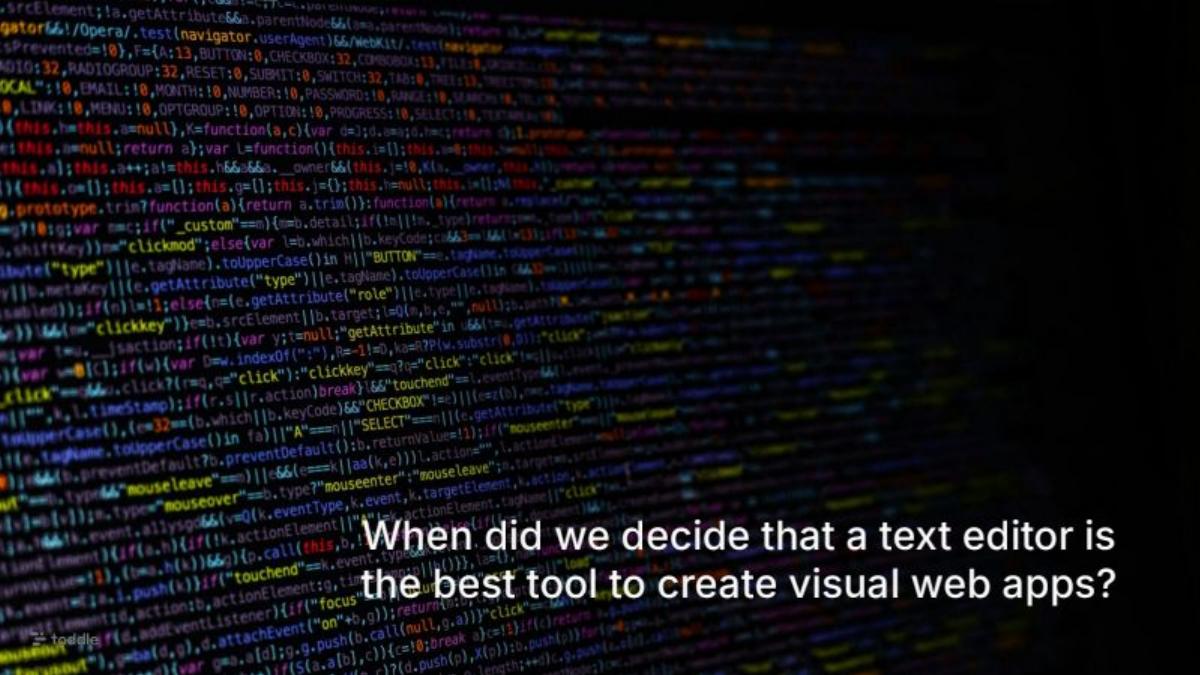
Slide 2 uses a background of dense, colorful code with the question: "When did we decide that a text editor is the best tool to create visual web apps?" This identifies the core friction Toddle seeks to solve: the disconnect between the visual nature of the web and the abstract, text-heavy nature of programming.
Slide 3: The Team
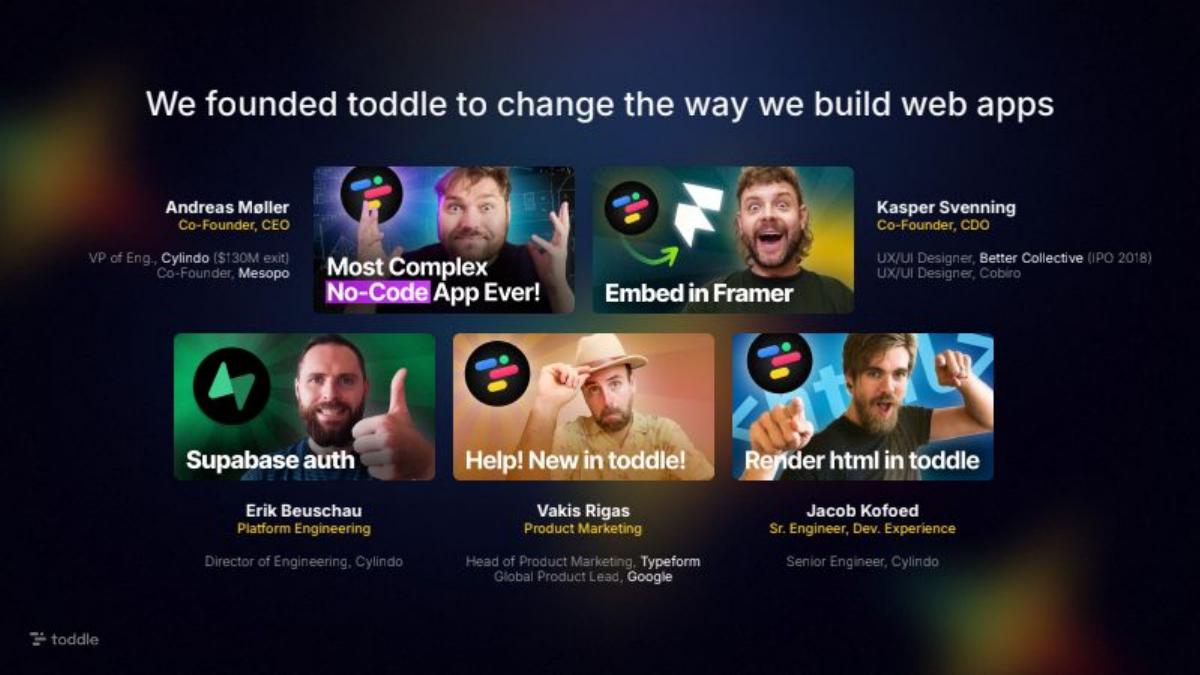
The team slide is unusually early in the deck, likely to establish immediate credibility for such a bold vision. Andreas Møller (Co-Founder, CEO) is noted for a $130M exit at Cylindo. Kasper Svenning (Co-Founder, CDO) brings experience from Better Collective (IPO 2018). The slide also features Erik Beuschau, Vakis Rigas, and Jacob Kofoed , highlighting backgrounds at Google, Typeform, and Cylindo. The use of YouTube-style thumbnails for the team members hints at their modern, content-forward approach to building a brand.
Slide 4: User Sentiment
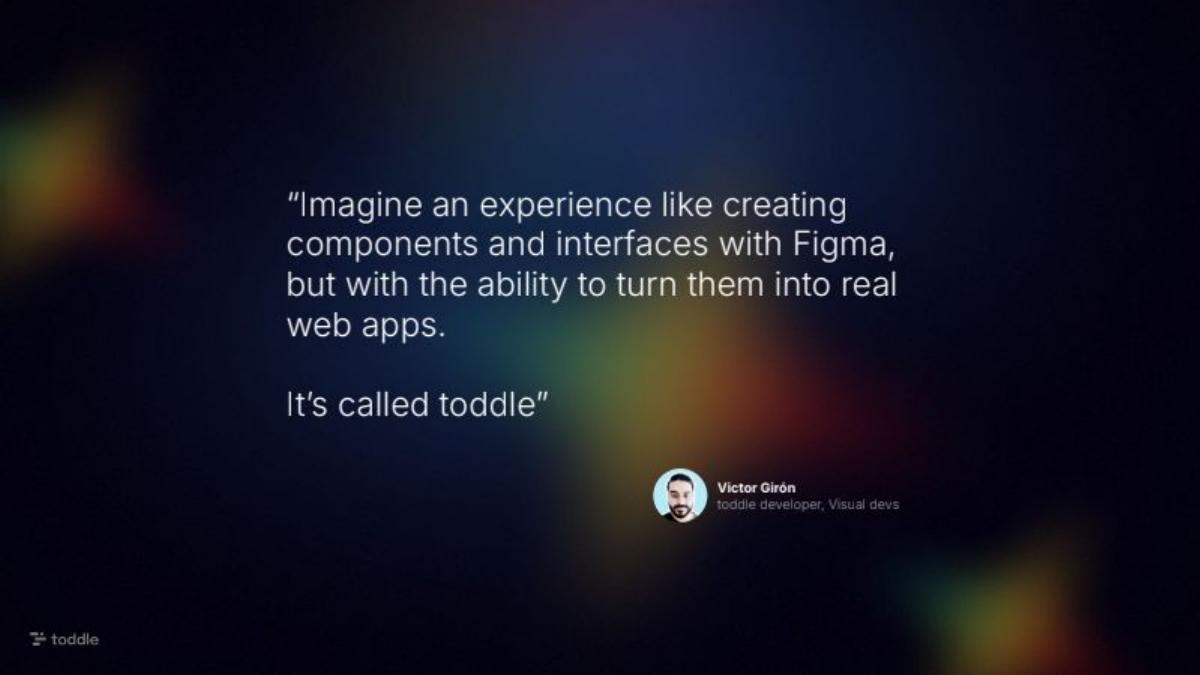
Instead of a traditional 'Solution' slide, Slide 4 uses a quote from a developer, Victor Girón: "Imagine an experience like creating components and interfaces with Figma, but with the ability to turn them into real web apps. It’s called toddle." This frames the product through the eyes of a user, making the value proposition tangible.
Slide 5: The New Workflow
Slide 5 elaborates on the vision. It posits that "Programming is a core skill" and shows how an Engineer, Designer, and Marketer all collaborate directly within the Toddle interface. This suggests that Toddle collapses the traditional silos of development, allowing different roles to contribute to the same visual source of truth.
Slide 6: Market Positioning
This is the most analytical slide in the deck. It maps "Product Complexity" against various tools. It shows that Figma, Webflow, Glide, and Bubble have successfully penetrated the Design, Website, Prototype, and MVP markets. However, it identifies the "SaaS" market as "Code-dominated" by frameworks like React . Toddle is positioned as the arrow breaking into this final, most complex frontier.
Slide 7: Product Capability
Slide 7 addresses the 'is it powerful enough?' question. It features a screenshot of the Toddle editor and a quote from a developer (Alosage) stating: "The fact that the editor itself is made in toddle is INSANE." This is a classic 'dogfooding' proof point, demonstrating that the tool is sophisticated enough to build itself.
Slide 8: Efficiency Gains
Slide 8 makes a bold claim: "A team of 5 competes with companies 10-50x larger." This speaks to the economic advantage of using Toddle—speed and resource efficiency—which is a primary driver for B2B SaaS adoption.
Slides 9-11: Community as a Moat
These slides focus on the ecosystem. Slide 9 shows a collage of user-generated content (YouTube tutorials, podcasts, reviews). Slide 10 provides a specific metric: "Eight months ago we answered all support questions, now 90% are answered by the community before we get a chance to reply." This is a powerful indicator of product-market fit and a self-sustaining user base. Slide 11 provides a wall of testimonials from Twitter and other platforms, reinforcing the 'love' users have for the tool.
Slides 12-14: Case Studies
Slide 12 (Localpost): Solopreneurs building faster without extensive coding knowledge. · Slide 13 (Syncdesk): Startups choosing Toddle over competitors like WeWeb and Bubble for long-term scalability. · Slide 14 (Productminds): Agencies increasing profitability and reducing overhead by shipping faster for enterprise clients.
Slide 15: Conclusion
The deck ends as it began, with the logo and a final positioning statement: "The next generation development platform."
What Works in This Deck
Strong Social Proof: By dedicating nearly half the deck to community and customer voices, Toddle proves that they aren't just building in a vacuum. The 90% community-support metric on Slide 10 is particularly impressive for a Seed-stage company.
Clear Differentiation: Slide 6 clearly explains why Toddle exists in a crowded market. They aren't trying to beat Webflow at marketing sites; they are trying to beat React at SaaS applications.
Founder-Market Fit: The team's background in engineering and their previous exits/roles at major tech companies give them the 'right to play' in the highly technical dev-tool space.
What Is Missing
Financials and Traction: There is no mention of revenue, number of paying customers, or growth rates. While the community engagement is high, the deck doesn't show how that translates into a business model.
The Ask: There is no slide detailing how much money they are raising or what they plan to do with the capital. This information was likely handled in the verbal pitch or a separate document.
Roadmap: The deck focuses heavily on what Toddle is today. It lacks a forward-looking product roadmap or a vision for how they will expand their market share over the next 3-5 years.
What Other Founders Should Copy
The 'Dogfooding' Proof: If you are building a tool for builders, show that you used your own tool to build the product. It is the ultimate proof of utility (Slide 7).
The Complexity Map: Using a bar chart to show where competitors fall short on a specific axis (like 'Product Complexity' on Slide 6) is a very effective way to visualize a gap in the market.
Community Metrics: If you have a Discord or Slack community, don't just say it's 'active.' Use a metric like the percentage of questions answered by peers to prove the depth of engagement (Slide 10).
Frequently asked questions
- How much did Toddle raise with this deck?
- According to the catalogue facts, Toddle raised $4.3M in a Seed round in 2024. The round was led by Inventure, with participation from PSV, Lifeline Ventures, and David Okuniev. Interestingly, the deck itself does not contain an 'Ask' slide or specify the amount being raised.
- What is Toddle's core value proposition?
- Toddle positions itself as the first no-code tool capable of building complex SaaS applications. As shown on Slide 6, they argue that while tools like Figma, Webflow, and Bubble have penetrated design and MVPs, the SaaS market is still dominated by code frameworks like React. Toddle aims to be the 'strongest alternative' for this high-complexity segment.
- Who are the founders of Toddle?
- The team, detailed on Slide 3, includes CEO Andreas Møller (formerly VP of Eng. at Cylindo, which had a $130M exit) and CDO Kasper Svenning (formerly at Better Collective). The broader team includes veterans from Google, Typeform, and Cylindo, emphasizing a high level of technical and product marketing expertise.
- Is Toddle an open-source project?
- Yes, the editorial context from the listing confirms that Toddle.dev is an open-source visual web builder framework. This aligns with the deck's heavy emphasis on community-led growth and the 'no-code' framework terminology used on Slide 6.
- What is missing from the Toddle pitch deck?
- The deck is notably missing several 'standard' venture slides. There are no financial projections, no mention of current MRR or ARR, no user growth charts, no competitive matrix beyond the complexity chart on Slide 6, and no roadmap or 'use of funds' slide. It is a purely product and community-focused presentation.