TNR Gold Pitch Deck Teardown: A Royalty-First Strategy for Green Energy Metals
TNR Gold positions itself as a hybrid royalty and exploration company, leveraging high-exposure projects like Mariana Lithium and Los Azules Copper. This teardown examines how the company balances the low-overhead royalty model with traditional mining exploration.
TNR Gold's investor presentation outlines a dual-track strategy: acting as a royalty holder for major green energy metal projects while maintaining direct ownership of gold exploration assets. The company holds a 1.8% NSR royalty on the Mariana Lithium project and a 0.36% NSR royalty on the Los Azules Copper project, both in Argentina. By utilizing a royalty and streaming business model, TNR aims to minimize the high operating expenses and infrastructure costs typically associated with mining, while benefiting from the production successes of partners like Ganfeng Lithium and McEwen Mining. T…
Key takeaways
The company holds a 1.8% Net Smelter Return (NSR) royalty on the Mariana Lithium property in Argentina (Slide 1).
TNR retains a 0.36% NSR royalty on the Los Azules Cu-Au project, operated by McEwen Mining (Slide 1).
The business model emphasizes using JV partnerships to mitigate costs and risk while maximizing value (Slide 6).
The Shotgun Ridge project in Alaska is described as a porphyry-style gold mineralized system with 'room to grow' beyond current resource estimates (Slide 11).
Los Azules is projected to be the 26th largest copper mine in the world if in production, with a life-of-mine average of 153 kt Cu/y (Slide 21).
Mariana Lithium's Measured and Indicated resource was updated to 4.41 million tonnes of Lithium Carbonate Equivalent (LCE) in 2020 (Slide 36).
The royalty model is specifically chosen to avoid costly infrastructure and achieve high revenue per employee compared to traditional miners (Slide 16).
Technical disclosures clarify that TNR has not engaged independent persons to verify disclosures provided by project operators like McEwen Mining (Slide 41).
Executive Summary and Portfolio Overview
Slide 1: Title and Core Assets
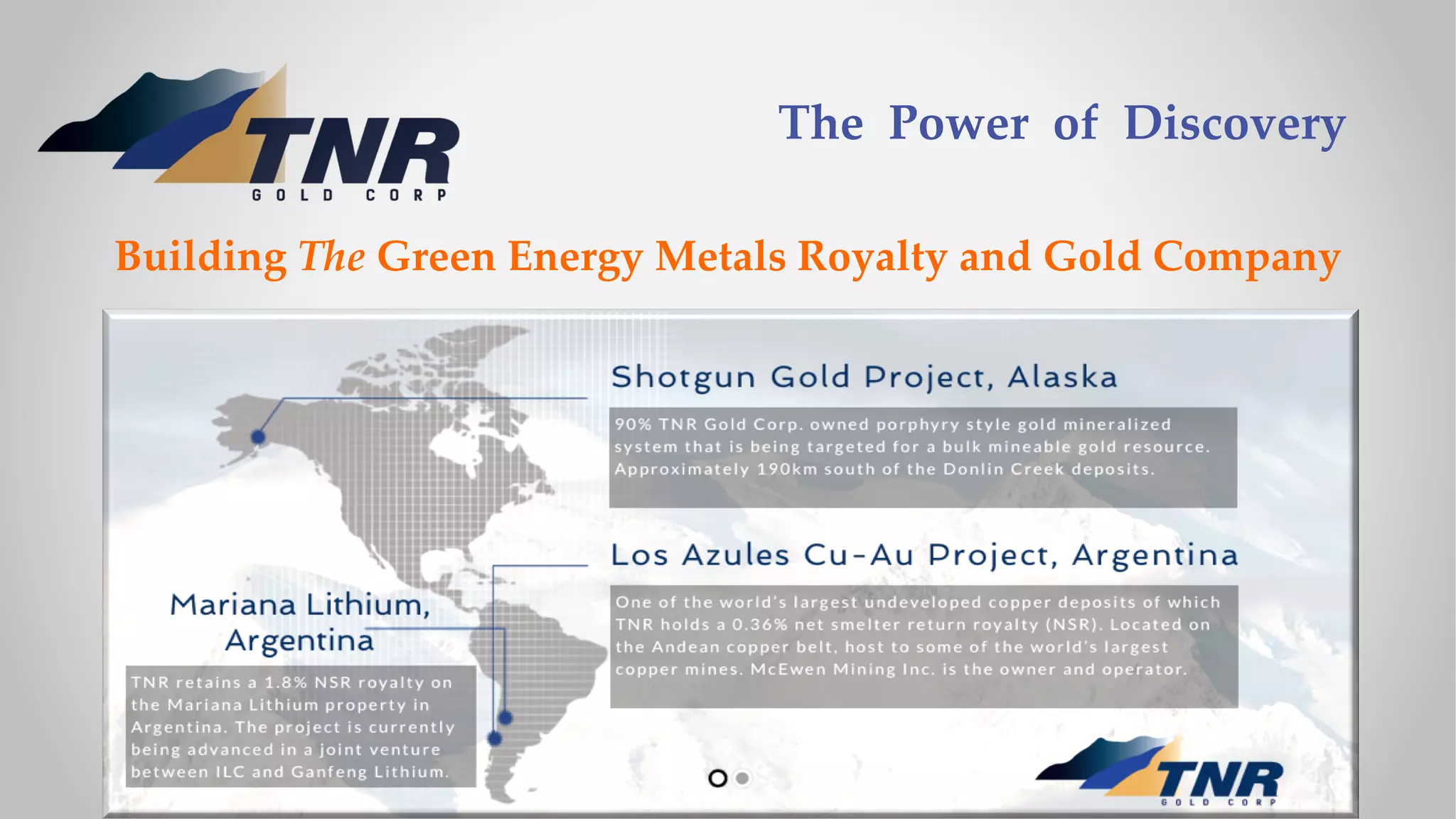
The presentation opens with the tagline "The Power of Discovery" and defines the company's mission: "Building The Green Energy Metals Royalty and Gold Company." The slide highlights three anchor projects. First is the Shotgun Gold Project in Alaska , which is 90% owned by TNR and described as a porphyry-style gold system 190km south of Donlin Creek. Second is the Mariana Lithium project in Argentina , where TNR retains a 1.8% NSR royalty; this project is a joint venture between ILC and Ganfeng Lithium. Third is the Los Azules Cu-Au Project in Argentina , where TNR holds a 0.36% NSR royalty. The slide notes that Los Azules is one of the world's largest undeveloped copper deposits and is operated by McEwen Mining Inc.
Slide 6: Corporate Culture and Strategy
This slide uses a flow chart to detail the company's operational philosophy. It emphasizes an "Experienced Management Team" and "Strong ownership by insiders and management." The business model is broken down into four pillars: identifying and acquiring projects at an early stage, selectively advancing those projects, using JV partnerships to mitigate costs and risk, and maximizing value while minimizing "success time." The strategic focus is explicitly split between energy metals (lithium and copper) and precious metals (gold).
Exploration and Resource Potential
Slide 11: Shotgun Ridge - Room to Grow
Focusing on the Alaskan gold asset, this slide provides a technical cross-section of the Shotgun Ridge site. It features an "Assay Colour Profile" ranging from 0.000 to 10.000. The primary takeaway is the annotation "Mineralization not included in resource estimate," pointing to several drill holes (such as SR06-41 and SR98-13) that suggest the deposit remains "OPEN" in multiple directions. A footnote refers investors to the end of the presentation for a full description of the resource estimate, emphasizing that the current figures may represent a floor rather than a ceiling for the project's potential.
Slide 16: GEM Royalty Business Model
This slide explains the rationale behind the royalty and streaming approach. It lists three primary advantages: royalty companies are not responsible for costly infrastructure, allowing them to avoid huge operating expenses; they hold diversified portfolios to mitigate concentration risk; and they maintain a high revenue-per-employee ratio compared to traditional miners. This slide serves as the economic thesis for the company, positioning TNR as a high-margin vehicle for metal exposure.
Major Project Deep Dives
Slide 21: Los Azules PEA Annual Production
This slide provides a comparative bar chart showing annual copper production for the world's largest mines. Los Azules is highlighted as the "26th largest in the world" based on 2017 data. The chart indicates that for years 1 through 13, the project is expected to produce 186 kt Cu/y, with a Life of Mine (LOM) average of 153 kt Cu/y. The "Future Plans" section for this asset includes advancing to the permit application stage and continuing the joint venture arrangement.
Slide 26: Los Azules Update
This slide reprints a news release from July 30, 2019, regarding McEwen Mining's Q2 results. The critical update is the validation of a new "low altitude all-year access route" (Northern access route). Previously, access was only possible for 4-5 months of the year. The slide also mentions that work on the road was slated to begin later that year and that an Environmental Impact Assessment was targeted for submission by the end of 2019, with a declaration expected in 2020.
Slide 31: Mariana Lithium Royalty Holding
TNR reports on the Mariana Lithium project in Salta Province, Argentina. The slide references a Preliminary Economic Assessment (PEA) from November 2018. Key highlights include a 25-year mine life producing 10,000 tonnes per year of Lithium Carbonate Equivalent (LCE) and 84,000 TPY of Sulphate of Potash (SOP). The estimated CAPEX is US $243 million, with an after-tax NPV of US $192 million at a 10% discount rate and a 20% post-tax IRR. The slide notes that the project is 82.754% owned by Ganfeng Lithium.
Slide 36: Updated Resource Estimate for Mariana
This slide provides a significant update from February 2019/2020 regarding the Mariana Lithium project. It announces a 253% increase in the Measured and Indicated resource over the 2017 estimate, totaling 4,410,000 tonnes of LCE. It also notes 49,700,000 tonnes of potash (KCl) in the same categories. This data reinforces the value of TNR's 1.8% NSR royalty by demonstrating the massive scale of the underlying resource being developed by Ganfeng.
Compliance and Disclosures
Slide 41: Technical Disclosure Statements
The final slide in the provided set contains the necessary legal and technical caveats. It states that information is based on studies by McEwen Mining and their "Qualified Persons" under NI 43-101. Crucially, it notes that TNR Gold Corp. "has not engaged an independent qualified person to verify the technical disclosures provided by McEwen Mining Inc." and cautions readers against placing undue reliance on these disclosures. It also clarifies that mineral resources are not mineral reserves and do not have demonstrated economic viability.
What TNR Gold Does Well
TNR Gold effectively communicates a complex "hybrid" model. By lead-generating with the royalty aspect, they appeal to investors who are wary of the capital-intensive nature of mining. The deck successfully leans on the credibility of its partners—Ganfeng Lithium and McEwen Mining—to validate the quality of the assets. Using third-party PEA data and production rankings (as seen on Slide 21) provides an objective sense of scale that internal company projections often lack.
Omissions and Weaknesses
The most glaring omission in the provided slides is a clear "Ask." There is no slide detailing how much capital the company is seeking, the valuation, or the specific use of proceeds. Furthermore, while the deck mentions a "Management Team" on Slide 6, there are no individual bios or track records provided in this selection to verify the "experienced" claim. The deck also lacks a clear timeline or roadmap for the Shotgun Gold project, leaving its development status somewhat vague compared to the royalty assets.
Founder Takeaways
Founders in the resource or heavy infrastructure space should note how TNR uses the "Royalty Model" to differentiate itself from high-burn competitors. If your company operates in a sector with massive CAPEX, finding a way to frame your business as a high-margin, low-overhead play (Slide 16) is a powerful way to attract a different class of investor. Additionally, the use of comparative charts (Slide 21) to show where a project sits in the global landscape is a highly effective way to communicate market importance without relying on hyperbole.
Frequently asked questions
What is TNR Gold's primary business model?
TNR Gold operates as a 'Green Energy Metals Royalty and Gold Company.' As shown on Slide 16, they focus on a royalty and streaming model to avoid the heavy capital expenditures of mine construction and infrastructure. They identify early-stage projects, advance them selectively, and then use Joint Venture (JV) partnerships to mitigate operational risks while retaining a percentage of the revenue (NSR).
Which major mining companies are TNR Gold partnered with?
The deck identifies several key partners. The Mariana Lithium project is a joint venture between International Lithium Corp (ILC) and Ganfeng Lithium (Slide 1). The Los Azules Copper-Gold project is owned and operated by McEwen Mining Inc. (Slide 1). These partnerships allow TNR to benefit from the technical expertise and financing capabilities of much larger industry players.
What are the specific royalty percentages held by TNR?
According to Slide 1 and Slide 31, TNR holds a 1.8% Net Smelter Return (NSR) royalty on the Mariana Lithium property. For the Los Azules project in Argentina, Slide 1 states they hold a 0.36% NSR royalty. These royalties provide top-line revenue exposure without the burden of ongoing operating costs or capital calls.
What is the status of the Shotgun Gold Project?
The Shotgun Gold Project in Alaska is 90% owned by TNR Gold. Slide 11 indicates that the project has significant 'room to grow,' with mineralization identified that is not yet included in the formal resource estimate. It is located approximately 190km south of the Donlin Creek deposits and is being targeted as a bulk mineable gold resource.
How does TNR Gold view the copper market through Los Azules?
TNR views Los Azules as a world-class asset. Slide 21 compares its potential annual production to the world's largest copper mines, noting it would be the 26th largest globally. The Preliminary Economic Assessment (PEA) cited on Slide 21 estimates production of 186 kt of copper per year for the first 13 years of the mine's life.
TNR Gold Corp. pitch deck, slide 1 (2020)
You’ve studied TNR Gold Corp.’s deck. Now score yours.
Upload your pitch deck and get AI-powered feedback to strengthen your pitch.
The full TNR Gold Corp. deck is embedded on this page and can be read slide by slide in the browser — no download or account required. Each slide is covered in the breakdown above.
What the TNR Gold Corp. pitch deck was used for
This deck is a circa-2020 investor presentation for TNR Gold Corp., a TSX-V listed junior mining and royalty company focused on lithium, copper, and gold projects. It highlights royalty interests in the Mariana Lithium project in Argentina and the Los Azules copper project, alongside the Shotgun gold exploration project in Alaska. At the time, TNR was positioning itself as a green energy metals royalty and gold company and supporting corporate costs and exploration through small private placement financings. The deck appears linked to ongoing non-brokered private placements announced in April–June 2020, used for exploration and project maintenance rather than a large discrete growth round.
Business model: Hybrid mineral royalty and exploration company. TNR holds net smelter return (NSR) royalties on advanced lithium and copper projects while retaining an exploration-stage gold project in Alaska.
Year
2020.
Headquarters
Vancouver, British Columbia, Canada.
Industry
Mining; mineral royalties (lithium, copper, gold).
Round: Public company financing (TSX‑V: TNR) via non-brokered private placement units.
Raising: Up to 13,333,333 units at C$0.03 per unit in a non-brokered private placement announced April 14 and May 21, 2020.
Raised: C$102,000 in the final tranche of a non-brokered private placement of up to 13,333,333 units at C$0.03 per unit, announced April 14 and May 21, 2020 and closed June 23, 2020.
Use of funds as presented: Exploration and maintenance of TNR’s projects in Alaska and Argentina, management consulting fees, office administration, regulatory fees, audit, legal and IT.
What happened after the TNR Gold Corp. deck
Around the time of the circa‑2020 deck, TNR Gold used small non-brokered private placements to fund exploration, project maintenance, and corporate overhead while holding NSR royalties on Mariana Lithium and Los Azules Copper and an exploration gold project in Alaska. Since then, operator progress—especially Ganfeng Lithium bringing Mariana into production—has moved TNR closer to its first royalty
Completion of the non-brokered private placement announced in April–May 2020, with a final tranche of 3,400,000 units at
Advancement of the Mariana Lithium project into production by Ganfeng Lithium, leading TNR to anticipate its first royal
Ongoing technical and economic work at Los Azules Copper, including a feasibility study confirming an economically robus
Later corporate updates and investor presentations rebranding TNR as a green energy metals royalty and gold company and
What the TNR Gold Corp. deck got right
High-leverage royalty exposure to major lithium and copper projects. TNR holds NSR royalties on two large, advanced projects: a 1.5% NSR on the Mariana Lithium Project in Argentina (with 0.15% held on behalf of a shareholder) operated by Ganfeng Lithium, and a 0.4% NSR on the Los Azules Copper Project, with 0.04% held on behalf of a shareholder. These assets provide leveraged exposure to lithium and copper markets without the capital intensity of being the operator.
Diversified commodity exposure via gold exploration and battery metals royalties. The company maintains the Shotgun gold project in Alaska alongside its royalty interests, offering optionality in gold and potential upside from exploration success in a relatively underexplored district. Combining gold exploration with battery metals royalties diversifies commodity exposure within a small-cap vehicle.
Low-operating-cost royalty model built on operator-led development. As a royalty-focused junior, TNR’s operating cost base is relatively low compared with full-scale mining companies, allowing the business model to emphasize optionality and long-term upside from operator-led project development. This structure is reinforced by the use of modest private placements to fund project maintenance and corporate overhead.
Material potential royalty cash flow relative to company size. Later analyses and corporate communications suggest that Mariana alone could generate meaningful annual royalty revenue (analysts estimating around US$1.6 million annually under certain price assumptions), highlighting substantial potential cash flow relative to TNR’s small size once royalties start.
Exposure to an economically robust, ESG-focused copper project. Subsequent feasibility and corporate updates for Los Azules describe it as an economically robust copper project with strong ESG performance, enhancing the perceived quality and long-term viability of TNR’s copper royalty interest.
Positioning as a green energy metals royalty and gold company. The company’s narrative ties its royalty interests to the global transition toward green energy, positioning lithium and copper royalties as strategic assets in electrification supply chains, which can broaden investor appeal compared with traditional junior gold stories alone.
What could have been stronger
Small financing size relative to scale of highlighted assets. Being a circa‑2020 deck for a TSX‑V junior, it is closely tied to a relatively small non-brokered private placement of up to 13,333,333 units at C$0.03 per unit, with the final tranche raising C$102,000. For institutional investors, this scale of financing and the implied market capitalization can appear modest relative to the size of the featured projects, potentially limiting perceived impact of the raise.
Limited near-term cash flow visibility at time of deck. The deck focuses on royalty exposure to Mariana Lithium and Los Azules Copper but, based on contemporaneous disclosures, these royalties were not yet generating cash flow in 2020. Without clear timelines or quantified near-term cash flow in the deck, investors may struggle to connect the royalty narrative to short- and medium-term financial outcomes.
Limited operating control over underlying projects. As a junior company with core assets being minority royalty interests and an exploration-stage gold project, TNR’s ability to influence project timelines or capital spending at Mariana and Los Azules is structurally limited. If the deck does not explicitly address this governance and dependency risk, investors have to infer it from the business model rather than seeing it clearly mitigated.
Perception that funds mainly support overhead rather than growth. The private placement proceeds in 2020 were spread across project maintenance and general corporate costs such as consulting, office administration, regulatory, audit, legal, and IT. If the deck does not clearly distinguish between growth capital and overhead, some investors may view the raise as primarily sustaining operations rather than accelerating value creation.
How an investor would read this deck
What draws attention
Scale and terms of the 2020 non-brokered private placement (units at C$0.03, aggregate size up to 13,333,333 units, proceeds in final tranche C$102,000). The modest raise size versus the large-scale projects may shape valuation and liquidity expectations.
Details of the NSR royalty interests on Mariana Lithium and Los Azules Copper: exact percentages, buyback rights (such as Ganfeng’s subsidiary LMA having the right to repurchase 1.0% of the NSR on Mariana, including 0.9% of TNR’s interest), and how those rights affect long-term revenue.
Status and advancement of operator-led work programs at Mariana (Ganfeng Lithium) and Los Azules (McEwen Mining and related entities), given TNR’s lack of operational control but reliance on these projects for future cash flow.
Shotgun gold project in Alaska: stage of exploration, any resource estimates, and how much capital from the 2020 placement and later financings is directed to advancing it versus maintaining royalty exposure.
Liquidity, trading volume, and capital structure on TSX‑V: impact of low-priced units and historical financings on dilution, float, and the potential for future raises at more attractive terms.
Risks that stand out
Commodity price risk in lithium, copper, and gold directly affects the value of NSR royalty cash flows, with Mariana and Los Azules exposed to market cycles in battery metals and base metals.
Project execution risk resides with operators Ganfeng Lithium at Mariana and McEwen Mining and partners at Los Azules; delays, cost overruns, or strategic shifts could push out or reduce royalty payments to TNR.
Structural risk of small-cap TSX‑V juniors: limited access to capital, thin trading liquidity, and potential need for dilutive financings to cover corporate and exploration costs while waiting for royalties to ramp.
Contractual risk around royalty buybacks, particularly Ganfeng’s subsidiary LMA’s right to repurchase 1% NSR on Mariana (0.9% from TNR), which could reduce TNR’s long-term royalty percentage, albeit with a one-time cash consideration.
Strategic concentration risk: TNR’s core value proposition is tightly focused on a small number of large projects (Mariana, Los Azules, Shotgun), so adverse developments at any one asset can significantly affect overall valuation.
Questions this deck invites
What is the full capital structure of TNR Gold Corp. around and after the 2020 private placement (shares outstanding, options, warrants, and prior financings) and how has dilution evolved since?
How do the NSR royalty agreements for Mariana Lithium and Los Azules Copper define buyback rights, production thresholds, and payment mechanics, and what scenarios indicate TNR’s net royalty percentages and cash flows after potential buybac
What are the latest technical and economic studies (PEA, PFS, FS) for Mariana and Los Azules, and how do those translate into forecast royalty revenue profiles for TNR under conservative commodity price assumptions?
What is the exploration plan, budget, and timeline for the Shotgun gold project in Alaska, and how contingent is its progress on repeated small private placements versus strategic partnerships or asset-level funding?
How has management executed since 2020 in terms of converting the royalty narrative into realized cash flow, controlling corporate overhead, and potentially crystallizing value via M&A or royalty sales?
What founders can take from the TNR Gold Corp. deck
A junior resource company can frame relatively small equity financings as bridge capital to maintain exposure to large royalty assets and exploration properties, emphasizing leverage to operator-led projects rather than its own balance sheet size.
Highlighting NSR royalty interests on advanced-stage, operator-controlled projects (Mariana Lithium, Los Azules Copper) allows a tiny company to present an asymmetric exposure story, but investors will scrutinize contract details and operator progress closely.
Explicit disclosure of use of proceeds—such as allocating funds among project maintenance, exploration, and corporate overhead—helps investors understand how incremental capital supports both value creation and survivability.
Positioning as a “green energy metals royalty and gold company” connects traditional mining royalties to macro themes like electrification and decarbonization, which can broaden investor interest beyond classic junior mining audiences.
Royalty companies with no immediate cash flow must clearly articulate timelines and catalysts (production start, feasibility studies, buyback events) to bridge the gap between long-term project value and current valuation; subsequent TNR communications show investors focusing on the first Mariana ro
Using multiple investor presentations over time (e.g., 2020 deck and later “Building The Green Energy Metals Royalty and Gold Company” decks) allows the company to update the narrative as projects advance, but also creates a record investors can compare to assess management’s delivery against earlie
TNR Gold Corp. pitch deck: common questions
What does TNR Gold Corp. do?
TNR Gold Corp. is a Vancouver-based junior mining and royalty company listed on the TSX Venture Exchange under the symbol TNR. It focuses on mineral royalties in lithium and copper, plus exploration-stage gold assets.
What royalty interests does TNR Gold hold on Mariana Lithium and Los Azules Copper?
According to company disclosures, TNR holds a 1.5% NSR royalty on the Mariana Lithium Project in Argentina (with 0.15% held on behalf of a shareholder) and a 0.4% NSR royalty on the Los Azules Copper Project, of which 0.04% is held on behalf of a shareholder. These royalties are on large, advanced-stage projects operated respectively by Ganfeng Lithium and McEwen Mining.
What fundraising was TNR Gold doing around 2020 when this deck was used?
Around the time of the circa‑2020 deck, TNR completed a non-brokered private placement announced in April and May 2020, closing the final tranche on June 23, 2020. The company issued 3,400,000 units at C$0.03 per unit for proceeds of C$102,000 in that final tranche, with total placement size “up to 13,333,333 units.”
How were the proceeds of TNR Gold’s 2020 financing intended to be used?
The 2020 private placement proceeds were allocated to exploration and maintenance of TNR’s projects in Alaska and Argentina, plus management consulting, office administration, regulatory fees, audit, legal and IT. This fits the deck’s emphasis on maintaining exposure to royalty assets while advancing the Shotgun gold project and covering corporate overhead. This allocation is from company news, not from the deck itself.
What has happened since this deck in terms of TNR Gold’s royalties and revenue outlook?
Subsequent to the 2020 deck, Ganfeng Lithium began production at the Mariana Lithium project, and analysts and management have stated that TNR is nearing its first royalty revenue from Mariana and potentially from Los Azules once that project advances. A later investor presentation and corporate updates frame TNR as building a green energy metals royalty and gold company, with estimated annual royalty revenue from Mariana alone of about US$1.6 million at certain lithium price assumptions.
Sources
Funding and outcome facts on this page were researched on 2026-08-22 from the pages below.
TNR Gold Corp. pitch deck — slide 1 of 43TNR Gold Corp. pitch deck — slide 2 of 43TNR Gold Corp. pitch deck — slide 3 of 43TNR Gold Corp. pitch deck — slide 4 of 43TNR Gold Corp. pitch deck — slide 5 of 43TNR Gold Corp. pitch deck — slide 6 of 43
What each slide of the TNR Gold Corp. pitch deck says
Slide 1
: Arr The Power of Discovery I 60LD CORP Building The Green Energy Metals Royalty and Gold Company dl Pay = a Shotgun Gold Project, Alaska Ng 90% TNR Gold Corp. owned porphyry style gold mineralized 2 system that is being targeted for a bulk mineable gold resource. Ls iy 1 Ji Approximately 190km south of the Donlin Creek deposits. iii \ fs py Los Azules Cu-Au Project, Argentina Mariana i, hs One of the world's largest undeveloped copper deposits of which E Li fet, TNR holds a 0.36% net smelter return royalty (NSR). Located on Argentina feces the Andean copper belt, host to some of the world’s largest Eo copper mines. McEwen Mining Inc. is the owner and operator. TNR retains a 1.8% NSR royal…
Slide 2
Certain of the statements made in this Presentation may contain forward-looking statements or information within the meaning of the United States Private Sceurities Litigation Reform Act of 1995 and applicable Canadian securities laws. Often, bul not always, forward-looking statements and forward-looking information can be identified by the use of words such as “plans”, “targels”, “targeted”, ‘expects’, "is expected”, “budget”, "scheduled", “estimates”, “forecasts”, "intends’, "anticipates', or believes" or the negatives thereof or variations of such words and phrases or statements that certain actions, events or results “may”, "could", ‘would, “might” or "will" be taken, occur or be achiev…
Slide 3
CAUTIONARY NOTE TO US INVESTORS ¥rnve Mineral Reserves and Mineral Resources - The terms "mineral reserve", "proven mineral reserve’ and "probable mineral reserve” referred to in the Company's disclosure are Canadian mining terms as defined in accordance with National Instrument 43-101 -Standards of Disclosure for Mineral Projects under the guidelines set out in the Canadian Institute of Mining, Metallurgy and Petroleum (the "CIM") Standards on Mineral Resources and Mineral Reserves, adopted by the CIM Council as amended from time to time by the CIM. These definitions differ from the definitions in the United States Securities & Exchange Commission ("SEC") Guide 7. Under SEC Guide 7 standar…
Slide 4
Introducing GEM Royalty TNR Gold Corp. “TNR “Our business model provides the unique entry point into the creation of supply chains or critical materials like energy metals which are powering Tesla Energy rEVolution and Gold industry which is providing the ultimate hedge during this part of the economic cycle. Our shareholders are participating in the building of The Green Energy Metals Royalty and Gold i ac In our portfolio, we have a unique combination of assets providing exposure to Agee parts of mining cycle: starting with the power of blue i iscovery and including ips with industry leaders like McEwen Mining and Ganfeng ithium as operators on the projects that will potentially Sercas ro…
Slide 5
LEADERSHIP HrnR Board of Directors Management Kirill Klip, MBA - Executive Chairman Kirill Klip, MBA - President and CEO John Davies Maurice Brooks, B. Sc., FCA (ICAEW) - CFO Greg Johnson, B.Sc. Nancy La Couvée — Corporate Secretary Natalia Lobanova Roberto Lara — Vice-President, Minera Solitario, Argentina Natalia Lobanova — Strategic Communications: Advisory Board PR, Marketing and Social Media Nicholas Winton Bilal Shirazi ...our corporate direction comes from a blend of proven creators of enterprise value and technical expertise... TSXV: TNR www.tnrgoldcorp.com 5
Slide 6
ER erlencea Masisgeaneit Tai Project Portfolio Strategic energy metals focus: lithium and Management copper Gold and precious metal assets Strong ownership by insiders and management | Proven Business Model |——| Identify and acquire projects at an early stage Selectively advance projects Use JV partnerships to mitigate costs and risk Ee Eo fii at oat ge -— NERA with strong management ownership. TSXV: TNR www.tnrgoldcorp.com 6
Slide 11
» Shotgun Ridge - Room to Grow i i H .- i i H . o i i : ‘ N i 3 5 I ¥ 4 I X i i %, e &at‘_.,’ : & - - e 3 <l 0w 1000 4/ | & J J | 1 H i i i i Mineralization not included in resource estimate®. (@ See slides at the end of this presentation for a full description of the resource estimate. TSXV: TNR www.tnrgoldcorp.com ke
Slide 16
ROYALTY & STREAMING COMPANIES « Not responsible for-costly:infrastructure, so huge operating expenses can'be avoided - Hold highly diversified portfelios'of mines and other assets, helping to mitigate concentration risk » Have a high revenue per employee compared to miners, lowering operating costs
Slide 21
» Los Azules Los Azules PEA Annual Production Annual Cu Production, kty If It Were in Production Now, Referenced to 2017 World Copper Mine Production ) Los Azules, Y1 to Y13 = Advance to permit 186 kt Culy application * Joint venture 700 a0 Los Azules, LOM 153 kt Culy 500 400 300 0% 5% 10% 15% 20% 25% 30% 35% 40% 45% 50% 55% 60% 65% 70% 75% 80% 85% 90% 95% 100% Cumulstive Percentile Production @Please refer to technical disclosure statements (x and 3)regarding the PEA. McEwen Mining TSXV: TNR www.tnrgoldcorp.com
Slide 26
» Los Azules update “TORONTO, July 30, 2019 (GLOBE NEWSWIRE) -- McEwen Mining Inc. (NYSE: MUX) (TSX: MUX) announces its results for the second quarter and first half ended June 30, 2019 (“Q2” and “H1"). Rob McEwen, Chairman and Chief Owner commented: “...At Los Azules we achieved a critical milestone in the project’s valuation by validating a new access route that will provide year round access, rather than the current 4-5 months...” Los Azules Project, Argentina (100% Interest) Last year, we identified a critical value-adding milestone for Los Azules - a new low altitude all-year access route (Northern access route). Currently access is only possible 4-5 months of the year. The Northern ac…
Slide 31
» TNR Gold Reports on Mariana Lithium Royalty Holding TNR Gold Corp. (TSXV: TNR) (“TNR” or the “Company*) advises that further to the Company’s news release dated December 12, 2018, International Lithium Corp. (TSX-V: ILC) (“ILC") has issued a news release dated January 22, 2019 in relation to the Mariana Lithium project in Salta Province, Argentina. TNR holds a 1.8% Net Smelter Returns (“NSR”) Royalty on the Mariana project. The news release issued by ILC states that a technical report “Preliminary Economic Assessment of the Mariana Lithium Brine Project,” or “PEA” with an effective date of November 15, 2018, is now available under ILC’s profile on SEDAR, http://www.sedar.com. The Mariana…
Slide 36
» TNR Gold Reports on Royalty Holding: Ganfeng Provides Technical Report with ‘ Increase of Measured + Indicated Resource to 4.41 Million Tonnes LCE at Mariana Lithium Brine Project f Vancouver B.C. February 10, 2019: TNR Gold Corp. (TSX-V: TNR) (“TNR”, “TNR Gold” or the "Comganfi‘_’% ivlease to announce that, further to the Company’s news release dated April 24, 2019, International Lithium Corp. (TSXV: ILC) (“ILC") issued a news release on February 6, 2020 related to the Mariana Lithium project in Salta Province, Argentina, TNR Gold holds a 1.8% Net Smelter Returns (“NSR”) Royalty on the Mariana Lithium project. The news release issued by ILC stated, “ILC is pleased to announce the receipt…
Slide text above is read directly from the TNR Gold Corp. deck PDF embedded on this page.