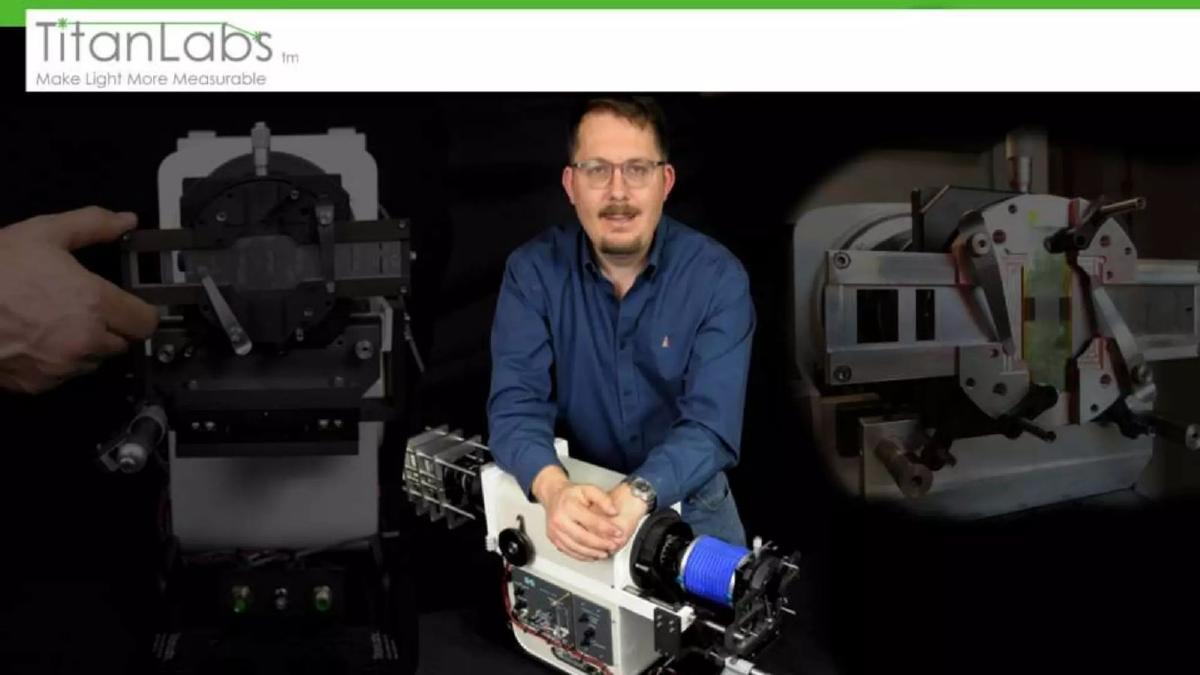
TitanLabs is a hardware startup developing ultra-high-speed streak cameras and comb generators for high-energy physics research. The deck highlights a clear technical advantage, claiming a temporal resolution of 100 femtoseconds, which significantly outperforms existing market solutions. Their business model relies on high-margin direct sales to a concentrated customer base of DOE National Laboratories and international research facilities like CERN. While the deck provides granular detail on startup costs and early traction—including a $55,000 initial sale—it lacks a formal 'Ask' slide due t…
Key takeaways
- The company claims a temporal resolution of 100 femtoseconds in a 105ps sweep, positioning it as a new class of streak camera (Slide 4).
- Early traction includes $55,000 in founder funding and a $55,000 invoice for an I-675-TL-S20 sale (Slide 2).
- The global market for streak cameras was valued at $106.3 million in 2018, with five companies controlling 69% of the market (Slide 6).
- TitanLabs identifies Sydor as a monopoly in the comb generator market, representing a specific target for disruption (Slide 6).
- Revenue is projected to come from three main products: Perseus (41%), Cronos (37%), and Hyperion (21%) (Slide 7).
- The deck outlines a specific path to non-dilutive funding, targeting a $200K SBIR Phase I and a $1.1M Phase II grant (Slide 2).
- Startup costs are meticulously detailed, including $105,580 for a 15-month founder salary and $109,470 for Perseus prototype parts (Slide 13).
- The marketing strategy is hyper-targeted, focusing on the 17 DOE National Laboratories and 47 User Facilities in the US (Slide 6, Slide 9).
Executive Summary and Technical Foundation
Introduction and Definitions
The TitanLabs deck begins with a highly technical introduction. Slide 0 features a photograph of a founder, presumably Scott Andrews, with the hardware. Slide 1 serves as an educational primer, answering 'What is a streak camera?' and 'What is a comb generator?' This is a necessary inclusion for a generalist investor, as the technology is extremely niche. The slide defines a streak camera as a tool for resolving events in the femtosecond range, used primarily in high-energy density laser labs. It defines a comb generator as a 'temporal ruler' used to analyze the camera's sweep. The inclusion of a footnote explaining the scale of a femtosecond (1 minute vs. the age of the universe) helps ground the extreme technical specifications in a relatable context.
Early Traction and Financials
Slide 2, titled 'Early Traction,' provides a transparent look at the company's beginnings. It lists $55,000 in founder funding and $20,000 from Sophia Chen of LSL under a profit-sharing agreement. Most importantly, it cites a specific sale (I-675-TL-S20) resulting in a $55,000 invoice, with $32,500 going to TitanLabs. This proves that a market exists and that the company can navigate the procurement processes of research institutions. The slide also outlines a clear roadmap for non-dilutive funding through the DOE-SBIR program, targeting $200,000 in June 2019 and $1.1 million in July 2020. This suggests the founders are capital-efficient and understand how to leverage government grants to offset R&D costs.
The Market Opportunity
Problem and Solution
Slide 3 identifies four core problems with current market offerings: lack of ease of use, a trade-off between resolution and dynamic range, slow speeds, and poor thermal management. Slide 4 presents the TitanLabs solution as a 'new class of streak camera.' The technical claims are bold: 100-femtosecond temporal resolution and less than 15ps jitter. The solution also addresses the 'ease of use' problem through mechanical improvements like an Indexed Multiple Slit Slider and a Master Trigger. By using an uncooled sensor and a tapered fiber bundle for the sCMOS sensor, they claim to have achieved both cost and performance advancements over the status quo.
Market Validation and Size
Slide 5 uses social proof to validate these claims. It mentions 'demo days' with high-energy density physicists from Stanford's SLAC National Accelerator Lab, including Siegfried Glenzer. The survey results are compelling: 90% of these experts agreed that cameras need more functionality and that costs are too high. Slide 6 quantifies the market. The global streak camera market was $106.3 million in 2018. While this is a small 'Total Addressable Market' (TAM) by VC standards, the slide notes the broader photonics market is $580B. The concentration of the market—five companies controlling 69%—suggests an oligopoly ripe for a superior technical entrant. The customer segments are clearly defined: 17 DOE labs and 47 user facilities in the US, plus CERN and hundreds of facilities in Europe.
Business Strategy and Operations
Business Model and Competition
Slide 7 details the revenue mix, projecting that 78% of revenue will come from two streak camera models (Perseus and Cronos) and 21% from comb generators. The projected profit margins of 30-45% are healthy for high-end hardware. Slide 8 provides a breakdown of the competition. Hamamatsu leads with 17.9%, followed closely by Optronis and Axis Photonique. The deck identifies Sydor Instruments as a primary North American competitor. This slide is excellent because it uses specific percentages rather than vague 'competitor logos,' demonstrating a deep understanding of the competitive landscape.
Marketing and Team
Slide 9 acknowledges the niche nature of the business. Because the customer base is so small, the marketing plan is 'tactical and direct,' involving direct mail, email, and event marketing at trade shows like Photonics West (pictured). Slide 10 introduces the team. Scott Andrews and Leslie Lukesh are listed as co-founders, with Peer Hofstra and Sophia Chen as key partners/advisors. However, the slide lacks professional summaries or specific track records for the individuals, which is a missed opportunity to build credibility in a field that requires immense specialized knowledge.
Future Roadmap and Use of Funds
Milestones and Fundraising
Slide 11 provides a chronological roadmap from 2018 to 2020. Key milestones include patent applications, the start of production for different hardware lines, and hiring a CEO and Production Manager. Slide 12 is a placeholder, stating that fundraising details were 'Removed to comply with Crowdfunded Rules.' This indicates the deck was likely used for a Regulation CF or similar public-facing offering. Slide 13 provides a very granular 'Use of Funds.' Unlike many decks that use broad categories like 'Marketing' or 'R&D,' TitanLabs lists exact dollar amounts for prototype parts ($109,470 for Perseus), inventory, and even the founder's 15-month salary ($105,580). This level of detail builds significant trust regarding the founders' operational planning.
Conclusion
The deck concludes on Slide 14 with a 'Questions?' prompt and a complex mathematical formula for temporal dispersion (delta TTTD). This final slide reinforces the company's identity as a deeply technical, engineering-first organization. While the deck is visually simple and lacks the polish of a consumer tech pitch, its specificity regarding technical specs, market share, and unit costs makes it a strong presentation for its intended audience of specialized investors and grant committees.
What TitanLabs Does Well
Technical Specificity: The deck does not shy away from the physics. By citing specific femtosecond resolutions and jitter rates, they speak the language of their customers and specialized investors. · Granular Financials: The 'Use of Funds' slide is one of the most detailed seen in a seed-stage deck. Listing specific part costs for prototypes shows a high level of preparation. · Market Mapping: Identifying the exact number of DOE labs and the specific market shares of five competitors demonstrates that the founders know exactly who their buyers and rivals are.
What is Missing from the Deck
Team Biographies: While names and photos are provided, there is no mention of where the founders worked previously or their academic credentials. In deep tech, the 'Why You?' is as important as the 'What?' · Intellectual Property Status: Slide 11 mentions 'Full patent applications' in 2019, but the deck doesn't specify what is currently protected or the strength of their IP moat against giants like Hamamatsu. · Exit Strategy: Given the small TAM ($106M), a traditional IPO is unlikely. The deck would benefit from identifying potential acquirers among the five large players currently dominating the space.
What a Founder Should Copy
The 'Primer' Slide: If you are building in a complex space, use Slide 1 to define your terms. Don't assume the investor knows what your hardware does. · Direct Competitor Analysis: Move away from the 'magic quadrant' and toward the market share breakdown seen on Slide 8. It feels more honest and researched. · Traction Transparency: Listing a single $55k invoice and how it was split (Slide 2) is more impressive than a vague 'in talks with several customers' bullet point.
Frequently asked questions
- What exactly is a streak camera?
- As defined on Slide 1, a streak camera is a time-resolved tool used by scientists to measure characteristics of light, typically in fusion research, accelerators, and high-energy laser labs. It allows researchers to observe events occurring on the scale of nanoseconds, picoseconds, and femtoseconds. TitanLabs uses the analogy that a femtosecond is to a second what one minute is to the entire lifetime of the universe.
- How does TitanLabs plan to make money?
- According to Slide 7, the company follows a direct sales model. They sell three primary hardware lines: the Perseus and Cronos streak cameras and the Hyperion comb generator. They anticipate profit margins between 30% and 45% during the first three years of production. Their primary customers are government-funded research institutions and universities.
- Who are the main competitors in this niche market?
- Slide 8 identifies five major global players: Hamamatsu (17.9% market share), Optronis (15.4%), Axis Photonique (15.3%), Sydor Instruments (12.1%), and BIFO (11.1%). TitanLabs specifically notes that Hamamatsu and Sydor are their primary competitors within the North American market, with Sydor currently holding a monopoly on comb generators.
- What is the company's funding history and future plan?
- Slide 2 shows the company started with $55,000 from the founder and $20,000 from Sophia Chen (LSL). They have also generated $32,500 in net revenue from a single sale. Their future funding strategy heavily emphasizes government grants, specifically aiming for a $200,000 DOE SBIR Phase I grant and a $1.1 million Phase II grant.
- What are the technical advantages of the TitanLabs solution?
- Slide 4 lists several key advancements: achieving 100-femtosecond resolution, improving usability via an Indexed Multiple Slit Slider, reducing costs using an uncooled sensor, and improving performance by coupling the sCMOS sensor directly to the image intensifier using a tapered fiber bundle. They also addressed thermal management by relocating electrical components.