Hardware Problem Slides: 6 Real Pitch Deck Examples
How hardware startups frame the problem: what today's devices cost, how long they last and where they fail, for a named buyer.
Hardware Problem Slide: Show Where Today's Devices Fail
A hardware startup usually asks buyers to replace a device or add a new one. Investors read a hardware problem slide for what today's devices cost, how long they last or how they fail, and who pays for that. This guide compares six real problem slides from decks tagged hardware in our library, from a sensor company that puts a lifespan and price on current parts to a combined slide where the problem is two short claims.
TL;DR
Say what today's devices cost, how long they last or where they fail, with numbers, and for whom. Omnitron says current MEMS sensors "Last <6 months" and "Cost $10's of thousands". Zoomzin gives how often Americans lose phones, wallets and keys and says RFID is "too expensive" for everyday use. TitanLabs lists four failings of streak cameras on the market. Alamo lists lawn-mowing chores, Meta Innovations lists IoT gaps, and Nemasu states two claims about sleep with no figures.
Hardware problem slides from real pitch decks
Each example shows the exact stored slide above its analysis and links to the full teardown. The clearest slides come first; weaker ones follow for contrast. Claims are as shown on the slides; comments are ours.
Omnitron Sensors problem slide — slide 4
MEMS sensor maker. Slide titled "The Problem", with a photo of a self-driving test car.
Omnitron Sensors deck, slide 4. Exact stored slide matched to this analysis.
Our analysis: Two of the three failings have numbers, and the photo suggests the buyer: self-driving car makers. The slide doesn't name that buyer in words or say which sensor the figures apply to, and "Low Performance" has no figure.
Evidence and limitation: A lifespan, a price range and a reason the technology hasn't improved.
What a founder can adapt: Name the buyer and the sensor type, and add a performance figure.
Supporting analysis
What the deck claims: "MEMs silicon process has been flat 10+ years." Three numbered points: "1 Unreliable: Last <6 months"; "2 Expensive: Cost $10's of thousands"; "3 Low Performance".
Presentation choice: For a component, lifespan and price are what a buyer compares; this slide gives both.
When it does not fit: Leaving the buyer to a photo.
Loss-prevention device and app. Slide titled "Problem Solved".
Zoomzin deck, slide 4. Exact stored slide matched to this analysis.
Our analysis: The loss rates make the problem common, and the slide says why RFID tags don't solve it. The figures have no source, and "too expensive" has no price.
Evidence and limitation: Three loss rates for a named group and one reason current technology fails.
What a founder can adapt: Source the loss rates and give the price of an RFID tag.
Supporting analysis
What the deck claims: "This year, 1 in 5 Americans will permanently lose their cell phone, 1 in 10 will lose their wallet, 1 in 4 will lose their keys." "Currently, loss prevention technology is characterized by solutions that protect the loss of priority data and identification tagging. RFID technology is too expensive for day-to-day consumer needs, but smart phone providers will soon have native hardware to support this technology."
Presentation choice: A consumer device needs to show how many people have the problem and why they don't already buy a fix.
When it does not fit: A "Problem Solved" title on a problem slide; say the problem.
Scientific camera maker. Slide titled "The Problem".
TitanLabs deck, slide 4. Exact stored slide matched to this analysis.
Our analysis: Naming streak cameras tells a technical buyer exactly what is being replaced, and the resolution trade-off is specific. None of the four points has a number, and the slide has spelling errors.
Evidence and limitation: A named existing product category and four failings.
What a founder can adapt: Add a figure for speed or resolution, and proofread.
Supporting analysis
What the deck claims: "There are 4 big problems with the streak cameras currently on the market: They aren't easy to use. They can't increase their resolution without decreasing dynamic range. They are to slow. They have poor thermal manigment."
Presentation choice: Naming the device being replaced sets up a direct comparison.
When it does not fit: Spelling errors on a slide for technical buyers.
Meta Innovations deck, slide 2. Exact stored slide matched to this analysis.
Our analysis: The last point is specific: low-energy radio and Wi-Fi don't work together. The rest could describe any IoT company, and no user is named.
Evidence and limitation: Four general gaps, one technical.
What a founder can adapt: Lead with the radio point and say which device makers it affects.
Supporting analysis
What the deck claims: "Physical devices and virtual things — inefficiencies in realm of IoT"; "Lack of good ecosystem"; "Vendor specific, lack of interoperability"; "Implementations lack low energy radio and Wifi that can co-exist".
Presentation choice: The specific technical gap is what sets the problem apart.
When it does not fit: General phrases like "lack of good ecosystem".
Sleep pod. A combined slide with rows for problem, solution, value, position and customer, dated 05.01.14.
Nemasu deck, slide 2. Exact stored slide matched to this analysis.
Our analysis: The problem row says sleep quality is falling but not by how much or why current beds and devices don't help. Putting everything on one slide leaves the problem two lines.
Evidence and limitation: Two claims with no figures; the numbers on the slide describe customers, not the problem.
What a founder can adapt: Give the problem its own slide with a sourced figure on sleep quality.
Supporting analysis
What the deck claims: Problem: "1. Sleep quality is more important than quantity 2. Sleep quality is decreasing". The customer row gives "62M Americans" or "$2B" and "19M Americans" with footnotes.
Presentation choice: Investors need to see the problem measured before the solution.
When it does not fit: Squeezing problem, solution and customer onto one slide.
Whether an investor can see the device being replaced, what its failure costs and who pays.
Example
Business
Today's option
Number
Who pays
Omnitron Sensors
MEMS sensors
Current MEMS sensors
<6 months; $10s of thousands
Implied (self-driving cars)
Zoomzin
Loss prevention
RFID tags
1 in 5, 1 in 10, 1 in 4 lose items
Consumers
TitanLabs
Scientific cameras
Streak cameras
Not stated
Not stated
Alamo
Robotic mower
Manual mowing
Not stated
Not stated
Meta Innovations
IoT hardware
Vendor-specific devices
Not stated
Not stated
Nemasu
Sleep pod
Not stated
Not stated (customer figures only)
Not stated
Key Takeaways
Name the device buyers use today and where it fails.
Give numbers: price, lifespan, failure rate or time.
Say who pays for the failure.
Explain why existing technology can't fix it.
Give the problem its own slide.
Build your hardware problem slide
Name the device buyers use today, measure where it fails and say who pays.
Buyer. Who buys the device today?
Device. What device or method do they use now?
Failure. What does it cost, how long does it last, or how often does it fail?
Why. Why can't existing technology fix it?
Source. Where does each figure come from?
Copyable framework: Headline: [buyer]'s [device] costs [price] and lasts [lifespan]. It fails because [reason], and [existing technology] can't fix it ([source]).
Illustrative example 1 — written by us
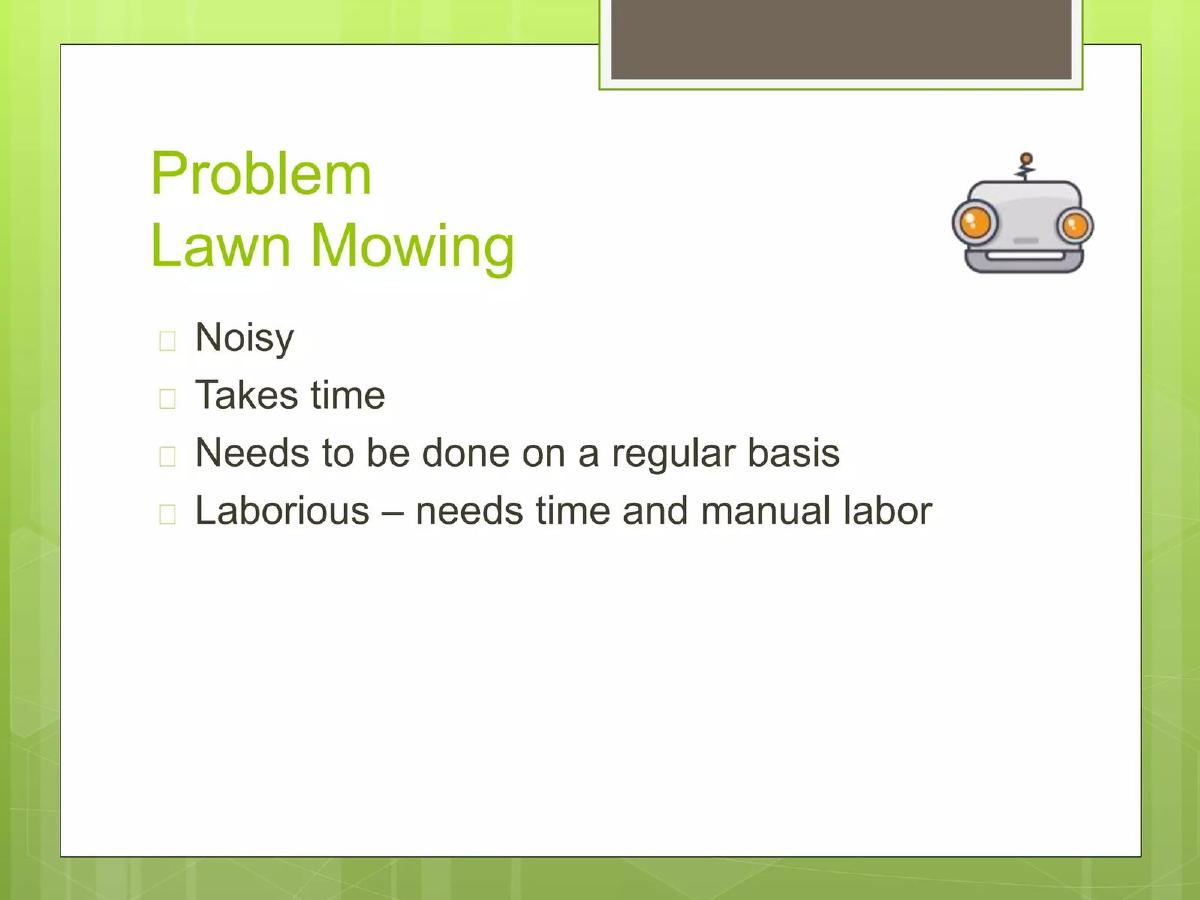
Before: Noisy. Takes time. Needs to be done on a regular basis.
After: Homeowners spend [hours] a season mowing; current robot mowers [limitation] ([source]).
What improved: Our illustrative rewrite; the bracketed details are placeholders, not Alamo's facts. It measures the chore and names what existing products miss.
What this guide adds
The general problem slide guide covers any company. Hardware adds a concrete comparison: an existing device with a price, a lifespan and known limits. Investors want to see those limits measured, because a new device has to beat them to be worth building.
Our library's hardware tag covers sensors, scientific instruments, consumer devices, robotics and connected-device platforms. We note each company's business in the examples.
How we read each slide
We quote the text on the stored slide images. We have not checked any price, lifespan or statistic.
Common mistakes
No device named. Say what buyers use today.
No numbers. Give price, lifespan or failure rate.
Buyer left implied. Name who pays in words.
Generic gaps. Lead with the specific technical limit.
Crowded slide. Give the problem its own slide.
Diagnostic checklist
A named buyer.
Today's device or method.
Price, lifespan or failure rate.
Why existing technology can't fix it.
Sources for figures.
Frequently asked questions
What should a hardware problem slide show?
Where today's devices fail, measured, and who pays. Omnitron says current sensors last under six months and cost tens of thousands of dollars.
Should I name the product I'm replacing?
Yes. TitanLabs names streak cameras and lists four failings, which sets up a direct comparison.
Can the problem share a slide with the solution?
It can, but Nemasu's combined slide leaves the problem two lines with no figures.
How we chose these examples
Corpus: published pitch deck teardowns on StartupFundraising.com. Founder-uploaded private decks are excluded.
Selection (2026-09-27): we searched extracted slide text in decks tagged hardware for slides that begin with "problem". 10 slides matched; we reviewed those with stored images and not used elsewhere.
Kept six. Left out: Limis p2 (already used in the manufacturing problem slide guide), Omnitron Sensors' second copy of the same deck (its deck is used in the deep tech team guide), ING Bags p3 (already used in the consumer problem slide guide) and WorkClout p4 (a software problem about front-line employees, not hardware). Only six suitable slides remained, so the guide has six. Meta Innovations' deck appears in the hardware product guide with a different slide. No uploads were requested.
Review: stored slide text and images were checked on 2026-09-27 and matched to company, deck and slide number (editorial model review). No person has yet completed an editorial review of this page.
Claims are as shown on the slides; we have not verified them. We make no claim that any slide caused a fundraising outcome.