Questo AI presents a solution for students burdened by the manual creation of study materials. By using AI to generate quizzes directly from textbooks and websites, the company targets the efficiency gap left by incumbents like Quizlet and Kahoot. The deck is notable for its granular, phased go-to-market strategy, which focuses on specific grade levels and campuses to build organic momentum. However, the presentation lacks critical financial data, including specific pricing for its B2C subscription model or B2B licensing fees. While the technical value proposition is clear—automating 'distrac…
Key takeaways
- The core value proposition is the instant creation of personalized study materials to eliminate time wasted on manual entry (Slide 2).
- The product uses AI to generate quizzes directly from textbooks or websites, positioning it as an automated alternative to manual tools (Slide 3).
- The business model is a hybrid B2C subscription and B2B licensing play for schools and publishers (Slide 4).
- Technical components of the AI include Text Analysis, Quiz Generation, and Distractor Generation (Slide 5).
- Initial growth strategy is hyper-local, focusing specifically on 'G10 (Dover)' to ensure a small, manageable target audience (Slide 6).
- User acquisition relies on 'champions'—students with high social capital—to present at school assemblies (Slide 7).
- Competitor analysis cites Quizlet (30M MAU) and Kahoot (50M MAU) but differentiates by highlighting their reliance on manual content creation (Slide 8).
- The team slide contains a typographical error, listing 'Taichi Kato' as the name for two different co-founders (Slide 9).
Introduction and Value Proposition
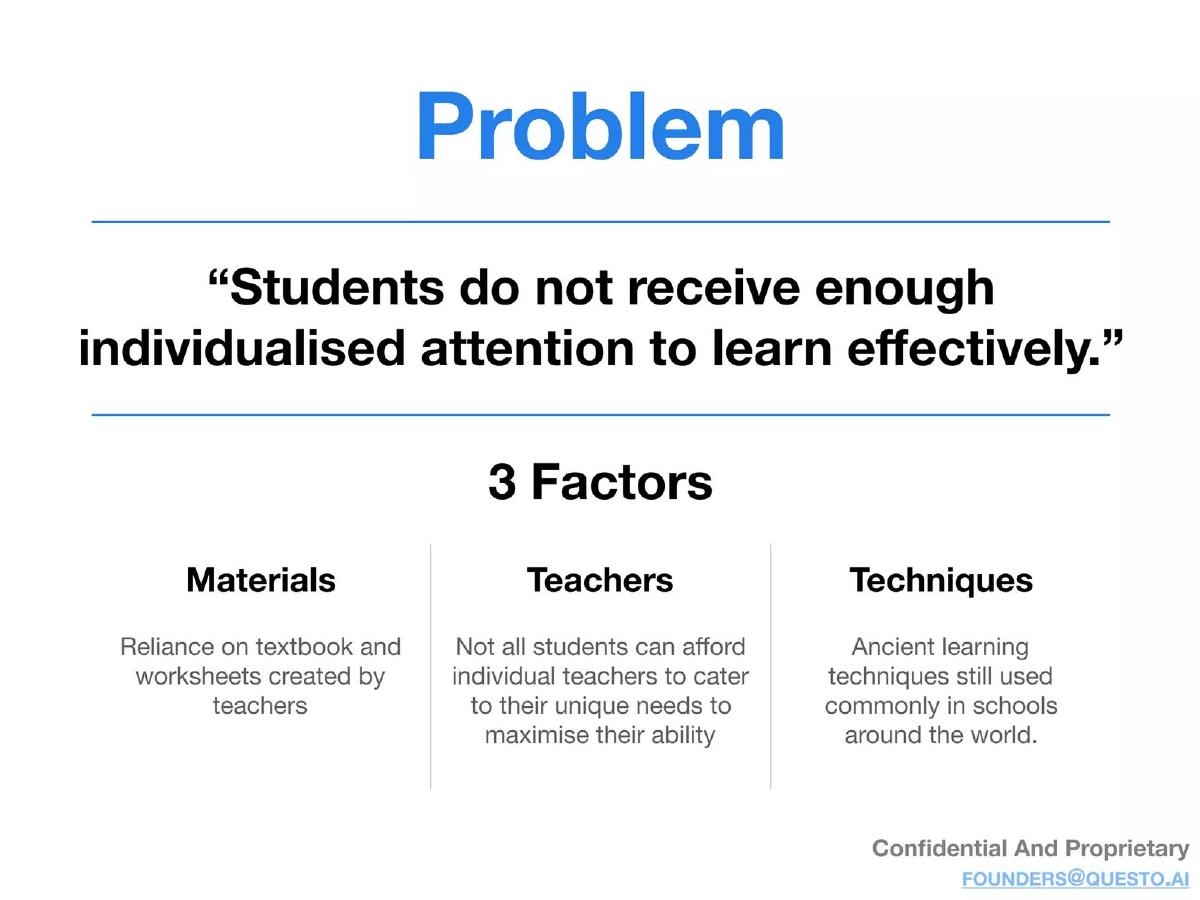
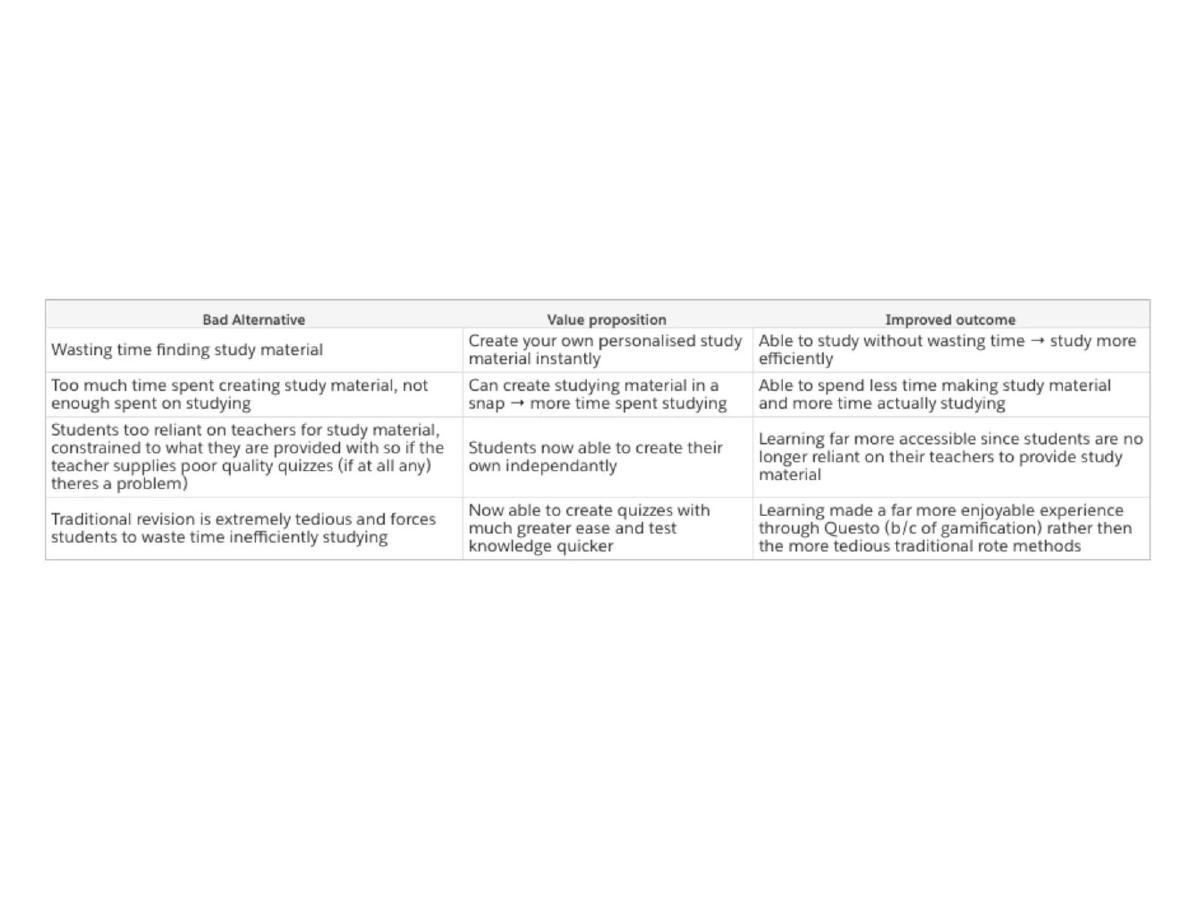
Questo AI enters the EdTech space with a clear focus on efficiency. The title slide (Slide 1) establishes the mission: "Using AI to Transforming Education." While the grammar is slightly flawed, the intent is immediate. The deck quickly moves into a detailed comparison table on Slide 2, which is an effective way to frame the problem. Instead of a vague "Problem" slide, they use a three-column grid: "Bad Alternative," "Value Proposition," and "Improved Outcome."
This table highlights four specific pain points: time wasted finding materials, time wasted creating materials, reliance on teachers, and the tedious nature of rote learning. By citing "gamification" and "instant" creation, the founders position Questo as a productivity tool for students who are currently bogged down by the administrative overhead of studying.
The Product and Technology
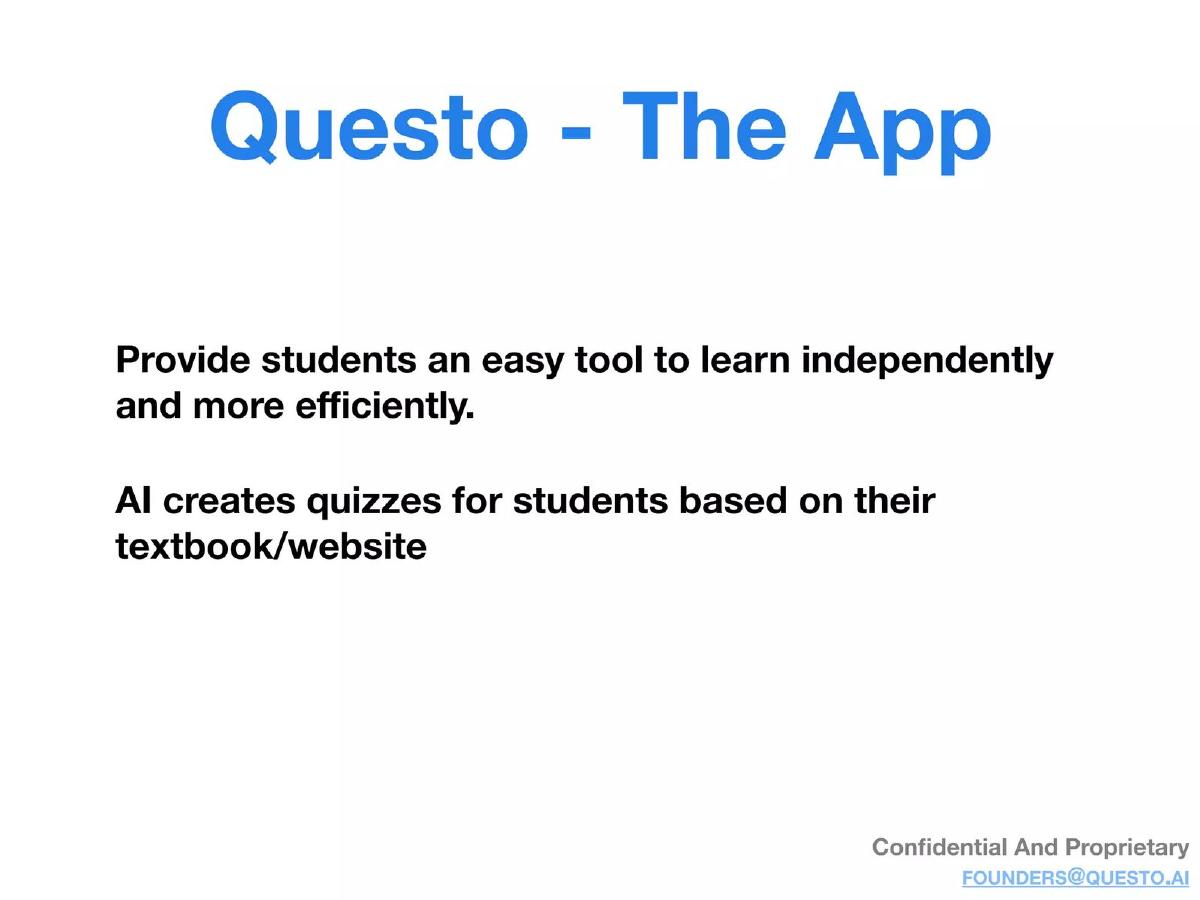
Slide 3, titled "Questo - The App," provides a high-level summary of the functionality. The core claim is that the AI creates quizzes based on a student's textbook or a website. This addresses the "manual entry" hurdle that plagues many flashcard apps. By automating the content creation, Questo moves the student directly to the active recall phase of learning.
Slide 5 provides a bit more technical depth, though it remains at a conceptual level. It identifies three specific modules: Text Analysis , Quiz Generation , and Distractor Generation . In the context of multiple-choice questions, "distractors" are the incorrect answers. Automating the creation of plausible wrong answers is a non-trivial NLP (Natural Language Processing) task, and highlighting this shows the founders understand the technical requirements of their niche.
Business Model and Market Strategy
The business model is presented across two slides (Slide 4 and Slide 5). The strategy is a classic "land and expand" approach. They intend to start with a B2C subscription model to validate the technology, obtain training data, and grow a user base. This B2C success is then intended to serve as a case study to win B2B contracts with schools and publishers.
Slide 5 specifies the B2B offerings: a "Quiz generation platform for teachers and students" for institutions, and a "Quiz generation SaaS for publishers." This dual-track approach is common in EdTech, as it allows for immediate cash flow from consumers while chasing the longer sales cycles of institutional buyers.
Hyper-Local Go-To-Market
One of the most unique aspects of this deck is the granularity of the Phase 1 growth plan (Slides 6 and 7). Rather than claiming they will capture a percentage of the global student market, the founders focus on "G10 (Dover)." This suggests a pilot program at a specific school or campus. Slide 6 notes this is the "easiest to accomplish with smallest target audience segment."
Slide 7 further details the acquisition tactics, mentioning a "champion" to spread the product organically. They define this champion as "someone with high social capital to lend credibility" and suggest they present at "assemblies." This is a refreshingly honest and tactical look at how early-stage startups actually get their first 100 users, moving away from the usual vague "social media marketing" bullet points.
Competitive Landscape
Slide 8 provides a competitive analysis of Quizlet, Kahoot, and Socrative. The deck acknowledges the massive scale of these players, citing 30M MAU for Quizlet and 50M MAU for Kahoot. However, it identifies a structural weakness in all three: the reliance on manual content creation. By focusing on this specific friction point, Questo AI carves out a niche for itself as the "automated" alternative. They also critique Kahoot for being "not suited for serious learning," implying that Questo is a tool for academic rigor rather than classroom engagement.
The Team
Slide 9 introduces the team. There is a notable error on this slide: the name "Taichi Kato" is listed under two different photos—one for Product Development and one for AI Research. A third member, Khush Jammu, is listed for Business Development with a question mark next to his title ("Co-Founder (?)"). This suggests the deck may have been an internal draft or was produced in a very early, unsettled stage of the company's formation. Despite the errors, the slide clearly delineates the three pillars of the startup: Product, Research, and Business.
What Works and What is Missing
What Works
Specific Problem Framing: The table on Slide 2 is excellent. It doesn't just say "studying is hard"; it identifies that the preparation for studying is the actual bottleneck. · Tactical GTM: The focus on a single grade at a single campus (Slides 6-7) shows a realistic understanding of how to build a community and test a product before scaling. · Technical Focus: Mentioning "Distractor Generation" (Slide 5) shows a deeper understanding of the product's value than just saying "we use AI."
What is Missing
Financial Projections: There are no slides detailing the expected revenue, the cost of the subscription, or the price of the B2B license. · The "Ask": The deck ends without a clear funding request. There is no mention of how much capital is being raised or how that capital will be allocated. · Unit Economics: While they mention a subscription model, there is no data on Customer Acquisition Cost (CAC) or Lifetime Value (LTV), even in a projected sense. · Traction Data: Aside from the plan to target G10, there is no evidence that the app has been built or tested. There are no screenshots of the actual user interface or examples of AI-generated questions. · Market Size: While they mention competitor MAUs, they do not provide a Total Addressable Market (TAM) or Serviceable Obtainable Market (SOM) for their specific automated quiz niche.
Founder Takeaways
Focus on the friction, not just the function. Questo AI succeeds in identifying that the "work before the work" (creating flashcards) is the biggest pain point for students. If your product automates a manual task, make that the centerpiece of your value proposition, as seen on Slide 2.
Be hyper-local in your early stages. Many founders try to look big by targeting "the US market." Questo's approach to targeting a specific grade level at a specific campus is much more believable and executable for a small team. It allows for rapid feedback and high-density word-of-mouth growth.
Proofread your team slide. The duplicate name and the question mark next to a co-founder's title on Slide 9 are significant red flags for investors. It suggests a lack of attention to detail or internal instability. Always ensure the team slide is professional and definitive.
Show, don't just tell, the AI. In a deck centered on AI-generated content, a slide showing a "Before and After" (e.g., a paragraph of textbook text next to the resulting AI-generated quiz) would have been far more persuasive than the conceptual boxes on Slide 5.
Frequently asked questions
- What is the primary problem Questo AI solves?
- According to Slide 2, the primary problem is that traditional revision is 'extremely tedious' and forces students to waste time finding or manually creating study materials. The deck argues that students are currently too reliant on teachers for quality quizzes, which limits their ability to study independently and efficiently.
- How does the technology work according to the deck?
- Slide 5 breaks the technology down into three functional pillars: Text Analysis, Quiz Generation, and Distractor Generation. The app processes textbooks or websites (Slide 3) to automatically produce these assessments, which the founders claim is a significant improvement over the manual input required by competitors like Quizlet.
- What is the proposed revenue model?
- The company proposes a dual-track revenue model on Slide 4 and Slide 5. For B2C, they plan a 'Subscription for premium' features. For B2B, they intend to license their question generation technology to institutions as a platform for teachers and to publishers as a SaaS tool for content creation.
- How does Questo AI plan to acquire its first users?
- The deck outlines a very specific 'Phase 1' strategy on Slides 6 and 7. They focus on a single grade (G10) at a specific location (Dover). They plan to use 'personal sales techniques' and 'champions'—students with high social capital—to pitch the product at school assemblies to generate organic growth.
- Who are the main competitors and how is Questo different?
- Slide 8 identifies Quizlet, Kahoot, and Socrative as main competitors. The deck differentiates Questo by noting that Quizlet and Socrative rely on 'manual creation of quiz materials,' while Kahoot is 'not suited for serious learning' and requires group competition rather than individual study.