Drive is a three-way marketplace connecting renters, drivers, and fleet managers in the Philippines. The deck highlights a peer-to-peer business model with a 25% commission on every booking. Unlike traditional car rental giants like Hertz or Avis, Drive focuses on a community-centric growth strategy, utilizing weekly onboarding seminars to build its supply side. While the deck demonstrates early traction with gross earnings reaching over 200,000 PHP in May 2019, it lacks a formal investment ask, detailed use of funds, or long-term financial projections. The team is led by Mike Miranda, who br…
Key takeaways
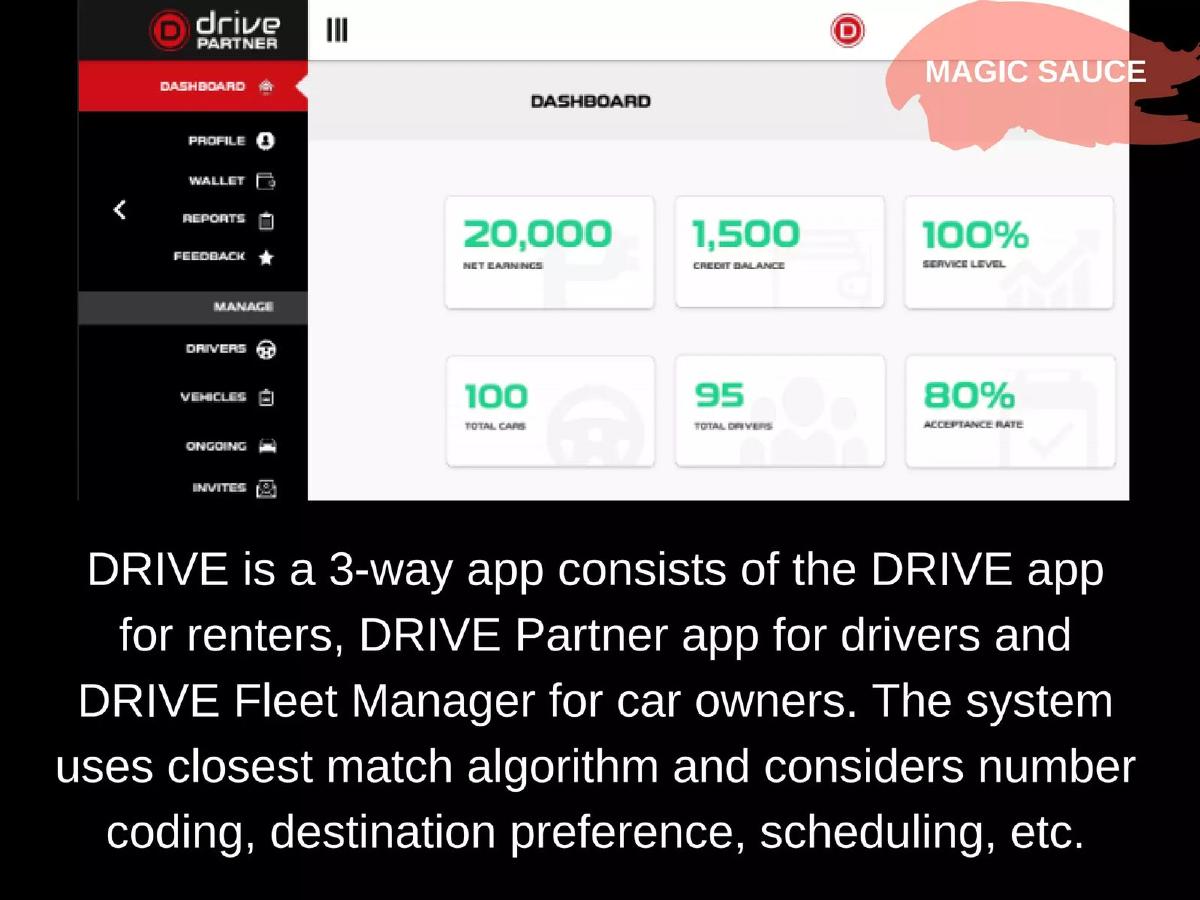
- The company operates a three-way app ecosystem involving renters, partners (drivers), and fleet managers (Slide 4).
- Drive takes a 25% commission on every booking made through the platform (Slide 5).
- Supply is built through physical weekly Partner Onboarding Seminars, while demand is driven by Facebook Ads (Slide 6).
- The platform claims a competitive advantage in social media engagement, showing 1.7K weekly engagements compared to Hertz Philippines' 320 (Slide 7).
- The founder, Mike Miranda, has a professional background including roles at Dell, Google, and Microsoft (Slide 8).
- The Philippine car rental market was valued at $83M in 2018 with a 10% CAGR (Slide 9).
- Actual gross earnings showed significant growth from approximately 75,000 PHP in January to over 200,000 PHP in May 2019 (Slide 9).
- The average price per booking on the platform is stated as 4,000 PHP (Slide 9).
Drive Pitch Deck Analysis
The Drive pitch deck, dated May 2019, presents a hyperlocal solution to the fragmented car rental and tour market in the Philippines. The company, Drive Manila Transport Services Corp., positions itself as a peer-to-peer (P2P) alternative to traditional rental giants. The deck is structured as a 10-slide introduction to their marketplace mechanics, community-led growth, and early traction metrics.
Slide 1: Introduction
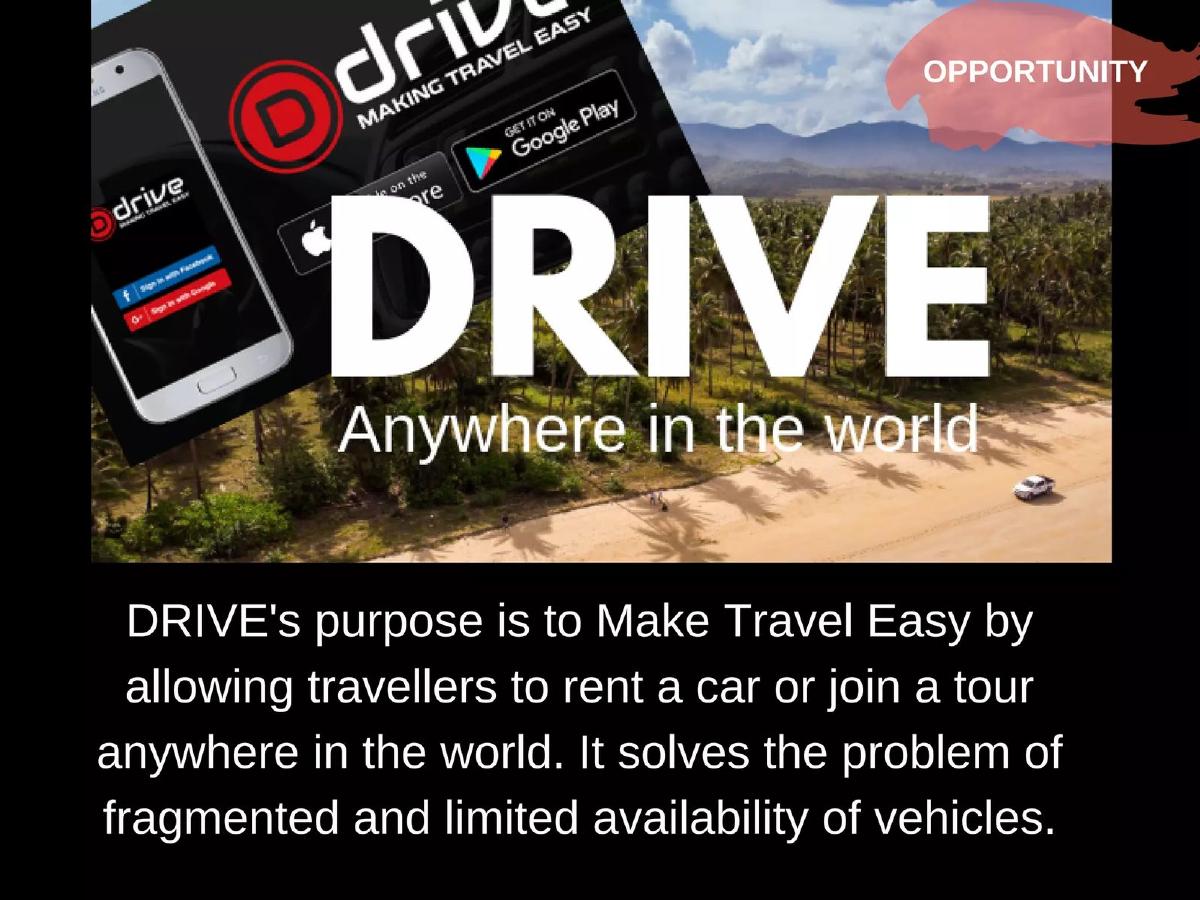
The cover slide introduces Drive with the tagline "Making Travel Easy." It identifies the parent entity as Drive Manila Transport Services Corp. and provides direct contact information for the President and Founder, Mike Miranda. The slide features the App Store and Google Play badges, along with a "Netizen's Choice" award seal, signaling that the product is live and has received some form of public recognition.
Slide 2: Opportunity
The opportunity slide defines the problem as the "fragmented and limited availability of vehicles." Drive's stated purpose is to allow travelers to rent a car or join a tour "anywhere in the world." While the vision is global, the subsequent slides clarify that the current focus is the Philippines. This slide establishes the dual nature of the platform: car rentals and organized tours.
Slide 3: Solution
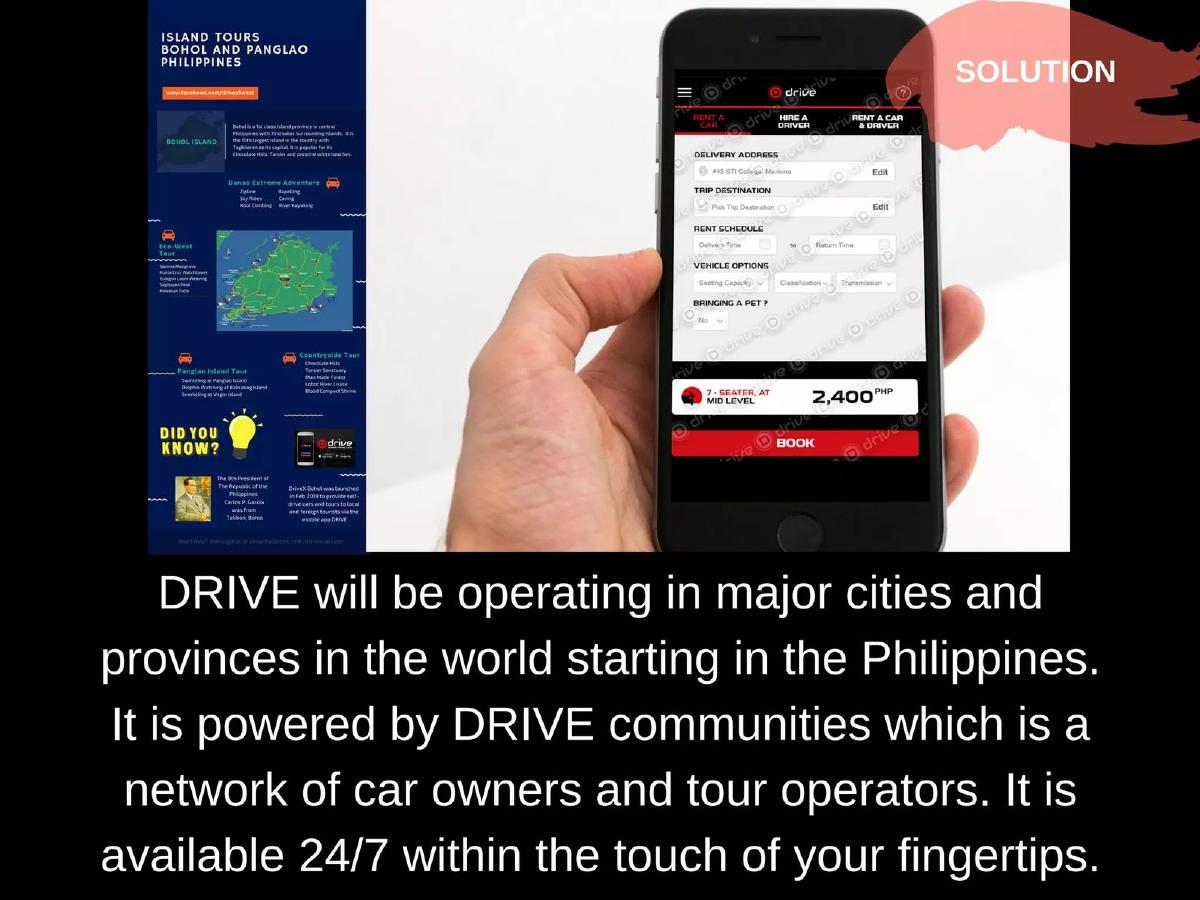
Drive describes its solution as a network of car owners and tour operators powered by "DRIVE communities." The slide shows a mobile interface where users can select between "Rent a Car," "Hire a Driver," or "Rent a Car & Driver." A specific price point of 2,400 PHP for a 7-seater mid-level vehicle is displayed, giving investors a clear view of the product's UI and pricing structure. The slide notes that operations start in the Philippines but aim for major cities globally.
Slide 4: Magic Sauce
The "Magic Sauce" for Drive is its three-way application architecture. The system consists of the Renter app, the Partner app (for drivers), and the Fleet Manager (for car owners). The technical differentiator mentioned is a "closest match algorithm" that accounts for local nuances like "number coding" (a traffic reduction system in the Philippines), destination preferences, and scheduling. A dashboard screenshot shows metrics like Net Earnings (20,000), Total Cars (100), and an Acceptance Rate (80%).
Slide 5: Business Model
The business model is straightforward: a 25% commission on every booking. Drive classifies itself as a peer-to-peer car rental and tours app. This high commission rate is notable for a P2P marketplace, suggesting that the company handles significant portions of the transaction value or provides high-value matching services that justify the take rate.
Slide 6: Marketing
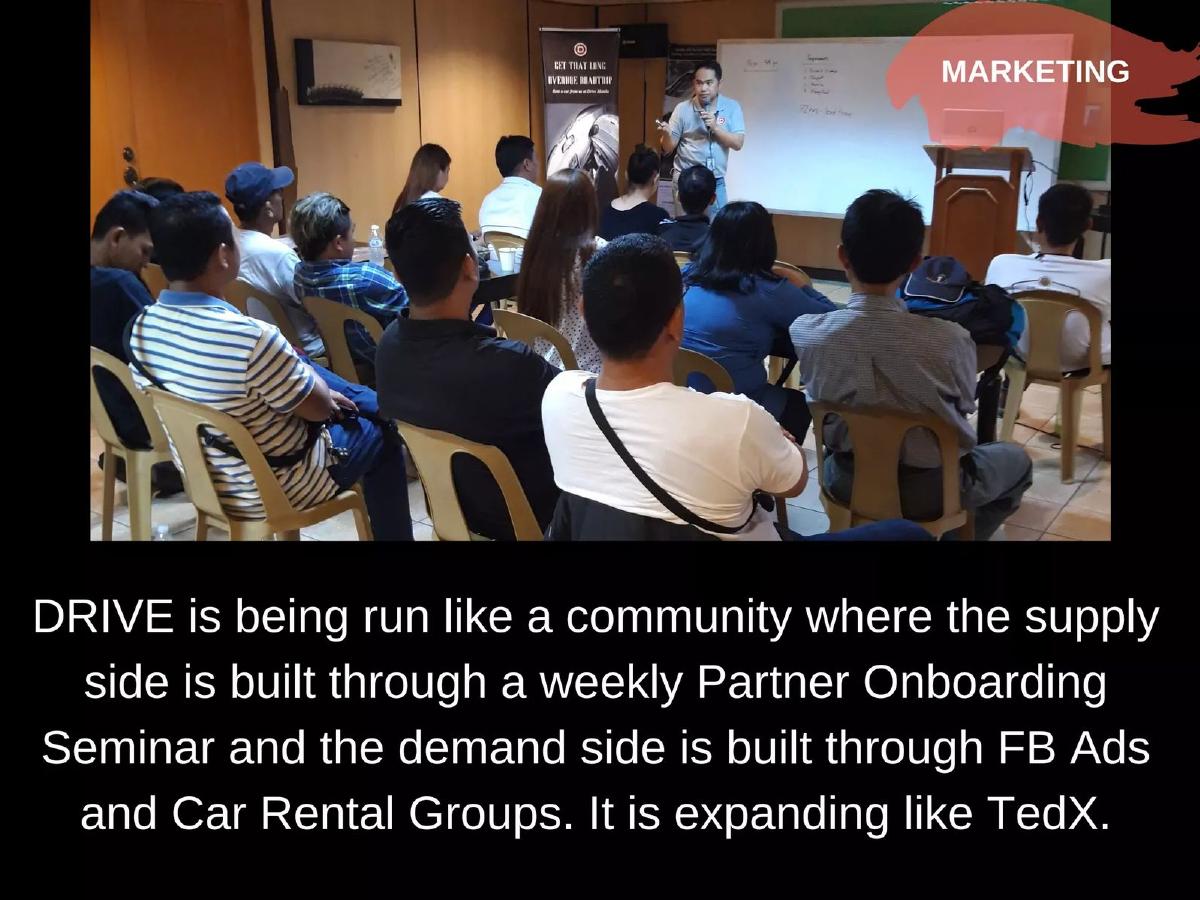
Drive's marketing strategy is bifurcated. The supply side is built through "weekly Partner Onboarding Seminars," which are physical events shown in the slide's photography. The demand side is driven by Facebook Ads and Car Rental Groups. The phrase "expanding like TedX" suggests a franchise-like or community-led expansion model where local leaders help grow the network in new provinces.
Slide 7: Competitive Advantage
Rather than comparing features, Drive compares social media performance. Using a "Pages to Watch" screenshot from Facebook, Drive shows it has 3.6K likes and 1.7K weekly engagements. This is contrasted against Hertz Philippines (14.7K likes but only 320 engagements) and Avis Philippines (2.7K likes and 325 engagements). The argument is that Drive has a more active and engaged organic community than the established corporate players.
Slide 8: The Team
The team slide features three members of the Miranda family: Mike Miranda (President/Founder), Grace Miranda (CEO/Co-founder), and Mayee Miranda (CHRO/Treasurer). Mike Miranda's pedigree is highlighted with past experience at Dell, Google, and Microsoft. The slide lacks specific professional details for the other two executives, which is a common oversight in early-stage decks.
Slide 9: Financials
This slide provides a mix of market sizing and actual performance. The "Target" is the $83M Philippine car rental industry (2018 data) with a 10% CAGR. The "Actual" section shows a bar chart of 2019 earnings. Gross earnings in January were approximately 75,000 PHP, dipping slightly in February, then growing steadily to over 200,000 PHP in May. The average price per booking is confirmed at 4,000 PHP.
Slide 10: Milestones
The final slide summarizes recent achievements: availability on both major app stores, expansion of local leadership to Manila, Bohol, Cavite, and Bataan, and the successful implementation of simultaneous onboarding seminars in co-working spaces. It reinforces the community-led growth narrative established in the marketing slide.
What Drive Does Well
Drive succeeds in clearly defining its marketplace participants. By explicitly stating there are three apps (Renter, Partner, Fleet Manager), they show a deep understanding of the operational complexity of a P2P rental business. The inclusion of "number coding" in their algorithm (Slide 4) demonstrates local market expertise that a global competitor might overlook.
The use of actual social media engagement data (Slide 7) is a clever way to show momentum. In a market dominated by legacy brands, proving that a new entrant has higher engagement levels suggests a lower customer acquisition cost (CAC) and a more loyal user base.
What is Missing from the Drive Deck
The most glaring omission is the lack of a formal investment ask. There is no mention of how much money the company is looking to raise, what the valuation expectations are, or how the funds will be allocated. Without a "Use of Funds" slide, investors cannot evaluate the scalability of the onboarding seminar model.
Furthermore, the deck lacks unit economics. While we see a 25% commission and a 4,000 PHP average booking, we do not see the cost to acquire a customer (CAC) or the lifetime value (LTV). The financial data is also limited to gross earnings; there is no information on net revenue, burn rate, or profitability timelines.
Founder Takeaways
Leverage local nuances: Drive’s mention of "number coding" in their algorithm is a great example of showing "product-market fit" through technical features. Founders should always highlight how their software solves specific local regulatory or logistical hurdles that generic global competitors might ignore.
Show, don't just tell, community growth: Instead of just saying they are "community-driven," Drive included photos of their onboarding seminars. This provides tangible proof of their growth engine and makes the "expanding like TedX" claim more believable.
Use relative metrics for competition: If you are smaller than your competitors in terms of total users or revenue, find a metric where you are winning. Drive’s use of Facebook engagement rates effectively turned a size disadvantage into a community-strength advantage.
Frequently asked questions
- What is the core business model of Drive?
- Drive operates as a peer-to-peer car rental and tours marketplace. According to slide 5, the company generates revenue by taking a 25% commission on every booking. The ecosystem is divided into three distinct user roles: the renter, the driver (Partner), and the car owner (Fleet Manager), all managed through a proprietary matching algorithm.
- How does Drive acquire its supply of vehicles and drivers?
- Drive uses a community-based approach for supply-side growth. Slide 6 explains that they conduct weekly 'Partner Onboarding Seminars' to recruit car owners and drivers. This physical, localized strategy is described as 'expanding like TedX,' suggesting a decentralized, community-led growth model rather than a purely digital acquisition strategy.
- What is the current scale of the company based on the deck?
- As of May 2019, the company reported presence in Manila, Bohol, Cavite, and Bataan (Slide 10). Financial data on slide 9 shows monthly gross earnings grew from under 100,000 PHP in early 2019 to over 200,000 PHP by May. The platform averages 4,000 PHP per booking.
- Who are the primary competitors mentioned in the deck?
- Slide 7 identifies traditional international car rental brands operating in the Philippines as the primary competition: Hertz, National, Budget, and Avis. Drive positions itself against these incumbents by highlighting its superior organic social media engagement and its peer-to-peer structure versus the traditional corporate fleet model.
- What critical information is missing from this pitch deck?
- The deck is missing several standard venture capital requirements. There is no 'Ask' slide detailing how much capital is being raised, no slide on the 'Use of Funds,' and no long-term financial projections beyond May 2019. Additionally, while the team is listed, the specific roles and backgrounds of the co-founders other than the President are not detailed.