Dropbox's seed-stage deck, dating back to 2007, is a remarkably lean document that prioritizes problem identification and technical differentiation. The presentation avoids the common trap of over-explaining market size, instead focusing on the friction of existing workflows like emailing files or using USB drives. With a team slide anchored by MIT credentials and a clear 'Why better?' slide that highlights deep OS integration, the deck makes a compelling case for a 'perfect world' where files are available on any device. While the provided slides lack financial projections or a specific fund…
Key takeaways
- The deck explicitly dates the problem to 2007, highlighting that it is 'still a pain' to work on multiple computers (Slide 2).
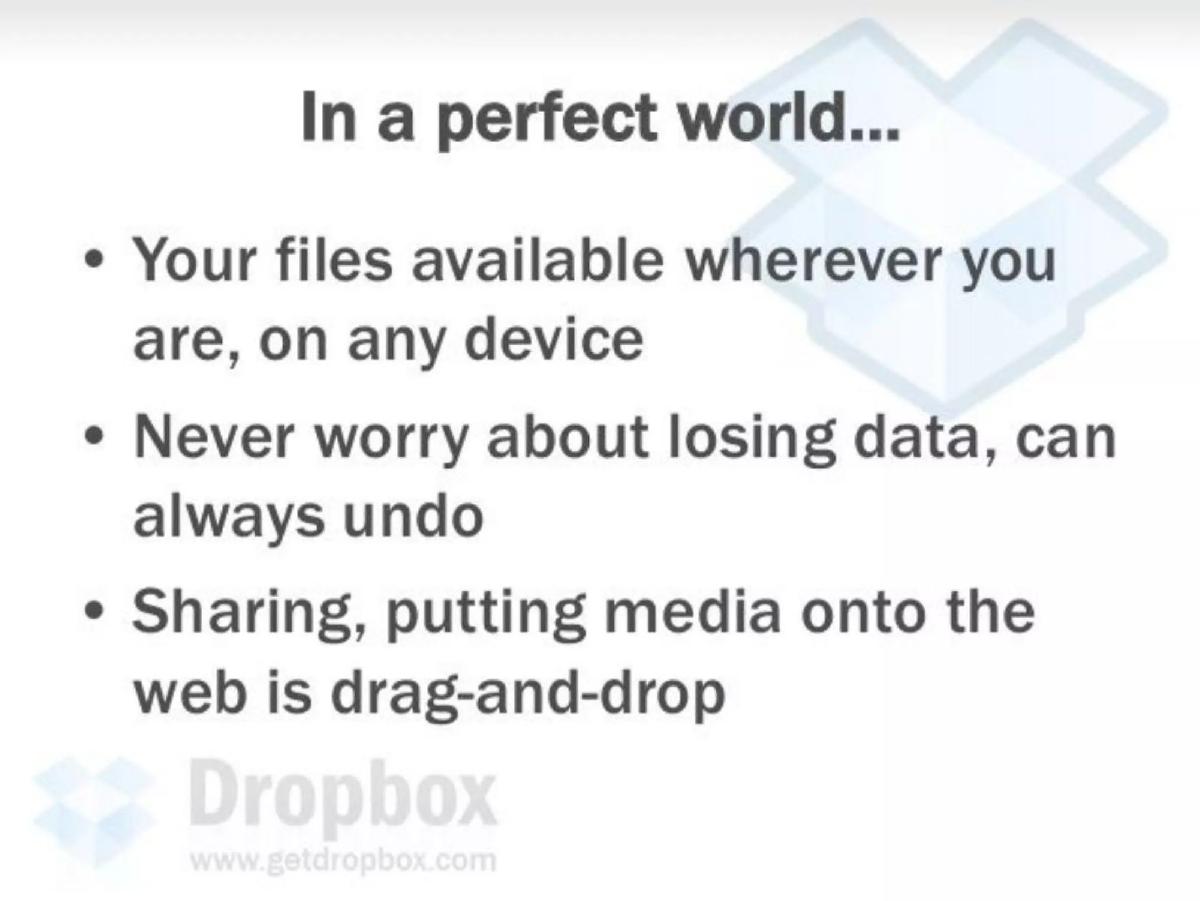
- The solution is framed as a 'perfect world' scenario where files are available on any device with 'drag-and-drop' simplicity (Slide 3).
- A dedicated 'Demo' slide uses screenshots of Windows and Mac interfaces to prove the product is functional and cross-platform (Slide 4).
- Technical differentiation is centered on 'Deep OS integration' and 'visual feedback' rather than just cloud storage (Slide 5).
- The founders directly critique competitors for having 'clumsy, verbose & technical UIs' that require manual configuration (Slide 6).
- The team slide emphasizes technical pedigree, noting Drew Houston's first line of code at age 6 and Arash Ferdowsi's role as director of the MIT programming competition (Slide 7).
- Dropbox positions itself as a 'platform' for all user-generated content (UGC), moving beyond a simple utility to an 'onramp' for web apps (Slide 8).
- External validation is provided via a VentureBeat quote ranking them #1 among summer YC startups (Slide 9).
Introduction: The 2007 Context
The Dropbox pitch deck is a time capsule of the late 2000s tech landscape. At the time, 'the cloud' was not yet a household term, and most users relied on USB flash drives or emailing files to themselves to move data between home and work. This teardown examines the 9 available slides of the original 17-slide deck, focusing on how Drew Houston and Arash Ferdowsi pitched a solution to a problem that many investors at the time thought was already 'solved' by giants like Microsoft and Google.
Slide 1: Title and Vision
The cover slide is minimalist, featuring the original blue box logo and the tagline 'Moving the world’s files.' Below this, the URL ' is listed. The tagline is ambitious; it doesn't say 'storing files' or 'syncing folders,' but 'moving' them, implying a dynamic utility rather than a static warehouse. This sets the stage for a platform-level play rather than a niche tool.
Slide 2: The Pain Point
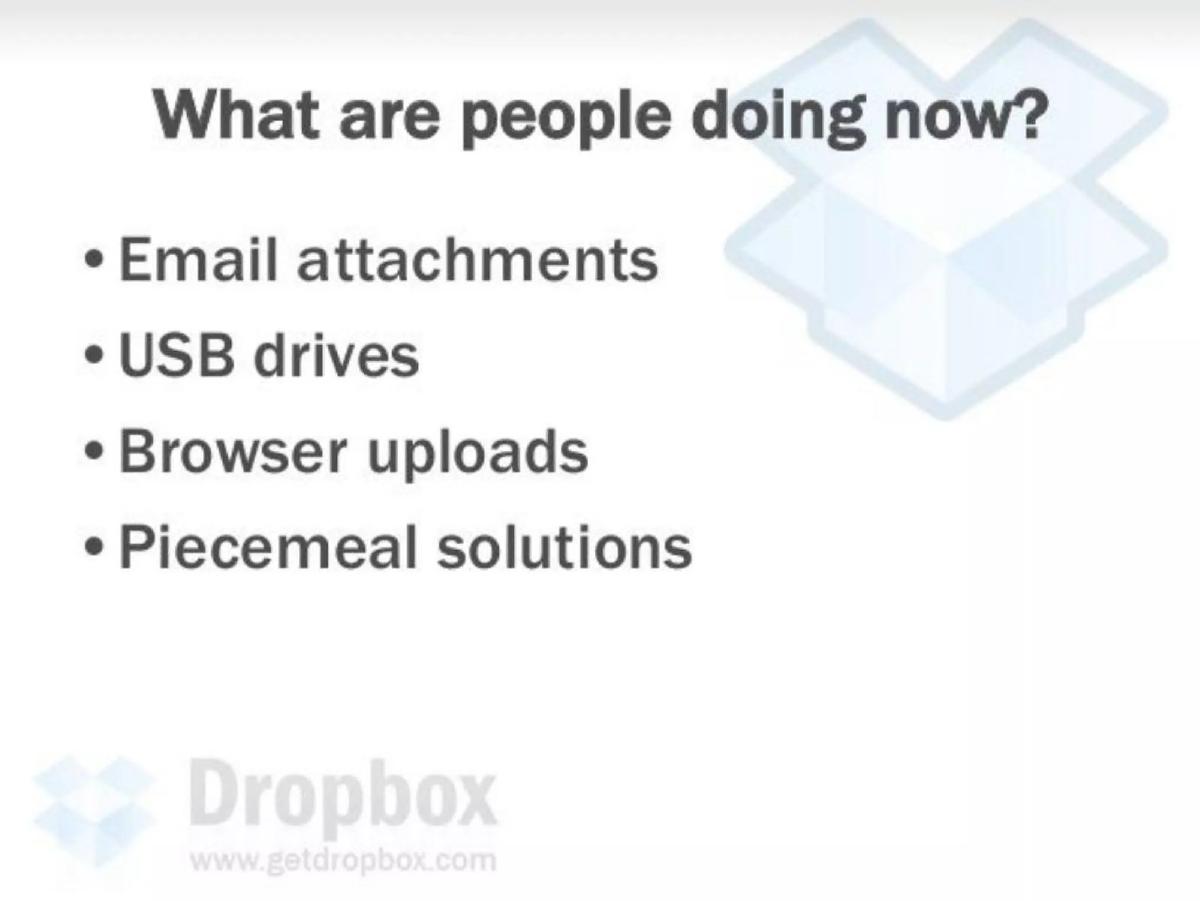
Slide 2 is titled 'It’s 2007, and it’s still a pain to...' This is a classic 'Problem' slide. It lists four specific frustrations: working on multiple computers, sharing files across a team, putting media onto the web, and protecting files from loss. By using the word 'still,' the founders acknowledge that while solutions existed, they were inadequate. This slide targets the emotional frustration of the user, which is a powerful way to start a pitch.
Slide 3: The Solution as a 'Perfect World'
Instead of jumping straight into features, Slide 3 describes the 'Perfect world.' The bullets include files being available anywhere on any device, never worrying about losing data, and 'drag-and-drop' sharing. This slide acts as a bridge between the pain of the previous slide and the product demo to follow. It defines the success criteria for the product before showing how the product meets them.
Slide 4: The Demo
Slide 4 is simply titled 'Demo' and features three overlapping screenshots. One shows a web interface, another a Windows XP file explorer window, and the third a Mac OS X Finder window. This is a critical technical proof point. It shows that Dropbox is not just a website, but a cross-platform utility that lives inside the user's native file system. In 2007, achieving seamless sync across Windows and Mac was a significant engineering hurdle.
Slide 5: Technical Differentiation
The 'Why better?' slide (Slide 5) addresses the 'so what?' factor. It claims to solve the 'entire genre of storage-related problems with one app.' The most important bullet point here is 'Deep OS integration, visual feedback.' This refers to the green checkmarks that appeared on files once they were synced—a small UI detail that became Dropbox's signature. It also mentions 'Open APIs,' signaling that they intended to build an ecosystem, not just a siloed product.
Slide 6: Competitive Analysis
Slide 6, 'What did they screw up?' , is a direct critique of the existing market. The founders argue that competitors 'Only tackle small pieces of the problem' and have 'Poor technical execution.' They specifically call out 'Clumsy, verbose & technical UIs' that 'require configuration.' This is a brilliant way to frame the competition. By making 'ease of use' a technical requirement, they position their simplicity as a result of superior engineering, not just better design.
Slide 7: The Team
The 'Team' slide (Slide 7) leans heavily on the founders' credentials. Drew Houston (CEO) is noted for his 'S.B. MIT EECS' degree, writing his 'first line of code at age 6,' and founding an online SAT prep company. Arash Ferdowsi (CTO) is also 'S.B. MIT EECS (on leave)' and was the 'director of MIT programming competition.' The inclusion of a photo titled 'Moving into our first office, 5/14/07' adds a layer of human authenticity and 'hustle' to the technical pedigree.
Slide 8: The Platform Vision
Slide 8, 'Platform,' moves the conversation from a utility to a business. It describes Dropbox as an 'Onramp for all UGC [User Generated Content] from desktop -> web.' It highlights that for web apps, Dropbox means 'more content uploaded, less friction & fewer failures.' This slide is designed to show investors that Dropbox could become the underlying infrastructure for the entire internet, not just a folder on a single user's computer.
Slide 9: External Validation
The final slide in this set (Slide 9) provides social proof. It notes that Dropbox was 'Ranked #1 among summer YC startups' and includes a quote from VentureBeat praising the 'simplicity and elegance of its interface.' For a seed-stage company, this kind of validation is essential to mitigate the perceived risk of a two-person team taking on a massive technical challenge.
What Works in This Deck
The Dropbox deck is a masterclass in clarity and focus . It identifies a universal pain point that every investor in the room would have personally experienced in 2007. By focusing on the 'friction' of existing tools, they make a compelling case for why a new solution is necessary. The 'Why better?' slide is particularly strong because it links technical execution (Deep OS integration) directly to user benefit (not having to change the way you work). The deck also benefits from a very strong Team-Market Fit ; the founders' MIT backgrounds and early coding history provide the necessary 'right to win' in a technically demanding space.
What Is Missing
Based on the 9 slides provided, several standard pitch deck elements are absent. There is no Market Size (TAM/SAM/SOM) slide, which is usually expected to show the scale of the opportunity. There is no Business Model slide explaining how they plan to make money (e.g., freemium, subscriptions). Most importantly, there is no Ask slide detailing how much capital they are raising and what the milestones will be. While these may have been in the 8 slides not included in this set, their absence in the core narrative flow is notable. The deck also lacks Unit Economics or User Growth metrics, though as a seed-stage deck, these may not have existed yet.
Founder's Playbook: What to Copy
The 'Perfect World' Slide: Use this to define the ideal user experience before you show your product. It helps the investor understand the 'why' before the 'how.' · Direct Competitor Critique: Don't just list competitors; explain their fundamental flaws. Dropbox's focus on 'clumsy UIs' and 'poor technical execution' was a specific, defensible critique. · Screenshots as Proof: If you have a working product, show it. The 'Demo' slide with Windows and Mac screenshots proved that the founders had already solved the hardest part of the problem. · Leverage Third-Party Validation: If you have been through an accelerator or mentioned in the press, use those logos and quotes to build instant credibility. · Keep it Simple: The slides are not cluttered. Each slide has a single, clear message supported by a few bullet points. This ensures the investor stays focused on the founder's narrative during the pitch.
Frequently asked questions
- What is the primary value proposition presented in the Dropbox deck?
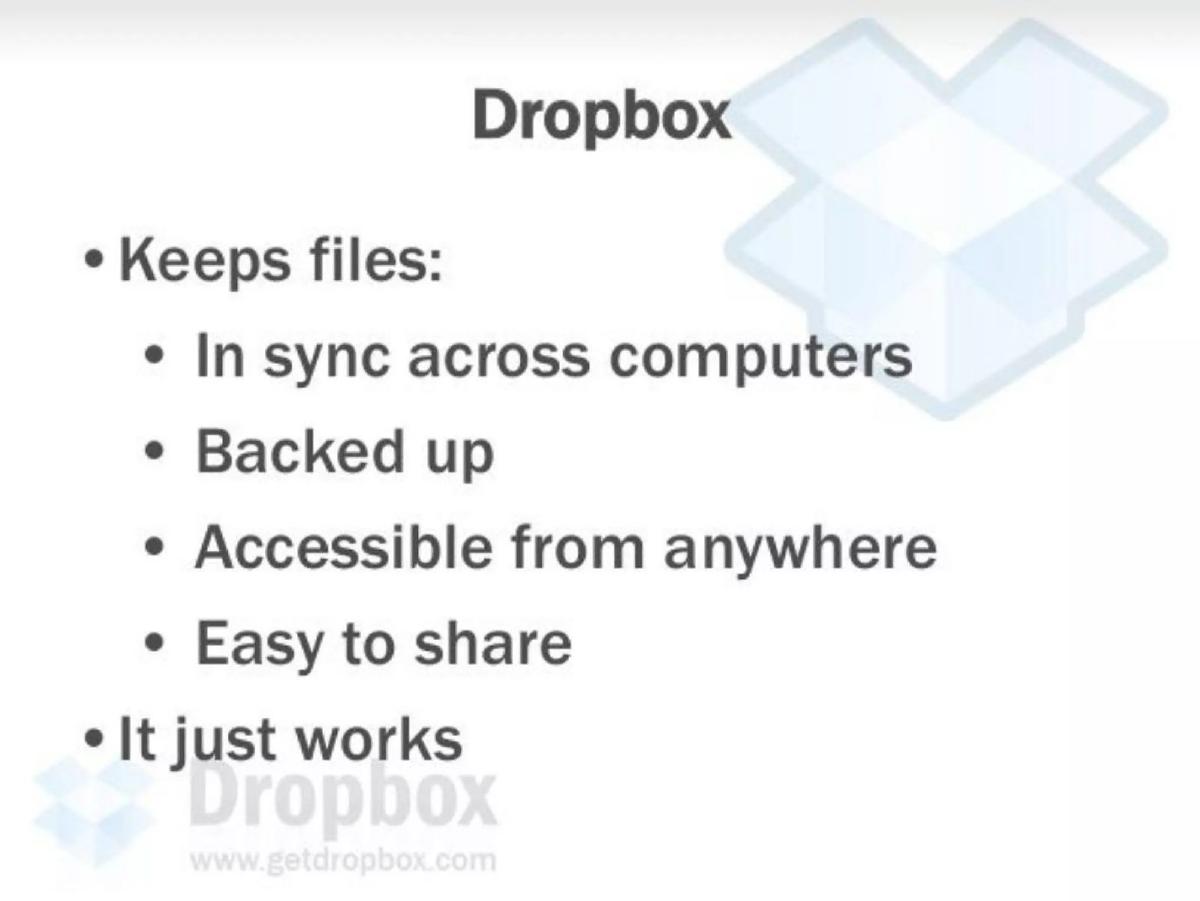
- Dropbox focuses on eliminating the friction of file management. In 2007, users struggled with syncing files across multiple devices and sharing large media. Dropbox proposed a 'single app' solution that integrated deeply with the operating system, making cloud storage feel like a local folder. The deck emphasizes that the product doesn't force users to change their workflow, which was a significant departure from the complex FTP and web-upload tools of the era.
- How does the deck handle competition?
- Rather than naming specific competitors on the provided slides, the deck categorizes the failures of the 'entire genre' of storage problems. It argues that existing solutions only tackle small pieces of the problem, suffer from poor technical execution, and have 'clumsy' user interfaces. By framing the competition as technically inferior and difficult to use, Dropbox positions its 'simplicity and elegance' as its primary competitive advantage.
- What role does the team's background play in this pitch?
- The team slide is heavily weighted toward technical excellence and early achievement. Both founders are linked to MIT EECS, and the deck highlights their long-standing relationship with code. This was crucial for a product that required 'Deep OS integration,' a notoriously difficult technical feat. The mention of Arash Ferdowsi being 'on leave' from MIT signals a 'all-in' commitment to the startup, which is a common signal sought by seed investors.
- Is there a business model or market size slide in the deck?
- Based on the 9 slides provided from the 17-slide deck, there is no explicit mention of a business model, pricing, or Total Addressable Market (TAM). The deck is product-centric, focusing on the 'Platform' potential and the 'Bigger picture' of delegating file access to web apps. This suggests the early pitch was focused on proving the technical viability and user demand before detailing the monetization strategy.
- How does Dropbox use social proof to bolster its case?
- The final slide in this set uses a third-party endorsement from VentureBeat. By citing their #1 ranking among Y Combinator startups and quoting a journalist on the 'simplicity and elegance' of the interface, Dropbox offloads the 'trust' requirement to a recognized tech publication. This is particularly effective for seed-stage companies that may not yet have massive user metrics to show.