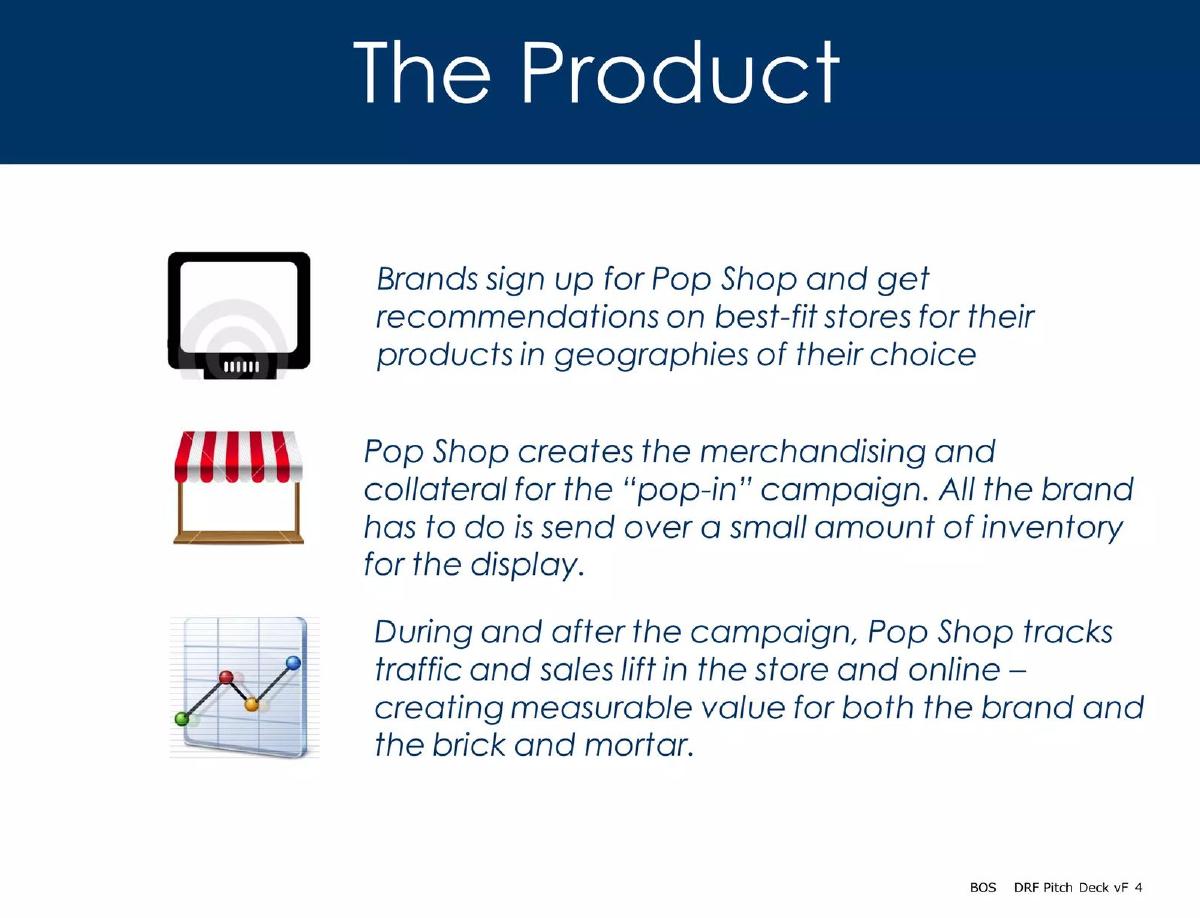
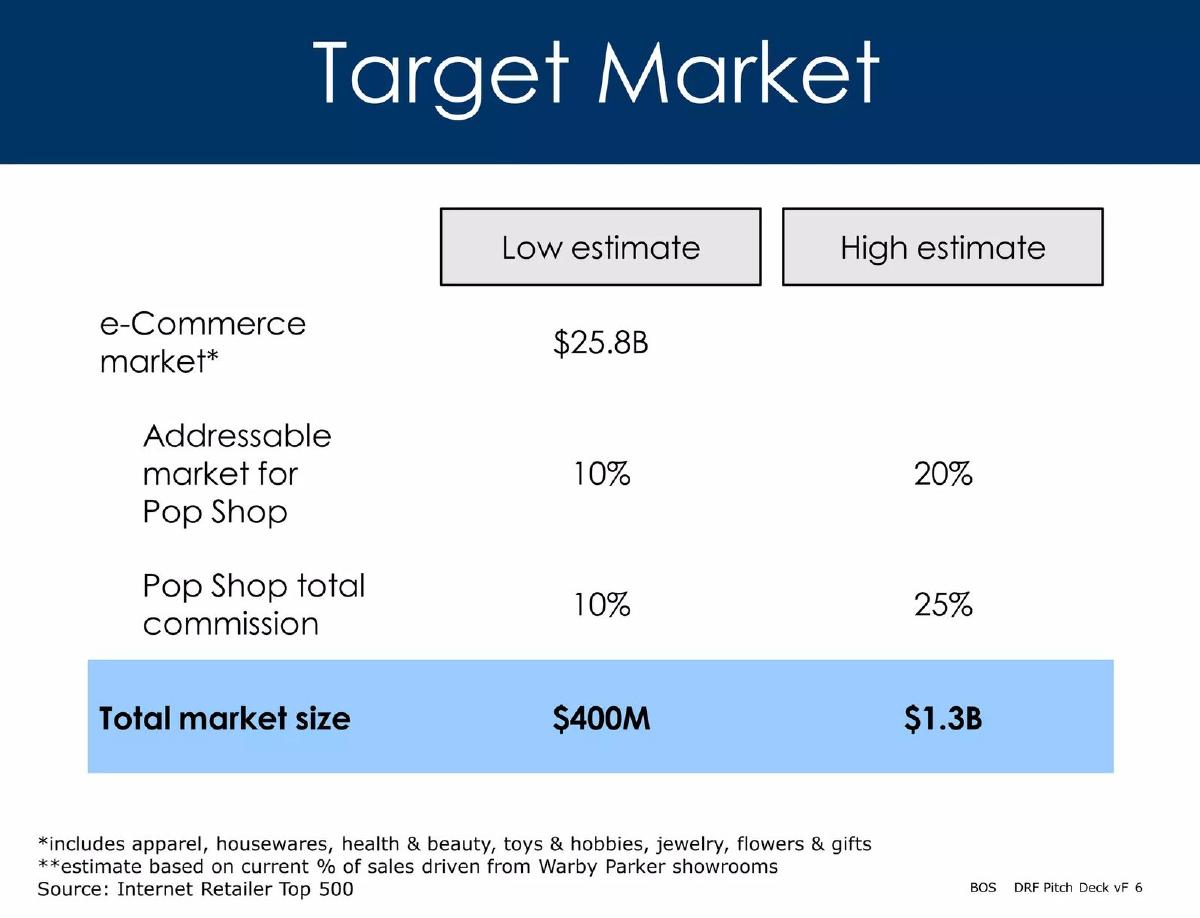
The DRF pitch deck, centered on a product called Pop Shop, addresses the 'showrooming' trend where consumers browse in-person but buy online. By creating a plug-and-play network for online brands to occupy physical retail space, the company aims to turn a traditional retail threat into a cross-marketing channel. The deck highlights early traction with 8 online brands and 6 stores signed up, alongside a pilot in Philadelphia. While it provides a detailed waterfall chart for store unit economics, the deck lacks a formal team slide and a specific capital ask in the provided pages. It relies heav…
Key takeaways
- The vision centers on disrupting the relationship between brands and stores by leveraging 'showrooming' as a scalable cross-marketing channel (Slide 1).
- The platform acts as a three-sided marketplace connecting online brands, physical retailers, and consumers (Slide 3).
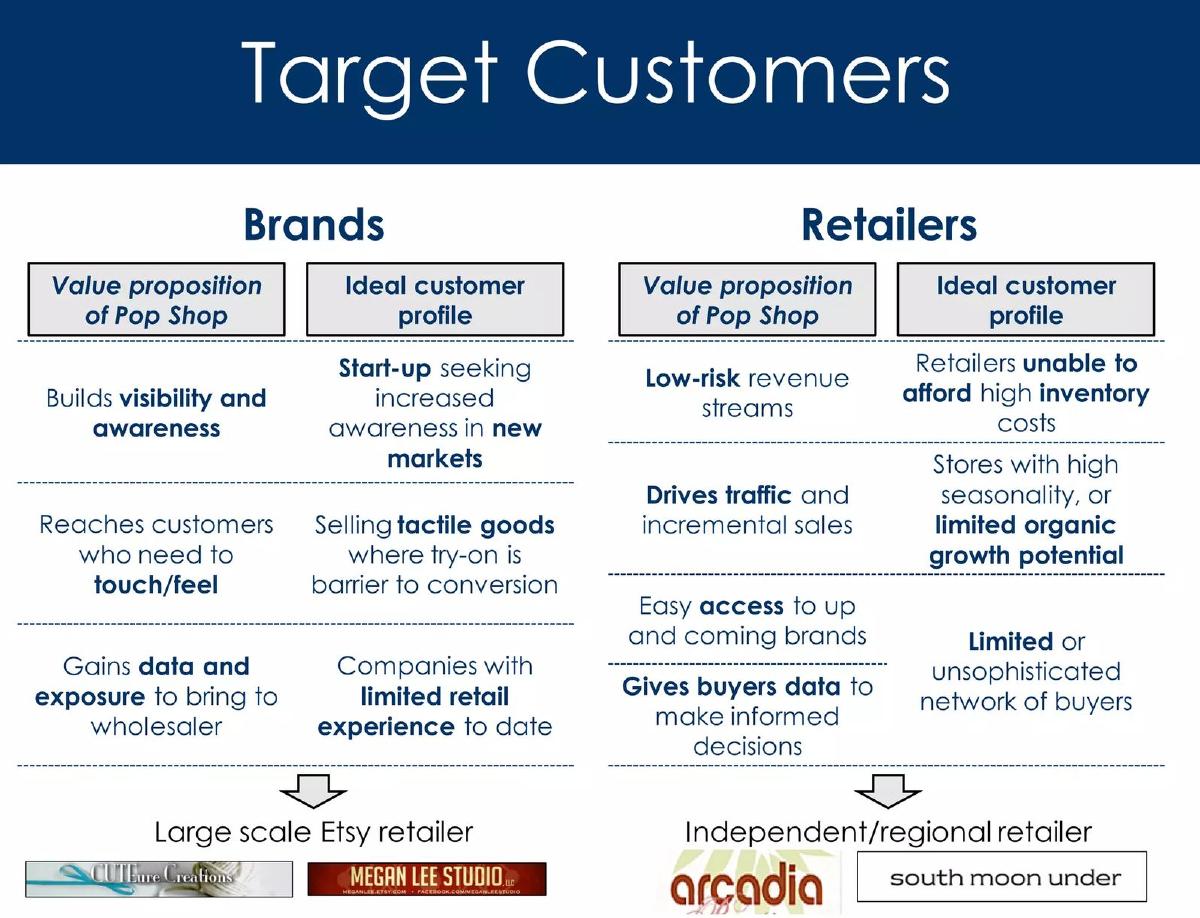
- Ideal brand customers are startups seeking awareness for tactile goods, while ideal retailers are those with high seasonality or limited organic growth (Slide 5).
- Market timing is supported by 2013 data showing 34% of shoppers buy from online-only retailers after viewing products in-store (Slide 7).
- The company claims a first-mover advantage and proprietary data ownership as its primary competitive moats (Slide 9).
- Store-side economics are tight, showing a projected -$62 profit per 20 sq ft campaign, which requires a 13% 'spillover spend' to reach breakeven (Slide 11).
- Early traction includes winning a pitch competition, signing 8 brands, and entering talks with a 19-location regional chain (Slide 13).
- The deck uses Bill Gurley’s 10 Marketplace Success Factors as a self-evaluation framework, claiming to meet 7 out of 10 criteria (Slide 15).
Executive Summary: The Showrooming Pivot
The DRF (Dorm Room Fund) pitch deck for Pop Shop is a time capsule of 2013 retail strategy. At a time when traditional retailers viewed the internet as an existential threat, Pop Shop proposed a symbiotic relationship. The deck is structured to move from a high-level vision of market disruption to the granular mechanics of a physical-digital marketplace. It leans heavily on the 'why now' argument, using then-current IBM research to validate the consumer shift toward omnichannel shopping.
Slide 1: Vision
The deck opens with a clear, text-heavy vision statement. It defines Pop Shop as a "scalable cross-marketing channel." The core thesis is to leverage "showrooming"—the act of consumers visiting stores to see products before buying them online—to disrupt the traditional brand-retailer relationship. By framing a common retail pain point as a "consumer driven phenomenon," the founders position themselves as facilitators of an inevitable market shift rather than fighters against it.
Slide 3: The Pop Shop Model
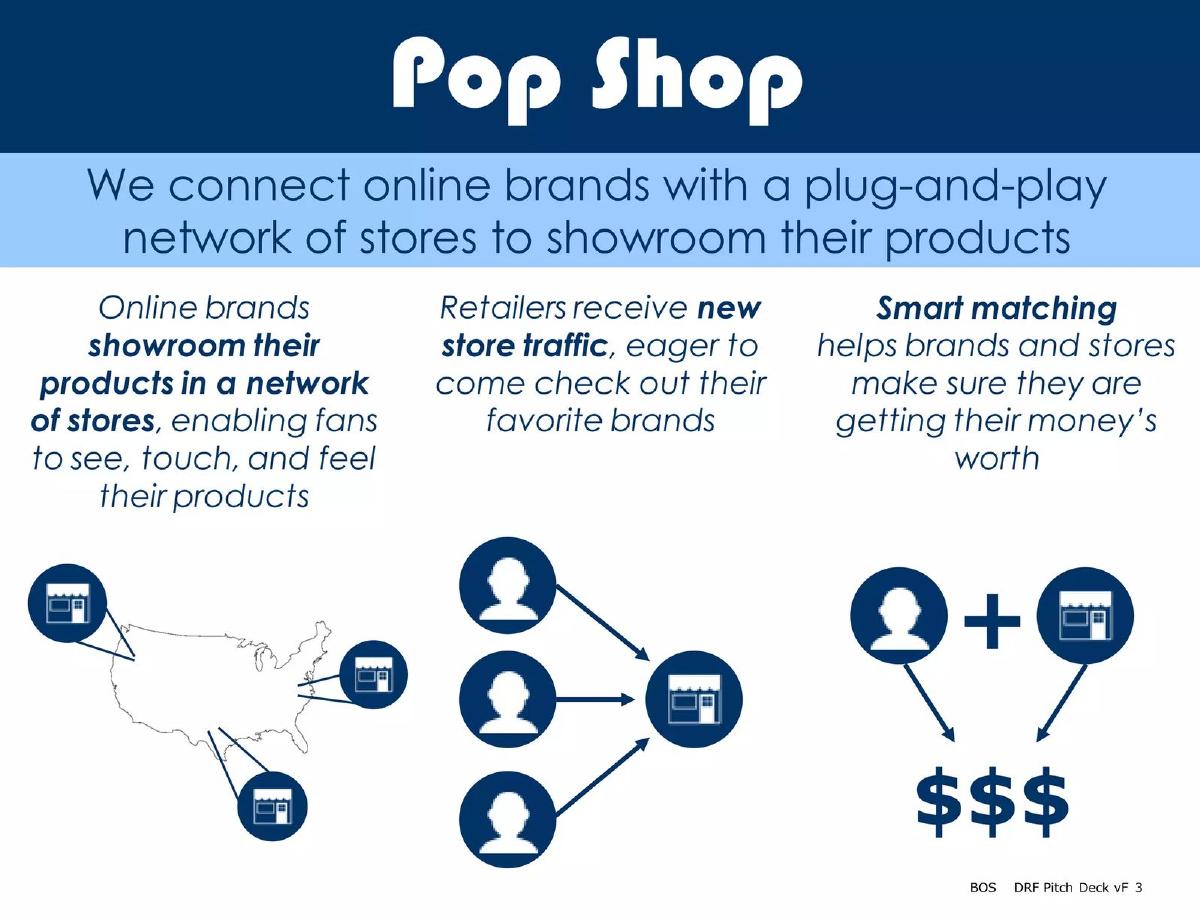
This slide explains the mechanics of the marketplace. It uses simple iconography to show three pillars: online brands, retailers, and smart matching. The value proposition is split: brands get to let fans "see, touch, and feel" products, while retailers receive "new store traffic." The inclusion of a US map with pins suggests a national ambition, though the later traction slides indicate they are starting much smaller. The "Smart matching" callout is a nod to the data-driven nature of the platform, promising that both sides will get "their money's worth."
Slide 5: Target Customers
Pop Shop provides a detailed breakdown of their Ideal Customer Profile (ICP) for both sides of the marketplace. For brands, they are looking for startups with "tactile goods" where "try-on is a barrier to conversion." They specifically name-check "Large scale Etsy retailers" like Megan Lee Studio. For retailers, the focus is on "independent/regional" stores like South Moon Under that are "unable to afford high inventory costs." This is a sophisticated slide because it acknowledges that the platform solves different problems for different users: visibility for brands and low-risk revenue for stores.
Slide 7: Why Now?
Market timing is often the most important slide in a seed deck. Pop Shop uses a USA Today quote from March 2013 citing IBM data: "nearly half of all online shoppers use this technique [showrooming]." The slide also lists "pioneering online only players" like Warby Parker, Bonobos, and Fab, alongside major retailers like Nordstrom and Target. This creates a sense of urgency, suggesting that if the giants are doing this, a platform is needed to help the smaller players compete.
Slide 9: Competitive Advantage
The company claims three main advantages: first-mover status, relationship ownership, and data ownership. The claim that "building out a marketplace is one of the few times there is truly a first mover advantage" is a bold assertion that investors might contest, as marketplaces often benefit more from liquidity than being first. However, the point about "proprietary data gathering" is strong; by tracking which brands perform well in which stores, Pop Shop creates a feedback loop that makes their matching algorithm more valuable over time.
Slide 11: Business Model: Stores
This is the most technical slide in the deck, featuring a waterfall chart for a "20 sq ft campaign, for 1 Month." It is refreshingly honest. It shows that after opportunity costs (-$406), COGS, and commissions, the store actually loses $62. The slide explicitly states that this loss is "Made up with ~13% spillover spend in store." Relying on spillover spend is a risky bet, but documenting it shows the founders have done the math on the retailer's bottom line. The "Fee to Pop Shop" is listed at a modest "$100/yr."
Slide 13: Where We're At
The traction slide provides a roadmap from April 2013 to June 2014. It lists specific milestones: a pilot in Philadelphia, developing the platform, and launching in 5 cities. The "To date" section is the most important part of this slide, noting they have signed 8 brands and 6 stores. Mentioning a "seasoned entrepreneur as an advisor" adds a layer of credibility to an otherwise student-led or early-stage team.
Slide 15: Why We Need DRF
The final slide in this set is a direct appeal to the Dorm Room Fund. It uses Bill Gurley’s famous "10 Marketplace Success Factors" as a checklist. Pop Shop claims to hit 7 out of 10, with question marks next to "Low Friction of Supplier Sign-up," "High Frequency of Transaction," and "Integration in Payment Flow." This level of self-awareness is rare in pitch decks. It tells the investor exactly what the founders are worried about and where they need help: "now we need to understand our suppliers more deeply."
What Works in This Deck
Honest Unit Economics: Slide 11 is a standout. Most founders try to hide the fact that their solution might be marginally profitable or even a loss-leader for one side of the market. By showing the -$62 profit and the 13% spillover requirement, Pop Shop demonstrates a deep understanding of retail reality.
External Validation: The use of the Bill Gurley checklist (Slide 15) and the IBM/USA Today data (Slide 7) anchors the startup's claims in industry-standard frameworks and credible news sources. This reduces the perceived risk of the "vision" being just a founder's hunch.
Clear Segmentation: Slide 5 does an excellent job of defining who the product is for. By listing specific examples like Etsy retailers and regional chains, the founders make the market opportunity feel concrete rather than theoretical.
What Is Missing
The Team: The provided slides do not include a team slide. In early-stage fundraising, the founders' backgrounds are often more important than the idea itself. Without knowing who is building the "smart matching" algorithm or who has the retail relationships, it is hard to judge the execution risk.
The Ask: There is no slide detailing how much money is being raised or how that capital will be allocated. While Slide 13 mentions "Fundraising" as a milestone, it lacks the specific dollar amount and the runway it provides.
Product Interface: While the deck mentions a "platform" and "smart matching," there are no screenshots or mockups of the actual software. For a company claiming to "own the data," seeing how that data is collected and presented to users is a critical omission.
What a Founder Should Copy
The Marketplace Checklist: Using a recognized expert's framework (like Bill Gurley's) to grade your own startup is a brilliant way to build rapport with sophisticated investors. It shows you speak their language and are thinking critically about your business model's flaws.
The 'Why Now' Slide: Pop Shop's Slide 7 is a masterclass in establishing market timing. It combines a macro trend (showrooming) with a specific data point (34% buy online) and examples of market leaders (Warby Parker) to create a compelling case for why the business must exist today.
Specific Traction Metrics: Instead of vague promises, Slide 13 lists exact numbers: 8 brands, 6 stores, and 1 regional chain with 19 locations. Even if the numbers are small, their specificity builds trust.
Frequently asked questions
- What is the core problem Pop Shop is trying to solve?
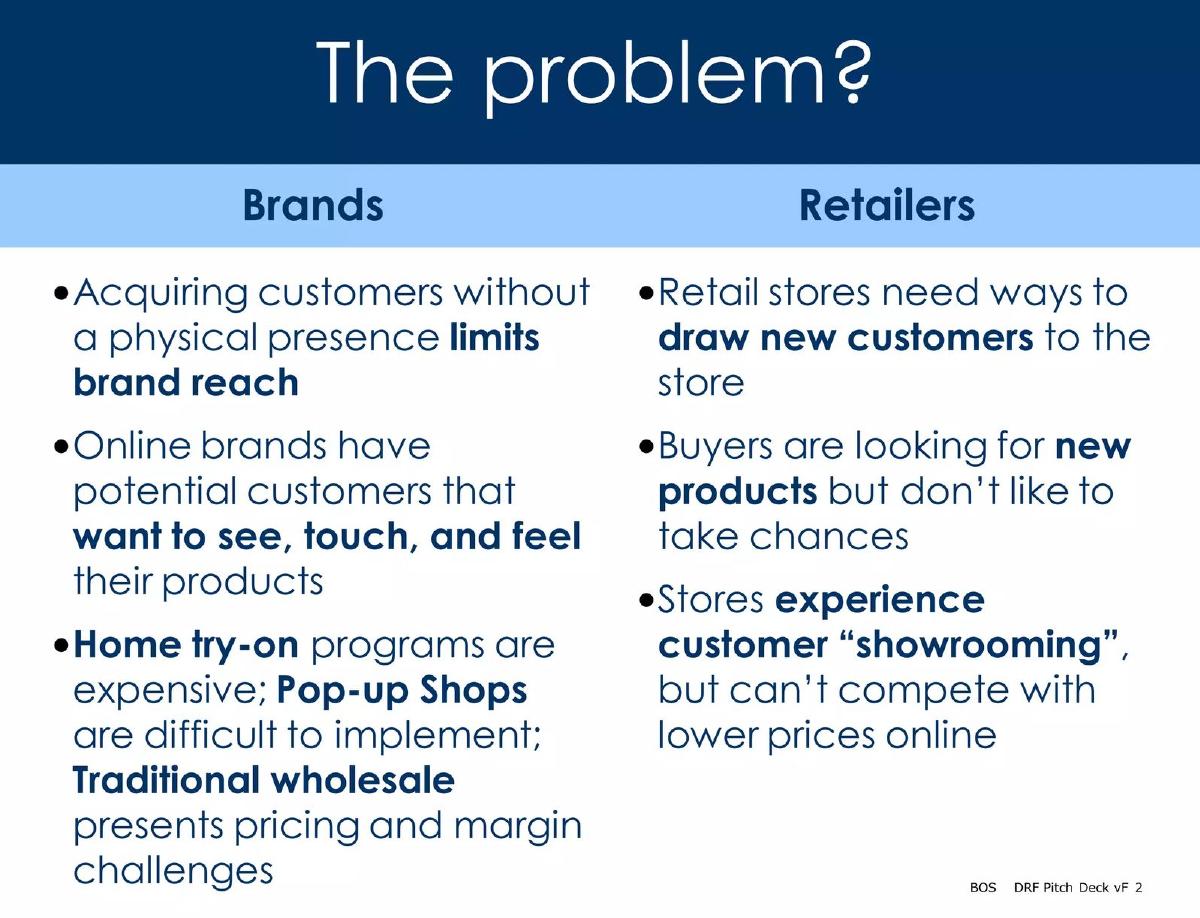
- Pop Shop addresses 'showrooming,' the consumer habit of examining products in physical stores before purchasing them online. Traditionally, this hurts brick-and-mortar retailers. Pop Shop attempts to monetize this behavior by allowing online-only brands to pay for physical presence, providing retailers with new revenue and foot traffic while giving brands the tactile exposure they lack online.
- How does the company plan to make money?
- According to the business model slide, the company charges a fee to the brands. The store economics slide mentions a '$100/yr' fee to Pop Shop, though it is unclear if this is a per-store subscription or a per-campaign fee. The model also accounts for rent paid to the store and commissions on sales, suggesting a multi-layered revenue approach.
- What is the current stage of the company based on the deck?
- The company is at the pre-seed or seed stage. As of the 'Where We're At' slide, they had won a pitch competition, signed up 8 brands and 6 stores, and were preparing for a pilot campaign in Philadelphia scheduled for April 5th. They were also in the process of incorporation and formal fundraising.
- What are the biggest risks identified in the deck's economics?
- The primary risk is store profitability. Slide 11 shows that a standard 20 sq ft campaign actually results in a loss of $62 for the store after accounting for opportunity costs and COGS. The model relies on an assumed 13% 'spillover spend' (customers buying other items in the store) just to reach a breakeven point.
- Who are the target customers for this platform?
- The deck identifies two distinct targets. For brands, they target startups selling tactile goods (like Etsy retailers) that need 'touch/feel' exposure. For retailers, they target independent or regional stores (like South Moon Under) that have excess space, high seasonality, or limited ability to afford high inventory costs.