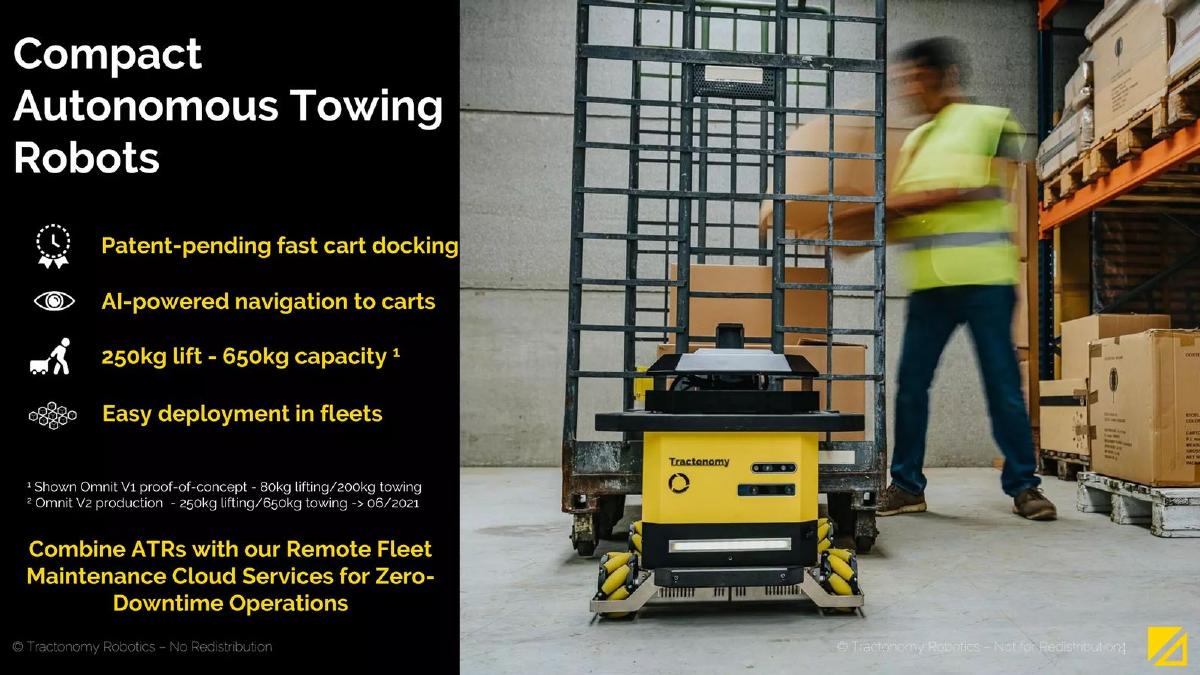
Tractonomy’s presentation for the MIDIH (Manufacturing Industry Digital Innovation Hubs) program focuses on the automation of manual cart handling in large-scale facilities. The deck identifies a significant operational bottleneck where companies manage between 100 and 50,000 carts manually or with outdated AGVs. Their solution, the Dreambot AMR, features vision-based cart searching and a towing capacity of 650kg. While the deck provides strong technical architecture diagrams and evidence of physical testing sites in Aalst and Langemarke, it is notably light on commercial metrics. The 'Busine…
Key takeaways
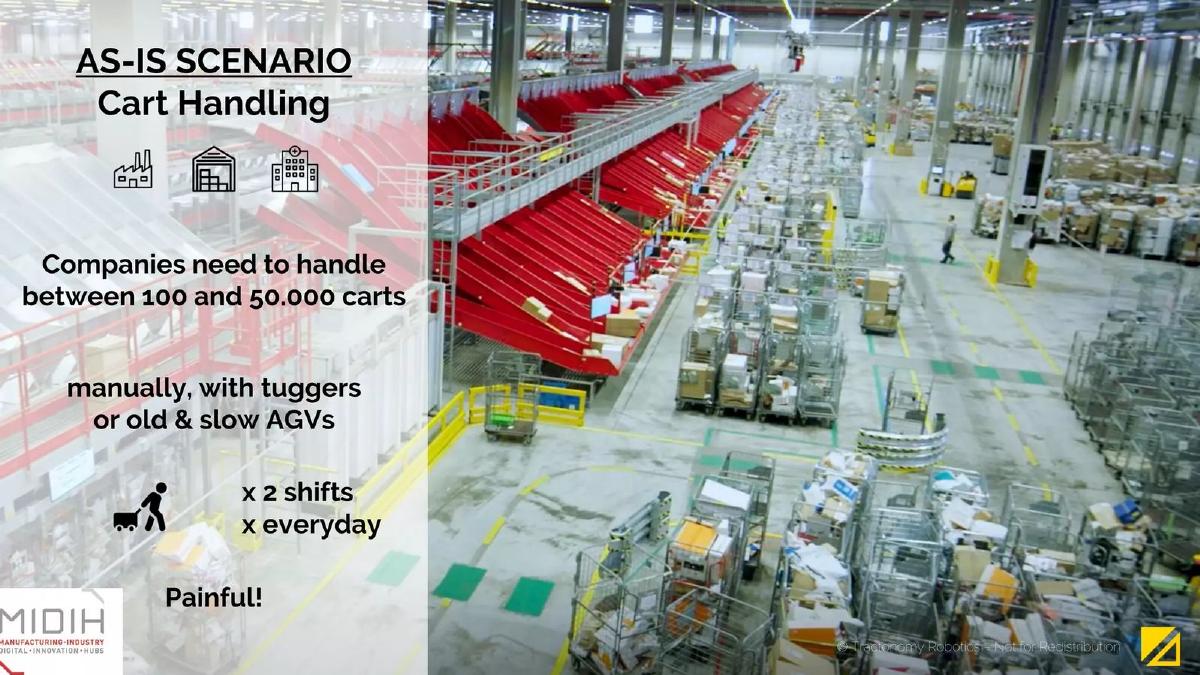
- The company identifies a massive scale problem, noting that facilities often handle between 100 and 50,000 carts (Slide 2).
- The 'As-Is' scenario highlights that current methods—manual labor, tuggers, or slow AGVs—are 'Painful' across multiple shifts (Slide 2).
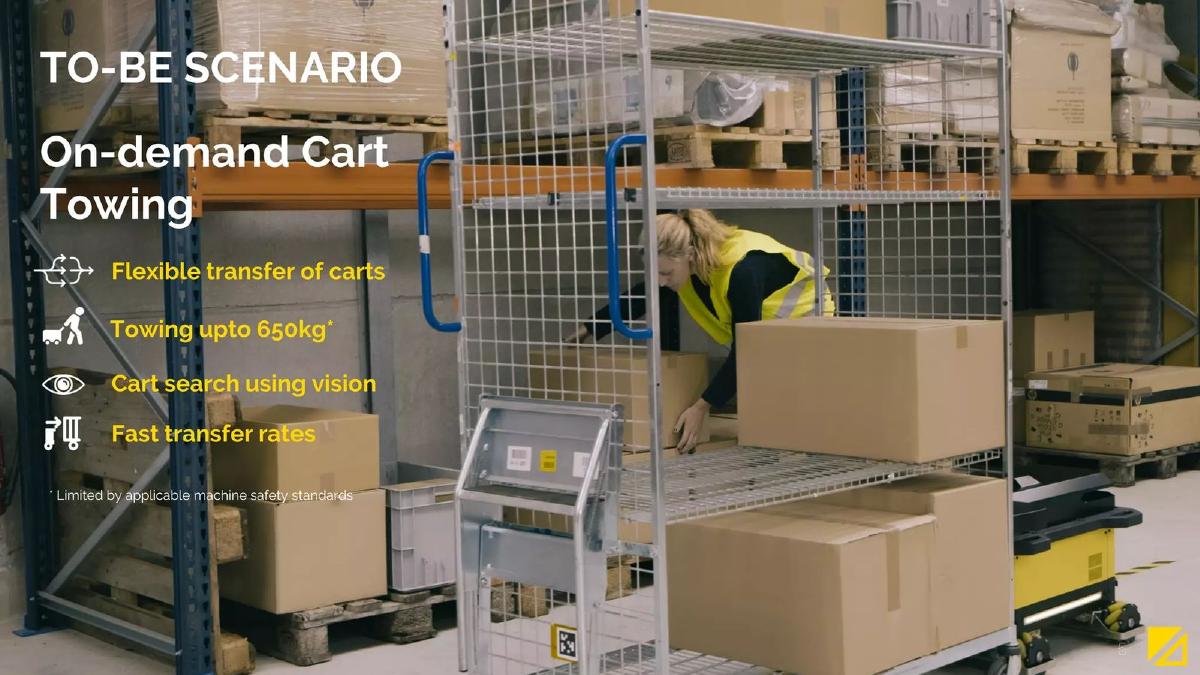
- Tractonomy’s Dreambot AMR supports towing up to 650kg, limited only by machine safety standards (Slide 3).
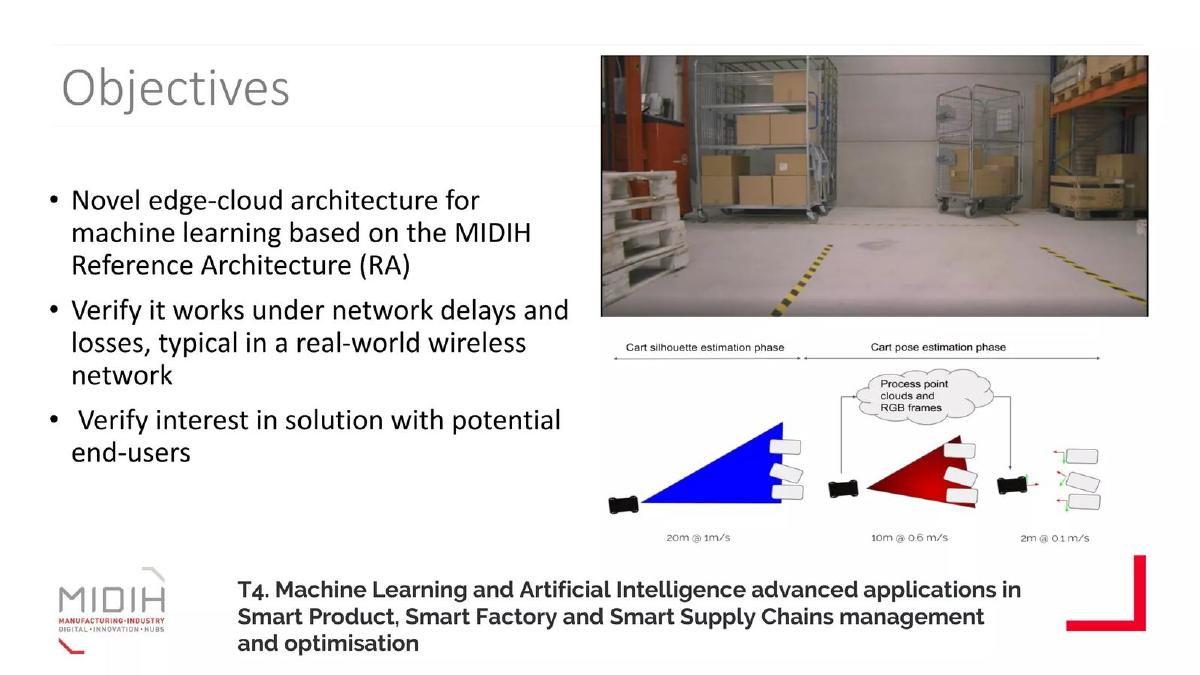
- The technical stack utilizes ROS2 (Robot Operating System 2) with dedicated security layers for both 'Data-at-Rest' and 'Data-in-Motion' (Slide 4).
- The solution incorporates vision-based cart searching to enable flexible, on-demand transfers (Slide 3).
- Testing has been conducted at two specific sites: a 70 m2 facility in Aalst and a 100 m2 facility in Langemarke (Slide 5).
- Commercial traction is limited to 'positive responses' and one mentioned 'paid study' due to COVID-19 restrictions on live demos (Slide 6).
- The deck lacks a formal investment ask, financial projections, or a detailed breakdown of the founding team's background (General Omission).
Executive Summary: The Automation of Industrial Towing
Tractonomy, through its Dreambot project, addresses a specific and labor-intensive niche within the logistics sector: the movement of industrial carts. The deck, presented under the MIDIH (Manufacturing Industry Digital Innovation Hubs) framework, outlines a transition from manual, 'painful' labor to a vision-enabled, autonomous towing system. While the technical foundation and problem statement are clearly articulated, the deck functions primarily as a technical milestone report rather than a comprehensive business case for investment.
Slide 1: Title and Project Identification
The cover slide introduces the company name, Tractonomy, and the project name, Dreambot. It identifies the presenters as Keshav Chintamani, Elias De Coninck, and Geert Dorme. A significant detail is the mention of a mentor, Emanuel Skubowius from Fraunhofer IML, a prestigious German research organization specializing in material flow and logistics. This association provides immediate technical credibility to the project. The MIDIH logo is prominent, indicating this presentation was likely part of a specific European innovation grant or accelerator program.
Slide 2: The 'As-Is' Scenario - Identifying the Pain Point
Slide 2 establishes the market need by focusing on the inefficiency of current cart handling. The company notes that factories, warehouses, and hospitals handle between 100 and 50,000 carts. The current state is defined by manual labor, manual tuggers, or 'old & slow AGVs.' The slide uses a simple but effective visual shorthand to describe the burden: 'x 2 shifts x everyday,' concluding with the word 'Painful!' This slide successfully quantifies the scale of the problem (up to 50k carts) while emphasizing the recurring operational cost of human labor.
Slide 3: The 'To-Be' Scenario - The Dreambot Solution
This slide introduces the Dreambot's value proposition. It lists four key advantages: flexible transfer of carts, towing capacity up to 650kg, cart search using vision, and fast transfer rates. The mention of 'vision' is critical, as it suggests the robot does not require fixed tracks or magnetic tape, unlike the 'old AGVs' mentioned in the previous slide. A footnote clarifies that the 650kg limit is tied to machine safety standards, showing an awareness of the regulatory environment in industrial robotics.
Slide 4: Technical Architecture and System Mapping
Slide 4 is the most dense, providing a 'Mapping with the MIDIH RA' (Reference Architecture). It breaks the system into a 'Local Cloud' and the 'AMR' (Autonomous Mobile Robot) itself. Key components include:
Data-at-Rest Layer: Featuring a SQL Database, Robot Discovery, and Pose Estimator. · Data-in-Motion Layer: Located on the AMR, including a Navigation Controller, Cart Classification, and Sensors. · Security: The use of ROS2 (Robot Operating System 2) Security is highlighted for both layers. · Connectivity: A ROS2/DDS bridge connects the local cloud to the robot via IoT Middleware.
The slide also includes a small UI screenshot of a login page and a photo of the physical Dreambot unit, which features omnidirectional wheels (mecanum wheels), allowing for high maneuverability in tight warehouse spaces.
Slide 5: Validation Through Testing Sites
To prove the project has moved beyond the conceptual phase, Slide 5 showcases two testing sites. The first is a 70 m2 space in Aalst, and the second is a 100 m2 space in Langemarke. The photographs show the robot in a controlled warehouse environment, navigating around pallets and through doorways. While these are relatively small spaces for industrial testing, they demonstrate that functional prototypes exist and are being put through their paces in real-world settings.
Slide 6: Business KPIs and the Impact of External Factors
This slide provides a candid look at the company's progress against its goals. It lists two specific KPIs: 'Demonstrator Views' and 'Interested Customers.' The results for the former are listed as 'COVID blocked any ability to offer live demonstrations.' For the latter, the company claims 'very positive responses including a paid study.' This is a vital piece of information for any evaluator; it shows that despite global disruptions, there is market appetite for the technology, evidenced by a customer willing to pay for a pilot or study.
Slide 7: Conclusion
The final slide is a standard 'Thank You' slide featuring an image of robotic arms on an assembly line. It lacks contact information or a call to action, which reinforces the feeling that this deck was intended for an internal program review rather than an external fundraising round.
What Works Well in This Deck
Clear Problem Definition: Slide 2 does an excellent job of explaining why this matters. By citing the number of carts (up to 50,000) and the shift-based nature of the work, they translate a technical problem into a clear labor-cost problem.
Technical Credibility: The inclusion of the Fraunhofer IML mentorship and the detailed ROS2 architecture diagram (Slide 4) suggests a high level of engineering competence. This isn't just a 'wrapper' startup; they are building a complex autonomous system.
Physical Proof: Showing the robot in actual testing sites (Slide 5) rather than just 3D renders is a major plus for hardware startups. It proves the team can build and iterate on physical hardware.
What Is Missing from the Deck
The Ask: There is no mention of how much capital the company is looking for or what they intend to do with it. This is the most significant omission for a 'pitch' deck.
Market Analysis: While they identify the problem, they don't quantify the Total Addressable Market (TAM). How many warehouses globally fit this profile? What is the potential revenue?
Competitive Landscape: The AMR space is crowded with companies like Locus Robotics, MiR, and Fetch Robotics. Tractonomy does not explain how its vision-based towing specifically beats these established players.
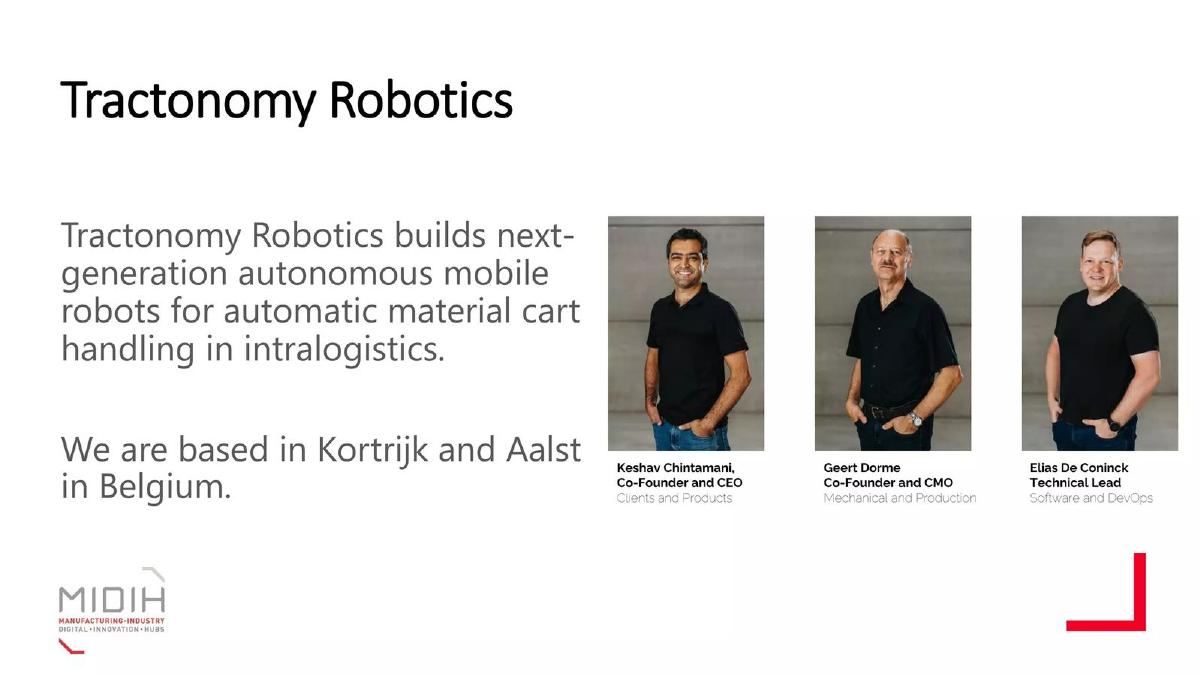
Team Backgrounds: While names are listed, their specific expertise (e.g., '10 years in robotics at X company') is missing. In early-stage deep tech, the pedigree of the founders is often as important as the tech itself.
Unit Economics: There is no mention of the cost to build a Dreambot versus the price they intend to charge, or the ROI a customer can expect (e.g., 'Payback period of 12 months').
Founder Takeaways: What to Copy and What to Avoid
Copy the 'As-Is' vs 'To-Be' Structure: Slides 2 and 3 are a textbook example of how to frame a solution. Identify the current 'painful' reality and then present the 'future' state where your product solves those specific pains.
Avoid the 'KPI Excuse': While the impact of COVID-19 was real, Slide 6 feels defensive. Instead of saying what was 'blocked,' founders should focus on what was achieved despite the blockers. For example, 'Pivot to virtual demos resulted in X views' sounds much stronger than 'COVID blocked us.'
Include a Roadmap: For a hardware company, showing the path from a 70 m2 test site to a full-scale factory deployment is essential. This deck stops at the test site, leaving the viewer wondering how the company scales from a prototype to a fleet.
Be Specific About Integration: The architecture slide (Slide 4) is great because it shows how the robot fits into existing enterprise IT stacks (SQL, Cloud, IoT). This is a major concern for industrial buyers, and addressing it early builds trust.
Frequently asked questions
- What is the primary problem Tractonomy is solving?
- Tractonomy targets the inefficiency of manual cart handling in warehouses, factories, and hospitals. According to slide 2, these facilities often manage up to 50,000 carts using manual labor or outdated automated guided vehicles (AGVs), which the company describes as a 'painful' process that requires constant staffing across multiple shifts.
- What are the key technical specifications of the Dreambot?
- The Dreambot is an Autonomous Mobile Robot (AMR) capable of towing loads up to 650kg. Slide 3 highlights its core features: flexible transfer of carts, vision-based cart searching, and fast transfer rates. Slide 4 further details a complex software architecture involving a local cloud, IoT middleware, and a navigation controller powered by ROS2.
- Where has the technology been tested?
- The company has utilized two distinct testing environments to validate the Dreambot. Slide 5 lists a 70 m2 site in Aalst and a 100 m2 site in Langemarke. The slide includes photographs of these warehouse-like environments, showing the robot navigating around pallets, shelving, and traffic cones.
- How has the company performed commercially?
- Traction appears to be in the early stages. Slide 6 indicates that COVID-19 prevented live demonstrations, which was a key KPI. However, the company notes they have received positive feedback from their pitch deck and have successfully secured at least one 'paid study' from an interested customer.
- What information is missing from this deck for a professional investor?
- This deck is missing several critical components of a standard VC pitch. There is no slide detailing the 'Ask' (how much money they are raising), no financial projections or unit economics, no competitive analysis, and no detailed biographies for the founders beyond their names on the title slide.