Dr. Ocean is a hardware-focused startup aiming to mitigate the environmental and financial costs of oil spills through a 'quick alarm' detection system. The deck, produced for the Climate Launchpad competition, focuses heavily on a beachhead market in the Persian Gulf, where they identify 200 platforms requiring 10 devices each. Their primary value proposition is a 7x reduction in annual spill-related costs, dropping from $30M to $4M for a typical operator. While the deck provides specific environmental impact figures—claiming the ability to prevent 20,000 tons of oil spills annually with 40%…
Key takeaways
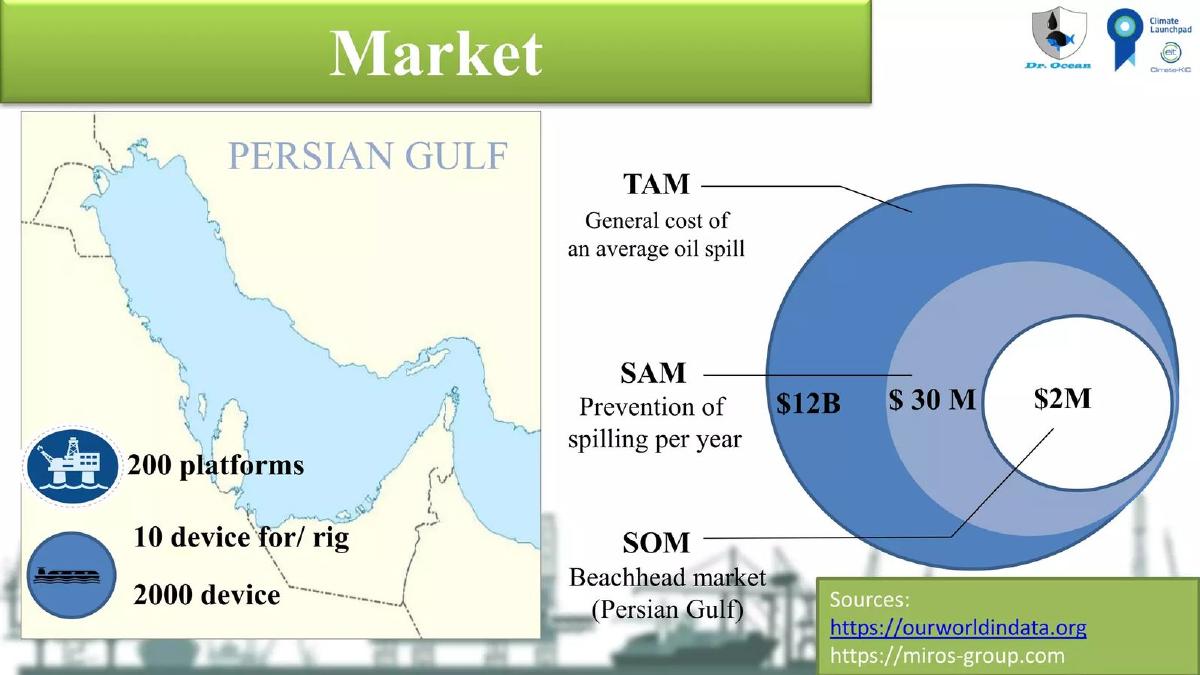
- The company identifies the Persian Gulf as its beachhead market (SOM), valued at $2M based on 200 platforms requiring 2,000 total devices (Slide 2).
- TAM is defined as the general cost of an average oil spill at $12B, while the SAM for spill prevention is cited at $30M (Slide 2).
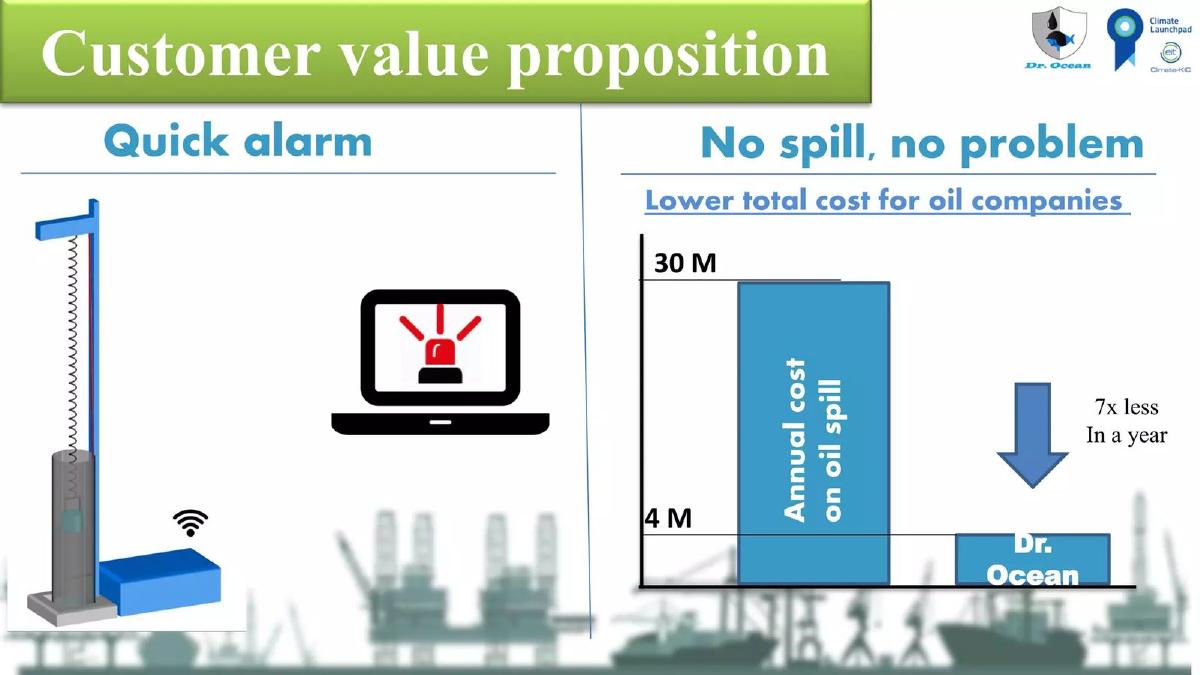
- The core value proposition is a 7x reduction in annual oil spill costs, moving from $30M to $4M (Slide 3).
- Customer discovery involved 100+ interviews, revealing that 93% of people do not know the purity of beach water (Slide 4).
- Environmental impact projections suggest that with 40% market share, the company can prevent 20,000 tons of oil spills per year (Slide 5).
- The deck includes a competition matrix comparing Dr. Ocean against 'Lab Methods' and 'Leakwise' across four features: Price, Detection period, Distance Monitoring, and Spill quantity detection (Slide 7).
- Critical fundraising elements are missing, including a team slide, a specific investment ask, and a detailed Go-To-Market strategy (Omitted).
Dr. Ocean Pitch Deck Analysis
The Dr. Ocean pitch deck is a mission-driven presentation focused on the niche but high-stakes industry of oil spill detection. The deck follows a standard competition format, likely developed for the Climate Launchpad program, as evidenced by the logos on several slides. It prioritizes the environmental and economic 'pain' of oil spills, specifically within the Persian Gulf region, while positioning a hardware solution as the primary remedy. However, the deck is notably light on technical specifications and corporate structure.
Slide 1: Title Slide
The title slide introduces the company name, Dr. Ocean , accompanied by the tagline "Making Oil Spills History." The visual branding features a shield logo containing a drop of oil and a fish wearing what appears to be a helmet, suggesting protection and defense. The bottom of the slide features a silhouette of industrial oil rigs and tankers, clearly defining the sector of operation. There are no founder names or contact details present on this opening slide.
Slide 2: Market Analysis
Slide 2 breaks down the market opportunity using the TAM/SAM/SOM framework, with a specific geographic focus on the Persian Gulf . The figures provided are as follows:
TAM (Total Addressable Market): $12B, described as the "General cost of an average oil spill." · SAM (Serviceable Addressable Market): $30M, described as the "Prevention of spilling per year." · SOM (Serviceable Obtainable Market): $2M, identified as the "Beachhead market (Persian Gulf)."
The slide further justifies the SOM by noting there are 200 platforms in the region, with a requirement of 10 devices for/ per rig , totaling 2000 devices . Sources cited include ourworldindata.org and miros-group.com.
Slide 3: Customer Value Proposition
This slide focuses on the dual benefits of the product: "Quick alarm" and "No spill, no problem." The left side of the slide shows a 3D render of a hardware device—a tall probe connected to a blue base with a wireless signal icon—communicating with a laptop. The right side presents a financial comparison. It claims the "Annual cost on oil spill" is currently 30 M (presumably USD), and that using Dr. Ocean reduces this to 4 M . A large blue arrow points downward, highlighting a "7x less In a year" cost reduction. This slide establishes the economic incentive for oil companies to adopt the technology.
Slide 4: Customer Discovery
Slide 4 details the qualitative research conducted by the team. It lists three "Key questions" asked during discovery:
What kind of methods do you use for detecting oil spills? (Answer: Mostly expensive and time consuming) · How much they costs for you? (Answer: Much more than we suggest for them) · Are they efficient? (Answer: Exact, but not efficient)
The slide also notes that 100+ Interviews were conducted "With people." Statistical findings include that 93% "Don't know purity of beach water" and 84% "Want to be informed about its content." This suggests a secondary consumer-facing or public safety angle that is not fully explored in the rest of the deck.
Slide 5: Climate Impact
This slide quantifies the environmental stakes. It states that 50000t/year crude oil spills worldwide occur. Dr. Ocean claims that "With 40% of the market, We can prevent 20000t of oil spilling per year." The slide uses graphic imagery of oil-covered wildlife to emphasize the impact, citing specific numbers of animals affected: 10,000 marine mammals , 2500 sea turtles , and 32,000 birds . Sources include ourworldindata.org and biologicaldiversity.org.
Slide 6: Backup Slides Transition
Slide 6 is a simple divider slide with the text "BACKUP SLIDES" in large, black capital letters against a white background. This indicates that the core narrative ended at Slide 5, and subsequent slides are intended for the Q&A portion of a pitch.
Slide 7: Competition
The final attached slide is a competitive matrix. It compares Dr. Ocean against "Lab Methods" and "Leakwise." The comparison is based on four features:
Price: Only Dr. Ocean receives a checkmark. · Detection period: Dr. Ocean and Leakwise receive checkmarks; Lab Methods does not. · Distance Monitoring: Only Dr. Ocean receives a checkmark. · Spill quantity detection: All three categories receive checkmarks.
The text above the table notes that "there are only a few products and services" in this space and positions Dr. Ocean as the only solution that satisfies all four criteria.
What Works
Specific Beachhead Market: The deck does an excellent job of narrowing its initial focus to the Persian Gulf. By identifying exactly how many rigs exist (200) and how many devices are needed per rig (10), the founders demonstrate a clear understanding of their initial sales target and a logical path to their $2M SOM.
Clear Economic Incentive: The 7x cost reduction claim on Slide 3 is a powerful hook. In the industrial sector, environmental solutions are often viewed as costs; by framing the product as a way to save $26M annually, the founders align their interests with the CFOs of oil companies.
Quantified Impact: The transition from global spill data to specific wildlife statistics and then to the company's potential prevention capacity (20,000 tons) provides a scale of impact that is easy for investors to grasp and remember.
What is Missing
The Team: There is no mention of who is building this. In hardware and environmental tech, the technical pedigree of the founders (engineers, marine biologists, or industry veterans) is critical for credibility. The absence of a team slide is a significant oversight.
Technical Validation: While the deck mentions a "quick alarm," it does not explain how the technology works. Is it optical, chemical, or satellite-based? Without a basic explanation of the underlying IP, the competitive advantages claimed on Slide 7 are difficult to verify.
Revenue Model and Ask: The deck identifies a $2M market but does not explain how Dr. Ocean captures that value. Is it a one-time hardware sale, a leasing model, or a subscription for monitoring? Furthermore, there is no slide stating how much money the company is looking to raise or what milestones that capital will achieve.
Go-To-Market Strategy: Beyond identifying the Persian Gulf, the deck does not explain how a startup penetrates the highly regulated and insular oil and gas industry. There is no mention of pilots, partnerships, or regulatory certifications.
Founder Takeaways
Use Bottom-Up Market Sizing: Founders should emulate Slide 2's approach. Instead of just saying "the oil industry is huge," they calculated the number of units needed based on physical infrastructure (platforms). This makes the $2M SOM feel attainable and grounded in reality.
Lead with the 'Pain' and the 'Gain': The deck effectively pairs the environmental 'pain' (Slide 5) with the financial 'gain' (Slide 3). For impact-focused startups, showing that the green solution is also the most profitable solution is the most effective way to secure investment.
Don't Bury the Competition: Including the competitive matrix in the backup slides is a tactical choice, but the information is vital. Founders should be prepared to show why they are better than established "Lab Methods," as Dr. Ocean does by highlighting the lack of distance monitoring in traditional approaches.
Avoid Vague Discovery Data: While Slide 4 shows effort, the phrase "100+ Interview With people" is too vague. Founders should specify who those people are—e.g., "100+ interviews with offshore rig managers and environmental compliance officers." This adds significantly more weight to the findings.
Frequently asked questions
- What is the primary product offered by Dr. Ocean?
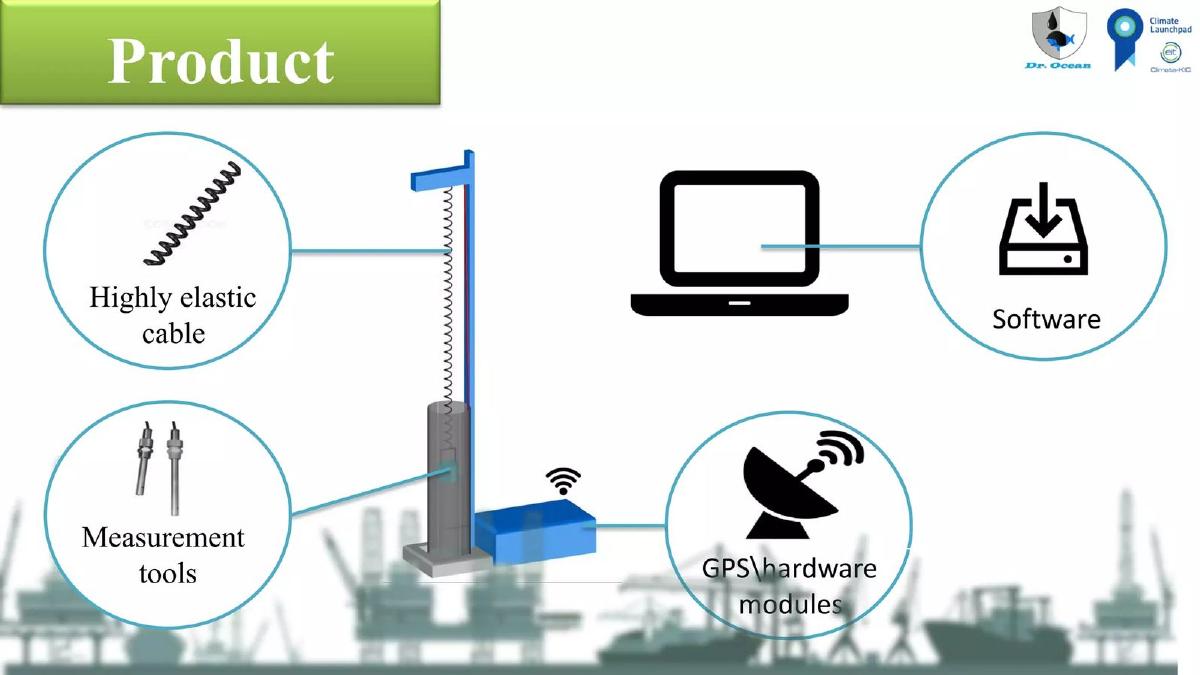
- Based on the visual representations on Slide 3, Dr. Ocean offers a hardware-based 'quick alarm' system. The illustration shows a vertical sensor or probe connected to a wireless transmitter that sends alerts to a laptop interface. The deck describes it as a method for detecting oil spills more efficiently and at a lower cost than current 'expensive and time-consuming' methods.
- How does Dr. Ocean calculate its market size?
- On Slide 2, the company uses a bottom-up approach for its Serviceable Obtainable Market (SOM). They identify 200 platforms in the Persian Gulf and estimate a need for 10 devices per rig, totaling 2,000 devices. This results in a beachhead market valuation of $2M. The Total Addressable Market (TAM) is listed as $12B, representing the cost of an average oil spill.
- What is the claimed financial benefit for customers?
- Slide 3 explicitly states that Dr. Ocean provides a 'Lower total cost for oil companies.' It features a bar chart showing that the current annual cost of an oil spill is $30M, which Dr. Ocean claims to reduce to $4M. This represents a '7x less' cost reduction over the span of a year.
- Who are the main competitors identified in the deck?
- Slide 7 (a backup slide) identifies two main competitors: 'Lab Methods' and 'Leakwise.' Dr. Ocean claims superiority by checking all four feature boxes: Price, Detection period, Distance Monitoring, and Spill quantity detection. Notably, they claim both Lab Methods and Leakwise fail on Price and Distance Monitoring.
- What environmental impact does the company promise?
- Slide 5 quantifies the impact by stating that with 40% market share, Dr. Ocean can prevent 20,000 tons of oil spills annually. They contextualize this against a global figure of 50,000 tons of crude oil spills per year. They also list the potential to save 10,000 marine mammals, 2,500 sea turtles, and 32,000 birds.