Drive, developed by Drive Manila Transport Services Corp., presents a 10-slide pitch deck focused on the peer-to-peer car rental and tour industry in the Philippines. The company positions itself as a solution to fragmented vehicle availability, utilizing a three-pronged app ecosystem for renters, drivers, and fleet managers. With a business model centered on a 25% commission per booking, the deck highlights a community-led growth strategy involving weekly partner onboarding seminars. While the deck provides specific local market data—citing an $83M industry value in the Philippines for 2018—…
Key takeaways
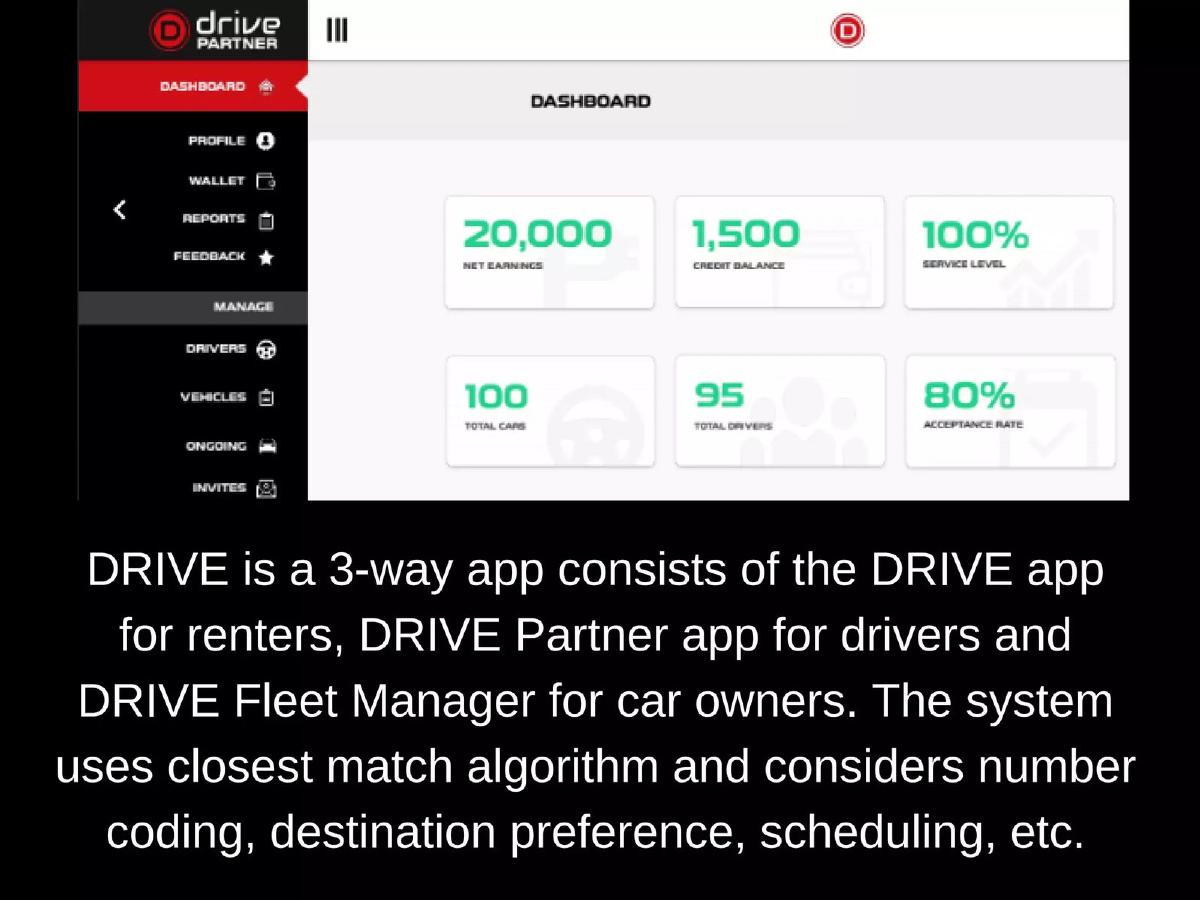
- The company operates a three-way app ecosystem including a renter app, a partner app for drivers, and a fleet manager app for owners (Slide 4).
- Drive charges a 25 percent commission for every booking made through the platform (Slide 5).
- Supply is built through weekly in-person 'Partner Onboarding Seminars' rather than purely digital acquisition (Slide 6).
- The deck claims the car rental industry in the Philippines was valued at $83M in 2018 with a 10% CAGR (Slide 9).
- Average price per booking is stated as PHP 4000, with an average of 30 bookings per month (Slide 9).
- The platform uses a 'closest match algorithm' that accounts for local 'number coding' traffic restrictions (Slide 4).
- The leadership team consists of three members of the Miranda family: Mike, Grace, and Mayee (Slide 8).
- The deck omits a specific fundraising 'Ask' slide, leaving the desired investment amount and terms unknown (Slide 10).
Drive Pitch Deck Analysis: The Hyper-Local Marketplace
The Drive pitch deck, dated May 2019, represents a specific moment in the Southeast Asian gig economy. It focuses on the Philippines, a market characterized by high tourism potential but often fragmented infrastructure. The deck is short, at only 10 slides, and functions more as a high-level company profile than a comprehensive venture capital pitch. It emphasizes community and local operational nuances over complex financial modeling.
Slide 1: Title and Contact
The cover slide introduces Drive as a mobile app for car rentals and tours. It explicitly names the parent entity as Drive Manila Transport Services Corp. A prominent 'Awarded Netizen's Best Choice' seal is displayed, though the awarding body is not specified. The slide provides direct contact information for Mike Miranda, the President and Founder, including a mobile number and email address. This is a standard, if somewhat cluttered, introductory slide that establishes the brand identity immediately.
Slide 2: Purpose and Problem Statement
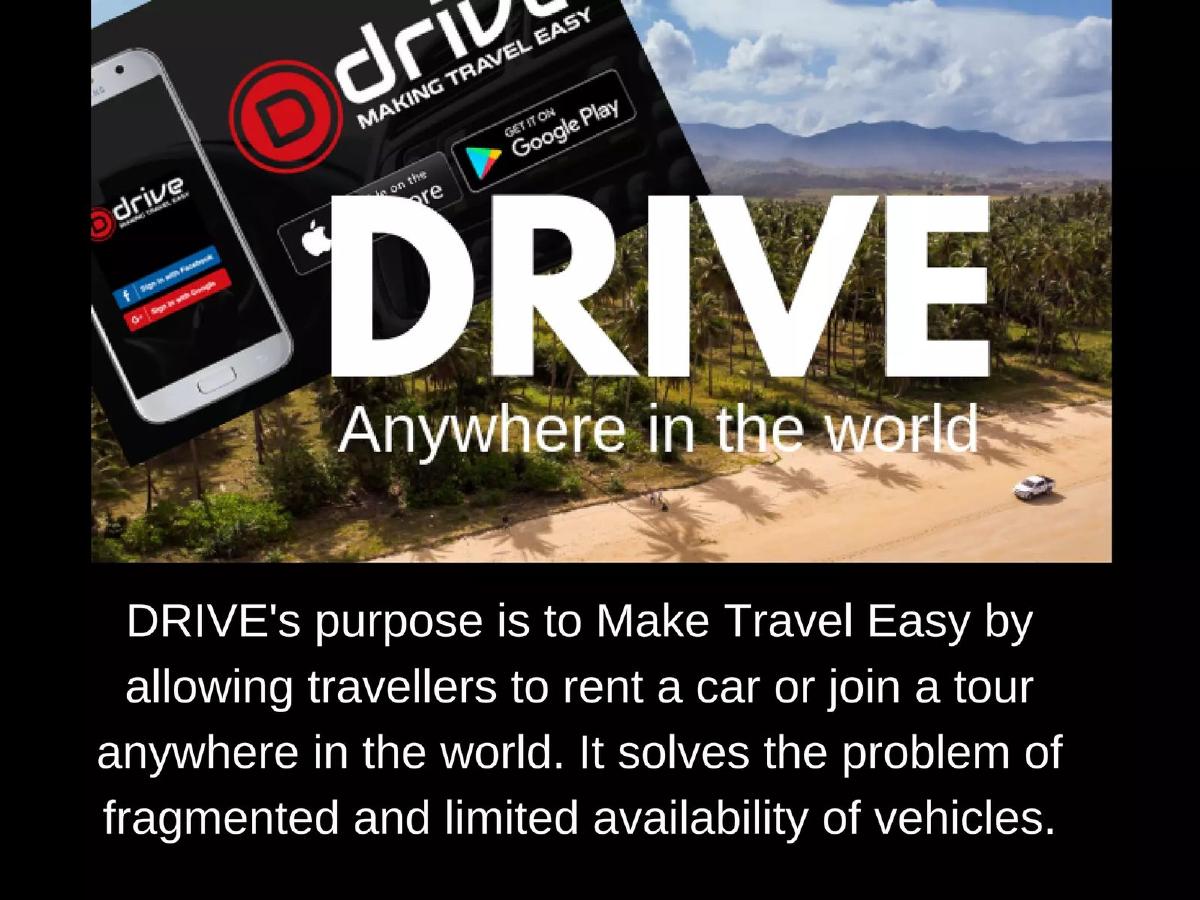
Slide 2 defines the company's mission: 'Make Travel Easy.' It identifies the core problem as 'fragmented and limited availability of vehicles.' The solution is a global vision ('anywhere in the world') starting with a peer-to-peer rental and tour model. The imagery uses a tropical beach setting, reinforcing the focus on the tourism sector rather than daily commuting.
Slide 3: Geographic Focus and Community
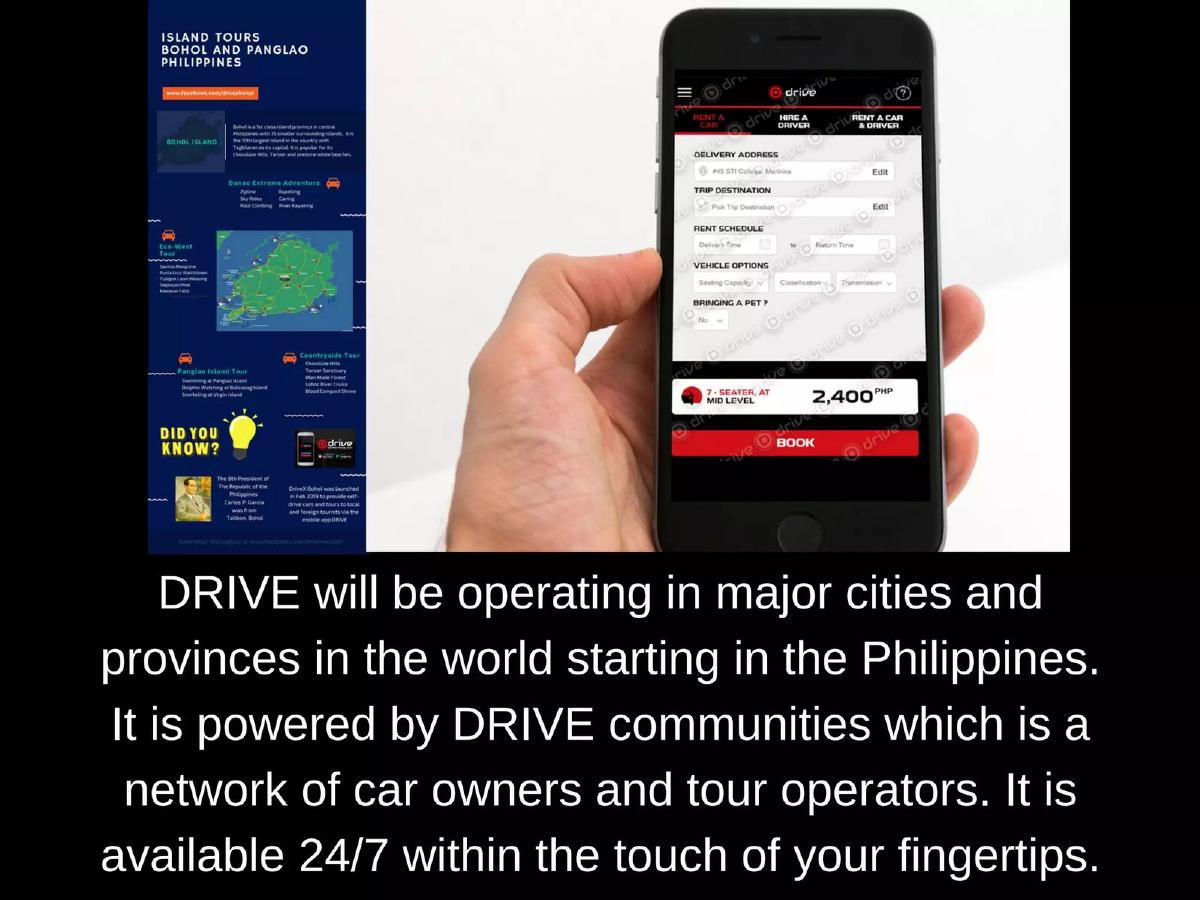
This slide clarifies the go-to-market strategy. While the previous slide mentioned a global purpose, slide 3 confirms they are 'starting in the Philippines.' It mentions specific locations like Bohol and Panglao. The slide introduces the concept of 'DRIVE communities,' which are networks of car owners and tour operators. A mobile mockup shows a booking interface with a price of '2,400 PHP' for a 7-seater vehicle, providing a concrete example of the user experience.
Slide 4: The Three-Way Ecosystem
Drive explains its technical architecture here. It is not just one app, but three: one for renters, one for drivers (Partners), and one for car owners (Fleet Managers). This suggests a sophisticated backend capable of handling multi-party transactions. The slide also mentions a 'closest match algorithm' that accounts for 'number coding'—a critical local detail referring to the Unified Vehicular Volume Reduction Program in the Philippines. This shows the product is tailored to the specific regulatory environment of its home market.
Slide 5: Business Model
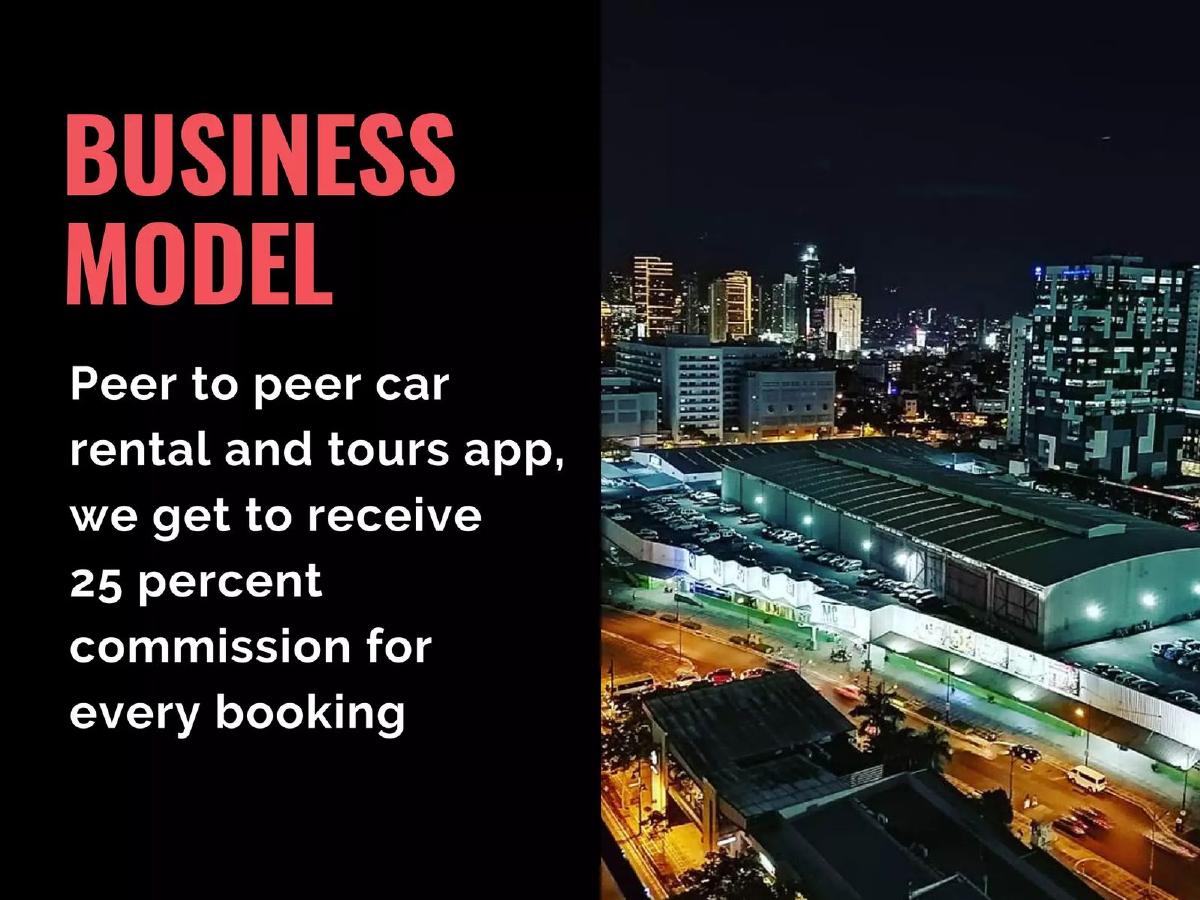
The business model is straightforward: a 25 percent commission on every booking. This is a standard marketplace take-rate, positioned as a peer-to-peer car rental and tours app. The slide features a night-time cityscape, likely Manila, emphasizing the urban market opportunity alongside the previously mentioned tourist destinations.
Slide 6: Growth and Onboarding
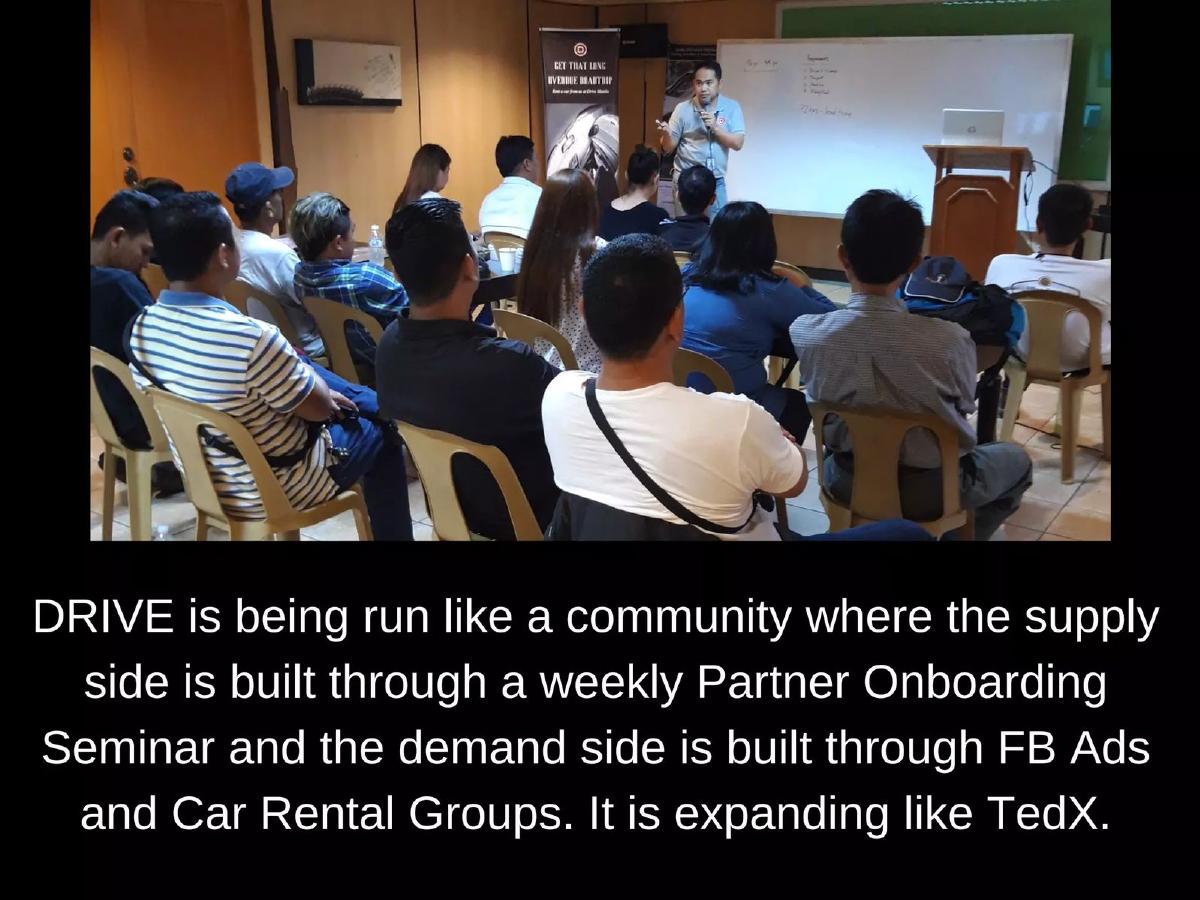
This slide is unique because it highlights a physical, offline component of their growth strategy. It shows a photo of a 'Partner Onboarding Seminar.' The text states that the supply side is built through these weekly seminars, while the demand side is fueled by Facebook Ads and car rental groups. The phrase 'expanding like TedX' is used, likely referring to a decentralized, community-led expansion model rather than a centralized corporate rollout.
Slide 7: Competitive Landscape
Drive compares itself to traditional incumbents: Hertz, National, Budget, and AVIS. Rather than a feature-comparison matrix, the slide uses a Facebook 'Pages to Watch' screenshot. It shows Drive Manila at 3.6K likes, growing at 1.9% weekly, with 1.7K engagements. This metric is used to argue that Drive has higher organic social media engagement than the established international brands in the Philippines market.
Slide 8: The Team
The team slide reveals a family-led executive structure. Mike Miranda is the President and Founder, Grace Miranda is the CEO and Co-founder, and Mayee Miranda is the CHRO and Treasurer. The deck does not provide professional bios or past experience for the founders, which is a significant omission for investors looking to evaluate execution capability.
Slide 9: Market Size and Traction
This slide provides the most significant data points in the deck. It values the Philippines car rental industry at $83M in 2018 with a 10% CAGR. On the traction side, it lists an 'Average price per booking' of PHP 4000 and an 'Average number of bookings per month' of 30. It is unclear if the 30 bookings refer to the entire platform or a per-partner average; if it is the former, the traction at the time of the deck was very early-stage.
Slide 10: Current Status and Roadmap
The final slide serves as a status report. It confirms the app is live on Android and iOS. It lists active 'Site Leads' in Manila, Bohol, Cavite, and Bataan, with upcoming expansions planned for Cebu, Davao, and Palawan. It reiterates the use of co-working spaces for onboarding seminars. Notably, there is no 'Ask' on this slide—no mention of how much capital is being raised or what the valuation expectations are.
What Drive Does Well
Local Context: By including 'number coding' in their algorithm description, they demonstrate a deep understanding of the Philippine operating environment that a global competitor might overlook. · Clear Monetization: The 25% commission is a clear, standard, and easy-to-understand revenue model. · Supply Strategy: The focus on in-person onboarding seminars suggests a high-trust model, which is often necessary in peer-to-peer marketplaces in emerging markets. · Niche Integration: Combining car rentals with 'tours' allows them to capture more of the traveler's wallet share than a simple car-sharing app.
What is Missing from the Deck
The Ask: The most glaring omission is the lack of a fundraising target. Investors cannot evaluate a deal if they don't know how much capital is required. · Founder Pedigree: While the names and titles are provided, there is no information regarding the founders' previous successes, industry experience, or technical expertise. · Financial Projections: There are no forward-looking statements regarding revenue targets, break-even points, or user growth goals. · Unit Economics: Beyond the commission rate, the deck doesn't address Customer Acquisition Cost (CAC) or Lifetime Value (LTV), which are vital for marketplace businesses. · Technology Depth: While three apps are mentioned, there is no mention of how they handle insurance, payments, or dispute resolution—the three biggest hurdles in P2P car rental.
What a Founder Should Copy
Social Proof via Engagement: Using Facebook engagement metrics to show 'community heat' against larger, stagnant competitors is a clever way to show momentum when absolute numbers are still small. · Specific Market Sizing: Citing a specific dollar value ($83M) and a specific growth rate (10% CAGR) for a local market shows that the founders have done their homework on the immediate opportunity. · Operational Transparency: Showing a photo of an actual onboarding seminar proves that the business is 'real' and operational, not just a set of wireframes.
Frequently asked questions
- What is the primary problem Drive aims to solve?
- According to slide 2, Drive addresses the problem of 'fragmented and limited availability of vehicles' for travelers. By creating a peer-to-peer marketplace, they aim to aggregate supply from individual car owners and tour operators, making it easier for tourists to find reliable transportation and tours in the Philippines.
- How does Drive acquire its supply of vehicles and drivers?
- Unlike many global tech platforms that rely on digital-only onboarding, Drive uses a high-touch 'community' approach. Slide 6 shows a photograph of an in-person 'Partner Onboarding Seminar.' They claim to hold these weekly to build the supply side, while using Facebook Ads and car rental groups to drive demand.
- What are the specific technical features of the Drive app?
- Slide 4 details a 'closest match algorithm' that considers several factors: destination preference, scheduling, and 'number coding.' Number coding is a specific traffic demand management program in the Philippines that restricts vehicles from certain roads based on the final digit of their license plate, indicating a localized product focus.
- Who are the main competitors identified by the company?
- Slide 7 lists traditional car rental giants as the primary competition in the Philippines: Hertz, National, Budget, and AVIS. The slide uses a Facebook 'Pages to Watch' screenshot to show that while Drive has fewer total likes than Hertz, it claims higher weekly engagement (1.7K vs 320).
- What is missing from this pitch deck that an investor would need?
- The deck is missing several critical components: a clear financial 'Ask' (how much money they want), a 'Use of Funds' breakdown, a roadmap for future development, and detailed unit economics beyond the 25% commission. It also lacks a slide on the 'Exit Strategy' or long-term financial projections.