Rasgo Intelligence successfully raised a $20M Series A in 2021, as reported by Business Insider, by positioning itself as the essential connective tissue in the data science lifecycle. The 14-slide deck focuses heavily on the 'Feature Store' concept, moving away from the traditional data warehouse silo to an ELT-based approach. The deck is notable for its technical clarity, specifically highlighting a 140X reduction in compute costs and a 17X+ improvement in query performance on slide 9. While the deck lacks a specific financial 'Ask' or a detailed roadmap slide in the provided materials, it…
Key takeaways
- The deck emphasizes a 'By Data Scientists, For Data Scientists' ethos on slide 1 to establish immediate founder-market fit.
- Slide 3 visualizes the Data Science Lifecycle, identifying a gap between data acquisition and model training.
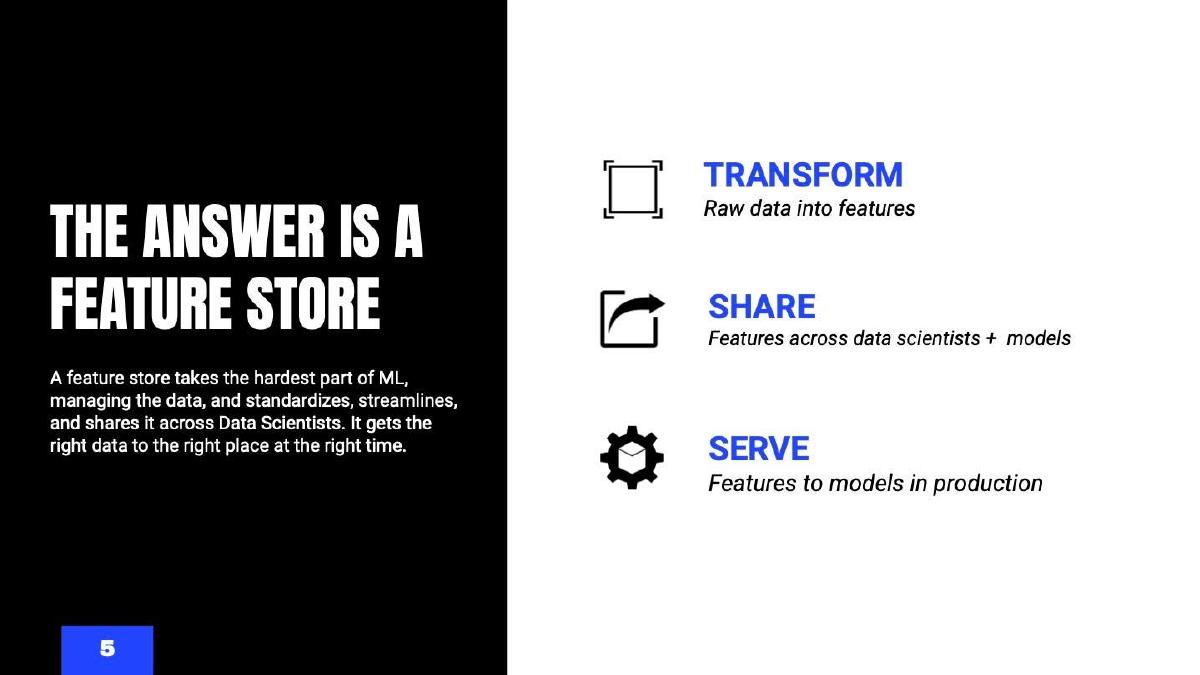
- Slide 5 defines the solution as a Feature Store that handles three core functions: Transform, Share, and Serve.
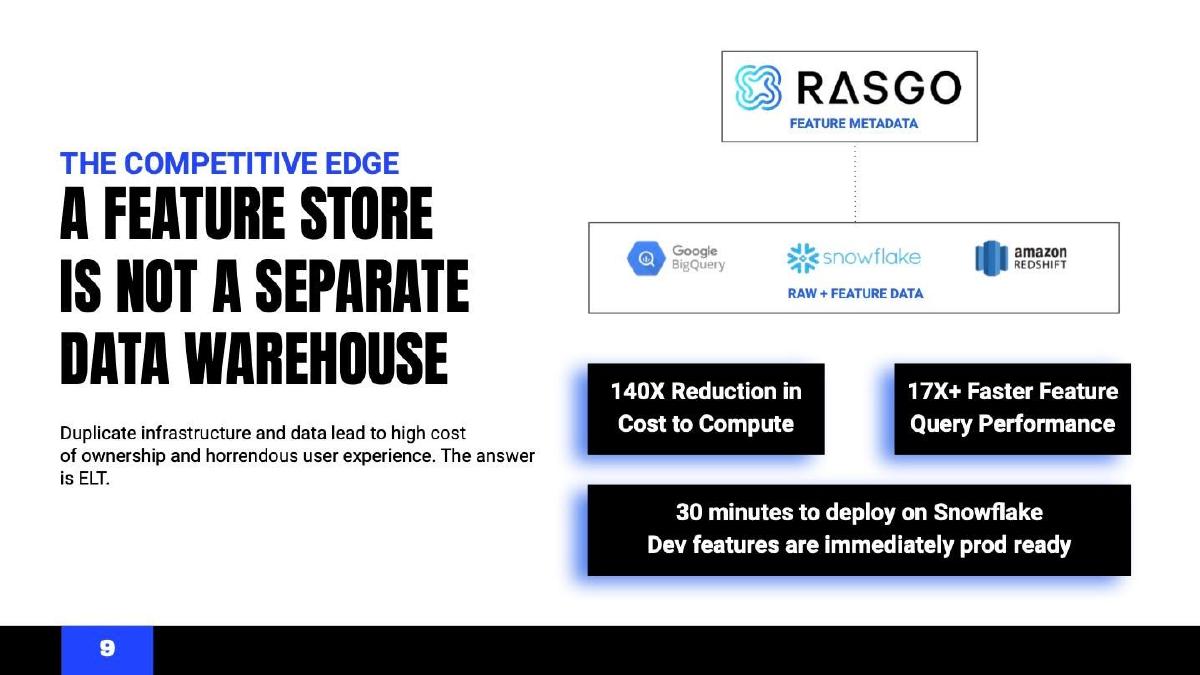
- The company claims a 140X reduction in cost to compute on slide 9 by avoiding duplicate infrastructure.
- Slide 9 also highlights a 17X+ faster feature query performance compared to traditional methods.
- Deployment speed is a key metric, with slide 9 stating it takes only 30 minutes to deploy on Snowflake.
- User validation on slide 11 features quotes from senior data scientists at social media and SaaS companies.
- The deck uses a minimalist aesthetic with high-contrast visuals to maintain focus on technical value propositions.
The Series A Narrative: Technical Efficiency Over Generalities
Rasgo Intelligence’s pitch deck is a focused, technical document designed to appeal to investors who understand the nuances of the MLOps (Machine Learning Operations) stack. In 2021, the 'Feature Store' category was heating up, and Rasgo’s deck reflects a company positioning itself as the most efficient way to handle data preparation. By focusing on the 'Data Science Lifecycle,' the deck moves quickly from the 'what' to the 'how,' providing specific performance benchmarks that are often missing in earlier-stage Seed decks.
Slide 1: Title and Positioning
The cover slide is minimalist, featuring the Rasgo logo and a clear subtitle: "Built for Data Scientists By Data Scientists." This is a classic founder-market fit play. In highly technical fields like data analytics, investors look for teams that have felt the pain they are solving. By leading with this phrase, Rasgo sets the tone that the product is built with an intimate understanding of the end-user's workflow.
Slide 2-4: The Data Science Lifecycle
Slide 3 provides a circular visualization of the "Data Science Lifecycle." It maps out the journey from Defining a Use Case to Data Acquisition, Exploration, Preparation, Feature Engineering, Model Training, Model Evaluation, and finally, Deployment. The slide includes logos of existing ecosystem players like Snowflake, Amazon Redshift, Google BigQuery, H2O.ai, and Databricks. This contextualizes where Rasgo fits: it isn't replacing the warehouse or the training model; it is the glue in the middle. The visual implies that without Rasgo, the loop is broken or inefficient.
Slide 5: Defining the Feature Store
Slide 5 is the 'Solution' slide, titled "The Answer is a Feature Store." It defines the product's purpose: to take the hardest part of ML—managing data—and standardize it. The slide breaks the solution into three pillars: Transform (raw data into features), Share (features across scientists and models), and Serve (features to models in production). This is a clean, functional breakdown that explains the product's utility without getting bogged down in code snippets yet.
Slide 6-8: The Transition to Differentiation
Slide 7 introduces "The Rasgo Difference." This serves as a transition into the technical 'meat' of the deck. In a Series A, investors aren't just looking for a good idea; they are looking for a competitive moat. Rasgo uses these slides to set up the argument that their architectural approach is superior to first-generation feature stores.
Slide 9: The Competitive Edge and Hard Metrics
Slide 9 is arguably the most important slide in the deck. Titled "A Feature Store is not a Separate Data Warehouse," it attacks the problem of duplicate infrastructure. It argues that separate silos lead to high costs and poor user experience. The solution presented is ELT (Extract, Load, Transform). The slide provides three massive data points: 140X Reduction in Cost to Compute , 17X+ Faster Feature Query Performance , and 30 minutes to deploy on Snowflake . These are the 'wow' metrics that justify a $20M Series A. They demonstrate that Rasgo isn't just a marginal improvement; it is an order-of-magnitude shift in efficiency.
Slide 10-11: User Validation
Slide 11, "Validated by End Users," moves from technical metrics to qualitative proof. It features four detailed quotes. One Senior Data Scientist notes that Rasgo hits on their "biggest pain points in a single product experience." Another mentions that they spend "90% of my time on feature selection and construction," highlighting the exact problem Rasgo solves. The use of titles like "Principle Data Scientist at a leading global media agency" adds significant weight to these claims, proving that the product has been tested in enterprise-grade environments.
Slide 12-14: The Team and Conclusion
Slide 13 is the "Founding Team" transition. While the specific bios are not detailed in the text provided, the placement of the team slide toward the end of a Series A deck is common when the product and its traction are the primary drivers of the narrative. The deck concludes with a clean brand finish, maintaining the high-contrast, professional aesthetic throughout.
What Rasgo Intelligence Does Well
The Rasgo deck excels at technical positioning . Instead of using vague marketing language, it uses terms that resonate with its specific audience—ELT, compute costs, feature engineering, and production readiness. By explicitly stating that their tool is not a separate data warehouse, they preemptively answer a common objection from CTOs regarding 'tool sprawl' and data duplication.
Furthermore, the quantification of value on slide 9 is exceptional. A 140X reduction in cost is a compelling reason for any enterprise to adopt a new tool. By anchoring the pitch in these specific numbers, Rasgo makes the investment case about ROI (Return on Investment) rather than just 'cool technology.'
What is Missing from the Deck
The most glaring omission in this version of the deck is the Financials and The Ask . While we know from Business Insider that they raised $20M, the deck does not show the company's revenue growth, burn rate, or how they intend to allocate the new capital. For a Series A, investors typically expect to see a 'Use of Funds' slide that details plans for scaling the engineering team or expanding the go-to-market (GTM) strategy.
Additionally, there is no Roadmap slide . While the current product is well-defined, a Series A pitch usually includes a vision of what the company will become in 3-5 years. Will Rasgo expand into other areas of the MLOps stack, or will it remain a specialized feature store? This forward-looking narrative is absent from the provided slides.
Founder Takeaways: How to Copy Rasgo's Success
Founders building in the developer tools or data infrastructure space should take note of Rasgo's ecosystem mapping on slide 3. By showing exactly where you sit between established giants (like Snowflake and Databricks), you reduce the perceived risk of your startup being 'crushed' by incumbents. You aren't competing with the warehouse; you are making the warehouse more valuable.
Another takeaway is the power of the practitioner quote . Rasgo didn't just get quotes from 'users'; they got quotes that specifically addressed the time-suck of the current workflow. If you are raising a Series A, your validation needs to move beyond 'we like this tool' to 'this tool changes how I spend 90% of my day.' Finally, keep your design high-contrast and low-clutter. Technical investors appreciate a deck that gets to the point without unnecessary fluff.
Frequently asked questions
- What is the primary problem Rasgo is solving?
- Based on slide 3 and 5, Rasgo addresses the 'hardest part of ML' which is managing, standardizing, and sharing data features. It aims to bridge the gap in the data science lifecycle between raw data acquisition and model deployment, reducing the time data scientists spend on manual feature construction.
- How does Rasgo differentiate itself from other data tools?
- Slide 9 explicitly states that 'A Feature Store is not a separate data warehouse.' Rasgo differentiates by using an ELT (Extract, Load, Transform) approach that lives on top of existing warehouses like Snowflake, BigQuery, and Redshift, rather than creating duplicate infrastructure that increases costs.
- What specific performance metrics did Rasgo share?
- On slide 9, Rasgo lists three major technical wins: a 140X reduction in compute costs, 17X+ faster feature query performance, and a 30-minute deployment time on Snowflake. These metrics serve as the core 'Competitive Edge' for the Series A pitch.
- Who is the target user for Rasgo?
- The deck targets technical practitioners. Slide 11 provides testimonials from a Senior Data Scientist at a social media company, a Lead Data Scientist at a SaaS company, and a Principle Data Scientist at a global media agency, confirming the product is built for high-level technical roles.
- Is there a financial roadmap or 'Ask' in the deck?
- The provided 14-slide deck does not include a slide detailing the specific dollar amount requested, the valuation, or a breakdown of how the funds will be spent. However, external reports from Business Insider confirm the round successfully raised $20M.