Rapid API’s 2016 pitch deck is a lean, 9-slide presentation that focuses heavily on efficiency gains. Raising $3.5M at the Seed stage, the company addressed the fragmented API landscape by proposing a marketplace of 'functional blocks.' The deck’s strength lies in its aggressive quantification of the problem: it claims traditional API integration takes 18 months, while Rapid API reduces this to just 5 weeks. With 5,000 developers already on board and a 48% month-over-month growth rate, the traction slide provided the necessary social proof to back up these bold claims. While the deck lacks a…
Key takeaways
- The deck uses a specific time-based metric—18 months—to anchor the severity of the API integration problem (Slide 6).
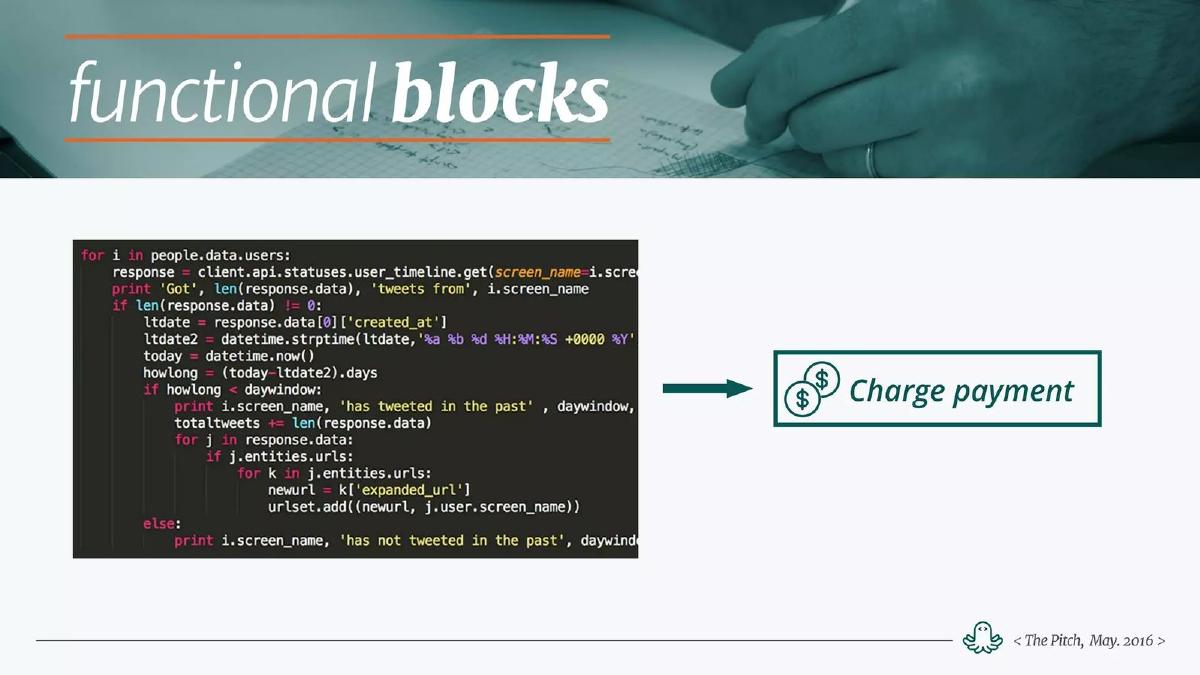
- Rapid API defines its solution as 'functional blocks' that simplify complex code into single actions like 'Charge payment' (Slide 4).
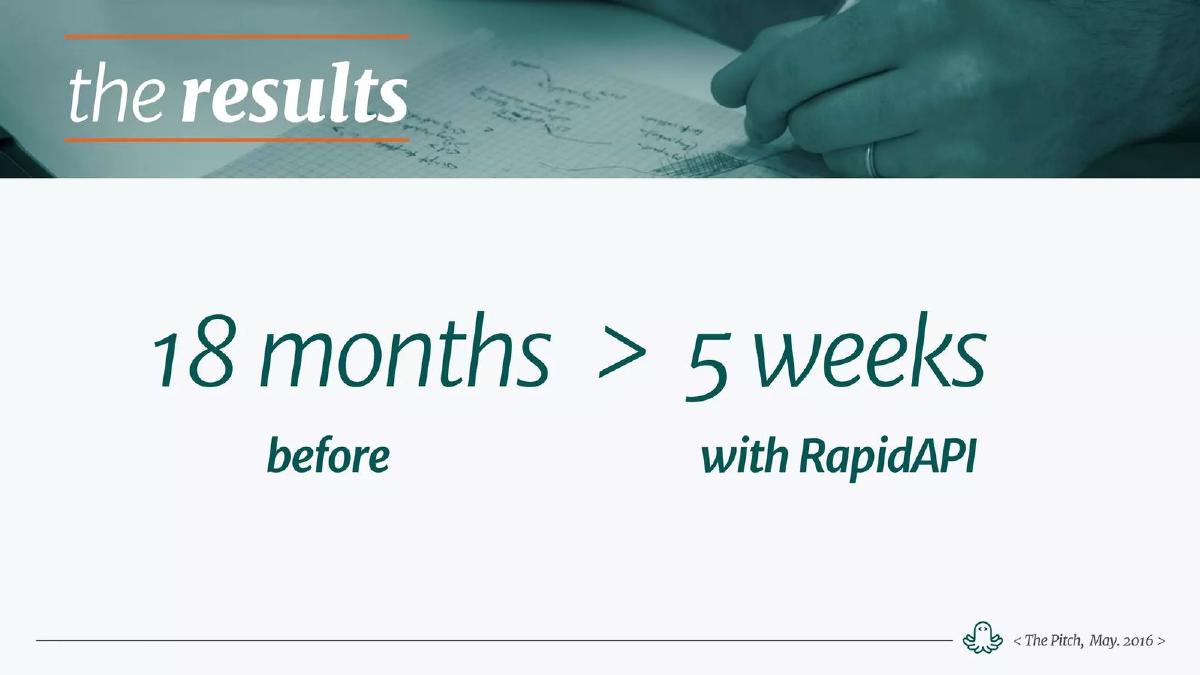
- The value proposition is presented as a direct comparison: 18 months versus 5 weeks with Rapid API (Slide 6).
- Traction is highlighted through three key metrics: 5,000 developers, $35,000 MRR, and 48% MoM growth (Slide 7).
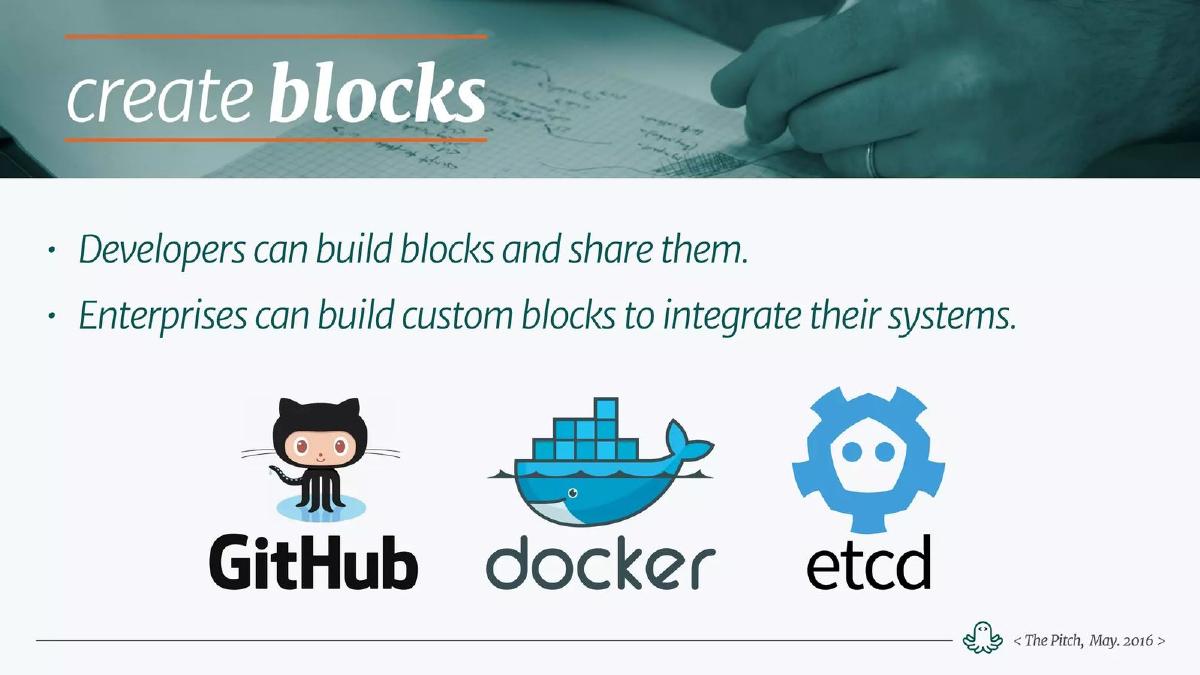
- The deck leverages ecosystem logos like GitHub and Docker to explain its 'create blocks' philosophy (Slide 5).
- There is no slide dedicated to the competitive landscape or market sizing (TAM/SAM/SOM).
- The presentation omits a formal 'Ask' slide, likely because it was designed for a Demo Day format where the round details are shared elsewhere.
- The team slide features three founders but provides no biographical text or previous company logos (Slide 8).
The 9-Slide Demo Day Sprint
Rapid API’s 2016 deck is a product of the 500 Startups accelerator environment. It is designed for speed, clarity, and high-impact metrics. In an era where API connectivity was becoming the backbone of software, Rapid API sought to position itself as the central hub for these connections. The deck does not waste time on industry history; it moves immediately into the friction of development.
Slide 1: Title and Context
The title slide is minimal, featuring the Rapid API logo (an octopus with a code bracket face) and the text 'Demo Day #500strong | May 2016.' This immediately sets the stage: this is a pitch for an audience of investors already primed for high-growth startups. It establishes the brand identity early without clutter.
Slide 2 & 3: The Problem of Slowness
Slide 2 shows a background of complex JavaScript code with the header '// Common integrations.' It visualizes the 'mess' that developers deal with daily. Slide 3 follows up with a stark, high-contrast overlay: 'Enterprise = even slower.' This is a classic 'pain point' setup. It identifies that while all integrations are hard, the enterprise sector—where the most money is—suffers the most. There are no bullet points here; the imagery does the heavy lifting.
Slide 4: The Solution as 'Functional Blocks'
Slide 4 introduces the concept of 'functional blocks.' On the left, it shows a large block of Python code (interacting with the Twitter API). An arrow points to a simple, clean box on the right labeled 'Charge payment' with dollar signs. This is the 'Before and After' of the developer experience. It suggests that Rapid API abstracts away the complexity of coding individual API calls into reusable, modular blocks.
Slide 5: The Ecosystem Play
Slide 5, titled 'create blocks,' explains the marketplace dynamics. It states: 'Developers can build blocks and share them' and 'Enterprises can build custom blocks to integrate their systems.' By placing the logos of GitHub, Docker, and etcd prominently on the slide, Rapid API is using 'association by design.' They are signaling that they belong in the same category of essential developer infrastructure as these established giants.
Slide 6: The Quantitative Value Proposition
This is the 'money slide' of the deck. Titled 'the results,' it presents a simple mathematical comparison: '18 months > 5 weeks.' It labels 18 months as 'before' and 5 weeks as 'with RapidAPI.' This is a bold claim that targets the primary concern of any CTO or VP of Engineering: speed to market. By reducing a year-and-a-half project to just over a month, the ROI is self-evident.
Slide 7: Traction and Social Proof
Slide 7 validates the claims made in the previous slides. It lists three key figures: 5,000 Developers , $35,000 MRR , and 48% MoM (Month-over-Month) growth . For a Seed stage company in 2016, $35k in monthly recurring revenue with nearly 50% growth is an exceptionally strong signal. It proves that the 'functional blocks' concept isn't just a theory—it’s a product that developers are already paying for.
Slide 8: The Team
The team slide is simple, featuring headshots of Daniel Chernenkov (CTO), Iddo Gino (CEO), and Mickey Haslavsky (VP Product). Notably, there is no text describing their pedigree. In a Demo Day setting, the speaker usually fills in these gaps verbally, but as a standalone document, this slide relies entirely on the strength of the preceding traction to validate the founders' capabilities.
Slide 9: Conclusion
The deck ends on a 'cheers' slide with the logo and date. There is no call to action, no contact information, and no 'Ask' for a specific dollar amount. This is typical for Demo Day decks where the goal is to generate interest for a follow-up meeting rather than to close the deal on the spot.
What Rapid API Got Right
The most successful element of this deck is its extreme focus on a single metric . By anchoring the entire pitch around the '18 months vs 5 weeks' delta, they made the value proposition impossible to forget. Investors may not understand the nuances of API protocols, but they understand the difference between 18 months of burn and 5 weeks of development.
Furthermore, the traction slide is perfectly balanced. It shows a community (5,000 developers), revenue ($35,000 MRR), and momentum (48% MoM). This 'traction trifecta' covers the three things investors care about most at the Seed stage: Is it being used? Is it being paid for? Is it growing fast?
What Is Missing
1. Market Sizing (TAM): There is no mention of how big the API market is. While today we know it is massive, in 2016, a slide showing the explosion of the 'API Economy' would have helped justify a $3.5M Seed round to more conservative investors.
2. Competition: The deck assumes a vacuum. It doesn't mention Mulesoft, Apigee, or other enterprise service buses that were the incumbents at the time. Explaining why 'functional blocks' are superior to traditional middleware would have strengthened the technical moat.
3. The Ask: As noted, the deck contains no information on how much they are raising or what the milestones for the next 18 months are. While common for Demo Day, a 'fundraising deck' usually requires a slide on the use of proceeds.
Founder's Guide: What to Copy
The 'Before and After' Code Comparison: If you are building a developer tool, show the code. Slide 4 is a perfect example of how to show complexity versus simplicity without using a single buzzword. · The Efficiency Delta: Find the one metric that your product changes (time, cost, or headcount) and make it the centerpiece of your 'Results' slide. · Minimalist Design: Notice the consistent use of the orange accent color and the clean, white backgrounds. The deck feels professional and modern, which reflects well on a technical product. · Growth Percentages: If your MoM growth is high (above 20%), highlight it as prominently as your raw revenue. It signals that you have found a repeatable growth lever.
Frequently asked questions
- How much did Rapid API raise with this deck?
- According to the catalogue facts, Rapid API raised $3.5M in a Seed round in 2016. The investors included Venture Capital firms and Angel Investors. The deck itself was used for a 500 Startups Demo Day, as indicated by the '#500strong' tag on the title slide.
- What is the core 'Problem' identified in the deck?
- The deck frames the problem around the slowness of common integrations. Slide 3 explicitly states that 'Enterprise = even slower.' The editorial context notes that the company quantifies this as an 18-month integration cycle, creating a tangible business bottleneck that investors can easily understand as a cost center.
- Does the deck explain the business model?
- The deck is light on business model specifics. It shows a 'Charge payment' block on Slide 4 and mentions $35,000 in MRR on Slide 7, but it does not explicitly detail the take rate, subscription tiers, or marketplace fees. The catalogue facts identify the business model as a Marketplace.
- Who were the founders at the time of this pitch?
- Slide 8 lists three founders: Iddo Gino (CEO), Daniel Chernenkov (CTO), and Mickey Haslavsky (VP Product). The slide is purely visual, showing their headshots and titles without additional background information or past work history.
- What is missing from this pitch deck?
- This is a very minimalist deck. It lacks a competition slide, a detailed market size analysis (TAM), a roadmap, and a specific 'Ask' slide detailing how the $3.5M would be spent. It relies almost entirely on the strength of its traction and the '18 months vs 5 weeks' efficiency claim.