Rapid Home Solutions, led by CEO Steve Diaz, pitched an automated construction model in 2017 aimed at the affordable housing market. The deck centers on a dramatic reduction in build time—from a 7-month industry standard to just 1 hour for component manufacturing via a fully automated plant. They claim a cost basis of $50 per square foot, compared to a $150 industry average, representing a theoretical 200% reduction in building costs. While the deck shows consistent client growth from 4 in 2012 to 232 in 2016, it lacks technical detail on the proprietary automation, a specific funding ask, or…
Key takeaways
- The company identifies a 7-month standard build time as the primary industry pain point, leading to slow ROI and high labor costs (Slide 5).
- Rapid Home Solutions claims their technology can construct all components for a 1,600 sf house in 1 hour via an automated plant (Slide 7).
- The deck asserts a building cost of $50 per square foot, which is $100 lower than the cited 'Average Competitors' at $150 per square foot (Slide 11).
- Traction data shows a steady increase in clients over five years, growing from 4 clients in 2012 to 232 clients in 2016 (Slide 13).
- The marketing strategy specifically targets low-to-moderate income families and individuals for affordable housing (Slide 13).
- Market validation is provided through U.S. Census Bureau data showing residential permits and starts hovering around 1.2 million units annually as of early 2017 (Slide 15).
- The deck lacks a formal 'Ask' slide, omitting the amount of capital sought and the intended use of funds.
- There is no dedicated team slide to establish the technical or operational expertise of the leadership beyond the CEO (Slide 17).
Executive Summary
Rapid Home Solutions, Inc. presented this investor deck in 2017, positioning itself as a disruptor in the residential construction space through extreme automation. The company’s value proposition is built on the massive disparity between traditional construction timelines and their proprietary automated process. By focusing on the affordable housing segment, the company attempts to solve both a logistical problem (build speed) and a social problem (housing affordability).
Slide 1: Title Slide
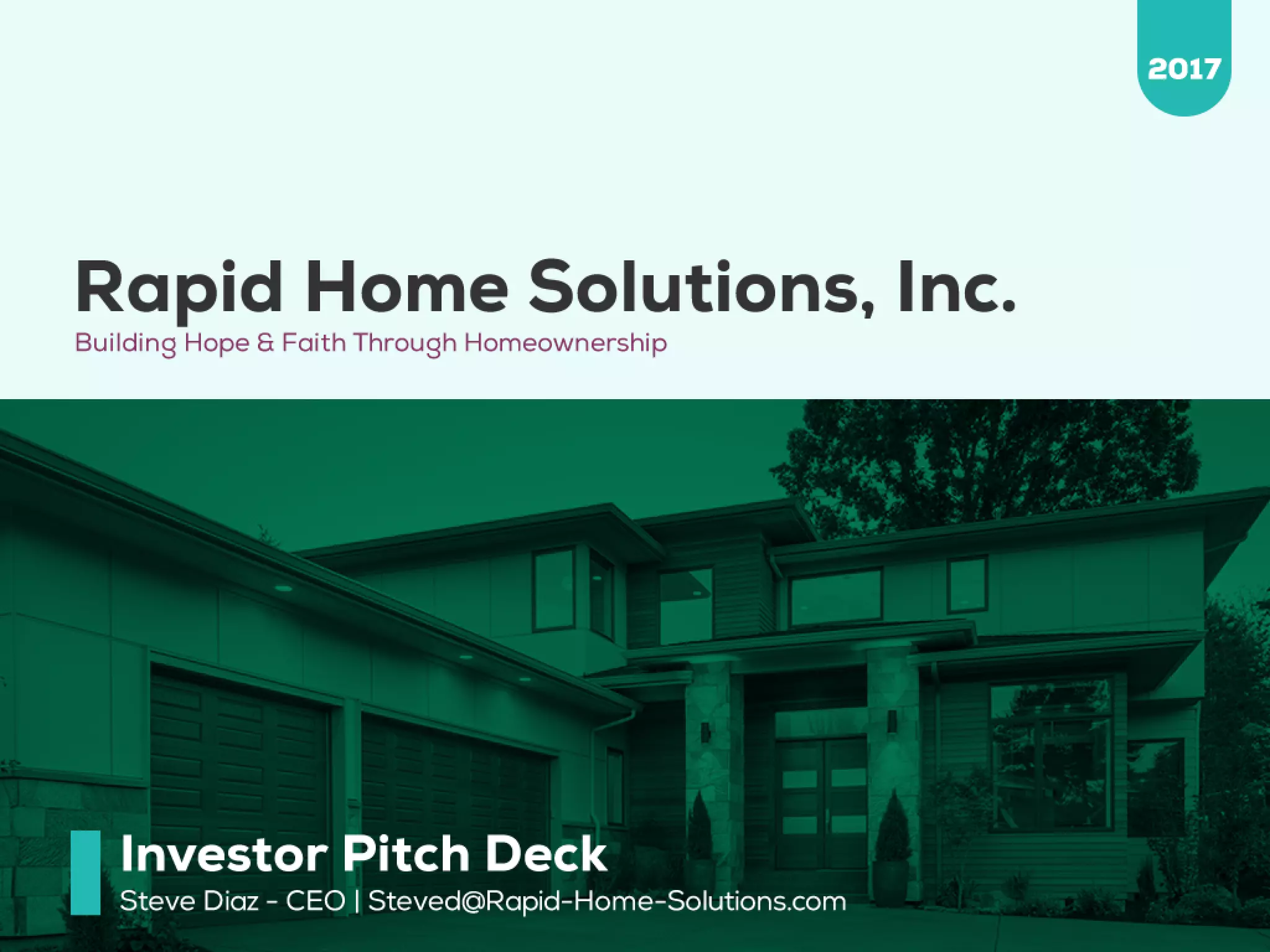
The cover slide introduces Rapid Home Solutions, Inc. with the tagline "Building Hope & Faith Through Homeownership." It identifies Steve Diaz as the CEO and provides his contact information. A "2017" badge in the top right corner dates the presentation. The imagery features a modern, high-end residential property, which is somewhat at odds with the later focus on low-to-moderate income housing.
Slides 3 & 5: The Problem
The deck uses a two-part problem statement. Slide 3 poses a rhetorical question regarding the time required to build a house using conventional methods. Slide 5 provides the answer: "7 Months." The company lists four specific disadvantages of this timeframe: slow return on investment, accumulated labor expenses, increased structural exposure to theft, vandalism, and weather, and seven months of interest rate notes. This establishes a clear financial and operational pain point for developers and homeowners alike.
Slides 7 & 9: The Solution
The solution is presented as a technological breakthrough. Slide 7 makes the bold claim that their technology can construct all components for a 1,600 sf house on an assembly line within "1 hour." A footnote specifies that this is achieved "via fully automated plant." Slide 9 expands on this, stating the technology increases speed and quality while reducing cost and improving structural integrity. The deck does not explain the specific mechanics of this automation or whether it involves 3D printing, pre-fabricated panels, or modular units.
Slide 11: The Advantage
This slide quantifies the competitive advantage in terms of cost. It claims a "Building cost reduced by about 200%" (mathematically, a 200% reduction would imply a negative cost, but the chart clarifies they mean their cost is one-third of the competition). The chart shows Rapid Home Solutions at $50 per square foot ($100,000 total for a 2,000 sq ft home) versus average competitors at $150 per square foot ($300,000 total). Footnotes indicate these are projections based on a 2,000 sq ft house and full automation.
Slide 13: Traction
The traction slide provides a bar chart showing "Client Growth Rate" from 2012 to 2016. The numbers show a steady upward trajectory: 4, 54, 98, 172, and 232 clients respectively, totaling 560 clients. The text attributes this success to a marketing strategy targeting low-to-moderate income families. This slide is crucial as it suggests the business model was already operational and generating demand prior to the 2017 pitch.
Slide 15: Market Validation
To demonstrate the scale of the opportunity, the company cites U.S. Census Bureau and HUD data from February 2017. The chart tracks "New Residential Construction" (Permits, Starts, and Completions) from 2012 to 2017. The data shows a market recovering and growing toward 1.2 million units annually. This slide serves to prove that the macro environment is favorable for a high-volume construction solution.
Slide 17: Contact
The final slide provides full contact details for CEO Steve Diaz, including phone, fax, email, website, and a physical office address in Placida, Florida. It reiterates the company mission and logo.
What Rapid Home Solutions Does Well
The deck excels at identifying a massive, universally understood inefficiency: the time and cost of traditional home building. By distilling the problem down to a single number (7 months) and the solution to a single number (1 hour), the founders create a compelling "hook" for investors. The focus on the affordable housing niche is also a strong strategic choice, as it represents a high-demand, underserved market where cost-efficiency is the primary driver of success. The inclusion of five years of historical client data provides a level of proof that the company is not just a theoretical concept but an active participant in the market.
Omissions and Weaknesses
The most glaring weakness in this deck is the lack of technical transparency. For a company claiming to build a house in one hour via a "fully automated plant," there are no photos of the plant, no diagrams of the assembly process, and no mention of intellectual property or patents. Investors in the construction tech space typically require deep dives into the "how" to validate such aggressive claims.
Furthermore, the deck is missing several critical components of a standard venture pitch:
The Team: Aside from the CEO, no other leadership or engineering talent is mentioned. In hardware and automation, the pedigree of the engineering team is often as important as the technology itself. · The Ask: There is no mention of how much capital the company is seeking or what milestones that capital will achieve (e.g., building the first plant, scaling to new markets). · Unit Economics: While the $50/sq ft figure is provided, there is no breakdown of margins, customer acquisition costs, or the capital expenditure required to build the automated plants. · Competition: The deck compares itself to "Average Competitors" but fails to acknowledge other modular or prefab startups that were active in 2017.
Founder Takeaways
Use dramatic comparisons: The contrast between a 7-month build and a 1-hour manufacturing process is a powerful way to frame a value proposition. Founders should look for these "orders of magnitude" differences in their own businesses to capture attention quickly.
Validate with macro data: Using third-party data (like the U.S. Census Bureau) helps ground a startup's claims in reality. It shows that the founder understands the broader market dynamics beyond their own product.
Don't forget the 'Ask': A pitch deck without a clear request for capital is a marketing brochure, not a fundraising tool. Always include a slide that specifies the funding goal and the roadmap it supports. Even if the deck is intended for a first meeting, investors need to know the scale of the opportunity they are evaluating.
Show, don't just tell, the tech: If your startup relies on a physical process or a factory, include visuals of that process. Claims of "full automation" are met with high skepticism; photos or videos of the machinery in action are essential for building credibility.
Frequently asked questions
- What is the core technology behind Rapid Home Solutions?
- The deck mentions a 'fully automated plant' and an 'assembly line' capable of producing all components for a 1,600 square foot home in one hour. However, the slides do not provide specific technical details, patent information, or descriptions of the materials used. It positions the technology as a way to increase speed and quality while reducing costs and improving structural integrity.
- How does the company's pricing compare to the rest of the market?
- According to slide 11, Rapid Home Solutions claims a building cost of $50 per square foot. They compare this to an industry average of $150 per square foot. For a 2,000 square foot home, this results in a total cost of $100,000 for Rapid Home Solutions versus $300,000 for competitors, though these figures are noted as projections based on full automation.
- What kind of traction did the company have at the time of the pitch?
- The company reported consistent year-over-year growth in its client base. Starting with 4 clients in 2012, they grew to 54 in 2013, 98 in 2014, 172 in 2015, and reached 232 clients by 2016. The deck notes a total of 560 clients served over that five-year period, focusing on the affordable housing market.
- Who is the target audience for these homes?
- The company’s marketing strategy is explicitly focused on 'low-to-moderate income families and individuals.' Slide 13 describes this as a 'captivated audience' that aligns with their mission of 'Building Hope & Faith Through Homeownership.' The value proposition is centered on making homeownership accessible through significantly lower construction costs.
- What critical information is missing from this pitch deck?
- The deck is missing several standard investor requirements. Most notably, there is no 'Ask' slide detailing how much money is being raised or the terms of the investment. There is also no team slide to introduce the founders' backgrounds, no detailed financial projections, and no competitive landscape analysis beyond a generic 'Average Competitors' price comparison.