RapidCanvas secured $7.5M in Seed funding in 2024 for its AI platform designed for non-technical business professionals. The 9-slide deck is a textbook example of a team-first narrative, placing the founder's 20-year track record at Google, Simility, and PayPal on Slide 2. Rather than overwhelming investors with technical jargon, the deck focuses on the 'talent shortfall' in AI and positions RapidCanvas as the solution for the millions of business experts who lack coding skills. By promising to reduce the AI implementation lifecycle from nine months to four weeks, the deck makes a compelling…
Key takeaways
- The deck prioritizes team credibility, showcasing 20+ years of experience at Google and PayPal on Slide 2.
- It identifies a specific market gap: 120+ platforms serve technical users, while 5,000+ vendors rely on high professional services (Slide 4).
- RapidCanvas claims to reduce the AI implementation lifecycle by 80%, from 9 months to just 4 weeks (Slide 7).
- The pricing strategy is explicitly stated as starting at $36K, compared to $200K for legacy approaches (Slide 7).
- It leverages external validation from Gartner, citing that 85% of AI projects currently deliver erroneous outcomes (Slide 3).
- The market opportunity is framed by the shortage of technical talent, noting only 300,000 AI engineers exist for millions of needed roles (Slide 5).
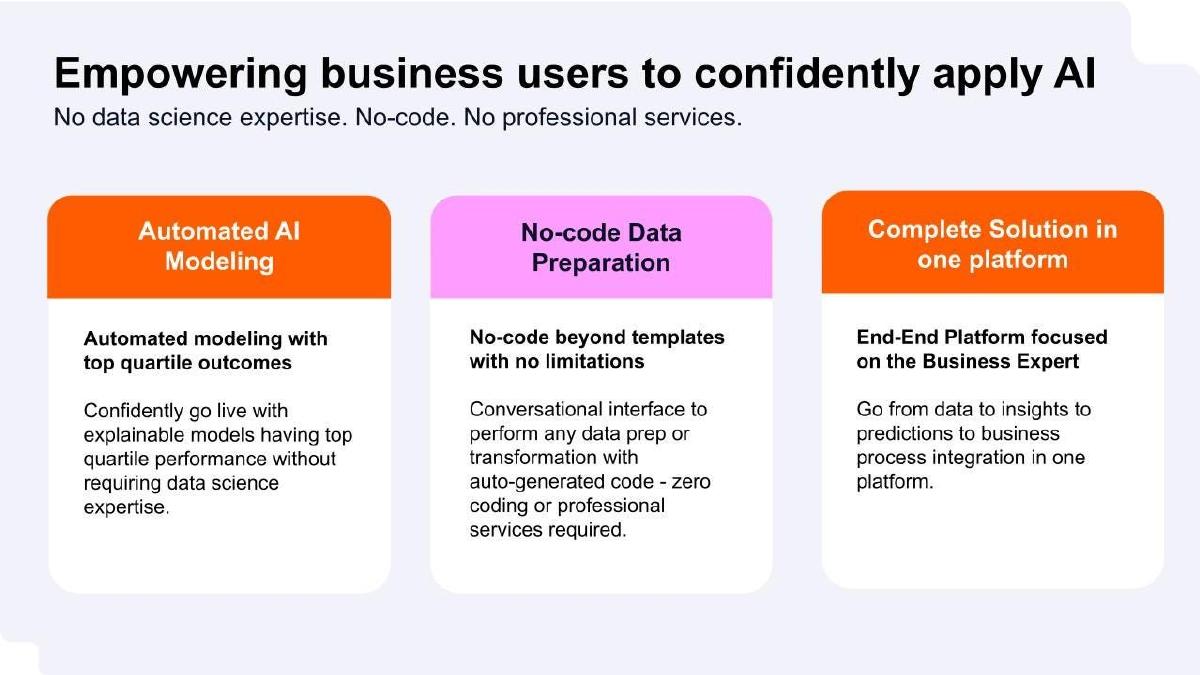
- The product is defined by three pillars: Automated AI Modeling, No-code Data Prep, and a Complete End-to-End Solution (Slide 6).
- The deck omits a specific fundraising 'Ask' or a detailed roadmap for the $7.5M capital deployment.
RapidCanvas: The 9-Slide Seed Deck Analysis
RapidCanvas entered the 2024 AI market with a clear mission: democratizing AI for business users who lack the technical depth of data scientists. The following teardown examines the 9-slide deck used to secure $7.5 million in Seed funding, as reported by Business Insider. This deck is a study in brevity and founder-market fit.
Slide 1: Title and Introduction
The cover slide is minimalist. It features the company logo, the tagline "AI platform for Business Experts," and the name of the founder, Rahul Pangam. By leading with "Business Experts" rather than "Generative AI" or "Machine Learning," the company immediately signals its target audience and differentiation in a crowded technical field.
Slide 2: The Power of Pedigree
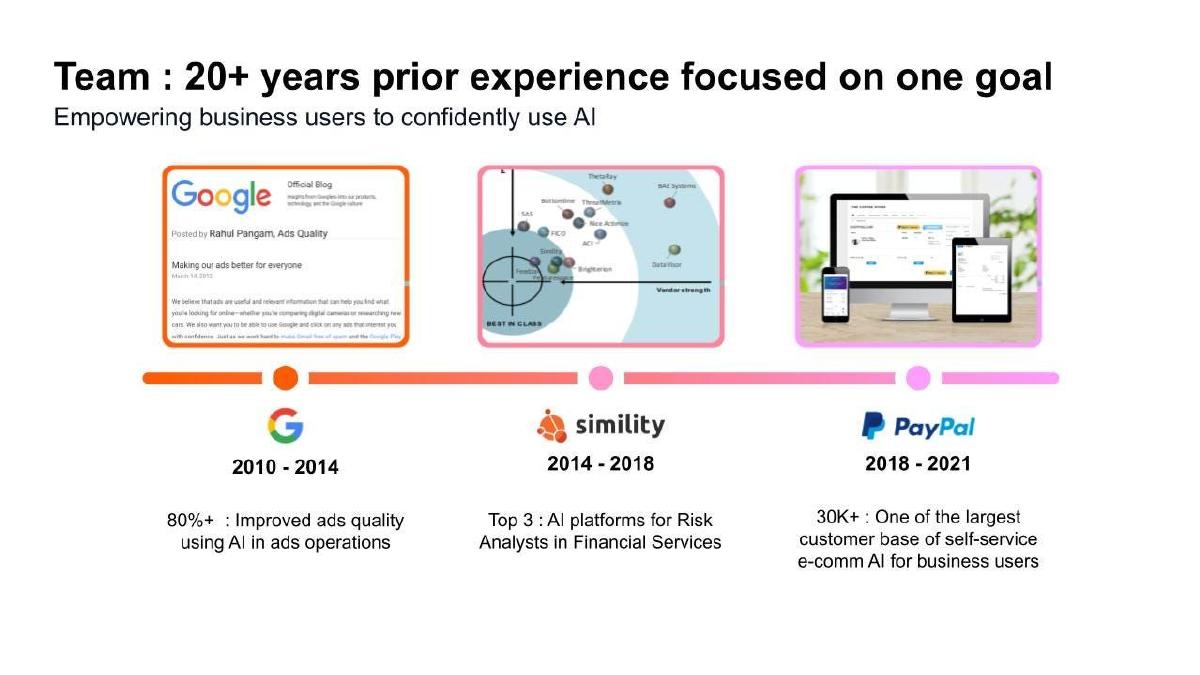
Unusually for a Seed deck, the team slide appears second. This is a strategic choice. When a founder has a background like Rahul Pangam’s, the 'who' is often more important than the 'what' in the early stages. The slide highlights "20+ years prior experience focused on one goal: Empowering business users to confidently use AI."
2010 - 2014 (Google): 80%+ improvement in ads quality using AI. · 2014 - 2018 (Simility): Ranked in the Top 3 AI platforms for Risk Analysts. · 2018 - 2021 (PayPal): Scaled to 30K+ customers, cited as one of the largest customer bases of self-service e-commerce AI.
This slide does the heavy lifting of de-risking the investment by showing the founder has built and scaled similar solutions at the highest level of the enterprise market.
Slide 3: The Enterprise AI Problem
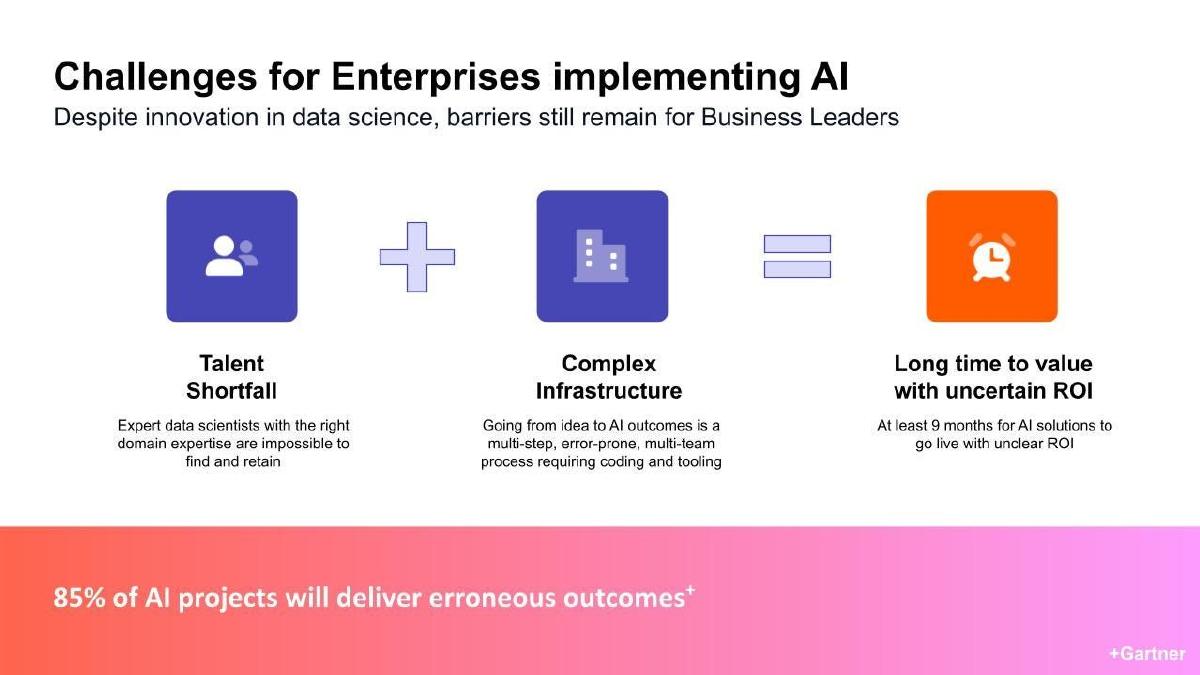
Slide 3 identifies three core barriers for enterprises: Talent Shortfall, Complex Infrastructure, and Long time to value with uncertain ROI. It uses a Gartner statistic to anchor the problem: "85% of AI projects will deliver erroneous outcomes." The slide notes that AI solutions typically take "at least 9 months" to go live, creating a clear opening for a solution that promises speed and reliability.
Slide 4: The Competitive Landscape (The Gap)
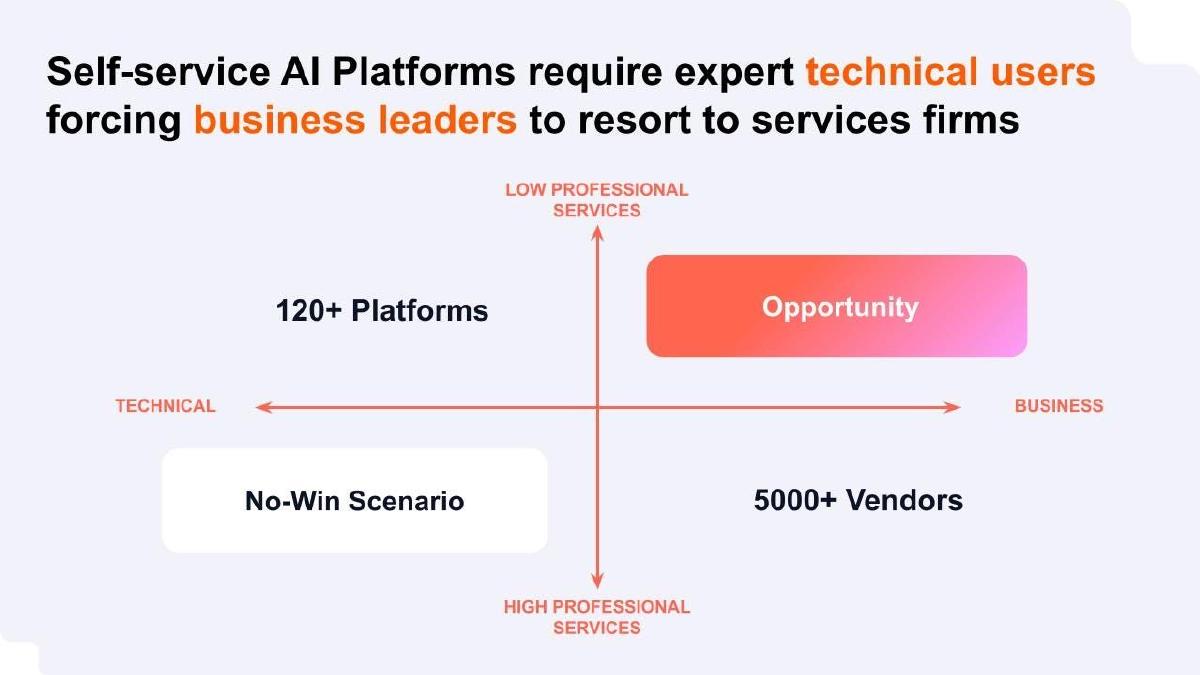
This slide introduces a 2x2 matrix. The X-axis ranges from Technical to Business users; the Y-axis ranges from High to Low Professional Services. The deck claims there are 120+ Platforms in the Technical/Low-Service quadrant (the 'No-Win Scenario') and 5000+ Vendors in the Business/High-Service quadrant. The 'Opportunity' is identified as the Business/Low-Service quadrant, which RapidCanvas intends to occupy.
Slide 5: Market Opportunity and Talent Scarcity
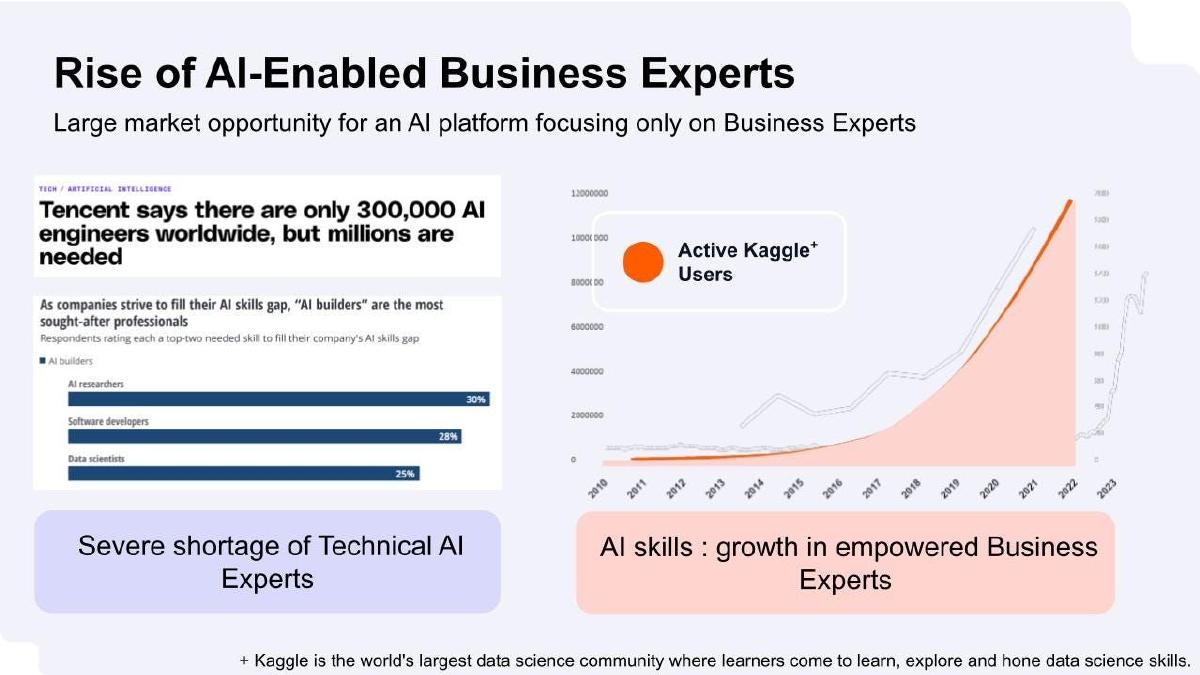
RapidCanvas doubles down on the 'Talent Shortfall' mentioned earlier. It cites a Tencent report stating there are "only 300,000 AI engineers worldwide, but millions are needed." A chart shows the growth of Active Kaggle Users (reaching over 12 million by 2023) as a proxy for the rise of 'AI-Enabled Business Experts'—people who are learning data science concepts but aren't necessarily full-time engineers.
Slide 6: The Solution Pillars
Automated AI Modeling: Promises "top quartile outcomes" without requiring data science expertise. · No-code Data Preparation: Features a "conversational interface" to perform data transformations with auto-generated code. · Complete Solution: An end-to-end platform that integrates predictions directly into business processes.
The emphasis here is on "No professional services" and "zero coding," reinforcing the low-friction nature of the platform.
Slide 7: The Brand Promise (Unit Economics)
Slide 7 is the most data-dense slide regarding the business model. It makes three specific promises:
Built for Business Experts: Reiteration of the no-code, no-service model. · 80% Accelerated time to value: A claim to reduce the 9-month lifecycle to 4 weeks or money back. · 80% Reduced cost: A starting price of $36K compared to $200K for legacy approaches.
By putting a specific price point ($36K) in a Seed deck, RapidCanvas shows they have a firm grasp on their go-to-market strategy and a clear understanding of the 'legacy' price floor they are disrupting.
Slide 8: Ownership of the Market
This slide is a near-duplicate of Slide 4, but with the RapidCanvas logo now occupying the 'Opportunity' quadrant. This repetition serves to drive home the positioning: they are the only platform designed for business users that doesn't require an army of consultants to implement.
Slide 9: Closing
The deck ends with a simple brand slide. There is no contact information, no 'Ask' for a specific dollar amount, and no roadmap. This suggests the deck was likely used as a visual aid for a live pitch rather than a standalone document, or that the version released was scrubbed of sensitive financial details.
What RapidCanvas Does Well
Founder-Market Fit: The deck spends 11% of its total real estate (Slide 2) proving that the founder has done this exact task before at Google and PayPal. For a Seed round, this is often the single most important factor.
Clear Positioning: The 2x2 matrix is used effectively. Instead of listing features, RapidCanvas lists the 'quadrants of pain' (too technical or too expensive) and shows exactly where they sit in the white space.
Quantified Value: Many AI startups speak in vagaries about 'efficiency.' RapidCanvas gives hard numbers: 4 weeks instead of 9 months, and $36K instead of $200K. These are figures an enterprise buyer—and an investor—can model.
What is Missing from the Deck
The 'Ask': There is no slide detailing how much money is being raised or how it will be spent. While we know from publisher reports the amount was $7.5M, a standard pitch deck usually includes a slide on milestones the funding will enable (e.g., hiring, R&D, sales expansion).
Traction: Aside from the founder's past successes, there are no metrics regarding RapidCanvas's current customer count, pilot programs, or revenue. This suggests the raise was heavily predicated on the team's pedigree and the strength of the prototype/vision.
Technology Deep-Dive: For an AI company, there is very little information on the underlying architecture. The deck treats the AI as a 'black box' that delivers outcomes, which aligns with the 'Business Expert' target but might leave technical due diligence for a later stage.
Lessons for Founders
Lead with your strengths: If you have a world-class background, don't hide it on Slide 12. RapidCanvas put it on Slide 2, and it set the tone for the entire pitch.
Use 'Anchor' Pricing: By stating a $200K legacy cost, the $36K price point feels like a bargain rather than an expense. Founders should always provide a frame of reference for their pricing.
Focus on the 'Time-to-Value': In the enterprise software world, the biggest competitor isn't another startup; it's inertia and the long implementation cycle. RapidCanvas's '4 weeks or money back' promise is a powerful tool to overcome buyer (and investor) skepticism.
Frequently asked questions
- How much did RapidCanvas raise with this deck?
- According to publisher reports from Business Insider, RapidCanvas raised $7.5 million in a Seed round in 2024. The deck itself does not state the amount being raised or the valuation sought, which is common for decks shared publicly after a round closes.
- Who is the primary target user for RapidCanvas?
- The deck explicitly targets 'Business Experts' rather than technical data scientists. Slide 5 highlights the 'severe shortage of Technical AI Experts' and positions the platform for the millions of business professionals who need to implement AI without coding skills.
- What is the stated value proposition regarding implementation time?
- Slide 7 promises an 80% reduction in time-to-value. It claims the platform can reduce a typical 9-month AI lifecycle to just 4 weeks, even offering a 'money back' guarantee on this accelerated timeline.
- How does RapidCanvas differentiate itself from competitors?
- RapidCanvas uses a 2x2 matrix on Slides 4 and 8 to show that most competitors either require high technical skills (120+ platforms) or high professional services (5,000+ vendors). RapidCanvas claims the 'Business' and 'Low Professional Services' quadrant for itself.
- What metrics are included in the deck?
- The deck focuses on macro-market metrics and comparative cost savings. It cites a $36K starting price vs. $200K for legacy approaches (Slide 7) and mentions the founder's past success, such as improving Google ads quality by 80%+ (Slide 2).