Rakam’s 2016 pitch deck is a masterclass in brevity, utilizing just 9 slides to communicate a complex technical value proposition. The deck identifies a specific pain point in the data lifecycle: the inevitable transition from third-party SaaS tools to expensive, custom in-house solutions. By positioning itself as a 'unified analytics platform' that offers 'full control,' Rakam targets the gap between restrictive off-the-shelf software and high-overhead custom builds. Despite missing critical financial projections, a business model, and a specific funding 'ask,' the deck successfully highligh…
Key takeaways
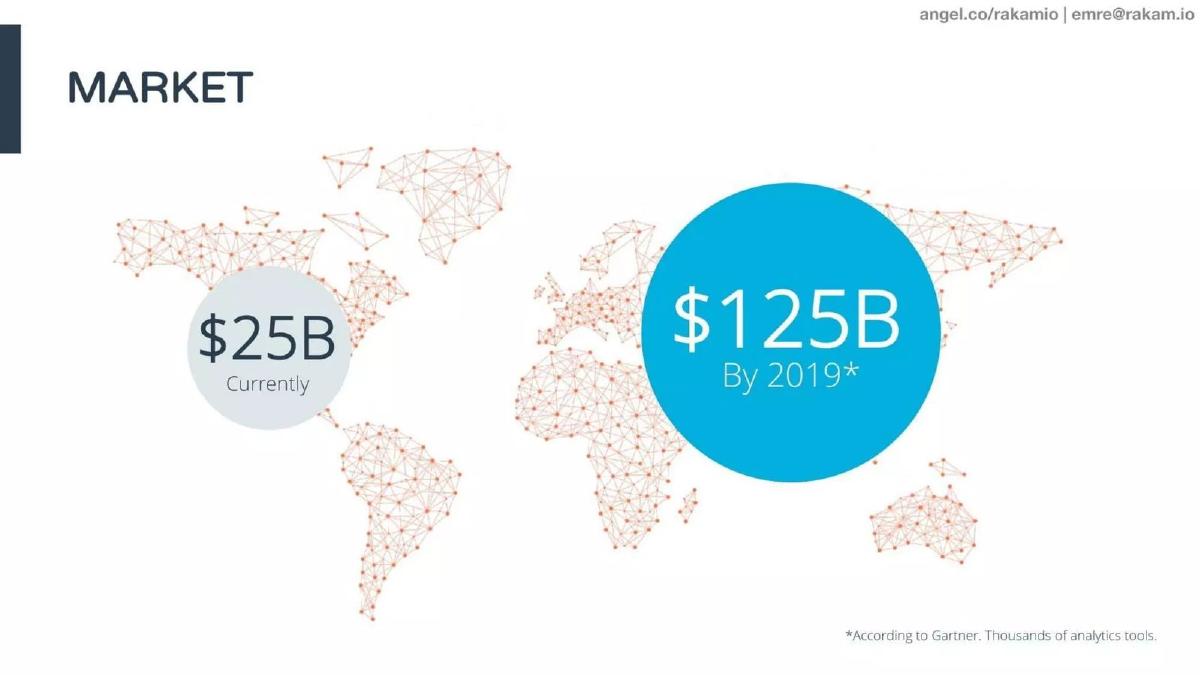
- The deck identifies a $125B market opportunity by 2019, citing Gartner as the primary source for this projection on slide 2.
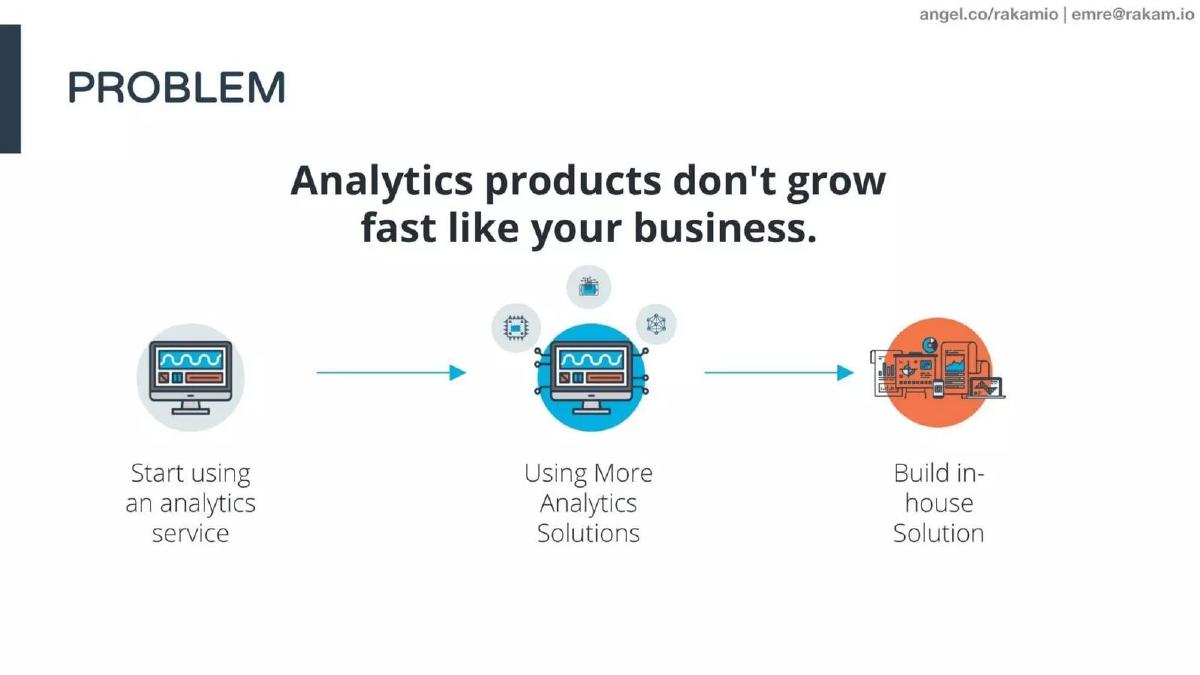
- Rakam defines the problem as a lack of scalability in existing analytics products, forcing companies to build costly in-house solutions (slide 3).
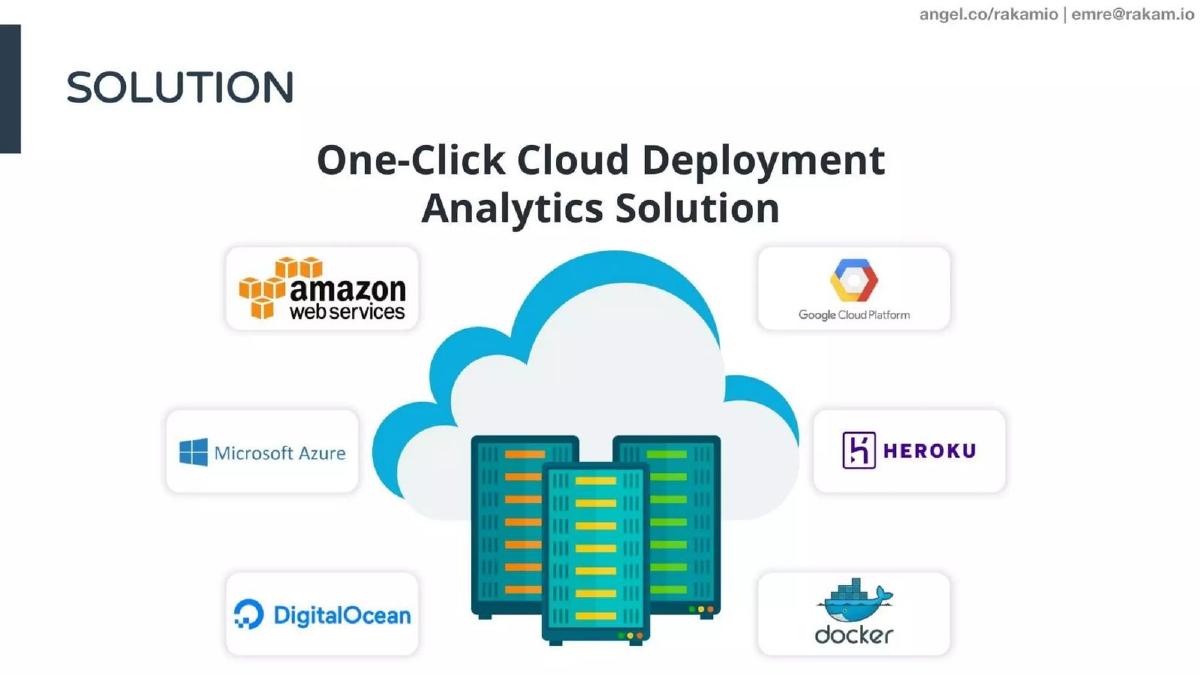
- The solution is presented as a 'One-Click Cloud Deployment' compatible with major providers like AWS, Azure, and Google Cloud (slide 5).
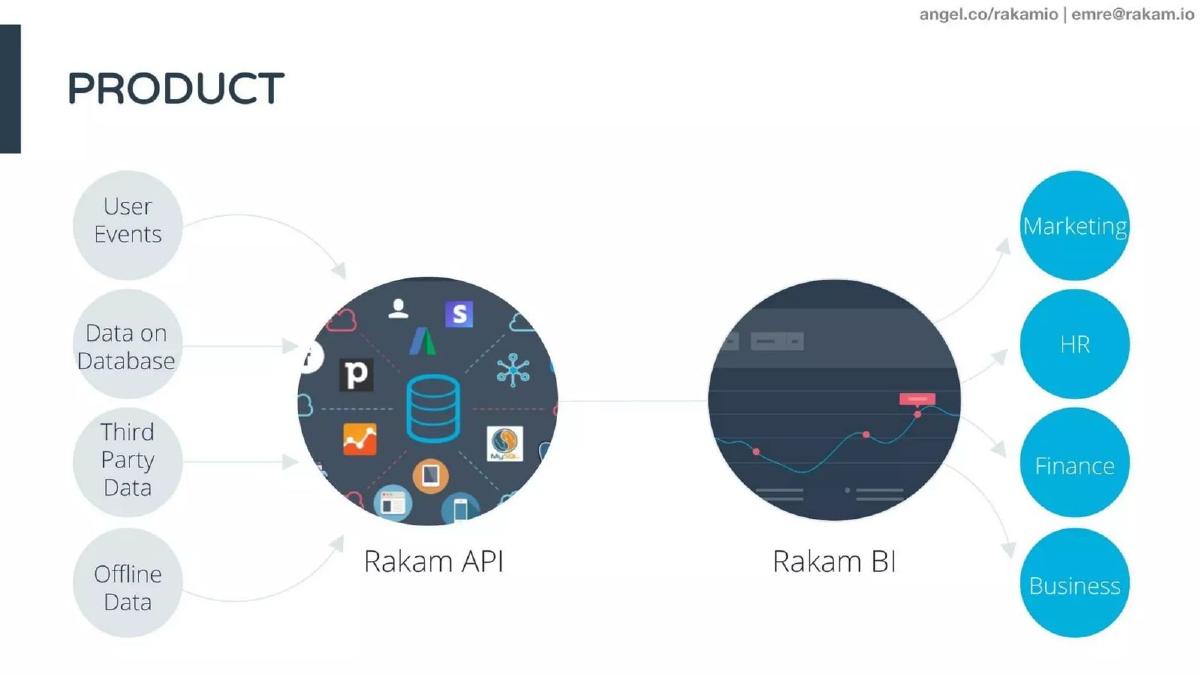
- Product architecture is simplified into a flow from 'Rakam API' to 'Rakam BI,' serving departments like Marketing, HR, and Finance (slide 6).
- Traction is the deck's strongest point, claiming +5 Billion monthly events and 20% MoM growth in the open-source community (slide 7).
- The company lists notable early users or customers including Ola, Qordoba, and Yellow Pages on its traction slide (slide 7).
- The team slide features two co-founders with backgrounds at Yandex and Hazelcast, but lacks a broader advisory or engineering team list (slide 8).
- The deck completely omits a business model, financial ask, use of funds, or competitive landscape analysis.
Introduction: The 9-Slide Technical Teaser
Rakam’s 2016 pitch deck is an example of a technical 'traction-first' presentation. At only 9 slides, it does not attempt to provide a comprehensive business plan. Instead, it focuses on the massive scale of data the platform was already handling and the technical problem it solves for growing enterprises. In the mid-2010s, the 'modern data stack' was still evolving, and Rakam’s pitch for a unified, full-stack solution was a direct response to the fragmentation of the market.
The Hook and the Market (Slides 1-2)
Slide 1: Title Slide The deck opens with a clean, dark aesthetic featuring a network visualization. The tagline is simple: "A platform for ALL your company's data." It includes contact information and an AngelList link in the top right corner, signaling its use as an outreach tool.
Slide 2: Market Rakam uses a classic 'big circle' market slide. It cites a current market size of $25B, growing to $125B by 2019. The source is attributed to Gartner, with a footnote mentioning "Thousands of analytics tools." While the numbers are large, the slide lacks a breakdown of the Serviceable Addressable Market (SAM) or Serviceable Obtainable Market (SOM), staying at a very high level of abstraction.
The Problem and Solution (Slides 3-5)
Slide 3: Problem The problem is framed as a scalability issue: "Analytics products don't grow fast like your business." The slide uses a three-step visual flow: starting with a basic analytics service, moving to multiple fragmented solutions, and finally being forced to "Build in-house Solution." This identifies a specific 'pain point'—the high cost and complexity of building custom data infrastructure when SaaS tools fail to scale.
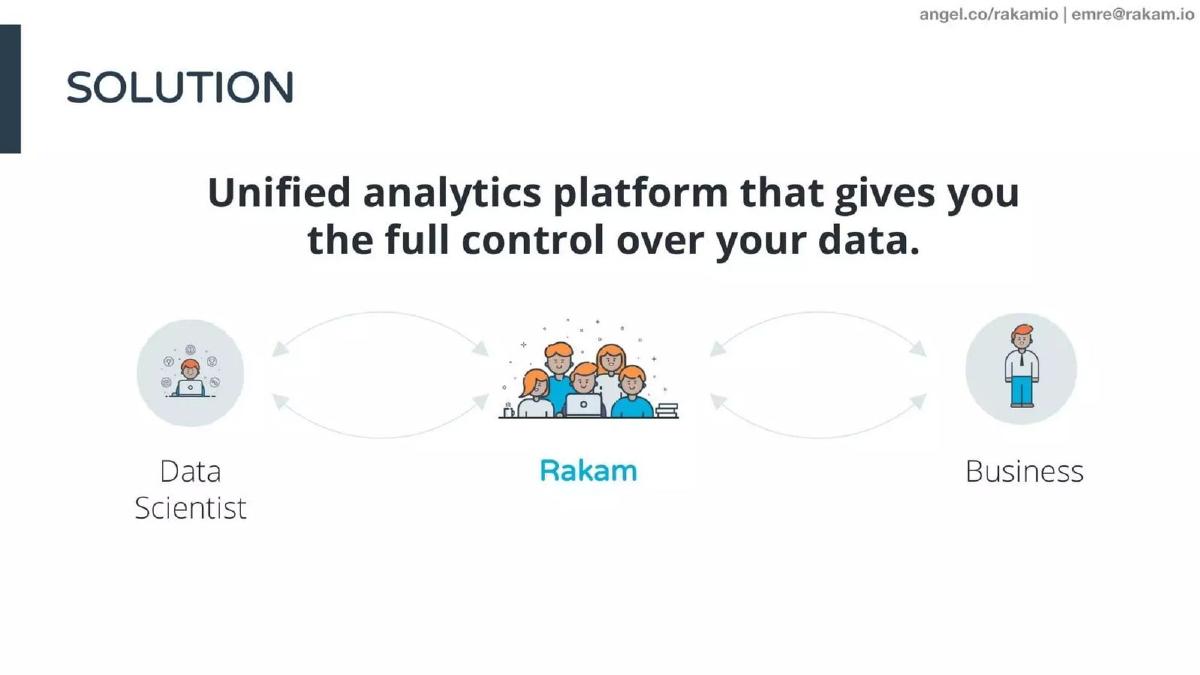
Slide 4: Solution (Part 1) The solution is defined as a "Unified analytics platform that gives you the full control over your data." The visual shows Rakam sitting in the middle of a bidirectional flow between the Data Scientist and the Business user. This positioning suggests that Rakam serves both the technical and non-technical stakeholders within an organization.
Slide 5: Solution (Part 2) This slide focuses on deployment, titled "One-Click Cloud Deployment Analytics Solution." It displays logos for Amazon Web Services, Google Cloud Platform, Microsoft Azure, Heroku, DigitalOcean, and Docker. This is a crucial 'de-risking' slide for technical investors, as it proves the platform is infrastructure-agnostic and easy to integrate into existing workflows.
Product and Traction (Slides 6-7)
Slide 6: Product The product slide provides a high-level architectural overview. Data flows from four sources—User Events, Data on Database, Third Party Data, and Offline Data—into the "Rakam API." From there, it moves to "Rakam BI," which then distributes insights to Marketing, HR, Finance, and general Business units. This slide effectively communicates the 'full-stack' nature of the product, covering everything from ingestion to visualization.
Slide 7: Traction This is the most compelling slide in the deck. It features two large metrics: "+5 Billion Events / monthly" and "20% MoM Growth (Open Source Community)." Below these numbers are logos of companies using the platform, including Ola (a major ride-sharing company), Qordoba, Twentify, Scorp, and Yellow Pages. For a $225k raise, handling 5 billion events is an impressive technical milestone that suggests the product is battle-tested.
The Team and Closing (Slides 8-9)
Slide 8: Team The team slide, titled "WE Slide 9: Closing The final slide repeats the call to action: "Let’s create your company-wide analytics platform together." It provides the website URL and contact email. Notably, there is no mention of the funding amount, the valuation, or the specific goals for the next 18 months.
What Works in the Rakam Deck
Technical Credibility: By highlighting the 5 billion monthly events and the founders' backgrounds at Yandex and Hazelcast, the deck establishes immediate trust in the product's ability to perform at scale. · Clear Problem Identification: The 'Build vs. Buy' dilemma is a well-known struggle for CTOs. Rakam identifies this exact moment of friction and positions itself as the alternative to a costly in-house build. · Infrastructure Flexibility: Showing compatibility with all major cloud providers and Docker (Slide 5) addresses a major barrier to entry for enterprise software. · Visual Simplicity: The deck avoids 'wall of text' slides. It uses iconography and simple flowcharts to explain complex data pipelines, making it accessible to non-technical investors.
What is Missing from the Rakam Deck
Business Model: There is no explanation of how Rakam makes money. Is it a per-seat license? Is it based on data volume? Is there a premium support model for the open-source version? · Competitive Analysis: The analytics market in 2016 was crowded with players like Mixpanel, Amplitude, and Segment. The deck fails to explain how Rakam differs from these well-funded competitors. · The Ask: A pitch deck is a fundraising tool, yet this deck does not state how much money is being raised or what that money will be used for (e.g., hiring more engineers, sales, or marketing). · Financial Projections: There are no charts showing revenue growth, burn rate, or future projections. The traction shown is purely technical (events and community growth) rather than financial.
What a Founder Should Copy
The Traction Slide Layout: If you have impressive technical metrics (like API calls, events, or users), present them as Rakam did on Slide 7—large, bold numbers with clear labels. · The Problem Flow: Slide 3 is an excellent way to visualize the 'evolution of a problem.' It shows the investor that you understand the customer's journey and the exact point where existing solutions fail. · The 'One-Click' Promise: If your software requires installation, showing a 'One-Click' or 'Integrations' slide with recognizable logos reduces the perceived 'friction' of your product. · Minimalist Design: Rakam keeps the focus on the data. The consistent use of a limited color palette and plenty of white space makes the deck feel professional and modern.
Frequently asked questions
- How much did Rakam raise with this deck?
- According to the catalogue facts from pitchdeckhunt.com, Rakam raised $225,000 in 2016. The deck itself does not mention the amount raised or the terms of the investment, which is common for decks used in early-stage networking or as a teaser for follow-up meetings.
- What is Rakam's core value proposition?
- Rakam positions itself as a 'unified analytics platform' that prevents companies from having to build their own in-house data solutions. As shown on slides 3 and 4, they aim to give businesses 'full control' over their data while maintaining the ease of a pre-built platform, effectively bridging the gap between SaaS and custom infrastructure.
- Who were the founders of Rakam at the time of this deck?
- The team slide (slide 8) lists two co-founders: Nurkan Kirkan, the COO, who previously worked at Yandex, and Burak Emre Kabakcı, the CEO, who has a background with Hazelcast. The deck emphasizes their technical pedigree in data-heavy environments.
- What kind of traction did Rakam have in 2016?
- Rakam demonstrated significant technical scale for an early-stage startup. Slide 7 highlights that the platform was processing over 5 billion events per month and experiencing 20% month-over-month growth within its open-source community, alongside logos from companies like Ola and Twentify.
- What are the biggest missing elements in this pitch deck?
- The deck is missing several standard 'must-have' slides: a Business Model (how they make money), a Competitive Landscape (how they beat Mixpanel or Heap), a Financial Projections slide, and a clear 'Ask' slide detailing how much capital they are seeking and how it will be spent.