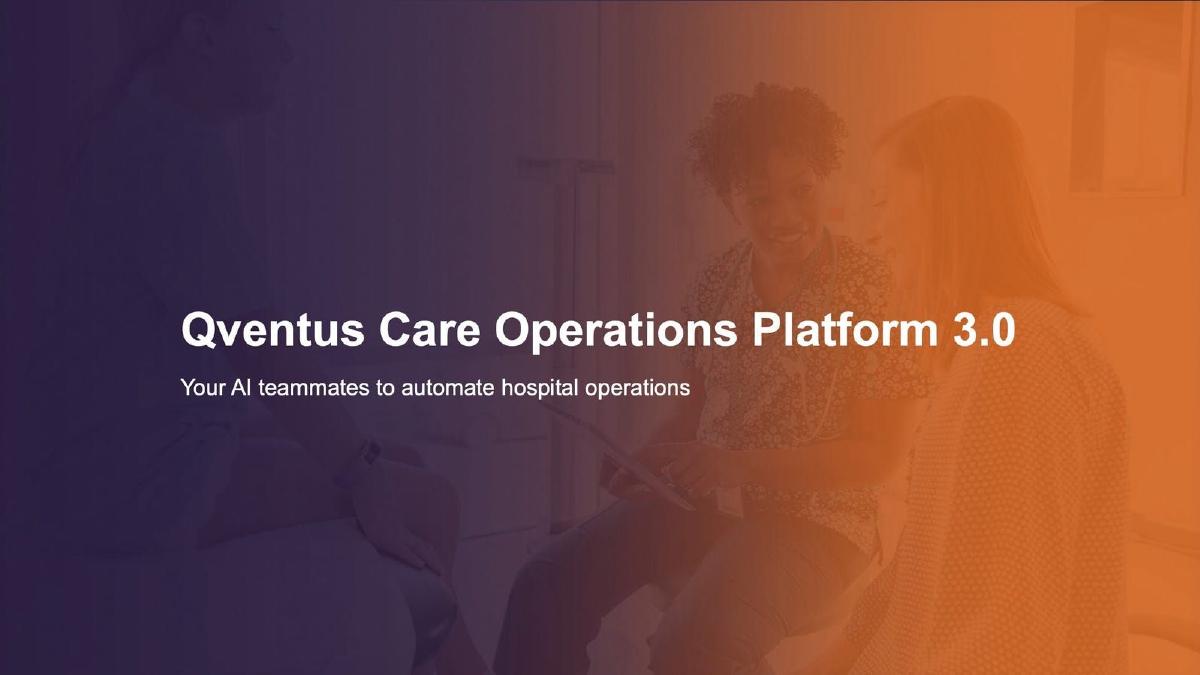
Qventus raised $105M in 2024 for their Series D round, as reported by Business Insider, using a deck that emphasizes the operational inefficiencies of modern healthcare. The narrative shifts from broad industry challenges—such as a projected shortage of 450k bedside nurses by 2027—to specific, high-ROI solutions for surgical growth and inpatient capacity. By positioning their AI as 'teammates' that handle the 'glue' roles (logistical tasks like faxes and phone calls), Qventus demonstrates a clear path to $10M+ ROI per 100 operating rooms. The deck is a masterclass in enterprise healthcare sal…
Key takeaways
- The deck identifies a massive labor gap, citing a shortage of 450k bedside nurses by 2027 on Slide 3.
- Qventus claims to unlock $4.5m in incremental revenue for every 25 operating rooms (ORs) on Slide 3.
- A comprehensive timeline on Slide 5 shows the company's evolution from a 2012 founding to a $100M funding round in 2022.
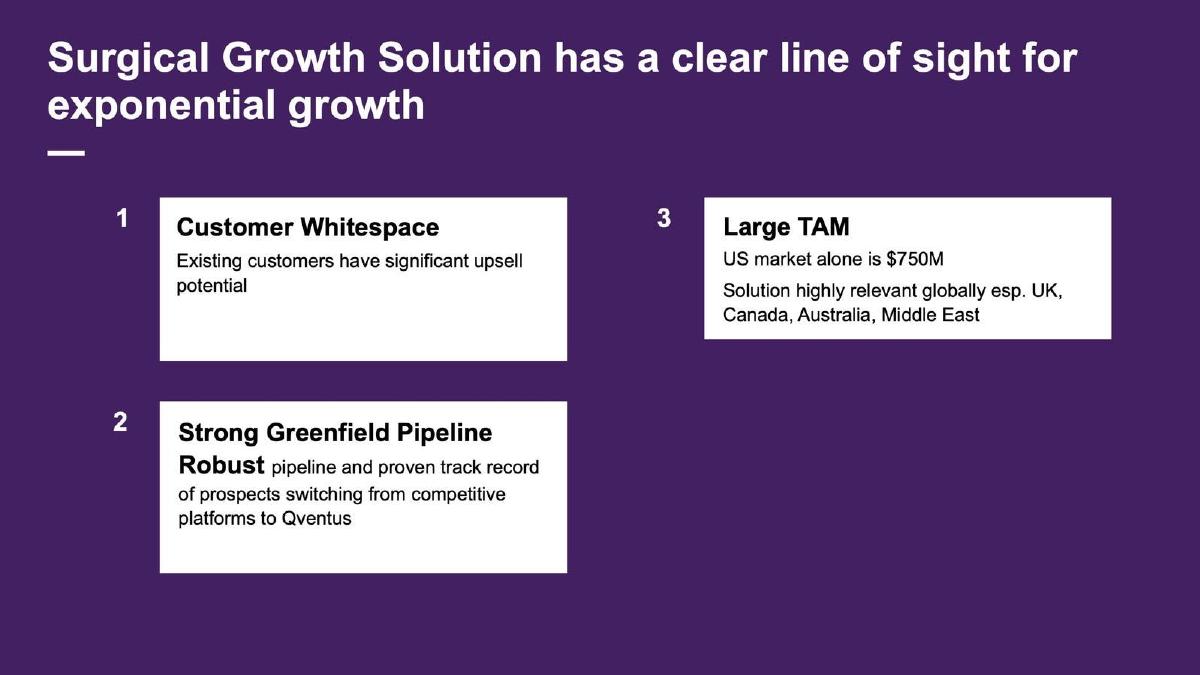
- The 'Surgical Growth Solution' is estimated to have a $750M TAM in the US market alone, according to Slide 7.
- Slide 11 introduces 'AI Operational Assistants' designed to eliminate 'below-license' logistical tasks.
- The platform aims to solve the 'broken process' of 10k+ faxes and 20k+ calls per month per 100 ORs as detailed on Slide 13.
- Total ROI is projected at $10M+ per 100 ORs, broken down into cancellations, productivity, and optimization on Slide 15.
- The deck omits a specific 'Ask' slide detailing the exact use of the $105M Series D funds.
Executive Summary: The Industrialization of Hospital Operations
Qventus represents a mature, Series D stage company that has moved past the 'visionary' phase into the 'execution and scale' phase. The deck, used to raise $105M in 2024 as reported by Business Insider, reflects this maturity. It does not lead with abstract technology; it leads with hard economics. The narrative is built around the concept of 'Care Operations'—the invisible infrastructure of hospitals that is currently failing under the weight of labor shortages and manual processes.
Slide 1: The Hook
The opening slide establishes the brand identity: 'Your AI teammates to automate hospital operations.' By using the word 'teammates,' Qventus positions its AI not as a replacement for human staff, but as a supportive layer. This is a strategic choice in a healthcare industry often wary of automation-led layoffs.
Slide 2 & 3: The Macro Economic Crisis
Slide 2 and 3 serve as the 'Problem' slides, but they are grounded in current, brutal realities. Slide 2 states 'Healthcare is broken,' while Slide 3 provides the data to back it up. The figures are stark: 40% of health systems are projected to lose money in 2024, and there is a looming shortage of 450k bedside nurses by 2027. Most importantly, it cites a $22.3B loss in revenue due to cancelled surgeries. This shifts the conversation from 'better care' to 'financial survival,' which is the primary driver for Series D investors and hospital CFOs alike.
Slide 4 & 5: A Decade of Validation
Slide 5 is one of the most important slides for a late-stage round. It shows a timeline starting in 2012. It highlights key milestones: 70+ deployments by 2017, saving 200+ lives during COVID-19 in 2020, and securing $100M in funding in 2022. This timeline proves that Qventus is not a 'wrapper' startup built on top of recent LLM hype; they have been building the data foundation for twelve years. It specifically mentions that their Perioperative Solution gained $10M in new business within just 7 months in 2023.
Slide 6: The Leadership
Slide 6 covers the executive team. While the text provided is a placeholder for the team, the context from Slide 5 indicates a McKinsey pedigree. For a Series D, investors are looking for a mix of deep domain expertise (healthcare) and the ability to scale a high-growth SaaS business.
Slide 7 & 8: Market Opportunity and Product Launch
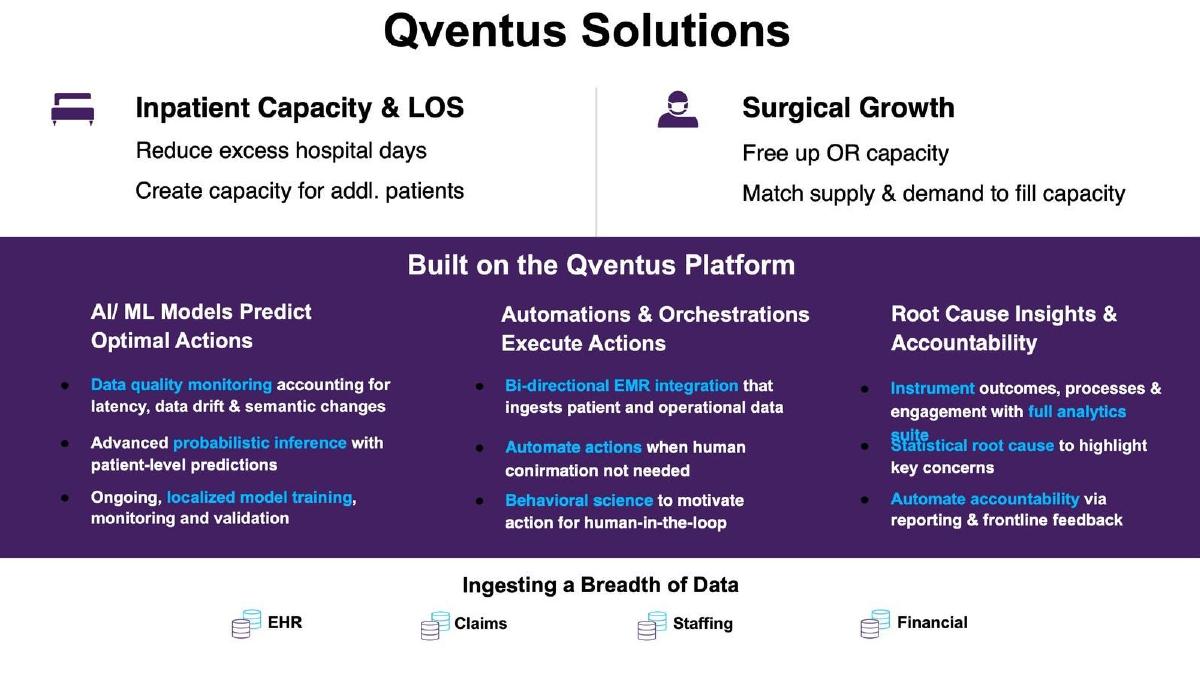
Slide 7 focuses on the 'Surgical Growth Solution,' claiming a 'clear line of sight for exponential growth.' It identifies a $750M TAM in the US alone and notes that the solution is highly relevant in international markets like the UK, Canada, and Australia. Slide 8 announces the launch of an 'EHR embedded inpatient capacity solution,' which is a critical technical moat. Being 'embedded' in the Electronic Health Record (EHR) means Qventus is part of the daily workflow, not a separate tab that clinicians will ignore.
Slide 9, 10 & 11: The 'Glue' Role Thesis
Slides 10 and 11 introduce the core thesis of the 3.0 platform. Qventus argues that healthcare is held together by 'millions of glue roles'—staff who spend their time on 'below-license logistical tasks.' Slide 11 defines their AI Operational Assistants (AIOA) as tools that can Read, Write, Speak, and Listen. This is a very clear way to explain complex AI capabilities to non-technical stakeholders. It transforms 'Generative AI' into 'an assistant that handles faxes and phone calls.'
Slide 12, 13 & 14: Orchestration and the Patient Journey
Slide 12 explains the 'orchestration' of these assistants. Slide 13 provides a visual map of the 'Pre/Post Surgical Optimization' journey. It identifies the 'broken processes' that lead to 10k+ faxes and 20k+ calls per month per 100 ORs. By visualizing the 'Surgery Booked' to 'Surgery' path as a winding road with pitfalls (like 'Patients not yet contacted'), Qventus makes the need for their solution feel urgent and tangible.
Slide 15: The ROI Slide
Slide 15 is the 'Money Slide.' It claims a $10M+ ROI per 100 ORs. It breaks this down into three buckets: Reducing Surgical Cancellations ($2M-$6M), Increasing Productivity ($3M-$8M), and Patient Optimization Revenue ($2M-$6M). For a Series D investor, this slide provides the 'Unit Economics' of the customer value proposition. If a hospital can spend $X on Qventus to get $10M back, the sales cycle becomes a mathematical inevitability.
Slide 16 & 17: The Solution Factory
Slide 16 positions Qventus as a 'solution factory,' implying that their platform can spin up new AI assistants for different hospital departments quickly. Slide 17 concludes with 'We are just getting started,' a standard closing that points toward a future IPO or massive exit, backed by the vastness of the healthcare market.
What Works in the Qventus Deck
Specific Financial Outcomes: The deck avoids vague promises of 'better outcomes.' Instead, it uses specific numbers like '$4.5m in incremental revenue' and '$20m of operating cost reduction.' This speaks the language of the buyer (CFOs) and the investor.
The 'Glue' Role Metaphor: By naming the problem 'glue roles,' Qventus creates a category. It makes the problem of 'doing paperwork' feel like a systemic failure that requires a systemic solution, rather than just a staffing issue.
Historical Credibility: The timeline on Slide 5 is a powerful defense against newer AI startups. It shows that Qventus has the data, the deployments, and the regulatory trust that takes a decade to build.
What is Missing from the Qventus Deck
The 'Ask' Slide: While we know from publisher reports that they raised $105M, the deck itself (as presented) does not include a slide detailing how that money will be spent. Will it go toward R&D, international expansion, or sales and marketing?
Competitive Landscape: Slide 7 mentions 'switching from competitive platforms,' but it never names them. In a Series D, investors usually want to see a head-to-head comparison against incumbents like Epic or other AI startups like LeanTaaS.
Unit Economics: While the ROI for the customer is clear, the deck doesn't explicitly show the company's unit economics (CAC, LTV, Gross Margins). For a late-stage round, these are usually expected in the appendix or a separate data room.
Lessons for Founders
Lead with the 'Why Now': Qventus uses the 2024 hospital margin crisis and the 2027 nurse shortage to create immediate urgency. If your product solves a problem that is getting worse every year, make that the centerpiece of your deck.
Quantify Everything: If you are selling to enterprise, you must have an ROI slide like Slide 15. Break down exactly where the money comes from (cost savings vs. revenue growth) so the investor can model your growth.
Use a Narrative Arc: The deck moves from the Macro (Healthcare is broken) to the Micro (The specific patient journey) and back to the Macro (The $750M TAM). This keeps the audience engaged by alternating between the 'big picture' and 'how it actually works.'
Frequently asked questions
- What is the primary problem Qventus aims to solve?
- Qventus focuses on the 'broken' state of healthcare operations, specifically targeting 'glue' roles—the logistical tasks that hold hospitals together. Slide 3 highlights decreased margins, with 40% of hospitals expected to lose money in 2024, and $22.3B in lost revenue due to cancelled surgeries. Their AI aims to automate these non-clinical, 'below-license' tasks to improve efficiency and revenue.
- How does Qventus quantify its financial impact for hospitals?
- The deck provides specific ROI metrics. Slide 3 states that for every 25 ORs, they unlock $4.5M in revenue. Slide 15 further breaks down a $10M+ ROI per 100 ORs: $2M-$6M from reducing cancellations, $3M-$8M from increasing productivity, and $2M-$6M from patient optimization revenue. They also claim a 1-day reduction in length of stay (LOS) for a 425-bed hospital unlocks $40M in total value.
- What is the 'Care Operations Platform 3.0' mentioned in the deck?
- Introduced on Slide 9 and detailed on Slide 12, the 3.0 platform is an orchestration layer for multiple AI assistants. It enables these assistants to 'Read and Understand' (PDFs/faxes), 'Write' (texts/emails), 'Speak' (automated calls), and 'Listen' (live guidance) within existing EHR workflows. This allows the software to act as a 'copilot' for task execution across the patient journey.
- What does the company's growth timeline look like?
- Slide 5 outlines a decade of development. Founded in 2012 by former McKinsey consultants, the company reached 70+ deployments by 2017. It pivoted to a full solution platform in 2019, supported the White House COVID-19 Task Force in 2020, and secured $100M in funding in 2022. By 2023, their perioperative solution was generating $10M in new business within seven months.
- Is there information about the management team and their background?
- Slide 6 is dedicated to the executive team, though the specific names and bios are not detailed in the text provided. However, Slide 5 notes the company was founded on the 'heels of hospital operations work at McKinsey' and emphasizes that as of 2024, the company remains 'founder-led,' suggesting continuity in leadership since its 2012 inception.