Queerie’s pitch deck is a mission-driven presentation targeting the social and mental health challenges faced by the LGBTQIA+ community. Seeking $300,000 in pre-seed funding, the company aims to move beyond its alpha stage, which currently includes 95 beta testers. The deck leans heavily on social impact metrics, citing high rates of loneliness and suicide risk among queer youth to justify the need for a dedicated community platform. While the financial projections are aggressive—forecasting a jump from $288,000 in 2024 to over $9.6 million by 2029—the deck lacks specific details on its monet…
Key takeaways
- The company is seeking a $300k pre-seed infusion to complete its mobile app and acquire 3,000 paying customers (Slide 11).
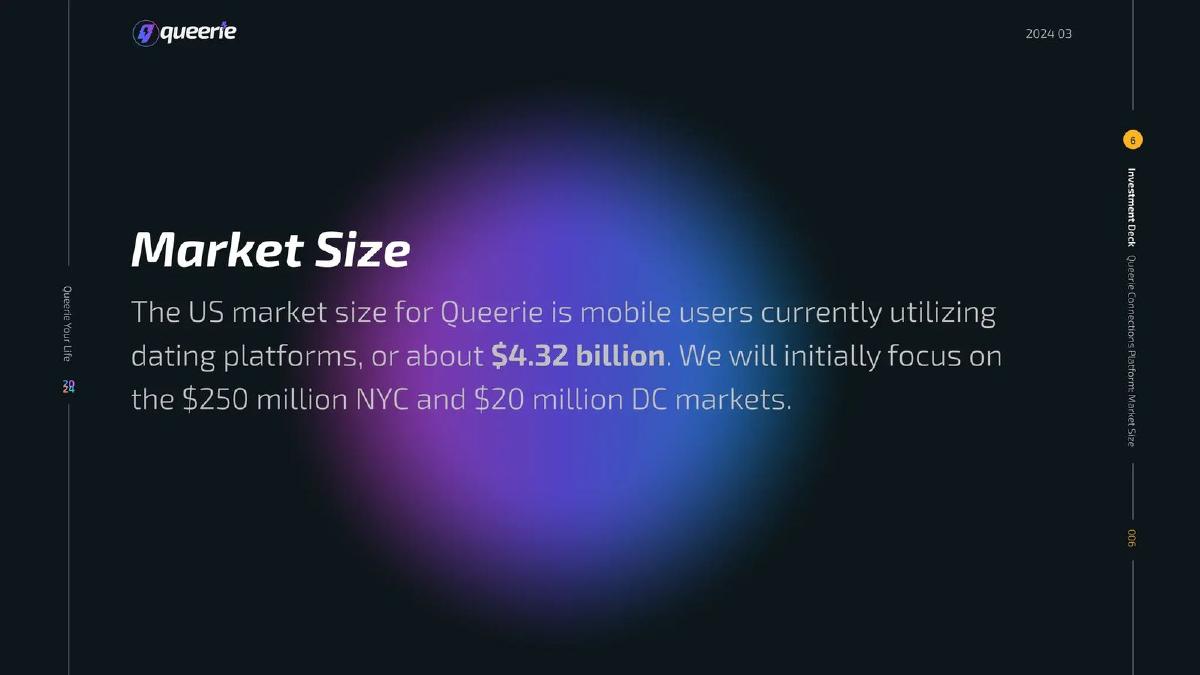
- Queerie identifies a US market size of $4.32 billion, with an initial focus on the NYC ($250m) and DC ($20m) markets (Slide 6).
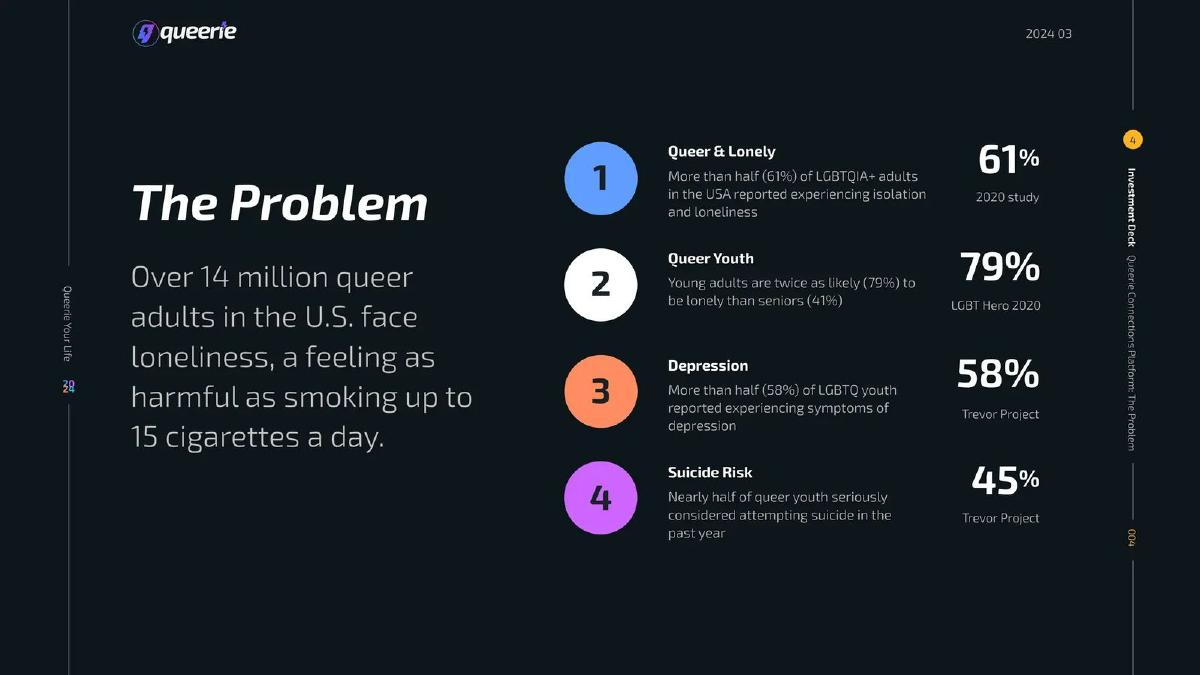
- The problem statement is built on mental health data, noting that 45% of queer youth seriously considered suicide in the past year (Slide 4).
- Traction is currently limited to an alpha version with 95 beta testers and a survey of 3,000 people (Slide 8).
- The team includes significant technical experience, specifically citing a Co-CTO with 18 years at Google (Slide 10).
- Financial projections anticipate the company becoming profitable within 24 months, reaching a net income of $354,290 in 2025 (Slide 12).
- The product roadmap includes a referral program intended to grow the user base to 1,000 by June 2024 (Slide 8).
- The competitive analysis positions Queerie against Grindr and Hinge, claiming superiority in community focus and well-being (Slide 9).
Introduction and Mission
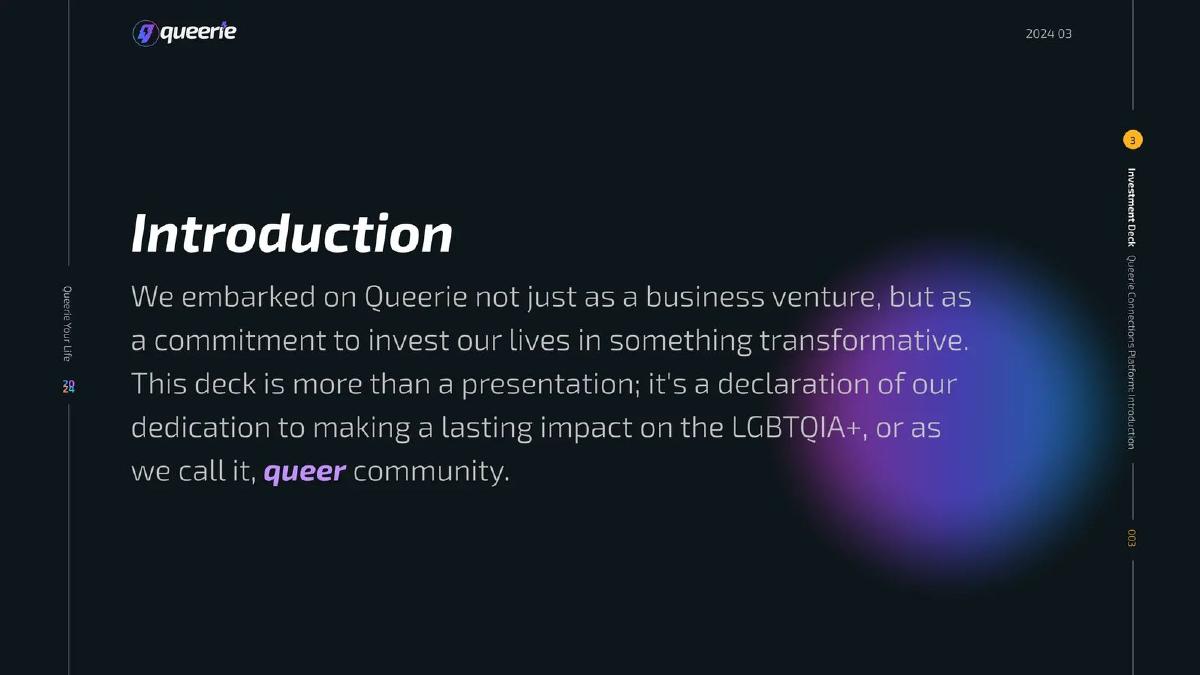
The Queerie pitch deck, dated March 2024, opens with a conversational and mission-driven tone. Slides 1 and 2 set the stage with the question, "Is the world ready for Queerie?" followed by the answer, "We believe it's overdue, darling." This establishes the brand voice immediately—informal, community-centric, and confident. Slide 3 reinforces this by stating that the venture is a "commitment to invest our lives in something transformative" rather than just a business, specifically targeting the LGBTQIA+ community.
The Problem: Loneliness and Mental Health
Slide 4 provides the quantitative justification for the platform. It cites that over 14 million queer adults in the U.S. face loneliness. The slide uses heavy-hitting statistics to create urgency: 61% of LGBTQIA+ adults report isolation, 79% of queer youth are lonely, and 45% of queer youth considered suicide in the past year. By framing loneliness as "as harmful as smoking up to 15 cigarettes a day," the founders position Queerie not just as a social app, but as a public health intervention.
The Solution and Market Opportunity
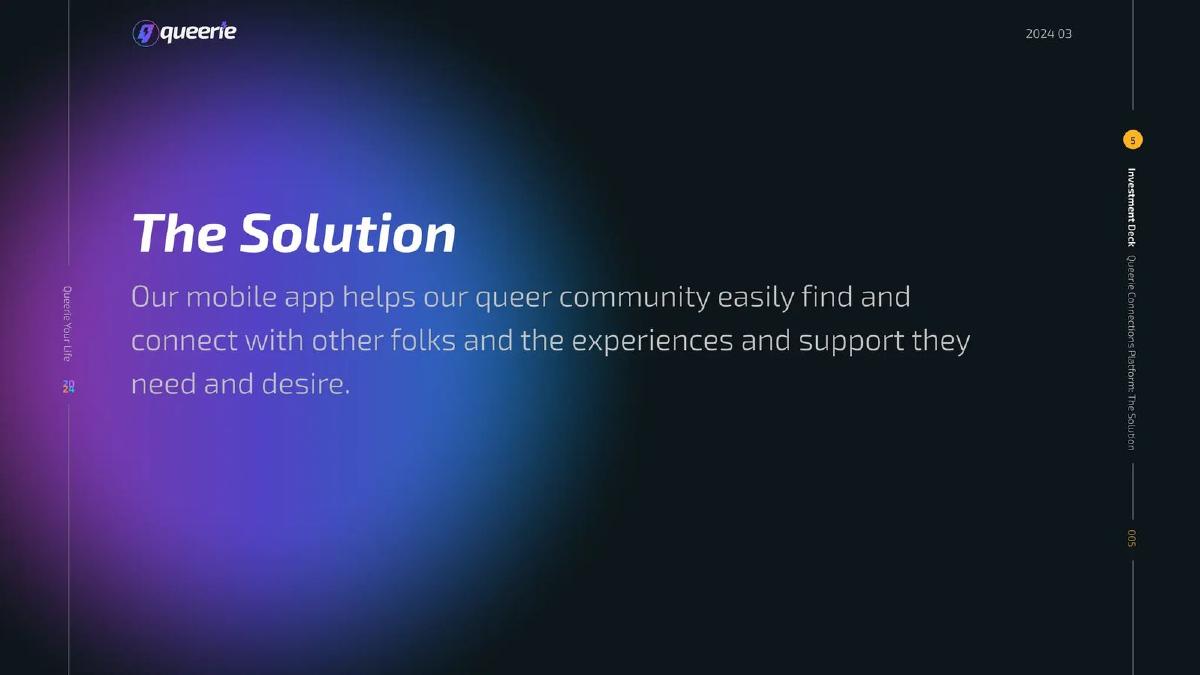
Slide 5 defines the solution as a mobile app that helps the community find connections, experiences, and support. Slide 6 quantifies the market, valuing the US mobile dating platform market at $4.32 billion. The strategy is localized; they intend to focus initially on New York City ($250 million) and Washington D.C. ($20 million). This geographic focus is a standard best practice for social platforms that require high user density to function effectively.
Product Mechanics and Current Traction
Slide 7, "How it Works," outlines a standard social discovery flow: Sign Up, AI-driven Matchmaking, Events & Groups, and Interaction. The emphasis is on both online and offline relationship building. Slide 8 details the current traction as of Q1 and Q2 2024. The company has built a closed alpha version with 95 beta testers and has surveyed over 3,000 people. They set a goal to reach 1,000 users by June 2024 through a referral program, aiming for "Strong Growth" by Q3 2024.
Competitive Landscape
Slide 9 uses a feature comparison matrix to differentiate Queerie from incumbents Grindr and Hinge. Queerie claims to be the only platform that is simultaneously cost-effective, community-focused, inclusive, and dedicated to well-being. Notably, it marks Grindr as not being community-focused or well-being-oriented, and Hinge as not being inclusive or community-focused. This slide highlights Queerie's intent to move away from the "hookup" or "pure dating" stigmas of existing apps toward a holistic community model.
The Team: "The Quuties"
Slide 10 is perhaps the strongest slide in the deck regarding investor confidence. The team possesses significant industry tenure. CEO Melvin Amaya has 16 years of UX experience. Co-CTO Nick Eskelinen spent 18 years at Google as a System Architect. Co-CTO Justin Schier has 20 years of experience, including a background with Scruff, a direct competitor in the queer social space. COO Alfredo Valiente adds 20 years of project management and a Harvard background. This level of senior technical talent is unusual for a $300k pre-seed ask and suggests a high execution capability.
The Ask and Financial Projections
Slide 11 outlines the $300,000 pre-seed ask. The majority (56%) is earmarked for engineering to complete the app, with the remainder split between marketing and operations. The stated goal is to acquire 3,000 premium subscribers. Slide 12 provides a six-year financial forecast. It projects revenue growing from $288,000 in 2024 to $9,676,800 in 2029. The model assumes a constant "Spend per Customer" of $8 and a "Marketing CPA" of $4.66. They anticipate reaching profitability in 2025 with a net income of $354,290.
What Works in This Deck
Strong Technical Pedigree: The inclusion of a long-term Google veteran and a former Scruff engineer provides immediate credibility to the "AI-driven matchmaking" claims. Investors at the pre-seed stage often bet on the team's ability to build, and this team has a proven track record.
Clear Geographic Focus: By naming NYC and DC as initial markets, the founders show they understand the "cold start problem" of social networks. Trying to launch nationally with $300k would be impossible; focusing on two high-density queer hubs is a viable strategy.
Urgency Through Data: The problem slide uses reputable sources (Trevor Project, LGBT Hero) to move the conversation from "another dating app" to a "necessary community tool."
What Is Missing or Needs Clarification
Monetization Specifics: Slide 12 mentions a "Spend per Customer" of $8, but the deck does not explain what this buys. Is it a monthly subscription? A one-time fee for events? A freemium model? Without knowing what the $8 represents, the revenue projections are difficult to validate.
Unit Economic Stability: The financials assume a flat $4.66 Customer Acquisition Cost (CAC) and a flat $8 revenue per user for six years. In reality, CAC usually increases as a company moves beyond early adopters, and revenue per user fluctuates. The lack of variability in these projections suggests a simplified model that may not account for market saturation or competitive response.
Product Visuals: For a team with 16 years of UX expertise, the deck is surprisingly devoid of app screenshots or UI mockups. Showing the interface would help bridge the gap between the "mission" and the "utility."
Founder's Guide: What to Copy
The Traction Roadmap: Slide 8 is a great example of how to present early-stage progress. It combines past milestones (MVP launch) with future targets (referral program, 1000 users) in a visually clear timeline.
The Use of Funds: Slide 11 is excellent. It doesn't just say "we need money"; it ties specific dollar amounts to specific percentages and, most importantly, to a specific outcome (3,000 premium subscribers). This gives investors a clear metric for success.
The Competitive Matrix: While often criticized for being biased, Slide 9 successfully identifies the "white space" in the market. By focusing on "well-being" and "community"—areas where giants like Grindr are frequently criticized—Queerie carves out a specific niche that feels defensible.
Frequently asked questions
- What is the primary problem Queerie aims to solve?
- Queerie focuses on the 'loneliness epidemic' within the LGBTQIA+ community. According to Slide 4, over 14 million queer adults in the U.S. face loneliness, which they equate to the health harm of smoking 15 cigarettes a day. They also cite Trevor Project data showing high rates of depression (58%) and suicide risk (45%) among queer youth.
- How does the platform actually work for the user?
- The user journey consists of four steps: Sign Up (creating a profile with interests), Matchmaking (using AI-driven recommendations), Events & Groups (joining resonant communities), and Interact (building relationships online and offline). This process is detailed on Slide 7, emphasizing a transition from isolation to a supportive community.
- What are the specific technical credentials of the founding team?
- The team, referred to as 'The Quuties' on Slide 10, features deep technical roots. Co-CTO Nick Eskelinen is credited with an 18-year legacy at Google as a system architect. Co-CTO Justin Schier has over 20 years of experience, including work on the app Scruff. CEO Melvin Amaya brings 16 years of UX/UI expertise.
- What is the planned allocation for the $300,000 investment?
- Slide 11 breaks down the $300k ask into three categories: 56% ($170k) for App completion/Engineering, 23% ($70k) for Marketing/User Acquisition, and 21% ($60k) for Operations/Management. The goal is to reach 3,000 premium subscribers with this capital.
- Are the financial projections realistic based on the current traction?
- The projections on Slide 12 are highly optimistic. The company plans to scale from 3,000 premium subscribers in 2024 to 104,000 by 2029. While they anticipate a net loss of $60,000 in 2024, they project a jump to $7.4 million in net income by 2029, assuming a constant $8 spend per customer and a fixed $4.66 CPA.