Social & Dating App Problem Slide: Pitch Deck Examples
How social, community and dating app startups present the problem in a pitch deck: name who is lonely or poorly served, measure it with a cited study.
Social & Dating App Problem Slide: Real Pitch Deck Examples
Eight problem slides from social-networking, community, events and dating startups, shown in full, compare whether each slide names who is affected, measures the problem with a cited source, and says why today's apps don't solve it.
TL;DR
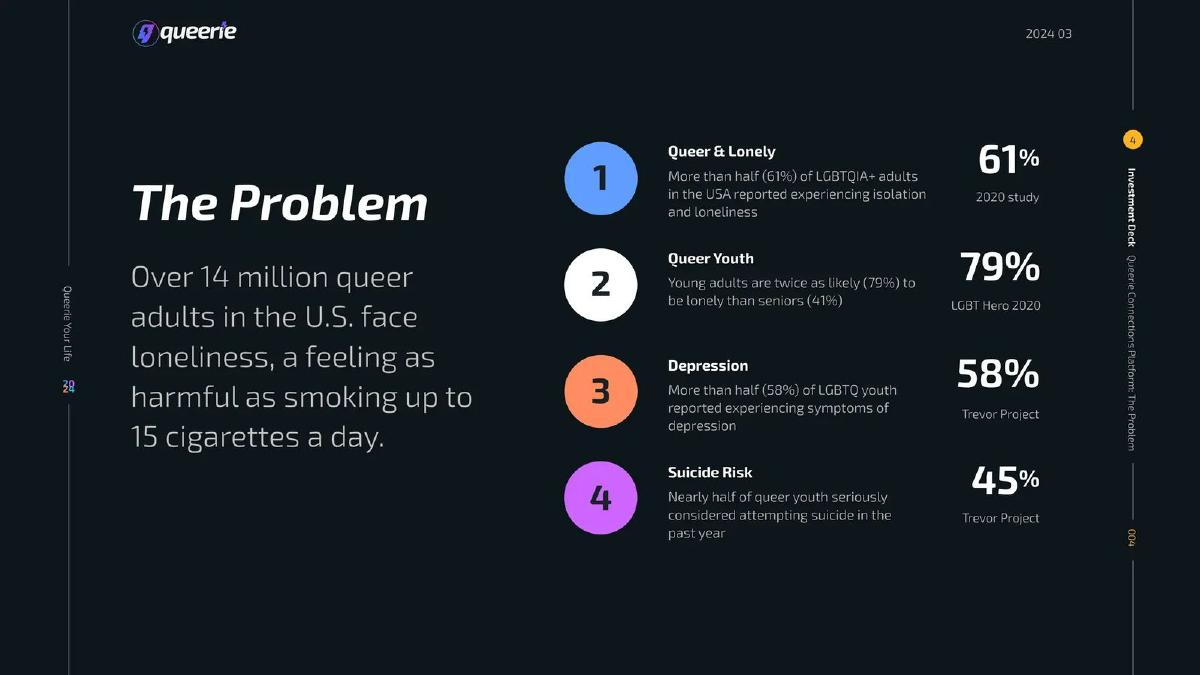
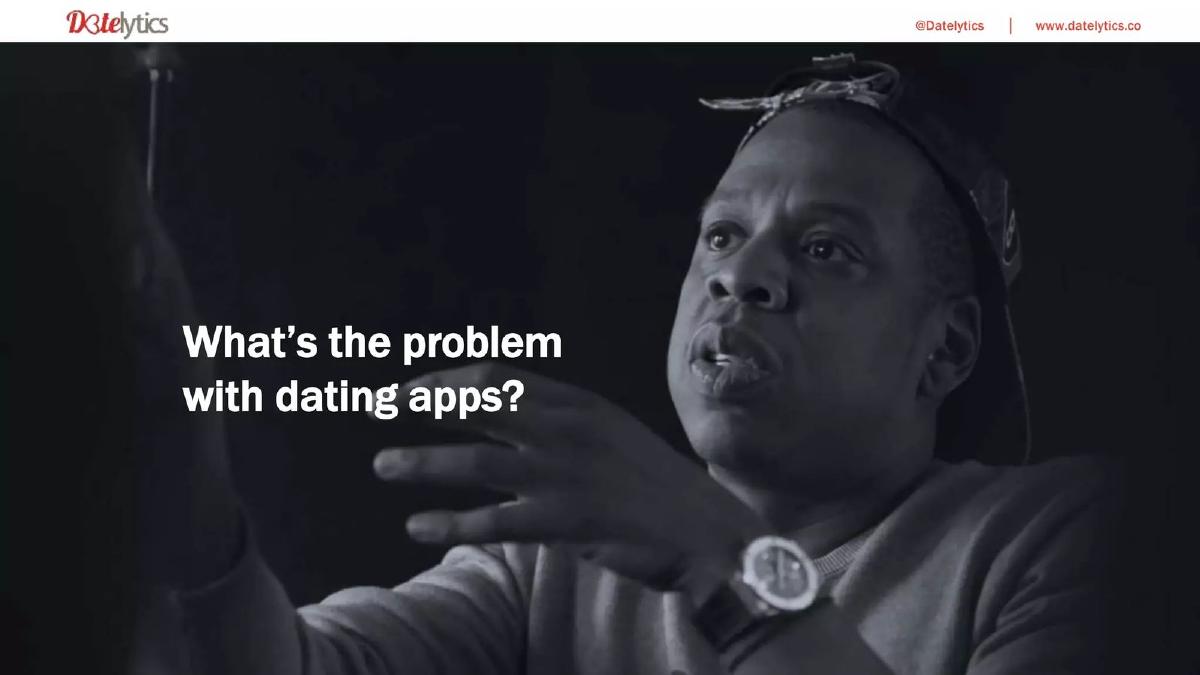
A social app problem slide should name one group, measure their loneliness or frustration with a cited study, and say why current apps fail them. Queerie does this: "Over 14 million queer adults in the U.S. face loneliness", with four sourced figures — "61%" of LGBTQIA+ adults report isolation (2020 study), young queer adults are "twice as likely (79%) to be lonely than seniors (41%)" (LGBT Hero 2020), "58%" of LGBTQ youth report symptoms of depression and "45%" seriously considered suicide (Trevor Project). Clyx adds a named source for its headline: "Loneliness is at a record high, as per Harvard Study of Adult Development." Datelytics's "What's the problem with dating apps?" over a photo asks the question without answering it, the weaker pattern.
Social and dating app problem slides from real pitch decks
Each example shows the exact stored slide above its analysis and links to the full teardown. Claims are as shown on the slides; we have not verified them.
Queerie problem slide — slide 4
Social app for queer friendship. A headline figure and four numbered, sourced stats.
Queerie deck, slide 4. Exact stored slide matched to this analysis.
Our analysis: The strongest example here: one group, a size, and four sourced figures that rise in seriousness.
Evidence and limitation: Five figures, three sources named.
What a founder can adapt: Put the source next to each figure, not in a footnote.
Supporting analysis
What the deck claims: "The Problem." "Over 14 million queer adults in the U.S. face loneliness, a feeling as harmful as smoking up to 15 cigarettes a day." "1 Queer & Lonely: More than half (61%) of LGBTQIA+ adults in the USA reported experiencing isolation and loneliness" ("2020 study"). "2 Queer Youth: Young adults are twice as likely (79%) to be lonely than seniors (41%)" ("LGBT Hero 2020"). "3 Depression: More than half (58%) of LGBTQ youth reported experiencing symptoms of depression" ("Trevor Project"). "4 Suicide Risk: Nearly half of queer youth seriously considered attempting suicide in the past year" — "45%" ("Trevor Project").
Presentation choice: Every figure carries its source beside it, so nothing reads as a guess.
When it does not fit: Name the "2020 study" in the first row too.
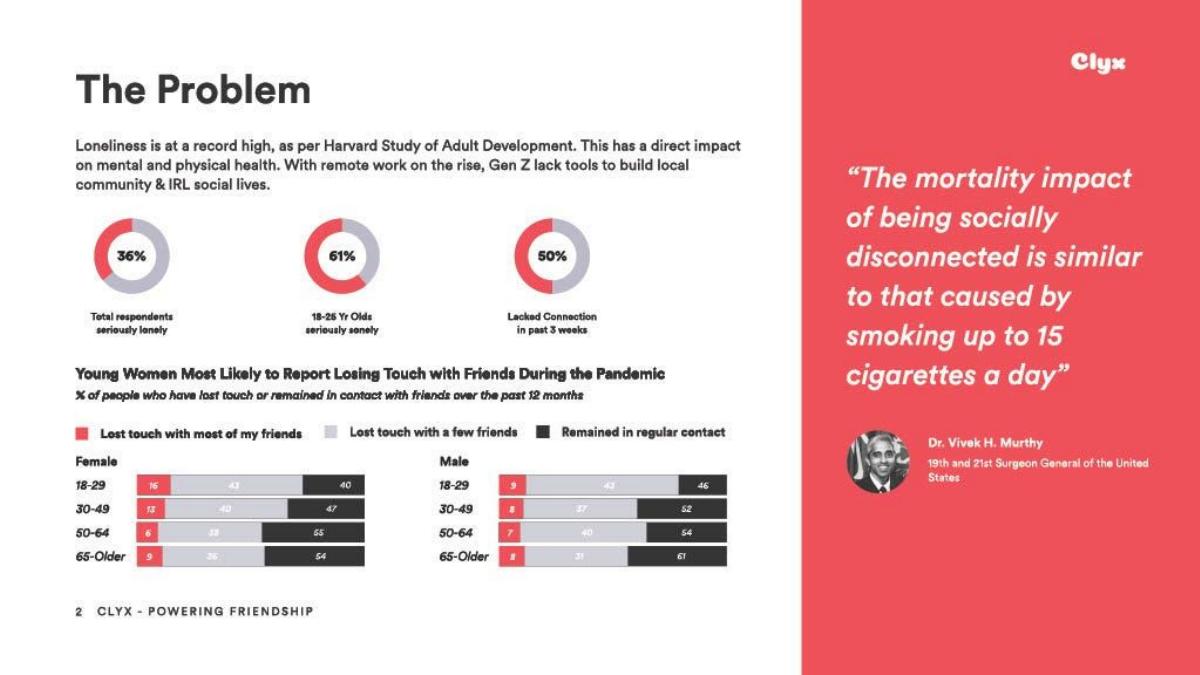
App for finding local friends and activities. Three ring charts, a bar chart and a quote.
Clyx deck, slide 3. Exact stored slide matched to this analysis.
Our analysis: It names the group (Gen Z), the cause (remote work) and what's missing (local tools).
Evidence and limitation: Three figures, a chart, a named study and an attributed quote.
What a founder can adapt: Say what's missing for your group, not only that they're lonely.
Supporting analysis
What the deck claims: "The Problem." "Loneliness is at a record high, as per Harvard Study of Adult Development. This has a direct impact on mental and physical health. With remote work on the rise, Gen Z lack tools to build local community & IRL social lives." Rings: "36% Total respondents seriously lonely", "61% 18-25 Yr Olds seriously lonely", "50% Lacked Connection in past 3 weeks". Chart: "Young Women Most Likely to Report Losing Touch with Friends During the Pandemic." Quote: "The mortality impact of being socially disconnected is similar to that caused by smoking up to 15 cigarettes a day" — "Dr. Vivek H. Murthy, 19th and 21st Surgeon General of the United States."
Presentation choice: The Surgeon General quote gives the problem weight an investor won't question.
When it does not fit: The small bar chart is hard to read; one figure would do.
Networking at events. A short scene and a boxed punchline.
Tagzidy deck, slide 4. Exact stored slide matched to this analysis.
Our analysis: A scene anyone has lived through, and a funny image that makes the gap memorable.
Evidence and limitation: No figures.
What a founder can adapt: Describe the moment your user feels the problem.
Supporting analysis
What the deck claims: "What We're Solving." "You're at a party, meet-up or event. The goal is to network & meet people. You're doing pretty well and making some new connections, but there is a problem:" "You miss a lot of opportunities because you can't meet & talk to EVERYONE. If you stand up on a table & start throwing handfuls of your business cards into the air while screaming your name & skills... you look like a lunatic."
Presentation choice: Humour works here because the problem is small and familiar.
When it does not fit: Add one figure, such as how many people an attendee meets at a typical event.
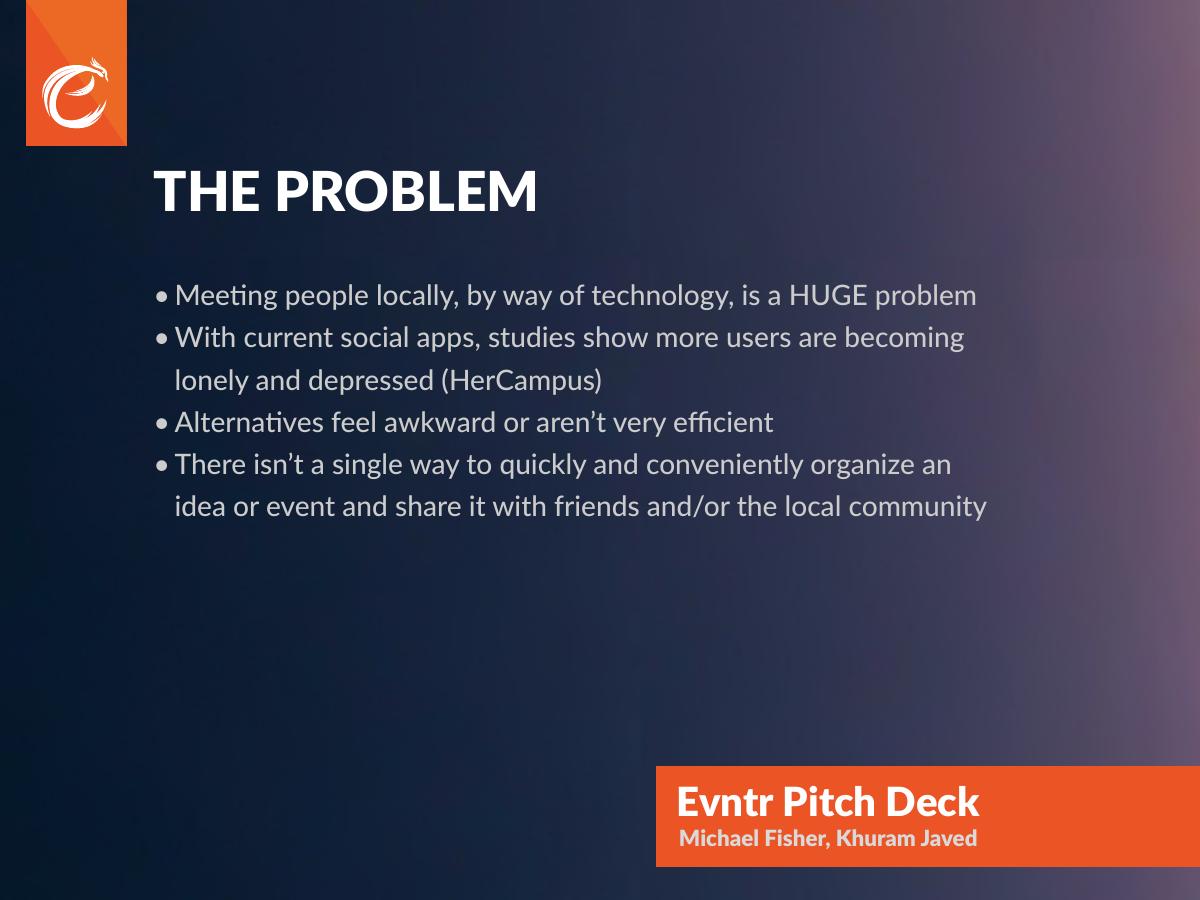
Evntr deck, slide 4. Exact stored slide matched to this analysis.
Our analysis: It says why current apps fail and what's missing, but gives no number and a weak source.
Evidence and limitation: One cited claim; no figures.
What a founder can adapt: Lead with the gap; support it with a figure from a named study.
Supporting analysis
What the deck claims: "The Problem." "Meeting people locally, by way of technology, is a HUGE problem." "With current social apps, studies show more users are becoming lonely and depressed (HerCampus)." "Alternatives feel awkward or aren't very efficient." "There isn't a single way to quickly and conveniently organize an idea or event and share it with friends and/or the local community."
Presentation choice: The last bullet ("no single way to organize...") is the real gap the product fills.
When it does not fit: "HUGE" in capitals doesn't replace a number.
Dating app built on real-time photos. Three problem–answer pairs under a close-up photo.
Raw deck, slide 3. Exact stored slide matched to this analysis.
Our analysis: Partial: it names real dating-app problems (scams, catfishing, ghosting), but mixes them with the answer and measures none.
Evidence and limitation: No figures.
What a founder can adapt: Give one pain its own slide with a figure, such as reported romance-scam losses.
Supporting analysis
What the deck claims: "Core focus on one feature, but solution for many pains." "Cut the fake, find rawmance: Raw is the only dating app that fixes common online dating problems like scams and catfishing." "Double camera. Not double standards: How? Daily photo updates and phone verification." "Love from the first back&front shot: No more boring content and ghosting. Raw's fresh, real-time approach paves the way for true connections and finding your new first love."
Presentation choice: Kept to show specific pains named in users' own words.
When it does not fit: Tiny type over a large photo.
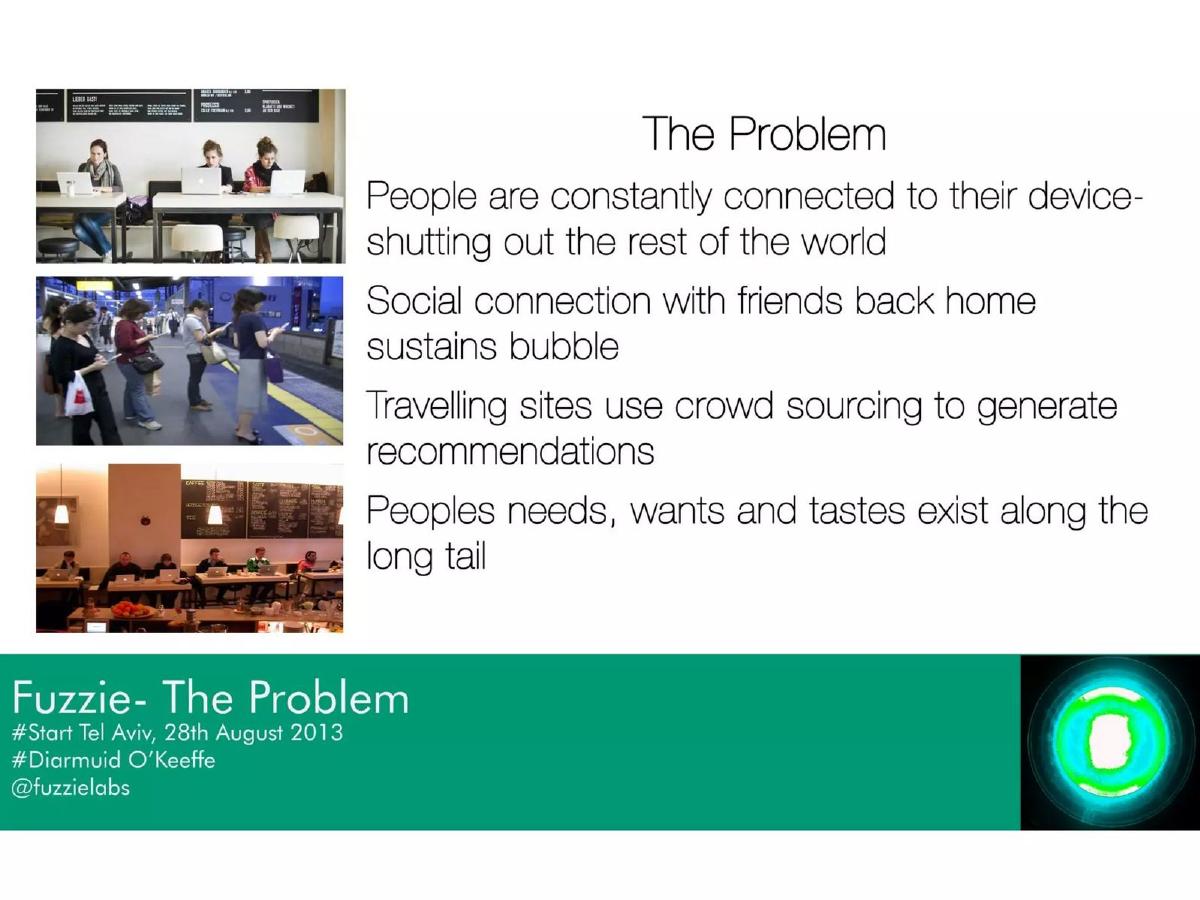
Location-based social app (2013). Four statements beside photos.
Fuzzie deck, slide 5. Exact stored slide matched to this analysis.
Our analysis: Partial: the first two lines describe a real problem; the last two are observations about other sites.
Evidence and limitation: No figures.
What a founder can adapt: Stop after the problem; move observations to the market slide.
Supporting analysis
What the deck claims: "The Problem." "People are constantly connected to their device—shutting out the rest of the world." "Social connection with friends back home sustains bubble." "Travelling sites use crowd sourcing to generate recommendations." "Peoples needs, wants and tastes exist along the long tail."
Presentation choice: Kept to show how a problem slide drifts into market observations.
When it does not fit: Four statements with no single user.
Jumparound deck, slide 3. Exact stored slide matched to this analysis.
Our analysis: Partial: a memorable phrase ("the three As"), but no user, no measure and lots of empty space.
Evidence and limitation: No figures.
What a founder can adapt: Give each "A" one figure, such as hours a day on social apps.
Supporting analysis
What the deck claims: "Why we do what we do - Problems." "What current social network have triggered: The three As: Anonymity – Addiction – Alienation -> Virtual life."
Presentation choice: Kept to show a strong phrase that needs evidence behind it.
When it does not fit: A slogan in place of a problem.
Whether each slide names who is affected, measures it with a source, and says why today's apps fail.
Example
Who
Measured and sourced
Why apps fail
Queerie
Yes (queer adults)
Yes (three sources)
No
Clyx
Yes (Gen Z)
Yes (Harvard, Surgeon General)
Partly (no local tools)
Tagzidy
Yes (event-goers)
No
Partly
Evntr
Partly
Partly (one weak source)
Yes
Raw
Partly (daters)
No
Yes (scams, catfishing)
Fuzzie
Partly
No
Partly
Jumparound
No
No
Partly (slogan)
Datelytics
No
No
No
Key Takeaways
Name one group: queer adults, Gen Z remote workers, people new to a city, event-goers.
Measure it: loneliness rates, time spent, share who lost touch with friends.
Cite each study by name; loneliness claims are easy to doubt.
Say why today's apps fail them: fakes, addiction, no local focus.
A question as a headline needs an answer on the same slide.
Build your social app problem slide
One group, a cited figure, why today's apps fail.
Who. Which group: age, identity, situation (new city, remote work)?
Figure. Loneliness rate, time spent, scam losses, with a named study.
Why apps fail. Fakes, addiction, no local focus, too public?
Moment. When does the user feel it most?
Copyable framework: [Figure] of [group] [problem] ([source]). Today's apps [why they fail].
Illustrative example 1 — written by us
Before: What's the problem with dating apps?
After: About 1 in 3 users of our survey had matched with a fake profile in the past year (survey of 800 app users); most apps verify a phone number once and never again.
What improved: Our illustrative rewrite; the figures are invented for the example. It names the group, a sourced figure and why apps fail.
What this guide adds
No other guide in the library covers social, community or dating apps. None of these eight slides appears elsewhere; the consumer solution guide uses Evntr slide 5, not its problem slide.
Social-app problems usually fall into two kinds: people who are lonely or cut off (Queerie, Clyx, Fuzzie), and people poorly served by existing apps (Raw, Evntr, Jumparound, Tagzidy).
Three things a social app problem slide proves
Who: "14 million queer adults in the U.S." (Queerie), "Gen Z" with remote work (Clyx), people at "a party, meet-up or event" (Tagzidy).
Why today's apps fail: "scams and catfishing" (Raw), "more users are becoming lonely and depressed" (Evntr), "Anonymity – Addiction – Alienation" (Jumparound).
Common mistakes
A question with no answer. Answer it on the slide.
Loneliness without a source. Name the study.
A slogan in place of a problem. Back it with a figure.
Market observations on the problem slide. Move them to the market slide.
No single group. Pick who feels it most.
Diagnostic checklist
It names one group.
It gives one figure with a named source.
It says why today's apps fail them.
It stays on the problem, not the product.
No unanswered headline question.
Frequently asked questions
How we chose these examples
Corpus: published pitch deck teardowns on StartupFundraising.com. Founder-uploaded private decks are excluded.
Selection (2026-09-25): we searched slides 2–5 for problem slides mentioning dating, loneliness, friends, social networks, meeting people or community. Alloy slide 5 was left out as a health-community deck (another Alloy slide is in the healthcare problem guide); betting and game decks were left out. Raw, Fuzzie and Jumparound are marked partial; Datelytics is kept as a weaker contrast.
Overlap check: none of these eight slides appears in another guide. The consumer solution guide uses Evntr slide 5; this guide uses Evntr slide 4.
Review: all eight stored slide images were inspected on 2026-09-25 and matched to company, deck and slide number (editorial model review). No person has yet completed an editorial review of this page.
Claims are as shown on the slides; we have not verified them. We make no claim that any slide caused a fundraising outcome. This page discusses loneliness, depression and suicide statistics as they appear on the slides; it is not health advice.