Clyx’s 22-slide deck positions the company as the antidote to the 'loneliness epidemic' exacerbated by remote work and globalization. By focusing on real-life (IRL) events rather than digital-only interaction, Clyx claims a Day 7 retention rate of 49.8%, significantly outperforming dating incumbents like Tinder and Bumble. The deck highlights a successful geographic expansion from Miami to London, where they reached over 32,000 downloads by Q3 2024. Monetization is diversified across advertising, in-app purchases, and ticketing, supported by high-profile case studies like a partnership with S…
Key takeaways
- Clyx reports a Day 7 retention rate of 49.8%, which they contrast against Tinder's 7.8% and Bumble's 12.3% on Slide 9.
- The company utilizes AI to aggregate city-wide events, ranging from yoga classes to gallery openings, to facilitate IRL connections (Slide 6).
- Growth in London accelerated through 'viral flagship events' like 'Hot Girl Walk,' reaching 32,811 total downloads by Q3 2024 (Slide 14).
- A partnership with Sony for the film 'Fly Me To The Moon' resulted in 100% of allocated tickets being sold within two minutes of an in-app promotion (Slide 23).
- The platform integrates Stripe to allow hosts to ticket events in under a minute, positioning itself as a social-first alternative to Eventbrite (Slide 26).
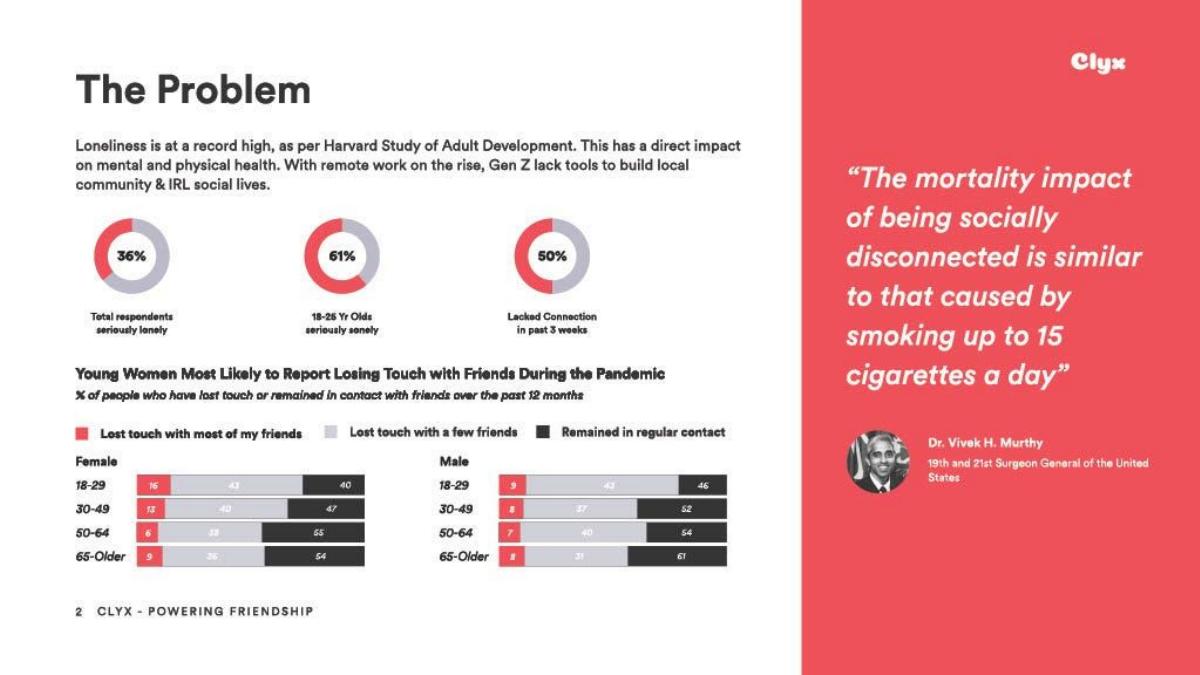
- Clyx frames its market necessity around the Harvard Study of Adult Development, citing record-high loneliness among Gen Z (Slide 3).
- The deck omits a specific 'Ask' slide detailing the exact valuation or breakdown of the $14M raise reported by Business Insider.
- Engagement metrics in London include 1.5M events viewed and 3M chats read, suggesting high depth of use per download (Slide 14).
Clyx: The Social Antidote to Digital Isolation
Clyx enters the crowded social media landscape not by promising more screen time, but by facilitating the exit from it. Their 22-slide Series A deck, which helped secure $14M in 2024, is a masterclass in framing a consumer app as a public health necessity. By anchoring the 'Problem' in the loneliness epidemic and the 'Solution' in AI-powered IRL (in real life) discovery, Clyx positions itself as the next evolution of social networking—one that prioritizes physical presence over digital scrolling.
Slides 1-5: The Macro Problem and the Loneliness Epidemic
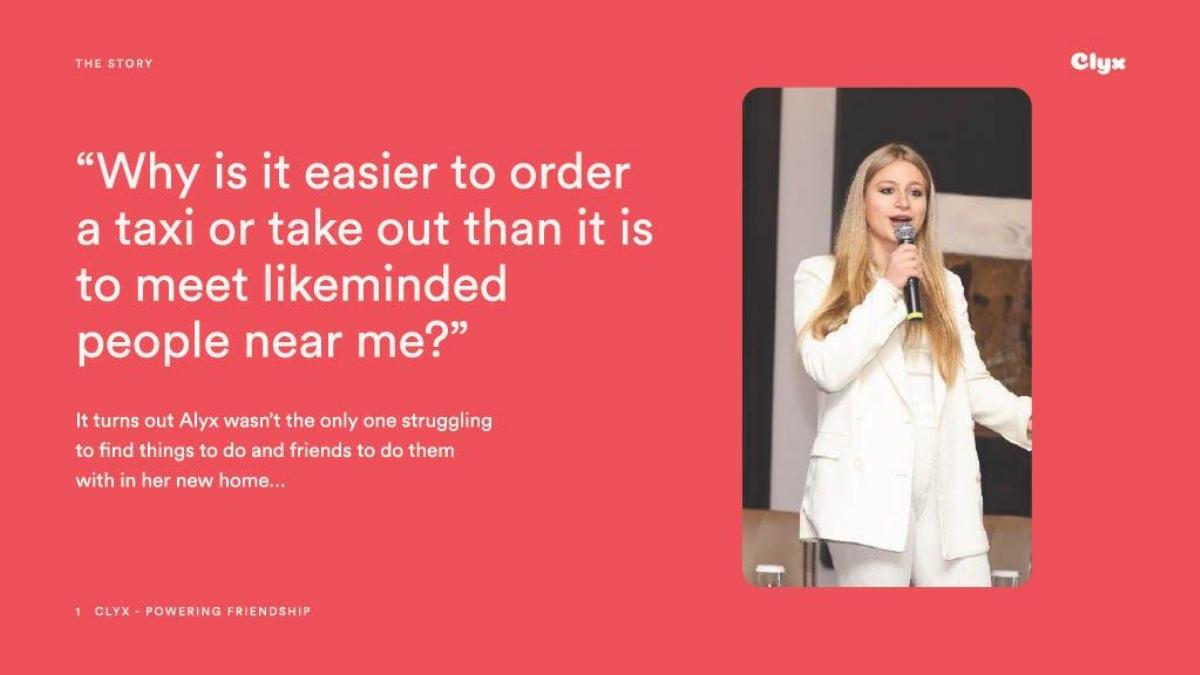
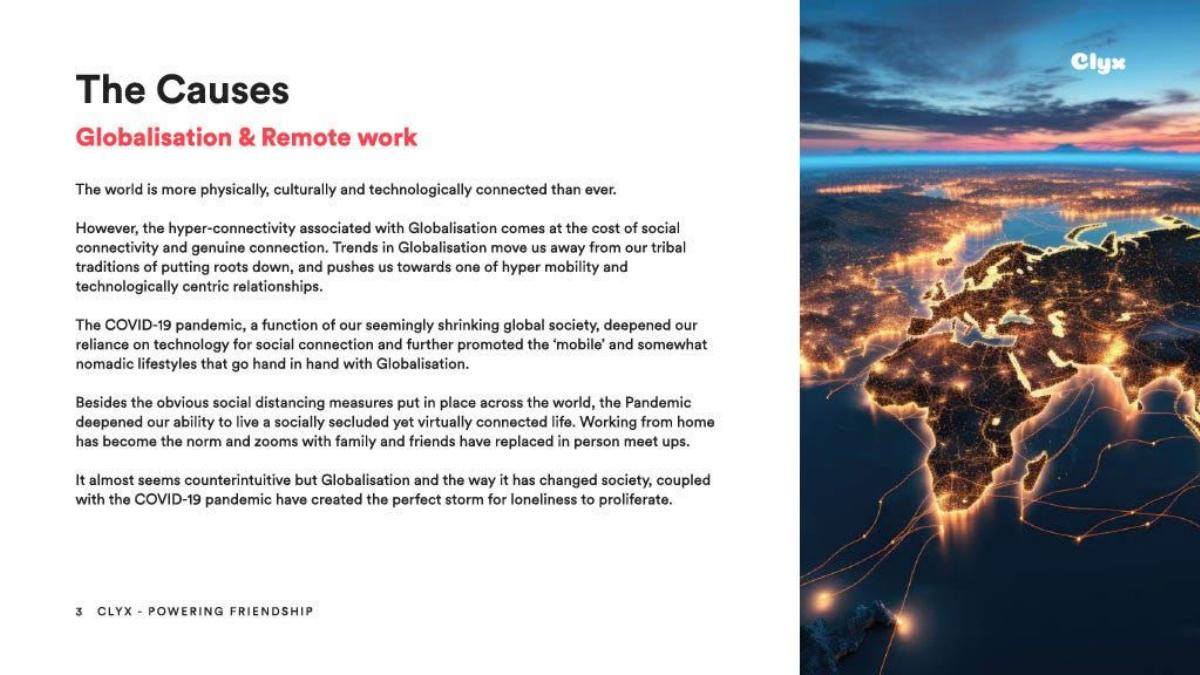
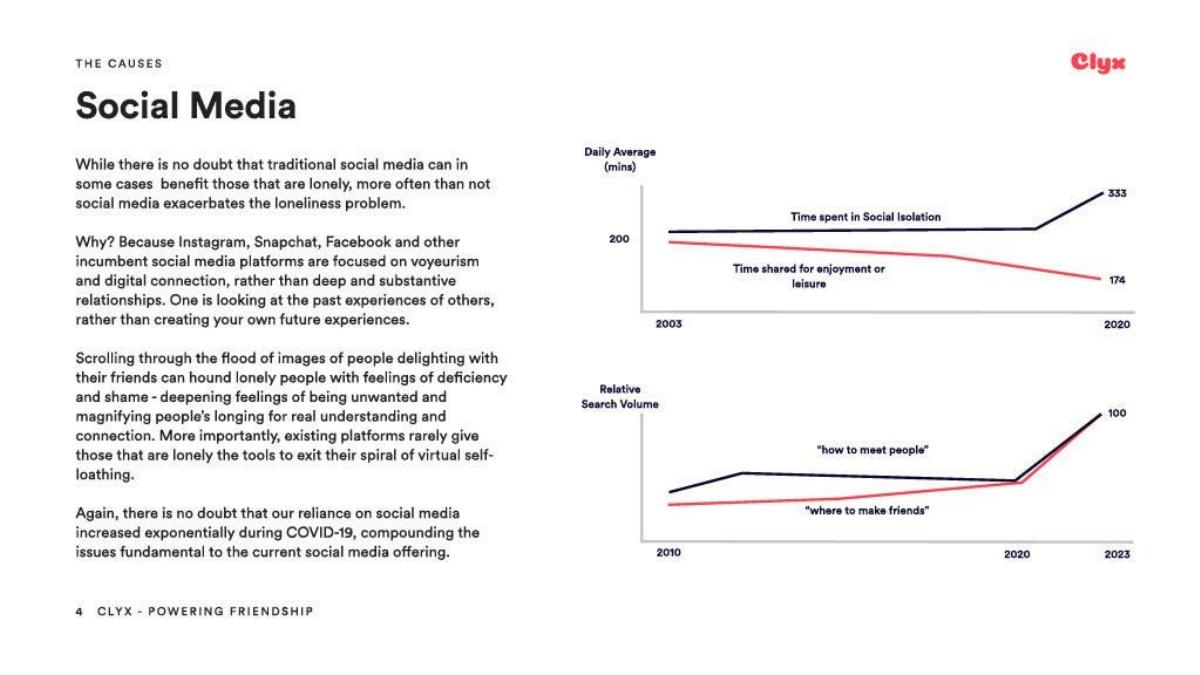
The deck opens with a mission statement: "A life lived with genuine friendships." This immediately signals that Clyx is not a utility for event discovery alone, but a brand centered on emotional well-being. Slide 2 introduces a personal narrative about the founder, Alyx, struggling to find community in a new home, which transitions into Slide 3's broader data. By citing the Harvard Study of Adult Development, Clyx validates the 'Loneliness Epidemic' as a massive, underserved market opportunity. Slide 4 and 5 connect this problem to the 'hyper-connectivity' of globalization and remote work, arguing that while we are more connected technologically, we are more isolated socially. This is a classic 'Why Now?' argument, leveraging the post-pandemic shift toward remote work as a permanent tailwind for their business model.
Slides 6-9: The Product and AI Integration
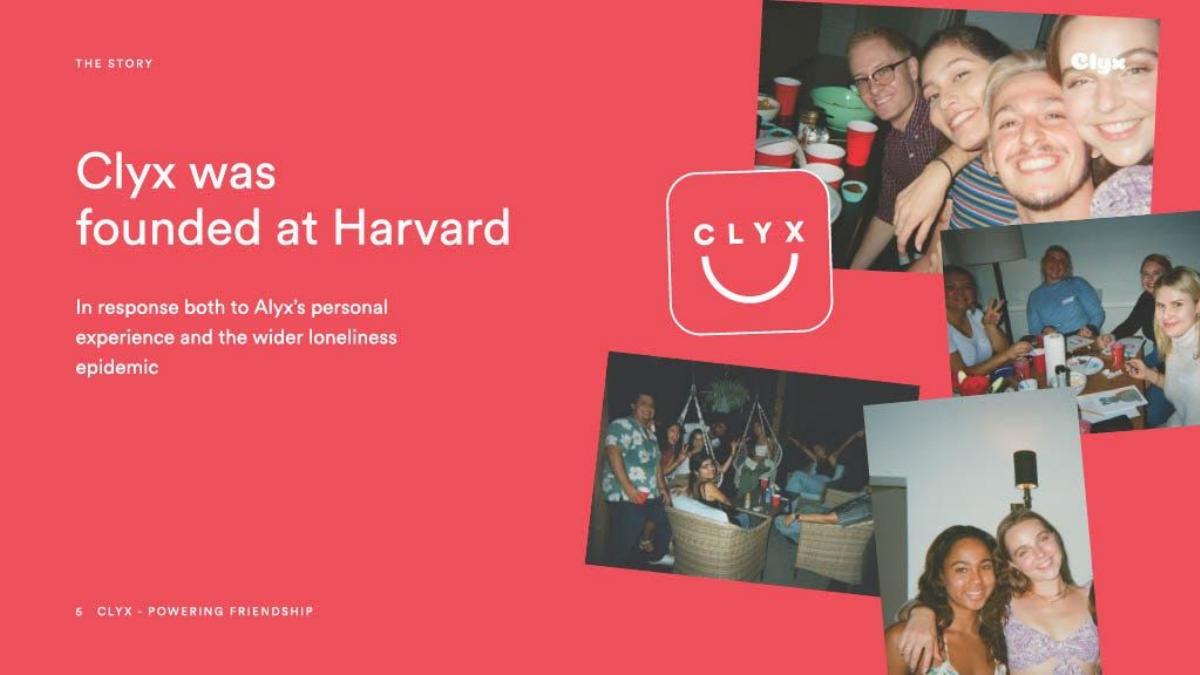
Slide 6 details the company's origin at Harvard, providing a pedigree that investors often favor. The solution is presented in three pillars: recommending real-life events, suggesting new friendships, and empowering local communities. The technical 'moat' is introduced here: AI aggregation. Instead of relying solely on user-generated content, Clyx uses AI to scrape and organize city-wide events, ensuring the app is never 'empty' for new users. Slide 9 showcases the user interface, which mimics the high-fidelity, image-heavy aesthetic of modern social apps like Instagram, but with a clear call to action: "Join event."
Slides 10-14: Retention and Geographic Traction
Slide 9 (labeled as 10 in the sequence) contains the deck's most compelling data point: a Day 7 (D7) retention rate of 49.8%. In the consumer social space, where D7 retention often hovers between 15% and 25% for successful apps, nearly 50% is an outlier. Clyx explicitly compares itself to Tinder (7.8%) and Bumble (12.3%), arguing that because their app is about friendship and recurring community events, users don't 'churn' once they find a connection. Slides 12 through 14 focus on their two primary markets: Miami and London. The London data on Slide 14 is particularly strong, showing a climb from 1,190 downloads in Q2 2023 to 32,811 in Q3 2024. The inclusion of 'App Sessions' (408,950) and 'Chats Read' (3M) suggests that the user base is not just downloading the app, but actively using it to communicate and plan.
Slides 15-19: Diversified Monetization
Clyx avoids the trap of relying solely on a single revenue stream. Slide 15 introduces their four-pronged approach: Advertising, In-app purchases, Ticketing, and Lagniappe advertising. Slide 23 (part of the Monetization section) provides a concrete case study with Sony. To promote the film 'Fly Me To The Moon,' Sony used Clyx to fill a VIP screening in Miami. The results were impressive: 100% of tickets were allocated within two minutes, and the campaign generated nearly 13,000 event impressions. This slide proves that Clyx has a 'high-intent' audience that brands are willing to pay to reach. Slide 26 focuses on Ticketing, showing a Stripe integration that allows local hosts to monetize their own events. By taking a fee on these transactions, Clyx positions itself as a social-first competitor to Eventbrite.
Slides 20-22: Team and Closing
The deck concludes with the team and investor slides. While the specific names are not listed in the summary, the 'Tech Investors' slide (Slide 21) serves to provide social proof and validation from the venture capital community. The final slide returns to the brand logo, reinforcing the 'Genuine Friendships' tagline. Notably, the deck does not include a slide for 'Unit Economics' (LTV/CAC) or a detailed 'Financial Projection' for the next 3-5 years, which is common in Series A decks that are still in the 'land grab' phase of growth.
What Works in the Clyx Deck
The Retention Comparison: The bar chart on Slide 9 is the 'hero' of the deck. By benchmarking against household names like Tinder and Bumble, Clyx makes a data-driven argument that their product category (friendship/events) is fundamentally stickier than dating. This addresses the primary concern investors have with consumer social: churn.
The 'Viral Flagship' Strategy: Slide 14 explains how they grow, not just that they are growing. Mentioning specific events like 'Hot Girl Walk' shows that the founders understand the cultural zeitgeist and how to manufacture virality at the local level. This gives investors confidence that the team can replicate their success in new cities.
High-Stakes Case Studies: The Sony partnership on Slide 23 is a powerful proof of concept. It moves the conversation from 'we might make money' to 'we have already delivered results for a Fortune 500 company.' The timeline showing tickets selling out in two minutes is a visceral metric for demand.
What is Missing from the Clyx Deck
Unit Economics: While retention is high, there is no mention of Customer Acquisition Cost (CAC). For a consumer app raising $14M, investors usually want to see how much it costs to 'buy' a user in London versus Miami and how long it takes to recoup that cost through their various monetization channels.
The 'Ask' Slide: The deck does not explicitly state how much they are raising or what the specific milestones for the next 18 months are. While this information is often shared in a separate document or during the pitch, its absence in the deck leaves the 'roadmap' feeling slightly vague.
Competitive Landscape: Aside from the retention comparison with dating apps, there is no slide addressing direct competitors like Meetup, Eventbrite, or newer entrants in the 'Gen Z social' space. Acknowledging the competition and explaining why Clyx's AI-first approach is superior would strengthen the 'Moat' argument.
Founder's Playbook: What to Copy
Use Macro Trends to Create Urgency: Clyx doesn't just say they have a cool app; they say they are solving a mental health crisis. Founders should look for academic studies or global trends (like the Harvard study cited on Slide 3) to frame their product as a necessary solution to a systemic problem.
Show, Don't Just Tell, the Product: The use of high-quality mockups on Slide 6 and Slide 26 allows investors to visualize the user journey. The Stripe integration screens are particularly effective because they show how easy it is for a user to become a 'customer' or a 'host.'
Focus on 'Depth' Metrics: Instead of just showing 'Total Users,' Clyx shows 'Chats Read' and 'Events Viewed.' For social apps, these engagement metrics are often more indicative of long-term success than raw download numbers. Founders should identify the 'North Star' metric that proves their users are actually getting value from the platform.
Frequently asked questions
- How does Clyx differentiate itself from dating apps?
- Clyx focuses on platonic, group-based IRL events rather than one-on-one romantic matching. According to Slide 9, this focus leads to significantly higher retention, as users engage with communities and recurring events rather than 'winning' the game by finding a partner and leaving the app.
- What is the primary growth engine for Clyx?
- Clyx relies on hyper-local community building and viral event programming. Slide 14 notes that they learned 'growth hacks' in London by starting with flagship events like 'Hot Girl Walk' and 'Hot Girl Wine Night,' which drove rapid adoption among students and young professionals.
- How does the app generate revenue?
- Monetization is split into four pillars: advertising (brand partnerships), in-app purchases, ticketing fees, and 'Lagniappe' advertising. Slide 26 specifically highlights their end-to-end ticketing solution that uses Stripe to facilitate quick event monetization for local hosts.
- What role does AI play in the product?
- As stated on Slide 6, Clyx uses AI to aggregate all events happening in a city. This reduces the friction of discovery by pulling in diverse activities like yoga, concerts, and gallery openings into a single feed, which are then recommended to users based on their social circles.
- Who are the investors behind Clyx?
- While Slide 21 is titled 'Tech Investors,' the specific names are not detailed in the provided text. However, publisher reports indicate the company successfully raised $14M in a Series A round in 2024 to fuel further expansion.