ClubApp’s 2016 investor deck outlines a strategic evolution from a niche utility for live sports updates into a comprehensive 'Communications & Commerce Platform.' The company anchors its value proposition in high-engagement metrics, reporting an 89.1% returning user rate and over 6 million page views (Slide 4). The narrative is heavily supported by institutional validation, specifically its participation in the MasterCard Start Path accelerator and a partnership with the England Schools FA (Slide 5). While the deck excels at demonstrating product-market fit through usage data and strategic a…
Key takeaways
- The platform identifies 'Live Scoring' as its core value proposition to drive user engagement (Slide 1).
- ClubApp reports high user retention with 89.1% of its 164,000 unique users returning to the platform (Slide 4).
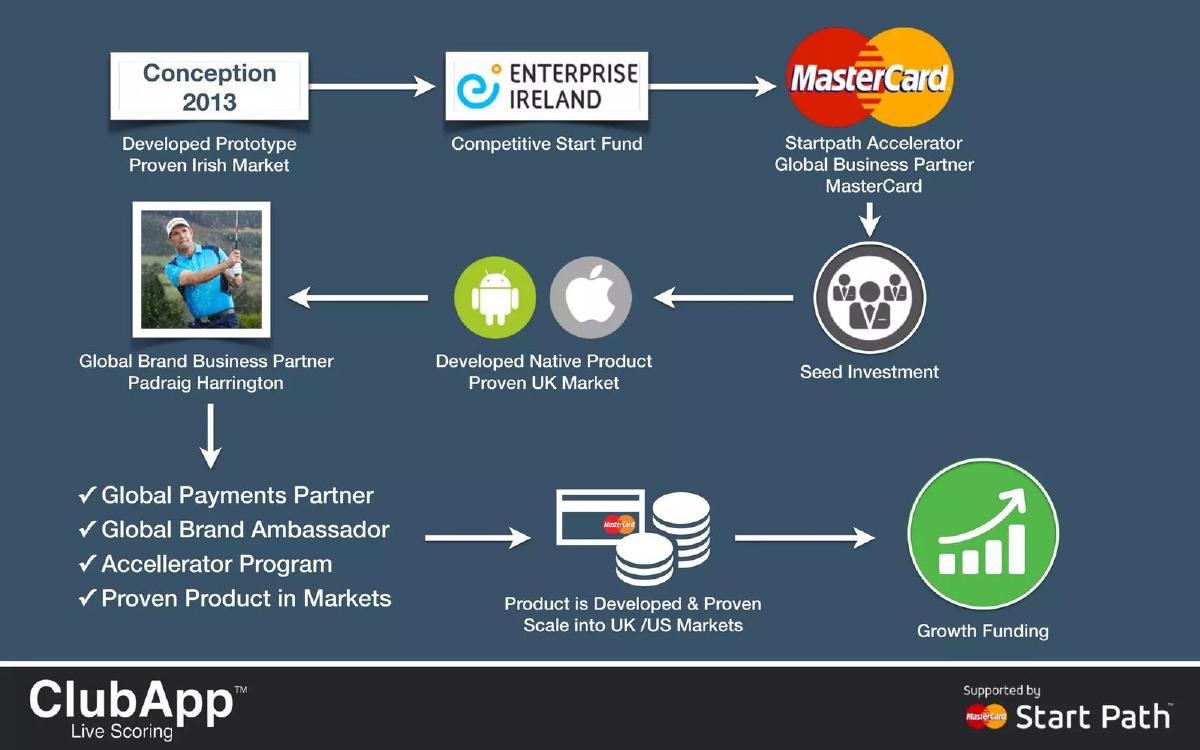
- The company has secured significant institutional backing from Enterprise Ireland and the MasterCard Start Path accelerator (Slide 3).
- Strategic partnerships are a central pillar of their growth, including being the Official Live Scoring Partner for the England Schools FA (Slide 5).
- The UK market opportunity is quantified at 151,000 sports clubs with an average subscription spend of £146 (Slide 6).
- The US market strategy focuses on high-participation school sports, led by Football with over 1 million participants (Slide 7).
- The business model extends beyond utility into commerce, offering integrated 'Club Stores' for merchandise and ticket sales (Slide 8).
- The deck omits a specific funding 'Ask' amount and detailed financial forecasts for the growth stage.
Executive Summary: The Utility-to-Platform Play
ClubApp’s 2016 investor deck is a study in using a high-frequency utility—live sports scoring—to capture a specific demographic before layering on a commerce engine. The deck positions the company not just as a sports app, but as a "Communications & Commerce Platform." By focusing on the amateur sports niche, ClubApp targets a massive, fragmented market that lacks the sophisticated digital infrastructure found in professional leagues. The presence of the MasterCard Start Path logo on every slide serves as a constant reminder of the company's fintech aspirations and institutional credibility.
Slide 1: Title and Core Value
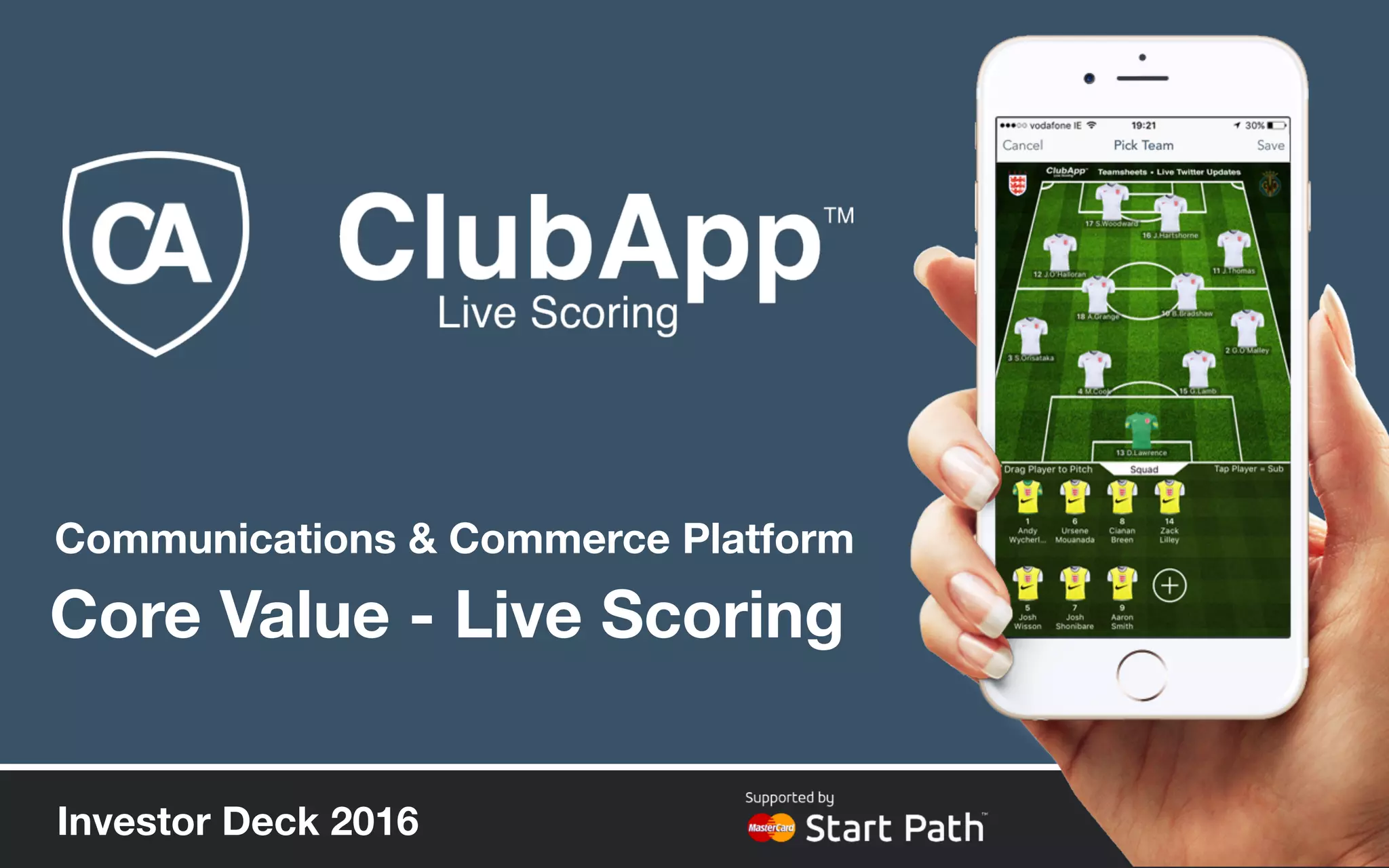
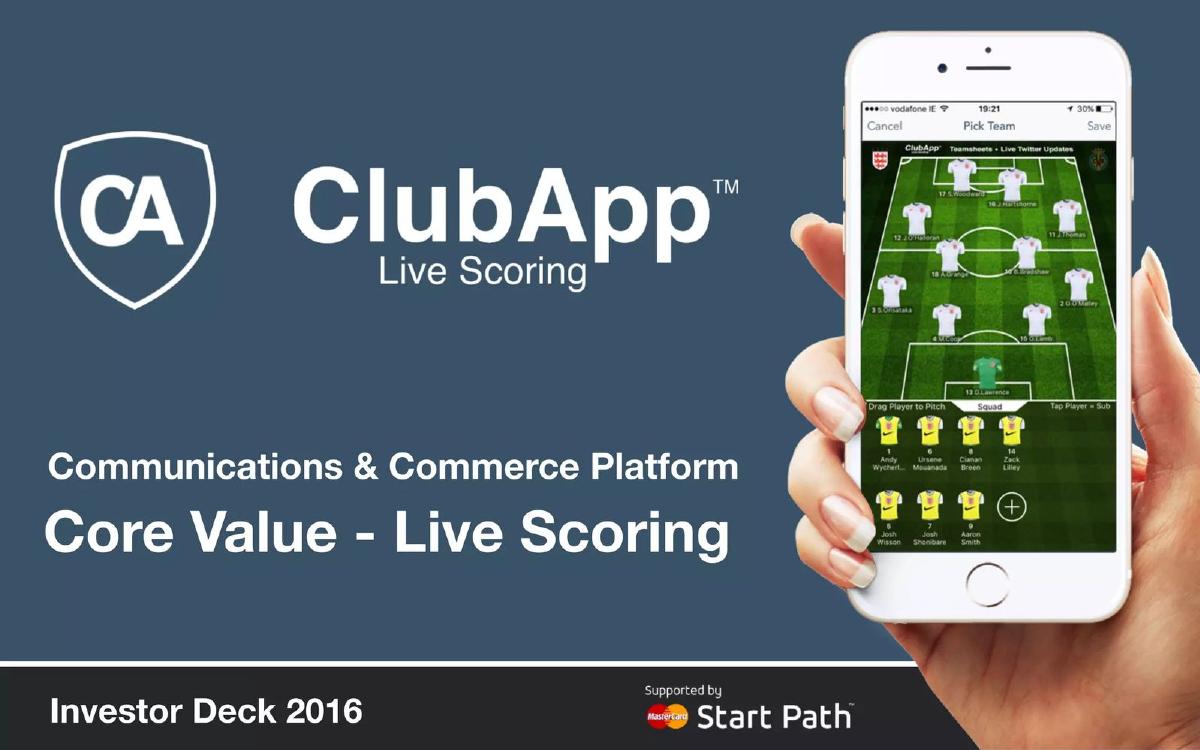
The cover slide immediately identifies the company's primary hook: "Live Scoring." It categorizes the business as a "Communications & Commerce Platform." The visual of a smartphone displaying a tactical football lineup and squad management interface reinforces that this is a mobile-first product. The inclusion of the "Supported by MasterCard Start Path" branding at the bottom is a strategic move to establish trust from the first second of the presentation.
Slide 2: The Value Proposition for Clubs
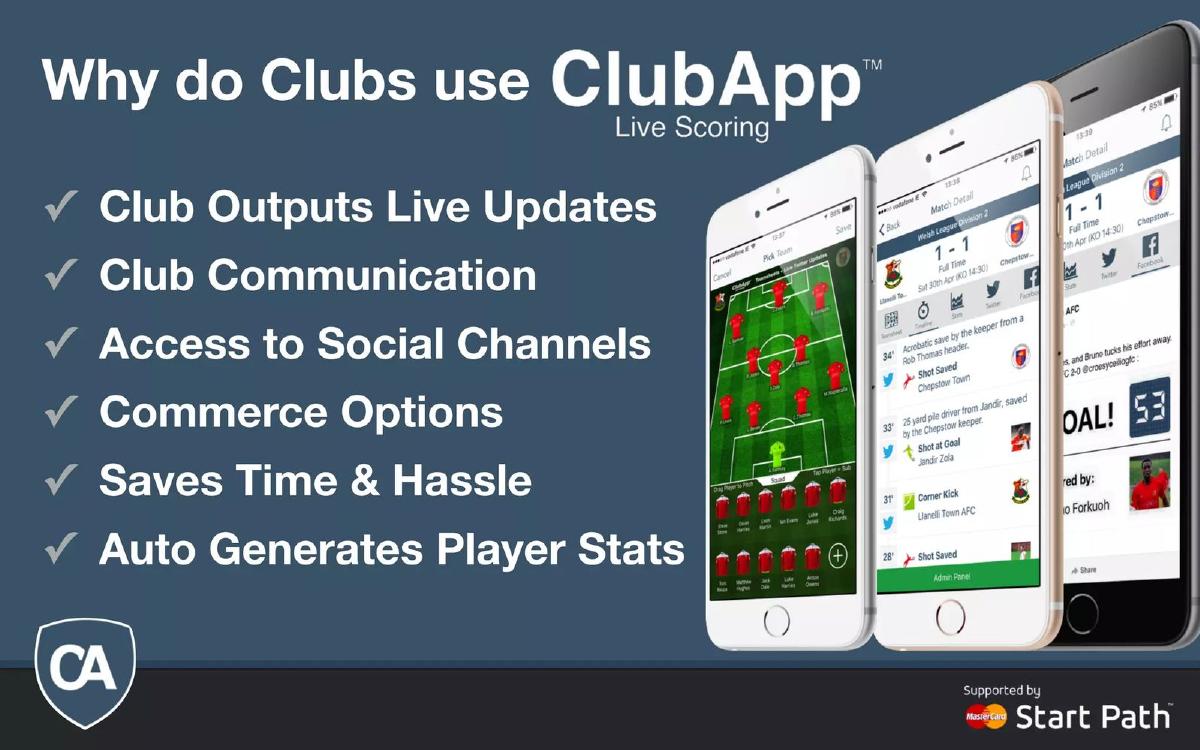
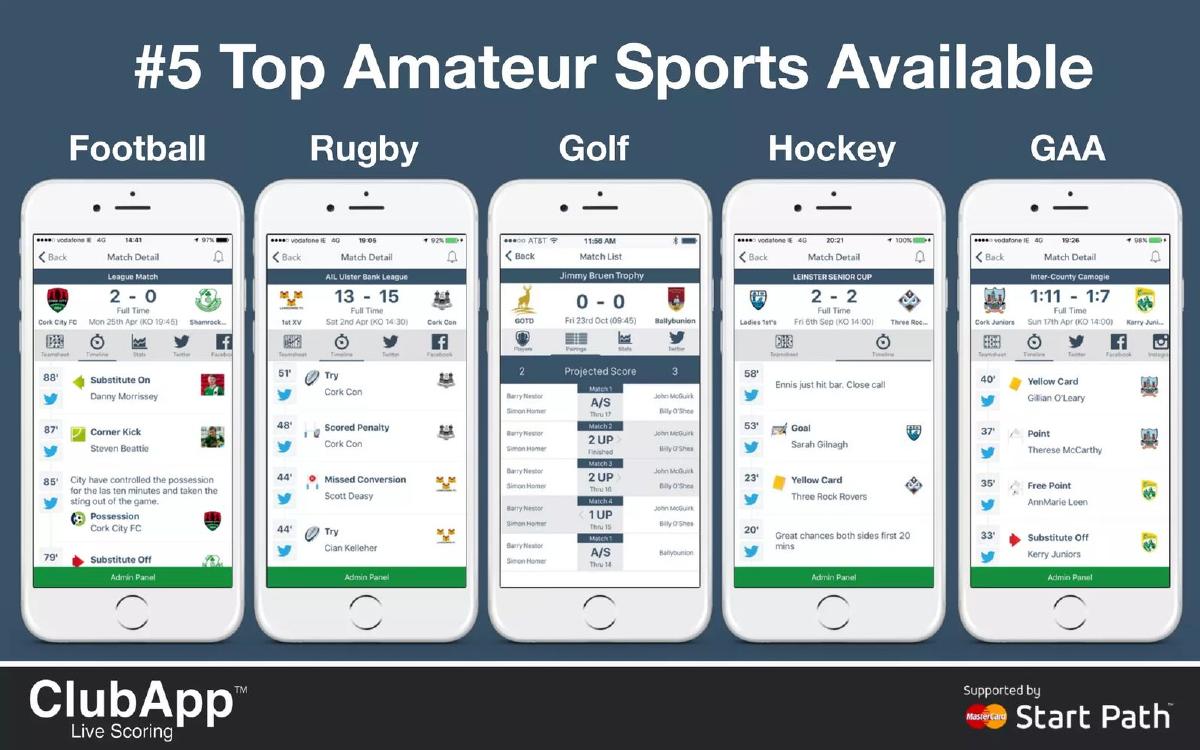
This slide answers the "Why?" for the B2B side of the marketplace. It lists six key benefits for sports clubs: live updates, communication, social channel access, commerce options, time-saving, and automated player stats. The visual shows the app's interface across multiple screens, demonstrating a timeline of match events and social media integration. This slide effectively argues that the app replaces multiple manual processes with a single automated solution.
Slide 3: The Roadmap and Validation
Slide 3 provides a chronological history of the company, starting from its "Conception 2013." It highlights three major milestones of validation: funding from Enterprise Ireland, participation in the MasterCard Start Path accelerator, and a seed investment. It also mentions the recruitment of Padraig Harrington as a "Global Brand Business Partner." The slide concludes with a transition toward "Growth Funding," intended to scale the "Proven Product" into the UK and US markets. This is the closest the deck gets to an 'Ask' slide, though it lacks a dollar figure.
Slide 4: Traction and Global Reach
This is arguably the strongest slide in the deck. It uses a world map to show that ClubApp has been visited from 152 countries. The metrics are impressive for a niche sports app: over 6 million page views, 1.5 million user visits, and 164,000 unique users. The most critical data point is the "89.1% Returning Users," which suggests a highly addictive product or a very loyal user base that relies on the app for recurring weekly match updates.
Slide 5: Strategic Partnership - England Schools FA
To prove their ability to capture entire ecosystems, the founders highlight their partnership with the England Schools FA (ESFA). ClubApp is the "Official Live Scoring Partner" and is "Recommended to Member Schools." This slide demonstrates a low-cost acquisition strategy: by partnering with a governing body, they gain top-down access to thousands of individual teams and their respective fanbases.
Slide 6: The UK Market Opportunity
The deck shifts to market sizing, focusing on the UK. It cites 24 million members of sports clubs and 151,000 total clubs. The most interesting figure here is the "£146 Average Subscription Spend." This provides a baseline for their SaaS revenue potential. By multiplying the number of clubs by the average spend, the deck implies a significant Total Addressable Market (TAM) without explicitly stating the final number.
Slide 7: US Market Expansion
The US market slide uses a bar chart to rank sports by participation and number of schools. Football leads with over 1 million participants across 14,154 schools, followed by basketball and soccer. This slide signals to investors that the company has a clear target list for international expansion, focusing on high-volume school sports where live scoring and parent/fan communication are in high demand.
Slide 8: The Commerce Engine - Club Stores
Slide 8 moves beyond the utility of scoring and into the "Commerce" part of their title slide. It introduces "Club Stores," which allow teams to sell replica kits (e.g., a "2015 Home Kit" for €39.99) and match tickets directly through the app. By integrating payments (likely via their MasterCard partnership), ClubApp positions itself to take a percentage of every transaction within the amateur sports economy, significantly increasing the potential Lifetime Value (LTV) of each club beyond a simple subscription fee.
Slide 9: The Founders
The final slide introduces the co-founders, Greg Coleman and Barry Nestor. While it provides their photos and direct contact information (phone and email), it is notably thin on professional background. There are no mentions of previous successful exits, specific technical expertise, or years of experience in the sports or fintech sectors. In a professional investor deck, this is a missed opportunity to build "founder-market fit."
What ClubApp Does Well
Institutional Credibility: The deck leans heavily on its associations with MasterCard and Enterprise Ireland. For a startup in the payments and commerce space, this third-party validation is essential for overcoming the trust barrier with investors and potential club partners.
Engagement Metrics: Highlighting the 89.1% returning user rate is a masterstroke. It proves that the "Live Scoring" feature isn't just a gimmick but a core utility that users return to repeatedly. This high retention is the foundation upon which they can build their commerce platform.
Clear Product Utility: The screenshots are clear and professional. An investor can immediately understand what the app does—it tracks scores, manages squads, and sells gear. There is no ambiguity about the product's function.
What is Missing from the Deck
The Financials: There are no historical revenue figures or future projections. While the deck mentions an average subscription spend in the UK, it doesn't state how much revenue ClubApp is actually generating or what their burn rate looks like.
The Competitive Landscape: The deck operates as if ClubApp is the only player in the space. In 2016, there were numerous team management and scoring apps. Failing to address competitors like TeamSnap or GameChanger leaves a gap in the strategic narrative.
The Ask: A pitch deck is a tool to raise money. By failing to specify how much capital they are seeking and exactly how that capital will be deployed (e.g., "Hiring 5 developers," "Marketing spend for US launch"), the founders miss the chance to set the terms of the conversation.
Lessons for Founders
Use a 'Trojan Horse' Strategy: ClubApp shows how a simple, free utility (scoring) can be used to capture a user base that can later be monetized through more complex features (commerce and payments). · Leverage Partnerships for Credibility: If you are in an accelerator or have a major corporate partner, put their logo on every slide. It acts as a continuous subconscious endorsement. · Quantify the Market with Specifics: Instead of just saying "the market is big," ClubApp provides specific numbers for clubs, members, and average spend. This makes their projections feel grounded in reality. · Don't Forget the Team's 'Why': A team slide should do more than provide a phone number. It should explain why these specific founders are the only ones capable of winning this market. Include past wins and relevant industry experience.
Frequently asked questions
- What is the primary problem ClubApp is solving?
- While not explicitly stated in a 'Problem' slide, the deck implies that sports clubs struggle with efficient communication, live data generation, and commerce. Slide 2 notes that the app 'Saves Time & Hassle' by auto-generating player stats and providing a single channel for live updates, social media integration, and commerce options that were previously fragmented for amateur clubs.
- How does ClubApp plan to generate revenue?
- The deck highlights two primary revenue paths: subscriptions and commerce. Slide 6 mentions an average subscription spend of £146 per club in the UK. Slide 8 introduces 'Club Stores,' which allow clubs to sell replica kits and match tickets through the app, suggesting a transaction-based or commission-based revenue model supported by their partnership with MasterCard.
- What level of traction had the company achieved by 2016?
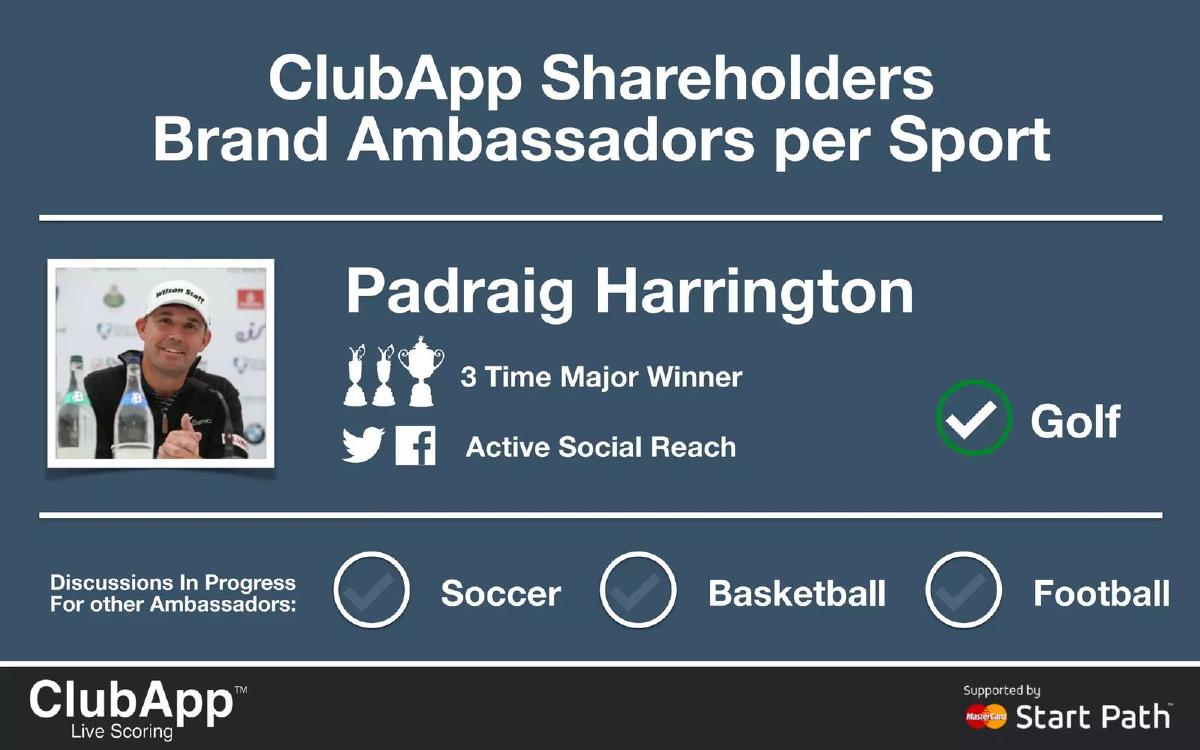
- ClubApp demonstrated significant reach, claiming over 6 million page views and 1.5 million user visits from 152 countries (Slide 4). They also moved beyond the prototype phase, having proven the product in the Irish and UK markets and secured a global brand ambassador in professional golfer Padraig Harrington (Slide 3).
- Who are the key partners mentioned in the deck?
- The most prominent partner is MasterCard, via their Start Path accelerator, which is featured on every slide footer. Other key entities include Enterprise Ireland (which provided a Competitive Start Fund), the England Schools FA (ESFA), and professional golfer Padraig Harrington as a brand business partner (Slides 3 and 5).
- What is missing from this pitch deck?
- The deck is missing several critical components for a late-seed or Series A round. There is no slide detailing the competitive landscape, no breakdown of unit economics (CAC/LTV), and no clear financial roadmap. Most importantly, the deck ends without a specific 'Ask'—it mentions 'Growth Funding' on Slide 3 but does not specify the amount or the intended use of funds.