Clover Health’s 2021 pitch deck is a masterclass in institutional storytelling, designed to facilitate a $1.2B SPAC merger. The narrative centers on a massive market opportunity—10,000 people becoming Medicare-eligible daily—and a technological solution, the Clover Assistant. By positioning themselves as a tech-first insurer, Clover argues they can achieve a 25% market share in established counties while maintaining superior margins through data-driven clinical interventions. The deck successfully bridges the gap between complex healthcare economics and high-growth software metrics, though it…
Key takeaways
- The deck highlights a significant market tailwind, noting that 10,000+ new people become Medicare-eligible every day (Slide 31).
- Clover positions its proprietary software, Clover Assistant, as a combination of machine learning and an expert system to drive clinical decisions (Slide 20).
- The company demonstrates strong local traction, claiming a 25% market share in its established counties (Slide 24).
- Financial projections target 450,000 members by 2023, representing a massive scale-up from their 2020 baseline (Slide 48).
- The business model aims for a long-term Adjusted EBITDA margin of 6-7% through improved Medical Care Ratios (MCR) (Slide 34).
- The SPAC transaction overview details a $3.702 billion enterprise valuation based on 4.2x 2021E revenue (Slide 39).
- The team slide emphasizes deep industry and tech roots, featuring leadership from CarePoint Health, Google, and Flatiron Health (Slide 62).
- Clover addresses the high-risk nature of their patient base, stating that 68% of members have two or more chronic conditions (Slide 26).
The $1.2B SPAC Narrative: A Deep Dive into Clover Health
Clover Health’s pitch deck is not a typical startup presentation. As a document designed for a SPAC (Special Purpose Acquisition Company) merger, it carries the weight of public market scrutiny and regulatory requirements. Spanning 98 slides, the deck is a comprehensive look at how a technology-enabled insurance company plans to dismantle the incumbents in the Medicare Advantage (MA) space. The following teardown analyzes the key slides that secured $1.2B in funding.
The Macro Opportunity and Shareholder Returns
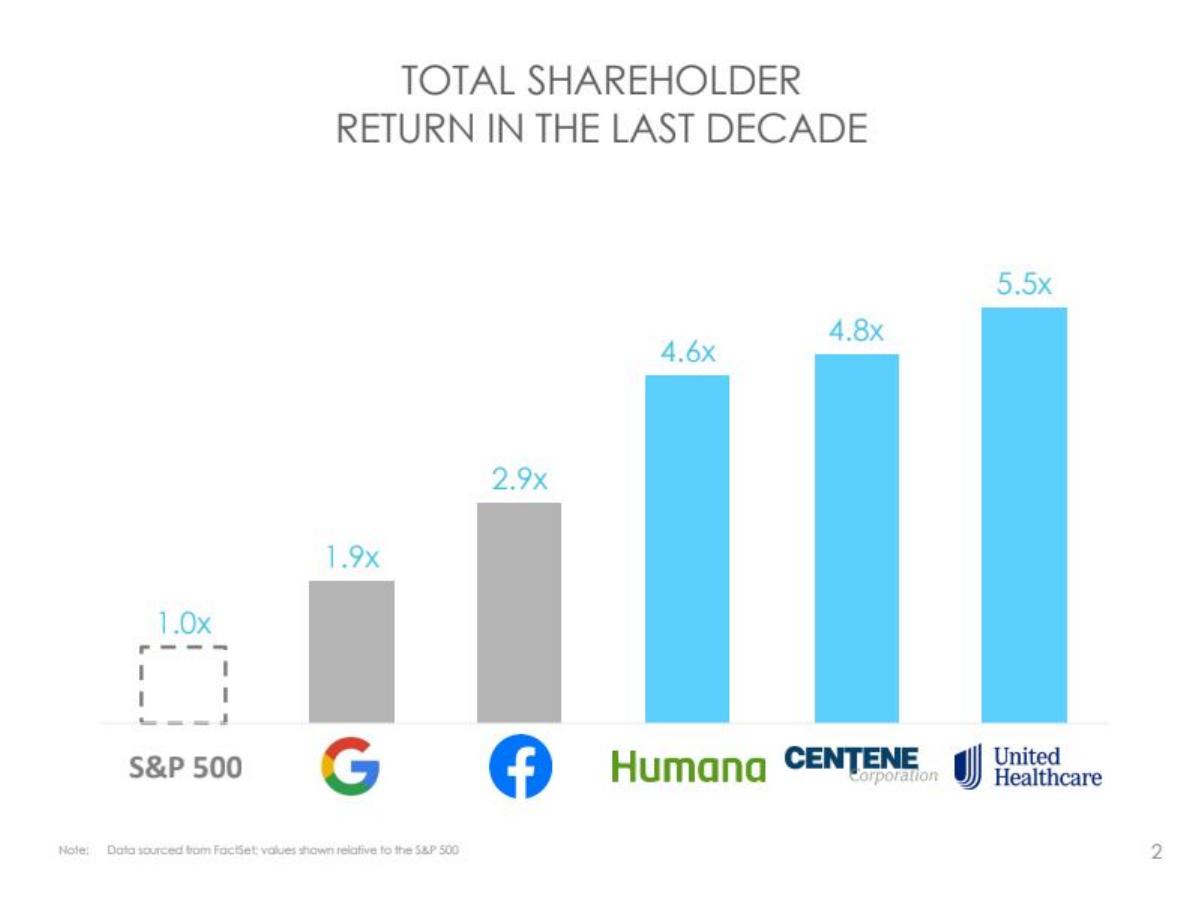
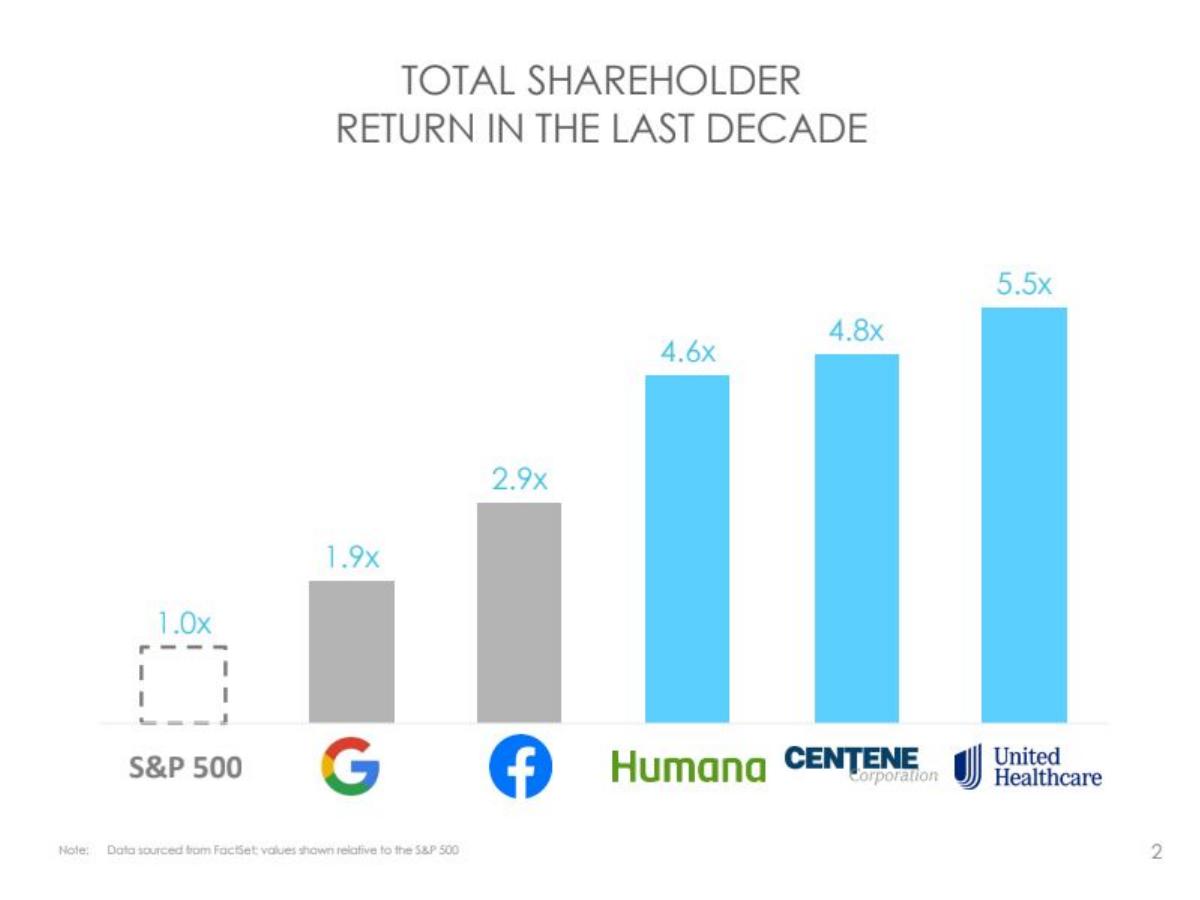
Slide 2: Total Shareholder Return in the Last Decade Clover opens with a powerful financial hook. Instead of starting with a problem statement, they show the massive returns generated by healthcare incumbents. The slide compares the S&P 500 (1.0x) against tech giants like Google (1.9x) and Facebook (2.9x), only to reveal that healthcare payers like United Healthcare (5.5x) and Centene (4.8x) have significantly outperformed the market. This sets the stage: healthcare insurance is a lucrative, high-performing sector ripe for a tech-driven challenger.
Slide 8: Once in a Generation Opportunity to Do the Right Thing This is a transition slide that pivots from financial returns to social mission. It frames the company’s entry into the market not just as a business move, but as a moral imperative to fix a broken system. This 'mission-driven' branding is a common trope in modern insurtech, designed to appeal to ESG-conscious investors.
Defining the Problem and the Clover Solution
Slide 4: Solving The Big Issues In US Healthcare Clover identifies two root causes for healthcare inefficiency: misaligned incentives and siloed data. They argue that by operating as a Medicare Advantage insurer, they can 'own' the data stack. The slide uses four icons to represent the symptoms of these issues: variability in care, demands on physicians, abysmal consumer experience, and wasteful spend. Their solution is a 'Consumer-Driven Marketplace' that leverages data to align these disparate interests.
Slide 9: A Fundamentally Different Approach To Insurance This slide introduces the 'Clover Assistant' as the central hub of their ecosystem. It depicts a diamond-shaped model where the software connects the Consumer Experience, the Physician Experience, and the US Healthcare System. The goal is to improve health outcomes while reducing the high-cost events that drive the majority of healthcare expenditures. It is a clear visual representation of their 'payer-provider partnership' model.
Slide 14: Average Life Expectancy To underscore the 'why now,' Clover points to a grim statistic: U.S. life expectancy (78.6) lags behind the OECD average (80.7). This slide serves as a reminder of the systemic failure Clover aims to address, providing a macro-level justification for their interventionist approach to insurance.
The Technology: Clover Assistant
Slide 19: The Clover Assistant Via Telehealth This slide provides a product screenshot, which is vital for a company claiming to be 'tech-first.' It shows the Clover Assistant interface, highlighting features like COVID-specific symptom prompts and embedded video functionality. The text notes their 'closed-loop system' allowed them to rapidly deploy these features, emphasizing agility—a trait usually lacking in traditional insurers.
Slide 20: Clover Assistant is a Combination of Machine Learning and an Expert System This is the technical 'secret sauce' slide. By defining the platform as both machine learning and an expert system, Clover is telling investors that their software doesn't just process data; it provides actionable, rule-based clinical guidance. This distinction is important for justifying their claim that the software can actually change physician behavior.
Market Dynamics and Traction
Slide 24: We Are In 34 Counties Representing 3.1mm Medicare Lives Clover demonstrates geographic focus. They report 57,000 members and a $664M FY20E Gross Premium Revenue. The most impressive metric here is the '25% Market Share in Established Markets.' This proves that their model is not just theoretical; in the counties where they have matured, they are capturing a quarter of the available market.
Slide 26: 80% Have 1+ Chronic Condition This slide defines the complexity of their patient population. With 68% of members having two or more chronic conditions, Clover is signaling that they are tackling the most expensive and difficult segment of the population. Their success depends entirely on their ability to manage these conditions through their software.
Slide 31: 10,000+ New People Become Eligible Everyday This is the 'TAM' (Total Addressable Market) slide. The aging US population provides a massive, built-in growth engine for Medicare Advantage. The sheer volume of new eligible seniors ensures that the market is expanding faster than most other insurance segments.
Slide 37: Market Share Growth Per County A simple line graph shows their market share climbing from roughly 15% in 2016 to 25% 'Today.' This consistent upward trajectory is meant to give investors confidence in their ability to replicate this growth as they expand into new territories.
Financials and Valuation
Slide 29: Financials (Transition) A high-quality image of a senior using a tablet introduces the financial section, reinforcing the 'tech-enabled senior' theme.
Slide 34: How We Achieve Enhanced Margins At Best-In-Class Growth This is arguably the most important slide for institutional investors. It breaks down the unit economics. They show 'Clover Assistant Returning Member MCR' dropping from 89% in 2019 to a projected 76% in 2022. As the MCR (Medical Care Ratio) drops, the Adjusted EBITDA margin improves. They target a long-term EBITDA margin of 6-7%. This slide connects their technology directly to their bottom line.
Slide 39: Transaction Overview This slide details the mechanics of the $1.2B raise. It lists the sources of funds: $828M from IPOC (the SPAC) and $400M from a PIPE (Private Investment in Public Equity). It sets the Pro Forma Enterprise Value at $3.702 billion. Notably, $500M of the uses is earmarked for 'Secondary proceeds,' meaning some early investors or employees are cashing out as part of the transaction.
Slide 48: 450K Members in 2023E A bold projection slide. Reaching 450,000 members would represent nearly 8x growth from their current 57,000 members. This is the 'hockey stick' projection that justifies the multi-billion dollar valuation.
Slide 54: Illustrative Valuation at Normalized Industry Economics Clover attempts to show that they are actually 'cheap' compared to incumbents. By projecting 589,000 total lives covered by 2023 and applying industry-standard revenue per member ($12,000) and profitability per member ($800), they argue their valuation is grounded in reality. This slide is a bridge between their current 'startup' phase and their future as a 'mature' insurer.
The Team and External Factors
Slide 62: Team The team slide features Vivek Garipalli (CEO and Founder) and Andrew Toy (President & CTO). The logos for CarePoint Health, Google, and Flatiron Health are prominently displayed, signaling a mix of deep healthcare operational experience and high-level tech pedigree. This 'bilingual' leadership (tech + healthcare) is presented as a competitive advantage.
Slide 44: COVID-19 Impact The deck addresses the elephant in the room. Clover notes that while they incurred costs for virus care, the overall reduction in healthcare utilization (due to deferred elective procedures) acted as a financial offset. They also highlight their 'nurse practitioner COVID-19 hotline' as a proactive member support tool.
What Clover Health Does Well
The Clover Health deck excels at contextualizing technology within a legacy industry . They don't just say they have 'AI'; they explain exactly where that AI sits (the Clover Assistant) and how it impacts a specific financial metric (the MCR). By focusing on the MCR, they speak the native language of insurance investors while promising the growth rates of a software company.
Furthermore, the use of incumbent performance data (Slide 2) is a brilliant way to anchor the opportunity. It reframes the risk: the risk isn't investing in a new insurer; the risk is missing out on a sector that has historically crushed the S&P 500.
What is Missing from the Clover Health Deck
Despite its length, the deck is notably thin on competitive analysis against other 'insurtech' players . While they compare themselves to legacy giants like United Healthcare, they omit comparisons to peers like Oscar Health or Devoted Health, who are pursuing similar tech-enabled strategies. This creates a vacuum where Clover appears to be the only modern player in the space.
Additionally, the regulatory risk section is largely absent from the core narrative slides. Medicare Advantage is a highly regulated space where changes in government reimbursement rates can swing profitability overnight. While likely covered in the legal disclaimers, a slide addressing how they navigate CMS (Centers for Medicare & Medicaid Services) relationships would have added a layer of operational credibility.
Founder Takeaways: What to Copy
Anchor your TAM in daily reality: Slide 31’s '10,000+ new people become eligible everyday' is much more visceral than a generic '$X Billion market' figure. · Connect tech to unit economics: If you are a 'tech-enabled' business, you must show exactly which line item on the P&L your software is improving. Clover does this with Slide 34. · Use 'Established Market' data to prove the future: If your overall numbers are small, show a 'micro-study' of your most mature market to prove that your model works at scale (Slide 24). · Lead with the 'Why Healthcare': Slide 2 is a masterclass in setting the stage. Show investors why your specific sector is the place to be before you show them why your company is the one to back.
Frequently asked questions
- What is the core technology Clover Health is pitching?
- The core technology is the 'Clover Assistant,' described on Slide 20 as a blend of machine learning and an expert system. It is designed to sit at the center of the physician-patient relationship, providing data-driven insights at the point of care to improve health outcomes and reduce wasteful spending. Slide 19 shows the interface integrated with telehealth, allowing for real-time symptom prompts and video functionality.
- How does Clover Health justify its valuation in this deck?
- Clover uses 'Illustrative Valuation at Normalized Industry Economics' on Slide 54. They compare their projected 2023 metrics—such as $12,000 annual revenue per member and $800 annual profitability per member—against incumbents like United, Humana, and Centene. By applying a 15x EBITDA multiple to their projected $471M EBITDA, they arrive at a $3.7B enterprise value.
- What specific market problem does the deck identify?
- Slide 4 identifies 'Widespread Misaligned Incentives' and 'Siloed and Inactionable Health Data' as the primary issues. The deck argues that these problems lead to variability in care decision-making and unsustainable spend. Clover’s solution is to 'own' the data stack as a Medicare Advantage insurer to create economic alignment between the payer and the provider.
- What are the key financial growth metrics presented?
- Slide 34 outlines their growth trajectory, showing member growth increasing from 31% in 2019 to a long-term target of 30%+. They also track 'Clover Assistant Penetration,' aiming for 70%+. Crucially, they project their Consolidated Medical Care Ratio (MCR) to drop from 99% in 2019 to a target of 82-83%, which is the primary driver for reaching profitability.
- How did COVID-19 impact their business according to the deck?
- Slide 44 addresses the pandemic directly. While Clover incurred additional costs to care for members with the virus, these were offset by a reduction in overall healthcare service utilization across the membership base. They also used the period to rapidly deploy telehealth support and home delivery for prescriptions to maintain care continuity.