The CLPI investor presentation, dated October 2016, outlines the strategy for MoneyOnMobile, a mobile payment network targeting India's massive unbanked population. The deck emphasizes the sheer scale of the opportunity, citing 607 million unbanked individuals and a market where 98% of transactions are cash-based. MoneyOnMobile positions itself as a critical intermediary, converting physical cash into digital money through a network of 310,676 retail stores. With a processed volume of $754 million USD over the trailing twelve months (as of March 2016), the company highlights its lead over com…
Key takeaways
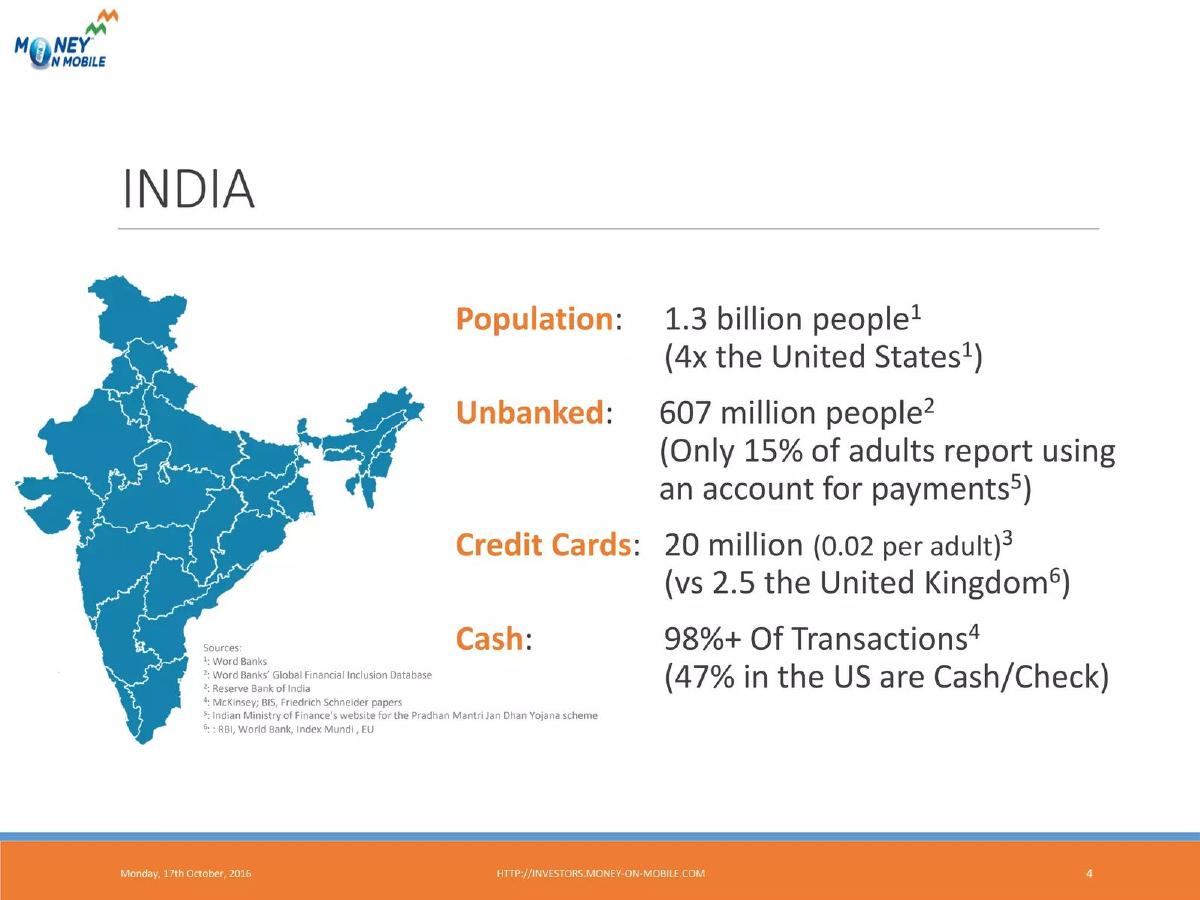
- India represents a massive market with 607 million unbanked people and 98%+ of transactions occurring in cash (Slide 4).
- The business model relies on a physical retail network, with 310,676 stores enabled to assist consumers with financial transactions (Slide 9).
- MoneyOnMobile processed $754 million USD in volume over the trailing twelve months ending March 31, 2016 (Slide 9).
- The company claims a user base of 170 million, which it asserts is higher than competitors like Paytm (120m) and MobiKwik (30m) at the time (Slide 16).
- Revenue flows from service providers through the company to the retail agents, covering over 600 cities (Slide 13).
- A partnership with Kalighat Society added 75,000 female agents to the network, emphasizing social impact and reach (Slide 19).
- Quarterly revenue shows significant fluctuations, peaking at $2.0 million in Q4 2016 before dropping to $1.4 million in Q1 2017 (Slide 22).
- The deck lacks a specific 'Ask' slide or detailed breakdown of how new capital would be deployed to stabilize or grow revenue.
Executive Summary: The Cash-to-Digital Bridge
The investor presentation for CLPI (MoneyOnMobile), dated October 17, 2016, outlines a massive infrastructure play within the Indian fintech sector. The company positions itself not as a standard digital wallet, but as a physical-to-digital bridge for the hundreds of millions of Indians who remain outside the formal banking system. By leveraging a vast network of neighborhood retail 'agents,' MoneyOnMobile facilitates transactions for a population that is 98% cash-reliant. While the scale of the network is impressive, the financial data suggests a business model that is still finding its footing in terms of consistent revenue generation.
Slide 1: Title and Context
The cover slide identifies the company as MoneyOnMobile and lists its OTC ticker: CLPI. The presentation is specifically noted as being 'for RedChip' and is dated October 17, 2016. The branding features a mobile phone icon inside a blue sphere, emphasizing the mobile-first nature of the service, though the subsequent slides reveal the importance of physical locations.
Slide 4: The Indian Market Opportunity
This slide establishes the 'Why India?' argument with stark demographic data. It cites a population of 1.3 billion people and highlights that 607 million are unbanked. Crucially, it points out the lack of financial infrastructure: only 20 million credit cards exist (0.02 per adult) compared to 2.5 per adult in the UK. The most significant metric is that 98%+ of transactions are cash-based, creating a massive opportunity for a service that can digitize that cash at the point of sale. Sources cited include the World Bank, McKinsey, and the Reserve Bank of India.
Slide 7: The MoneyOnMobile Agent
This slide is purely visual, showing a typical 'kirana' or small neighborhood grocery store in India. It features two women at a counter surrounded by consumer goods. This slide serves to ground the high-level tech talk in the reality of the Indian consumer experience. The 'Agent' is the local shopkeeper who acts as the human interface for the MoneyOnMobile network, providing a level of trust and accessibility that a standalone app might lack.
Slide 9: Mobile Payment Network Scale
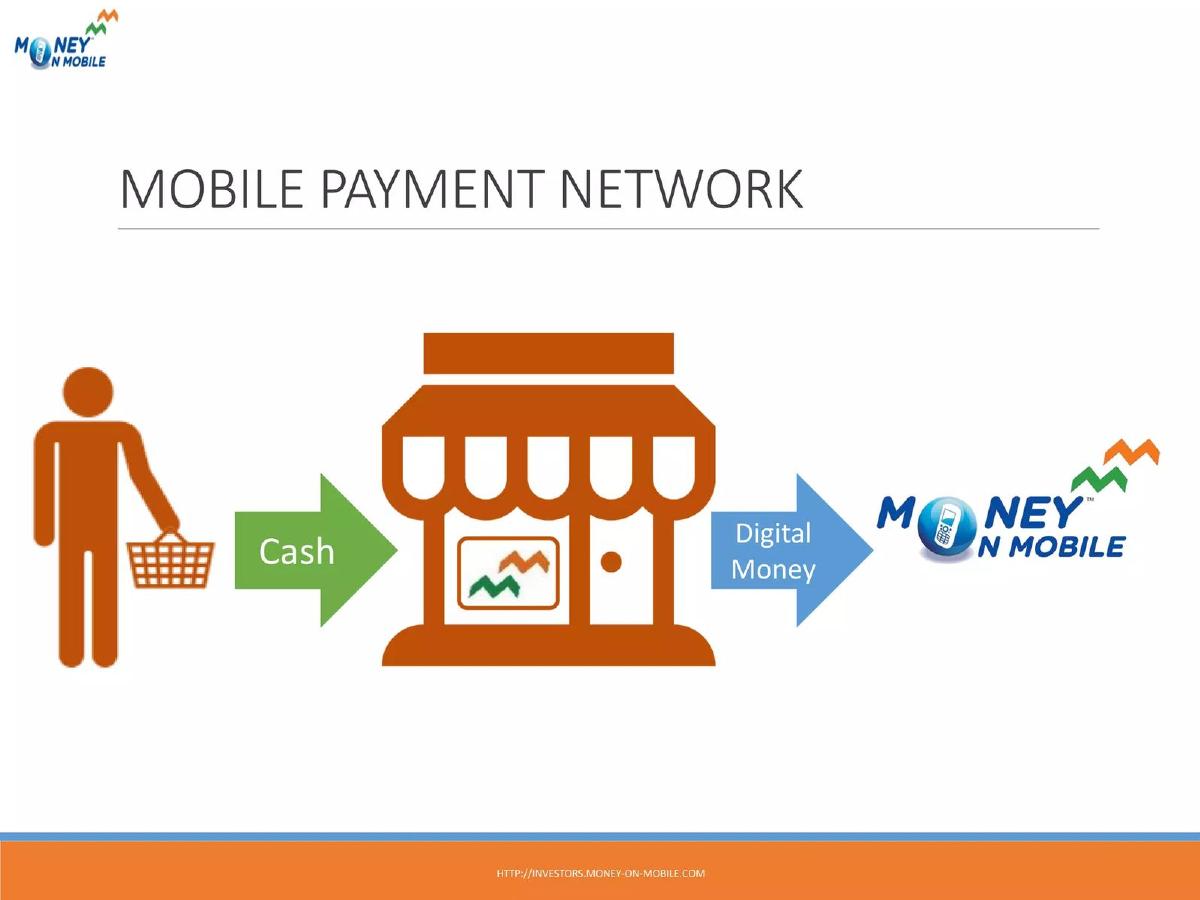
Slide 9 provides the core KPIs for the business as of March 31, 2016. The company claims to have served 173 million mobile phone users to date. The network consists of 310,676 enabled retail stores. The most impressive figure is the $754 million USD in processed volume over the trailing twelve months. The infographic illustrates the flow: a consumer brings cash to a retail store, the store earns revenue for assisting the transaction, and the cash is converted into 'Digital Money' via the MoneyOnMobile network.
Slide 13: Revenue Flow and Geographic Reach
This slide maps the distribution of the network across India. It claims a presence in over 600 cities with over 300,000 agents. The 'Revenue Flow' diagram shows a three-step process: Service Provider to MoneyOnMobile to Agent. This suggests a B2B2C model where MoneyOnMobile acts as the central clearinghouse for various services (likely mobile top-ups, utility payments, or domestic remittances) that agents sell to the end consumer.
Slide 16: Local Market Peer Comparison
This is a critical positioning slide. MoneyOnMobile compares itself to major players like Paytm, MobiKwik, and Oxigen. The company claims 170 million users, which at the time was higher than Paytm's 120 million. However, it acknowledges that Paytm has a higher Monthly Processed Volume ($113.64m vs. MoneyOnMobile's $93.94m). The strategic distinction made here is 'Primary Focus.' MoneyOnMobile labels itself as 'Unbanked Consumer Focus At Scale,' while categorizing Paytm and others as 'Banked Consumer Focused.' It also labels smaller competitors like Beam and ItzCash as 'Subscale.'
Slide 19: Financial Empowerment and Social Impact
This slide highlights a partnership with the Kalighat Society, which added 75,000 female agents to the network. By including photos of the agents and a RedChip representative, the company emphasizes the social impact of its business model. This 'financial empowerment' angle is a common theme in emerging market fintech decks, aiming to appeal to ESG-conscious investors and demonstrating a grassroots expansion strategy.
Slide 22: Revenue Trend Analysis
The final slide in this set provides a quarterly revenue breakdown in USD millions. The trend shows growth from $0.9m in Q1 2015 to a peak of $2.0m in Q4 2016. However, the most recent data point, Q1 2017 (dated September 2016 on the slide footer, suggesting a fiscal year alignment), shows a decline to $1.4 million. The text notes an '11% Growth in Q1 17 Revenue over Q1 16,' which is a positive spin on a significant quarter-over-quarter drop. This volatility is a potential red flag for investors, suggesting that while transaction volume might be high, the take-rate or revenue consistency is not yet stabilized.
What Works in This Deck
The deck excels at conveying the sheer scale of the Indian market. By using comparisons to the US and UK (Slide 4), it makes the 'unbanked' problem relatable to Western investors. The use of a physical photo for the 'Agent' (Slide 7) is a smart move; it moves the business out of the abstract and into a tangible, recognizable setting. Furthermore, the peer comparison (Slide 16) is bold. By claiming a larger user base than Paytm at the time, CLPI makes a strong case for its dominant position in its specific niche.
What Is Missing
The most glaring omission is a clear explanation for the revenue dip in the final quarter shown on Slide 22. Investors generally dislike unexplained downward trends in a growth-stage company. Additionally, there is no slide detailing the unit economics—how much does the company make on a $10 transaction? How much does the agent keep? Without this, the $754 million processed volume is a 'vanity metric' that doesn't necessarily translate to a profitable business. Finally, the deck lacks a 'Use of Funds' or 'Ask' slide in this selection, leaving the investor's next steps unclear.
Founder's Playbook: Lessons from CLPI
Founders should emulate the way CLPI defines its 'Primary Focus' in the competitive landscape. Instead of just saying they are better than Paytm, they defined a specific segment (the unbanked) where they could claim leadership. This 'niche dominance' narrative is very effective. However, founders should be wary of presenting revenue charts that end on a down note without a robust explanation. If your revenue drops, your next slide must be about the 'why' and the 'how we are fixing it.' Lastly, always back up massive transaction volumes with take-rate data to prove that the business is more than just a high-volume, low-margin pass-through entity.
Frequently asked questions
- What is the core problem MoneyOnMobile is solving?
- The company addresses the 'last mile' financial inclusion problem in India. According to slide 4, 607 million people are unbanked and only 15% of adults use accounts for payments. By enabling local retail stores to act as transaction hubs, MoneyOnMobile allows cash-heavy consumers to access digital financial services without needing a traditional bank account or credit card.
- How does the company differentiate itself from competitors like Paytm?
- MoneyOnMobile distinguishes itself by focusing on the 'Unbanked' segment at scale. Slide 16 shows that while Paytm has a higher monthly processed volume ($113.64m vs. $93.94m), Paytm is categorized as 'Banked Consumer Focused.' MoneyOnMobile claims a larger store count (315,000 vs. 80,000) and more users (170m vs. 120m) within the specific unbanked demographic.
- What do the financial trends indicate about the business health?
- The financials present a mixed picture. While the trailing twelve-month processed volume is high at $754 million (Slide 9), the actual quarterly revenue is relatively low and inconsistent. Slide 22 shows revenue growing from $0.9m in Q1 2015 to $2.0m in Q4 2016, but then declining to $1.4m in Q1 2017. This suggests that transaction volume does not always correlate linearly with revenue.
- What is the significance of the retail agent network?
- The retail agents are the backbone of the service. Slide 13 notes over 300,000 agents across 600 cities. These are typically small shop owners (as shown in Slide 7) who earn revenue by assisting consumers with transactions. This 'human-assisted' model is vital in a market where digital literacy may be low and cash is the primary medium of exchange.
- Is there a clear path to profitability mentioned in the deck?
- No. The provided slides focus on market size, network scale, and revenue trends, but they do not include a path to profitability, burn rate, or unit economics. The revenue dip in the final quarter shown (Slide 22) highlights a potential struggle with sustainability or seasonal volatility that isn't explained in the available slides.