Metaphysic’s 2022 Seed deck is a masterclass in narrative-driven fundraising for a deep-tech company. Rather than leading with complex architectural diagrams, the company focuses on the 'why' and the 'how much cheaper.' By contrasting the millions of dollars spent by Disney on CGI with the 'three weeks' and 'open tools' used by a single creator to achieve better results, Metaphysic makes a compelling case for the disruption of the content economy. The deck leans heavily on the founders' existing viral success—specifically the @deeptomcruise TikTok account—to bypass the need for technical vali…
Key takeaways
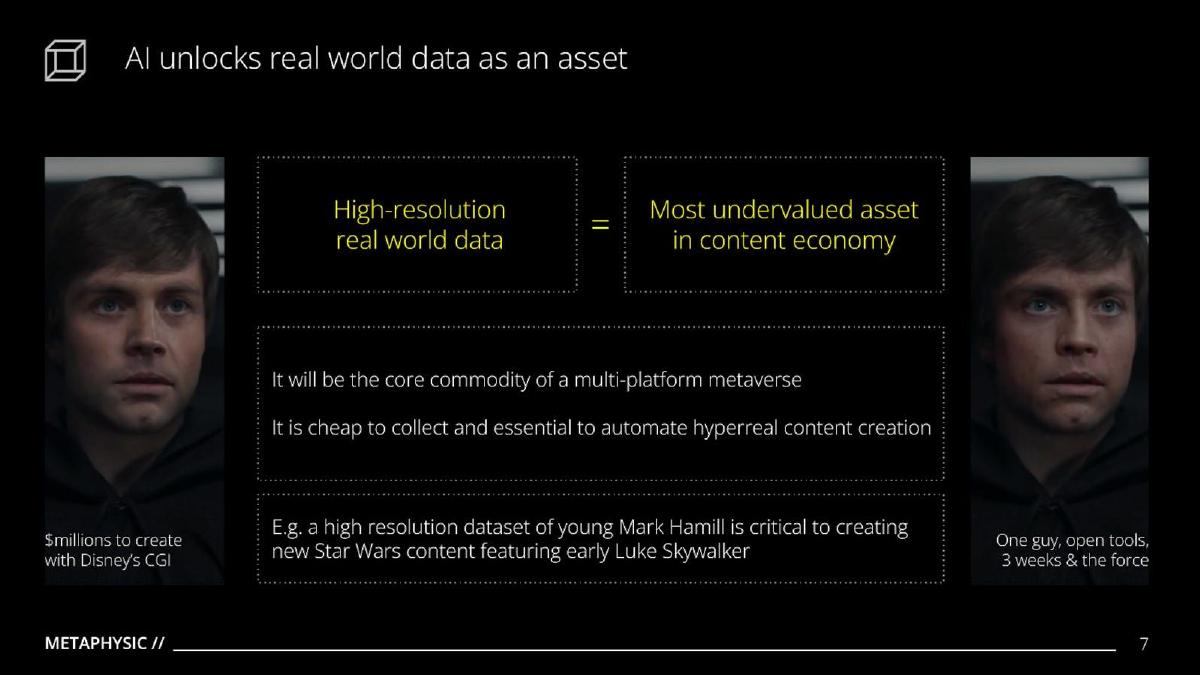
- The deck positions high-resolution real-world data as the 'most undervalued asset in the content economy' on slide 7.
- Metaphysic uses a direct comparison between Disney's multi-million dollar CGI and a single creator's three-week AI project to demonstrate cost efficiency on slide 7.
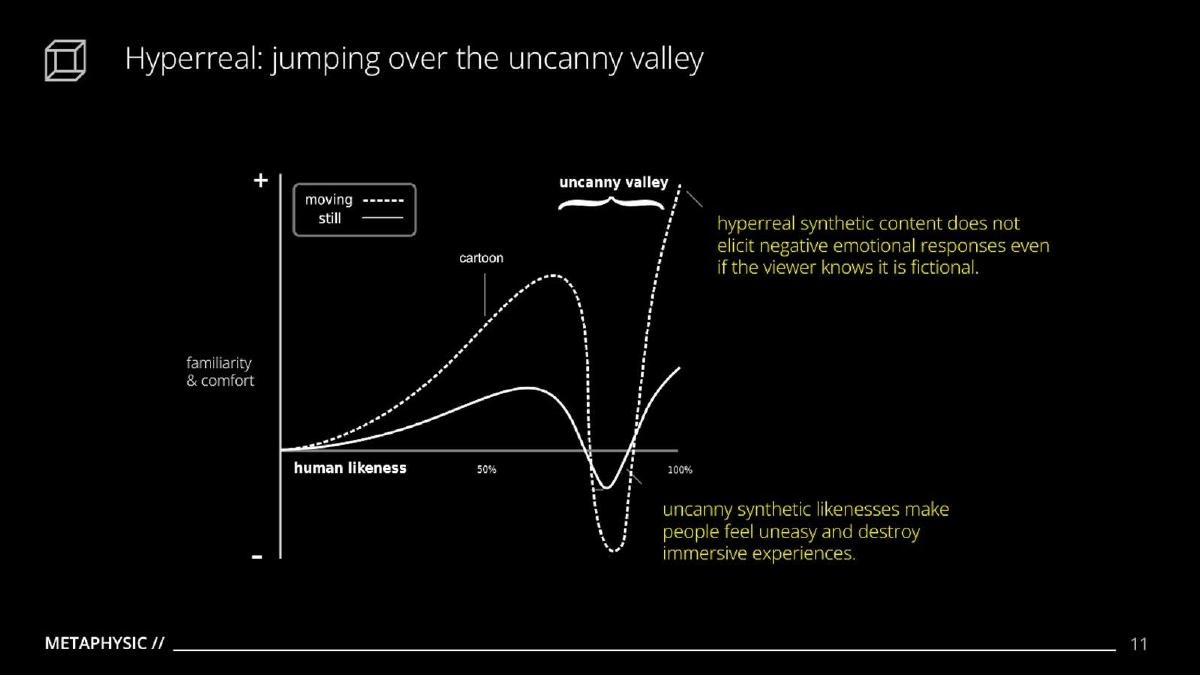
- The narrative centers on 'jumping over the uncanny valley,' arguing that hyperreal content prevents negative emotional responses on slide 11.
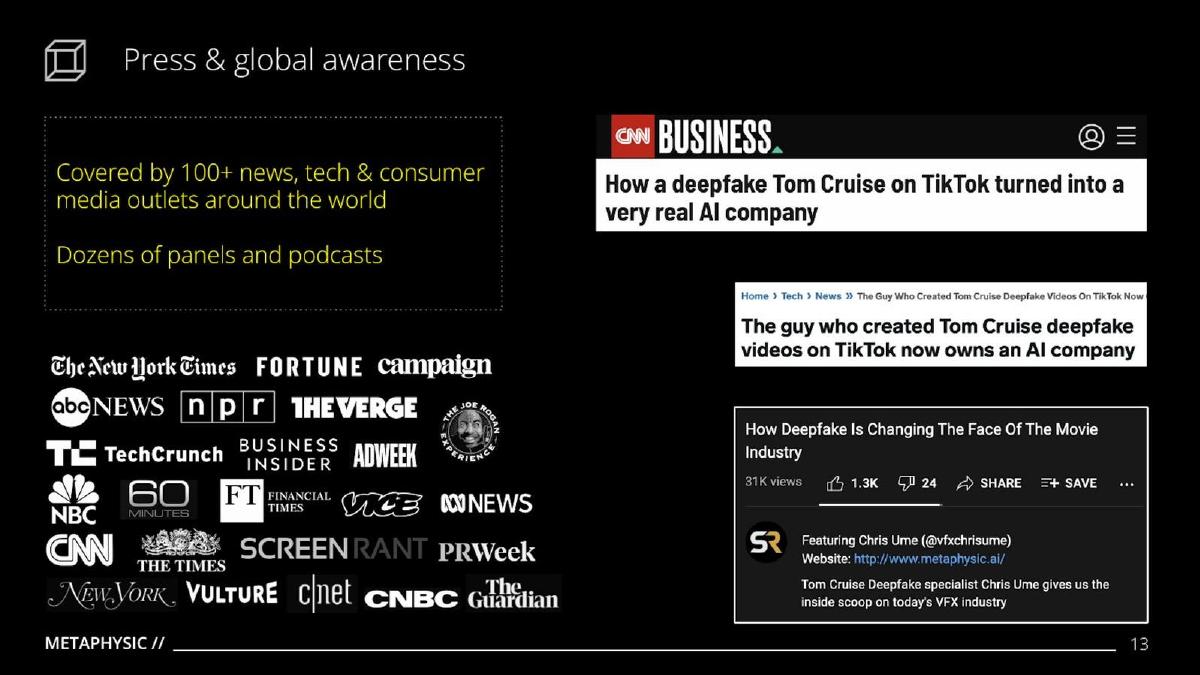
- Social proof is a core pillar of the pitch, citing coverage by over 100 news outlets and viral TikTok success on slide 13.
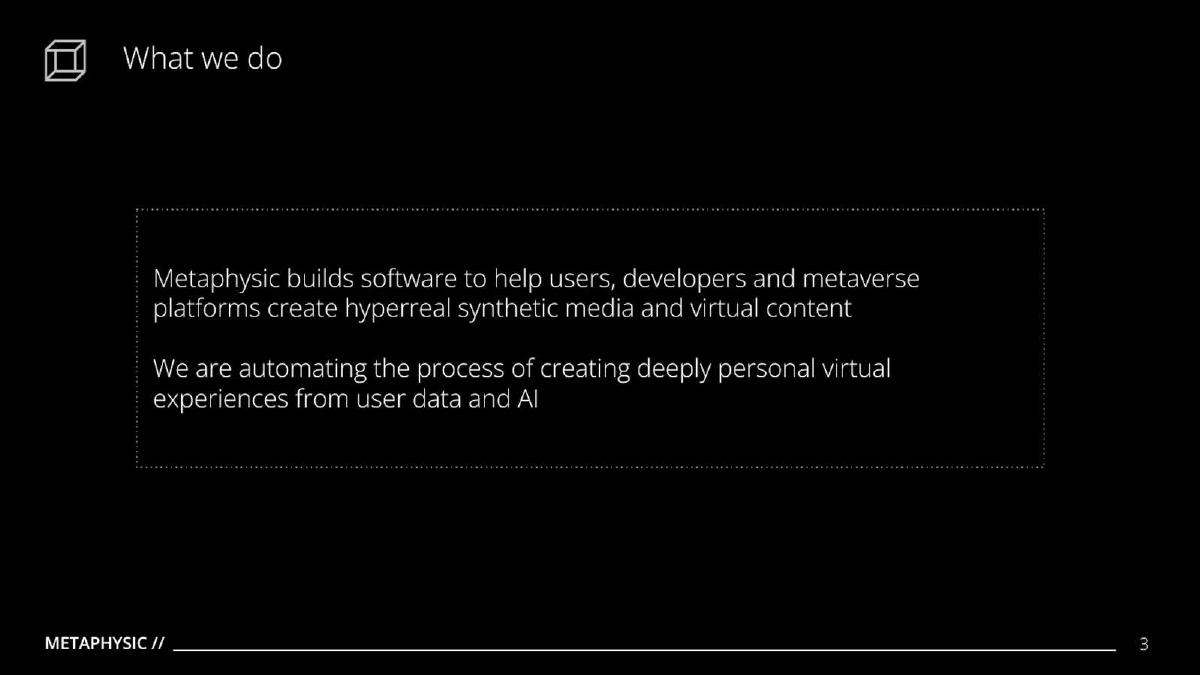
- The company defines its mission as automating deeply personal virtual experiences from user data and AI on slide 3.
- The deck omits a traditional team slide, financial projections, and a specific funding ask in the provided 15-slide sequence.
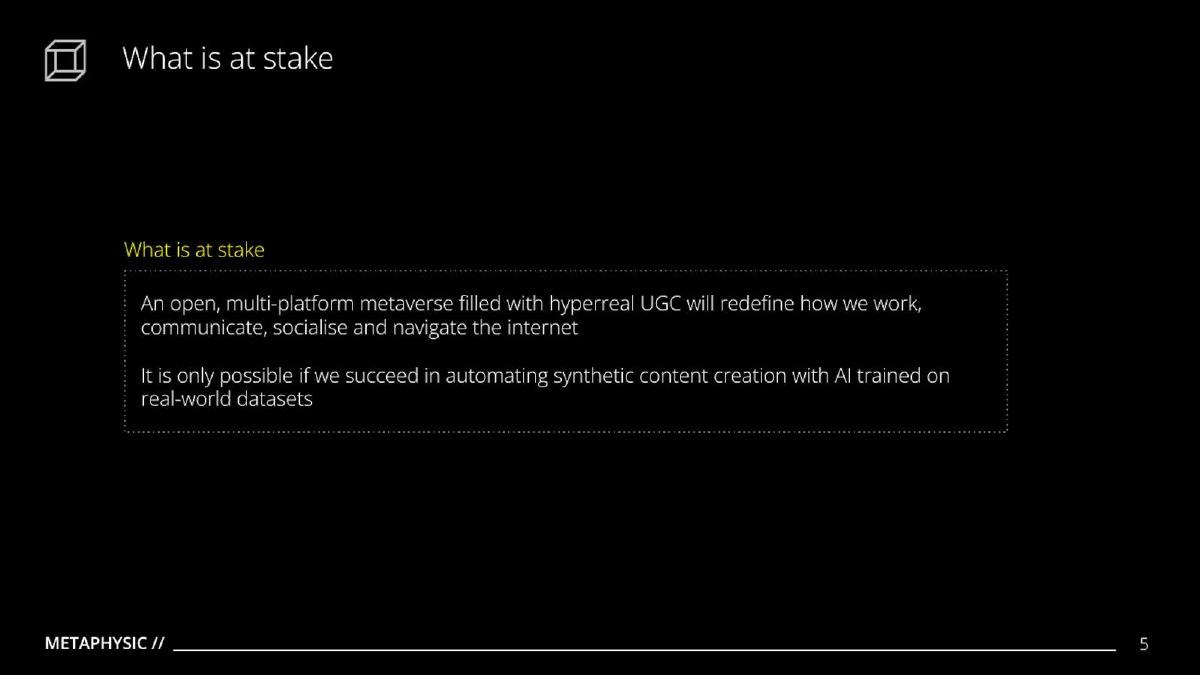
- Metaphysic frames its technology as the necessary fuel for an 'open, multi-platform metaverse' on slide 5.
- The presentation utilizes a minimalist aesthetic with high-contrast visuals to emphasize the quality of their synthetic output on slides 7 and 9.
The Narrative of Hyperrealism
Metaphysic’s pitch deck is a fascinating example of a company selling a technological shift rather than just a product. In 2022, the 'Metaverse' was the dominant buzzword, and Metaphysic positioned itself as the engine room for that future. The deck, which helped secure $7.5M in Seed funding, is remarkably light on text and heavy on conceptual framing. It moves away from the 'deepfake' label—which carries negative ethical connotations—and instead leans into 'hyperreal synthetic media.'
Slide 1-2: Branding and Vision
The deck opens with a minimalist title slide. The logo for Metaphysic uses multi-colored, stylized lettering against a black background. The sub-headline, 'AI to create hyperreal synthetic experiences,' immediately establishes the category. By using the word 'experiences' rather than 'videos' or 'tools,' the company signals a broader ambition than just being a VFX house.
Slide 3: The Mission Statement
Slide 3, titled 'What we do,' provides the core thesis: 'Metaphysic builds software to help users, developers and metaverse platforms create hyperreal synthetic media and virtual content.' The second paragraph is the most important: 'We are automating the process of creating deeply personal virtual experiences from user data and AI.' This suggests a B2B2C model where their tech acts as an infrastructure layer for other platforms.
Slide 5: The Stakes
Slide 5 attempts to create urgency. Titled 'What is at stake,' it argues that an 'open, multi-platform metaverse' will redefine work, socialization, and internet navigation. Crucially, it claims this future is 'only possible' if synthetic content creation is automated. This is a classic 'Why Now' slide, linking the company’s success to the success of a much larger, inevitable market trend.
Slide 7: The Economic Disruption
This is arguably the most powerful slide in the deck. Titled 'AI unlocks real world data as an asset,' it presents a side-by-side comparison. On the left, a shot of Luke Skywalker from a Disney production with the caption '$millions to create with Disney’s CGI.' On the right, a visually similar (or superior) version with the caption 'One guy, open tools, 3 weeks & the force.' By framing high-resolution real-world data as the 'most undervalued asset in the content economy,' Metaphysic makes a clear case for the massive margin expansion their technology offers to the entertainment industry.
Slide 9: User Experience and Immersion
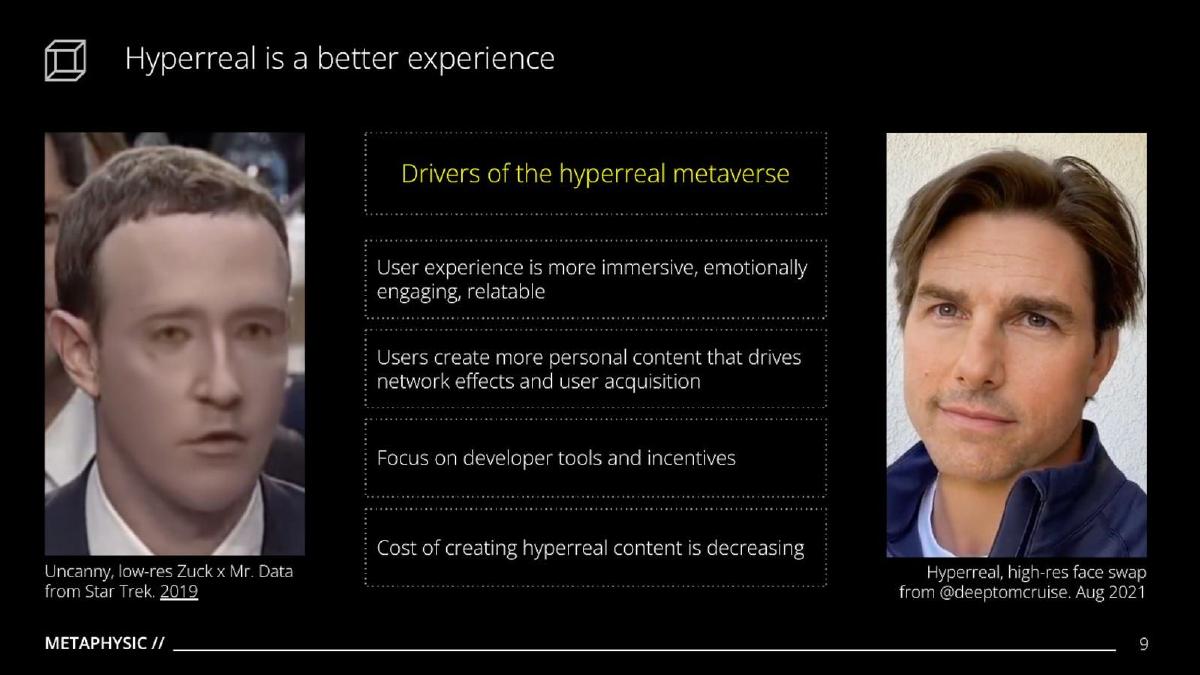
Slide 9 contrasts 'Uncanny, low-res Zuck x Mr. Data' from 2019 with the 'Hyperreal, high-res face swap from @deeptomcruise' in 2021. The slide lists drivers of the hyperreal metaverse: immersive user experience, emotional engagement, and decreasing costs. The visual evidence of their Tom Cruise work serves as a 'show, don't tell' proof of their technical lead over the rest of the market.
Slide 11: Overcoming the Uncanny Valley
Technical founders often struggle to explain why their quality matters. Metaphysic uses slide 11 to solve this with a graph of the 'Uncanny Valley.' It plots 'familiarity & comfort' against 'human likeness.' The graph asserts that while 'uncanny synthetic likenesses make people feel uneasy,' their 'hyperreal' content jumps over the dip, reaching a point where viewers are comfortable even if they know the content is fictional. This is a psychological justification for their R&D focus on high-fidelity output.
Slide 13: The Power of Viral Proof
Slide 13, 'Press & global awareness,' is a massive wall of logos including The New York Times, BBC, CNN, and Forbes. It specifically highlights the CNN Business headline: 'How a deepfake Tom Cruise on TikTok turned into a very real AI company.' For a Seed round, this level of earned media is extraordinary. It proves that the technology isn't just a lab experiment; it has already captured global attention and passed the 'litmus test' of public scrutiny.
Slide 15: Contact and Closure
The deck ends with a simple contact slide for Thomas Graham. It includes social media icons for YouTube, Twitter, Instagram, and LinkedIn, emphasizing the company's presence in the very digital ecosystems they intend to disrupt.
What Works in the Metaphysic Deck
1. The Comparison Strategy: The Luke Skywalker slide (Slide 7) is a perfect example of how to demonstrate value. It doesn't talk about algorithms; it talks about millions of dollars saved and weeks of time recovered. This speaks directly to the bottom line of potential enterprise customers.
2. Leveraging Viral Traction: Most Seed-stage companies have to promise they can get attention. Metaphysic arrived with 100+ news outlets already covering them. Using the @deeptomcruise account as a case study provides immediate credibility that no amount of technical whitepapers could match.
3. Psychological Framing: By using the 'Uncanny Valley' chart, the founders move the conversation from 'is this cool?' to 'is this viable for human interaction?' It frames their high-fidelity output as a requirement for the metaverse, not just a luxury.
What is Missing from the Metaphysic Deck
1. The Team Slide: While Chris Ume is mentioned in the press clippings, there is no slide dedicated to the founders' pedigree, technical backgrounds, or previous exits. In a deep-tech play, the 'who' is often as important as the 'what.'
2. Business Model and Unit Economics: The deck explains what they do, but not how they make money. Is it a SaaS license? A per-minute processing fee? A professional services model? The lack of a business model slide suggests this was a vision-heavy deck intended to capture interest based on technical superiority.
3. The Ask: There is no slide detailing how much capital is being raised or how that capital will be deployed. While this is often removed from public versions of decks, its absence means we don't know if the $7.5M raised was the original target or a result of oversubscription.
4. Roadmap: The deck is very 'present-tense.' It shows what they have done (Tom Cruise) and what the future looks like (The Metaverse), but it lacks a middle ground showing the next 12-24 months of product development or market expansion.
Founder Takeaways
If you are building in a space that is visually driven, your deck must be visually superior. Metaphysic avoids the 'death by bullet point' trap, using high-contrast images and simple graphs to convey complex ideas. Founders should copy the way Metaphysic frames their technology as an economic inevitability. By showing that the old way (CGI) is too expensive and the new way (AI) is already here and viral, they make investing feel like a logical necessity rather than a speculative gamble. Finally, if you have a 'hero' piece of content or a viral win, make it the centerpiece of your deck. It acts as a shortcut to trust that is invaluable in the early stages of fundraising.
Frequently asked questions
- How much did Metaphysic raise with this deck?
- As reported by Business Insider, Metaphysic raised $7.5 million in a Seed round in 2022. The deck itself does not state the amount raised or the valuation sought, which is common for decks shared publicly after a round closes.
- What is the primary value proposition of Metaphysic?
- The primary value proposition is the automation of hyper-realistic synthetic media. Slide 7 highlights that while Disney spends millions on CGI, Metaphysic’s approach allows a single person to create comparable or superior results in three weeks using AI and real-world datasets.
- Does the deck include a team slide?
- No, the provided 15-slide deck does not include a dedicated team slide detailing the founders' backgrounds. However, slide 13 mentions 'Chris Ume,' the specialist behind the viral Tom Cruise deepfakes, and slide 15 lists 'Thomas Graham' as a contact.
- How does Metaphysic address the 'Uncanny Valley' problem?
- Slide 11 features a graph showing that 'hyperreal synthetic content does not elicit negative emotional responses even if the viewer knows it is fictional.' They argue their technology jumps over the valley where lower-quality AI makes people feel uneasy.
- What market does Metaphysic target?
- The deck focuses heavily on the 'Metaverse' and the 'content economy.' Slide 5 suggests that an open, multi-platform metaverse is only possible through the automation of synthetic content creation using AI trained on real-world datasets.