Metadata's pitch deck is remarkably brief, consisting of only seven slides, yet it successfully conveys a high-growth narrative that eventually led to $56.9 million in total funding. The deck eschews traditional deep-dives into market size or competitive landscapes, focusing instead on a singular, painful problem—unproductive leads—and the immediate financial traction gained by solving it. By showcasing a jump from $100 to $34.5k in Monthly Recurring Revenue (MRR) within a few months, the founders established immediate credibility. The inclusion of heavy-hitting logos like Cisco and Comcast,…
Key takeaways
- The deck identifies a specific pain point on slide 2, stating that over 98% of leads are unproductive.
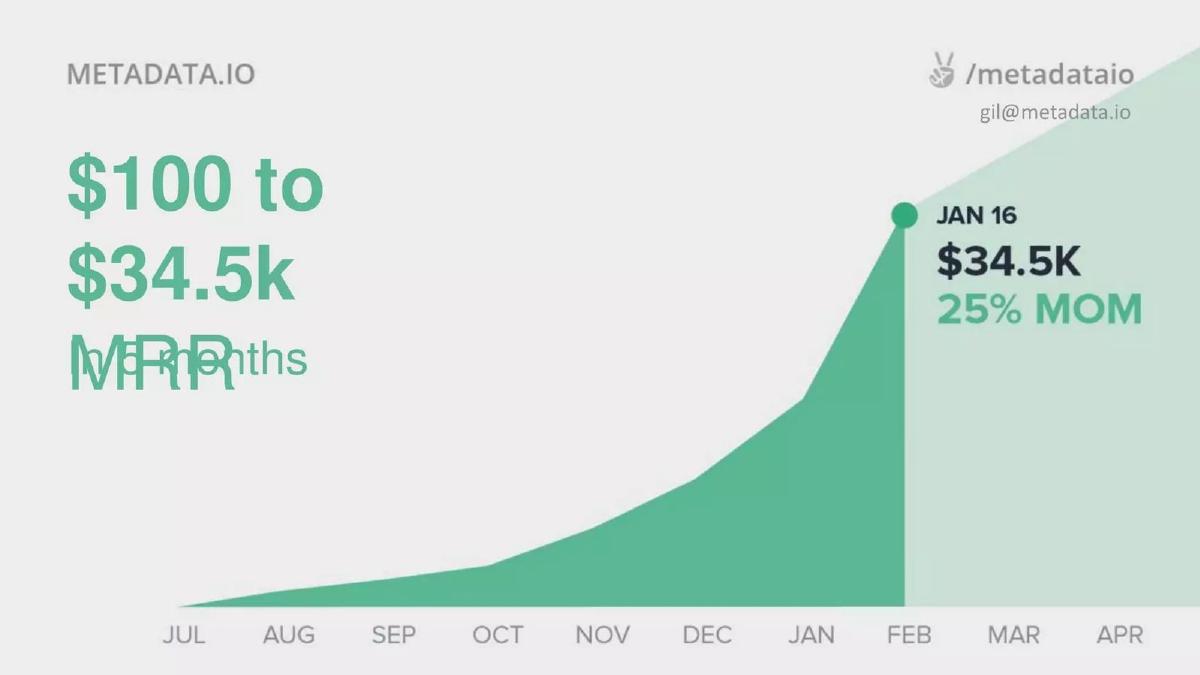
- Traction is the centerpiece of the deck, with slide 4 showing growth from $100 to $34.5k MRR.
- The company maintained a 25% Month-over-Month (MOM) growth rate as of January 2016, according to slide 4.
- Enterprise validation is established on slide 5 with logos from Cisco, Comcast Spotlight, and UBM.
- The founding team possesses deep industry roots, including an R&D Manager from Marketo and a 4X Head of Marketing, as shown on slide 6.
- The deck is extremely concise at only 7 slides, omitting traditional sections like Market Size (TAM), Competition, and the specific Investment Ask.
- The product is positioned as 'Demand generation on auto-pilot' on the cover slide.
- The company leverages its association with The Alchemist Accelerator, prominently displayed on the team slide.
The Power of Brevity: Metadata's 7-Slide Narrative
Metadata’s pitch deck is a masterclass in the 'less is more' philosophy of fundraising. In an industry—B2B marketing technology—often cluttered with complex diagrams and jargon, Metadata opted for a minimalist approach that emphasizes results over promises. Founded in 2015 and based in San Jose, the company set out to automate the most tedious parts of demand generation. This teardown examines how they used just seven slides to communicate a high-growth trajectory that eventually commanded nearly $57 million in total funding.
Slides 1-2: The Hook and the Pain Point
Slide 1: Cover The deck opens with a clean, professional image of a user engaged with a laptop, establishing the persona of the B2B marketer. The tagline is simple and bold: 'Demand generation on auto-pilot.' This immediately tells the investor what the product does (automation) and who it is for (demand gen teams). The branding is consistent, featuring the Metadata.io logo and a clear, modern font.
Slide 2: The Problem Metadata avoids a long list of grievances, choosing instead to highlight a single, devastating metric: '>98% unproductive leads.' The background image is a cluttered, chaotic office, visually representing the mess that marketers deal with when their lead generation isn't targeted. By using such a high percentage, Metadata creates an immediate sense of urgency. If 98% of a budget is being wasted, the solution isn't just a 'nice to have'—it is a financial necessity.
Slides 3-4: The Solution and Explosive Traction
Slide 3: The Product This slide features a laptop mockup showing the Metadata website. The copy on the screen reads, 'Accelerate Inbound Marketing' and explains that the platform 'fuels your marketing campaigns by leveraging marketing automation data into laser-focused targeted advertising.' This slide is light on technical details but heavy on the value proposition. It positions the software as a bridge between existing marketing automation data and actual ad execution.
Slide 4: Traction This is the 'money slide' of the deck. It features a steep upward curve showing growth from '$100 to $34.5k MRR' in just a few months. The slide explicitly notes a '25% MOM' (Month-over-Month) growth rate as of January 2016. For an early-stage investor, this chart is the ultimate de-risking mechanism. It proves that the market is not only interested but is actively paying for the solution at an accelerating rate. The simplicity of the graph makes the growth look inevitable.
Slides 5-7: Validation, Team, and Contact
Slide 5: Our Clients To further de-risk the investment, Metadata displays a 'wall of logos.' This isn't just a list of small startups; it includes enterprise giants like Cisco, Comcast Spotlight, and UBM. Seeing these names tells an investor that Metadata has passed the rigorous procurement and security hurdles of major corporations. Other logos include Align Commerce, Datawatch, Platform9, Atscale, Driven, Apptopia, and Avatier. This diversity of clients suggests the product has broad appeal across different B2B sectors.
Slide 6: The Team The team slide focuses on 'Founder-Market Fit.' CEO Gil Allouche is highlighted as a '4X Head of Marketing,' meaning he has felt the pain described on slide 2 four times over. COO Yan Manevich is credited with '$15M Revenue at MS service,' and CTO Asaf Shilat is noted as a former 'R&D Manager at Marketo.' The inclusion of Marketo is crucial, as it is one of the primary platforms Metadata integrates with. The bottom of the slide features logos from Stanford, Cornell, Technion, and The Alchemist Accelerator, providing academic and institutional credibility.
Slide 7: Contact The final slide repeats the laptop mockup and provides clear contact information, including an AngelList handle and a 'Founders@' email address. It is a standard, functional closing slide that maintains the deck's clean aesthetic.
What Works in This Deck
The Traction Curve: Slide 4 is the strongest element. Moving from $100 to over $34,000 in monthly revenue is a clear signal of product-market fit. Investors are often willing to overlook missing slides (like competition or market size) if the revenue growth is this aggressive.
Enterprise Social Proof: Including Cisco and Comcast (Slide 5) is a massive win for a young company. It proves that the '98% unproductive leads' problem is felt even at the highest levels of the Fortune 500, and that Metadata’s solution is robust enough for enterprise use.
Domain Expertise: The team slide (Slide 6) doesn't just list schools; it lists specific roles that prove they understand the industry. Having a CTO from Marketo is a significant competitive advantage when building a tool designed to integrate with marketing automation stacks.
What is Missing from This Deck
Market Size (TAM): There is no mention of how large the total addressable market is. While the B2B marketing space is known to be large, a standard deck usually quantifies this to show the potential for a billion-dollar exit.
Competitive Landscape: The deck does not address how Metadata differs from other automation tools or ad-tech platforms. It assumes the investor either knows the space or will ask during the Q&A.
The Ask: There is no slide detailing how much money is being raised, the valuation, or the milestones the company intends to hit with the new capital. This suggests the deck was used as a conversation starter rather than a standalone investment memo.
Unit Economics: While MRR is shown, there is no data on Customer Acquisition Cost (CAC), Lifetime Value (LTV), or churn rates. These are critical metrics for 'Later' stage companies, though perhaps less vital if this deck was used during their earlier seed/Series A transitions.
What a Founder Should Copy
Focus on the 'One Big Number': If you have a metric that is truly impressive (like 25% MOM growth), make it the center of your deck. Don't bury your best news on slide 15.
Visual Simplicity: Metadata uses very little text. Each slide has one clear message. This prevents 'death by PowerPoint' and keeps the investor focused on the founder's narrative during a live pitch.
Highlighting Relevant Pedigree: When listing your team, don't just put your title. Put the one sentence that proves you are the best person in the world to solve this specific problem, just as Gil Allouche did by highlighting his 4X experience as a Head of Marketing.
Use Logos Strategically: If you have big-name clients, give them their own slide. The psychological impact of seeing a familiar, successful brand associated with a startup cannot be overstated. It acts as a shortcut for trust. Define the Problem with a Single Stat: Slide 2 is a perfect example of how to frame a problem. Instead of explaining why leads are bad, they just stated that 98% of them are. It's a 'hair on fire' problem that requires an immediate solution.
Company: Metadata · Total Raised: $56,900,000 · Year: 2015 · Stage: Later · Slides: 7
Frequently asked questions
- Why is the Metadata deck so short at only 7 slides?
- Metadata likely used this as a 'teaser' deck or a high-level presentation for investors who already understood the B2B marketing space. When a company can show 25% month-over-month growth and enterprise clients like Cisco in the first few months, they don't need 20 slides to prove product-market fit. The brevity forces the investor to focus on the explosive revenue growth and the quality of the team.
- What is the primary problem Metadata is solving according to the deck?
- Slide 2 defines the problem with a single, stark statistic: '>98% unproductive leads.' This targets the inefficiency of traditional inbound marketing. The deck suggests that while companies are generating leads, the vast majority are a waste of resources. Metadata positions itself as the solution that 'fuels marketing campaigns' by using automation data to create 'laser-focused targeted advertising,' as noted on slide 3.
- How does Metadata prove its team is qualified?
- Slide 6 highlights specific, relevant achievements rather than just titles. CEO Gil Allouche is listed as a '4X Head of Marketing,' and CTO Asaf Shilat is noted as a former 'R&D Manager at Marketo.' By highlighting experience at Marketo (a category leader in marketing automation) and BlueKai, the team demonstrates they have the technical and domain expertise to build and sell in this specific niche.
- Is there a specific financial 'Ask' in this deck?
- No, the 7-slide deck does not include a slide detailing how much capital is being raised or how the funds will be used. This is common in decks designed for early-stage interest or when the founders prefer to discuss terms in person. However, the catalogue facts indicate the company eventually raised a total of $56,900,000 across its funding history.
- What major components are missing from this pitch deck?
- This deck omits several standard elements: a Total Addressable Market (TAM) slide, a competitor matrix, a detailed product roadmap, and unit economics (like LTV/CAC). While these omissions would be risky for a pre-revenue startup, Metadata's rapid MRR growth and high-profile client list (slide 5) likely served as proxies for market demand and competitive advantage.