MetaCert's pitch deck addresses a specific technical vulnerability: the lack of built-in security in mobile in-app browsers (WebViews) compared to native browsers like Chrome or Safari. By positioning themselves as a security layer for team collaboration tools and SME-built apps, they offer a low-friction integration that takes only 30 seconds to deploy. The deck highlights a team with significant pedigree in web standards, including a founder who co-instigated the W3C Standard for Web/URL categorization. Despite a historical pivot after failed integrations with Samsung and Apple, the company…
Key takeaways
- The core problem is that in-app browsing lacks the built-in security features found in native browsers like Safari and Chrome (Slide 4).
- MetaCert offers a 30-second integration for enterprise customers, requiring no hardware or software and working across all devices in an organization (Slide 8).
- The revenue model is bifurcated: $1.50 per user/month for enterprise collaboration and $5 per app/month for SMEs (Slide 12).
- Go-to-market tactics include leveraging strategic partnerships with platforms like HipChat, which has over 49,000 customers (Slide 16).
- Founder Paul Walsh has deep domain expertise, having co-instigated the W3C Standard for Web/URL categorization (Slide 20).
- The company previously raised $1.2M between 2011-2014 to build its crawling technology and content classification platform (Slide 23).
- A significant pivot occurred after Samsung and Apple declined integrations for 1.3 billion devices, leading MetaCert to move from 'Internet Safety for kids' to a general Mobile Security API (Slide 23).
- The technical 'WebView' explanation clarifies that these libraries were not originally designed for the 'hybrid' app scale seen today, creating the current security gap (Slide 27).
MetaCert Pitch Deck Analysis
MetaCert positions itself at the intersection of mobile utility and enterprise security. The deck is structured to highlight a specific, often overlooked technical vulnerability: the 'WebView.' By focusing on the security gap between native browsers and in-app browsing, MetaCert builds a case for a specialized security layer that is easy to deploy and difficult for platform owners to replicate quickly. The following teardown examines the eight provided slides to understand their value proposition and market strategy.
Slide 1: Title Slide
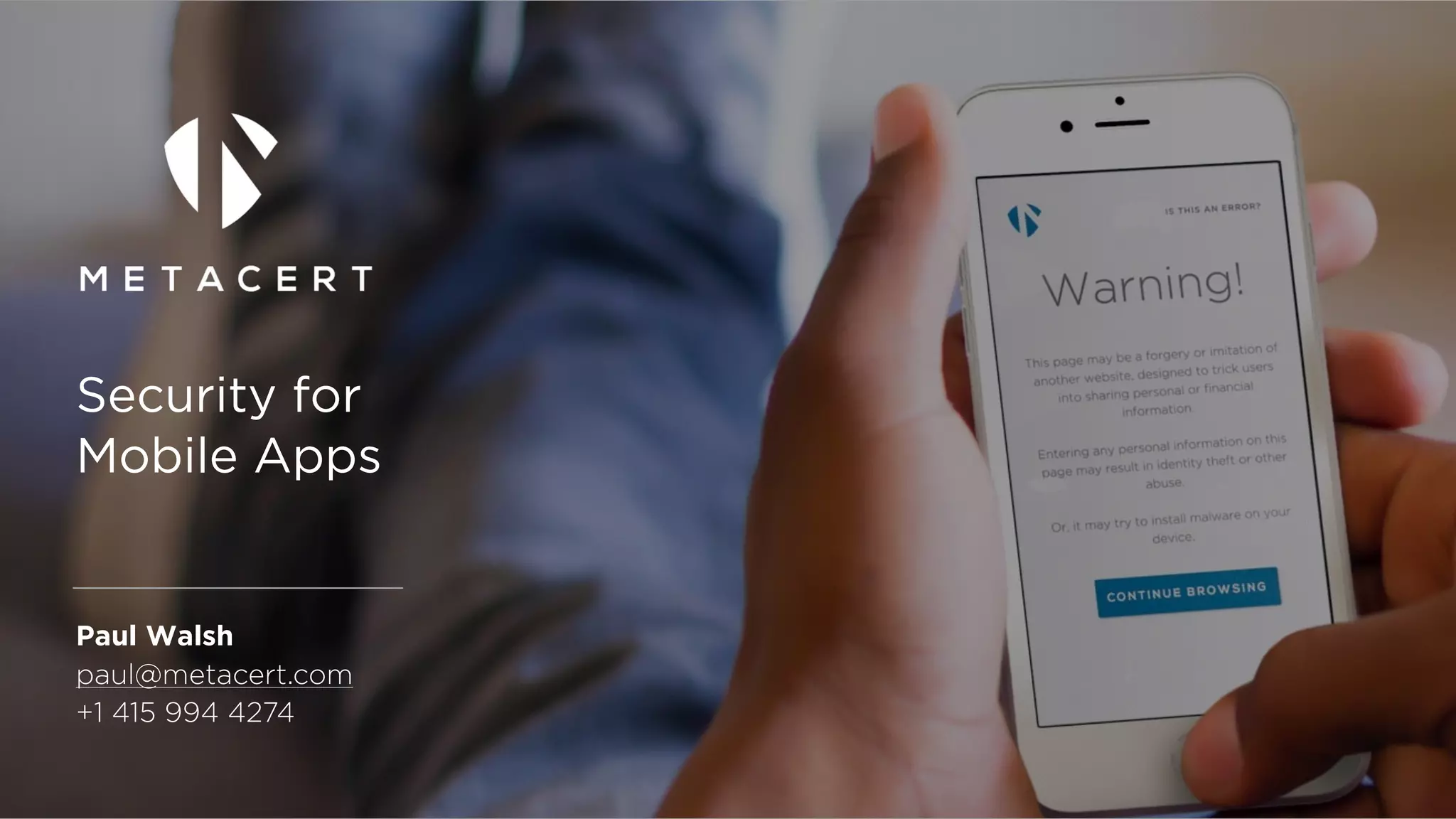
The title slide is minimalist, featuring the MetaCert logo and the clear subtitle 'Security for Mobile Apps.' It identifies Paul Walsh as the primary contact. The background image of a user holding a smartphone displaying a 'Warning!' screen immediately establishes the product's function: intercepting dangerous web content before it reaches the user. This visual shorthand effectively sets the stage for a security-focused pitch.
Slide 4: The Problem
Slide 4 defines the market pain point. It argues that while native browsers like Safari and Chrome have robust, built-in security, 'in-app browsing' does not. This is a critical distinction. The slide notes that millions of apps built by SMEs lack a reliable way to protect users from malicious links. Furthermore, it highlights a specific vulnerability in Team Collaboration apps, where the rapid increase in user bases has outpaced the development of necessary security protocols. By framing the problem this way, MetaCert identifies two distinct customer segments: app developers (SMEs) and enterprise organizations using collaboration tools.
Slide 8: The Solution for Team Collaboration
This slide focuses on the enterprise side of the business. It emphasizes ease of use, stating that 'no hardware or software' is required and that integration takes only 30 seconds. The visual shows a mock-up of a HipChat integration settings page with checkboxes for 'Phishing and Malware Protection' and 'Stop Pornography Websites.' The claim that one person can install the integration for the entire organization is a powerful selling point for IT departments looking for low-overhead security solutions. The slide also mentions a database of over 10 billion classified URLs, providing a sense of the scale of their underlying data.
Slide 12: Revenue Model
MetaCert presents a straightforward, two-pronged revenue model. For enterprise customers using collaboration services, the cost is $1.50 per user/per month , which covers all services. For SMEs using app-making platforms, the cost is $5 per app/per month , with services paid for separately. The slide also hints at future revenue streams, such as 'App Identity Verification' to help businesses distinguish their legitimate apps from clones or malicious versions. This clear pricing structure allows investors to easily model potential returns based on user or app acquisition targets.
Slide 16: Go-To-Market Strategy
The go-to-market strategy is divided into three tactical areas: driving awareness, demonstrating the solution, and driving reach. Awareness is built through PR (TechCrunch, Business Insider) and speaking at conferences. The 'Demonstrate' phase relies on Proof of Concept (POC) trials with partners like HipChat to gather data on blocked links. The 'Drive Reach' phase is perhaps the most important, focusing on distribution partnerships with 'bottom of the pyramid' app platforms like AppMakr and strategic partners like HipChat (noting their 49K+ customers). The long-term roadmap includes embedding at the OS level (e.g., Android), showing an ambition to move from an integration to a core infrastructure component.
Slide 20: Team
The team slide is a 'pedigree' slide, designed to build massive credibility. Paul Walsh (CEO) is highlighted as a co-instigator of the W3C Standard for Web/URL categorization, placing him in the same professional circles as Tim Berners-Lee. His past success with Segala ($2M+ revenue) and an unexpected mention of owning a Michelin-starred restaurant add a layer of personal achievement and entrepreneurial tenacity. David Rooks brings further W3C experience and a long working history with Walsh. Alfonso Valdes provides the technical 'teeth' as a certified Ethical Hacker with a background in major telecommunications firms. This combination of standards-setting expertise and practical security engineering is a strong signal to investors.
Slide 23: Company History
This slide is unusually honest for a pitch deck, detailing a significant pivot. It reveals that MetaCert originally focused on 'Internet Safety for kids' and raised $1.2M between 2011-2014 . It openly admits to winning pitches with Samsung and Apple for 1.3 billion devices, only for those companies to back out because the 'timing wasn't right.' Instead of hiding this, MetaCert uses it to justify their new focus on the Mobile Security API, which they claim is a 'bigger opportunity.' This transparency can build trust with investors, showing that the founders are capable of navigating failure and identifying more lucrative market shifts.
Slide 27: Technical Context (WebView)
The final slide in this set acts as an educational tool, explaining 'WebView' in plain English. It describes WebView as a code library from Apple and Google that allows developers to show web content inside apps without forcing users to open a native browser. The slide explains that because these ecosystems were not originally designed for the current scale of 'hybrid' apps, security was overlooked. By citing the 2014 W3C recommendation for HTML5, MetaCert anchors its technical necessity in the evolution of web standards, reinforcing the idea that they are solving a modern problem created by rapid technological shifts.
What MetaCert Does Well
MetaCert excels at contextualizing a technical problem . Most investors may not know what a 'WebView' is or why it is a security risk. By dedicating a slide to explaining this in 'plain English' (Slide 27) and contrasting it with the security of native browsers (Slide 4), they make the necessity of their product obvious. They also do an excellent job of leveraging founder pedigree . In the world of security and web standards, having a founder who literally helped write the rules (W3C) is a significant competitive advantage that is hard for startups to replicate.
The low-friction integration story is another highlight. In enterprise sales, the '30-second setup' (Slide 8) is a dream for reducing sales cycles and implementation hurdles. By removing the need for hardware or complex software deployments, MetaCert positions itself as a 'plug-and-play' security layer for the modern, cloud-based workforce.
What is Missing from the Deck
While the deck is strong on technical merit and team, the provided slides are missing current traction metrics . We see the potential reach of partners like HipChat (49K+ customers), but we don't see how many of those customers MetaCert has actually converted. There is no mention of current Monthly Recurring Revenue (MRR) or user growth rates since the pivot to the Mobile Security API.
Additionally, the competitive landscape is absent from these slides. While they mention native browsers, they don't address other third-party security integrations or how they plan to defend their position if Apple or Google eventually decide to harden WebView security themselves. Finally, there is no 'Ask' slide in this selection. While the source listing states they secured $1.2M, the specific terms, use of funds, and milestones they intend to hit with the new capital are not detailed here.
Founder Takeaways: What to Copy
The 'Plain English' Slide: If your product relies on a specific technical niche (like WebViews), include a slide that explains the concept simply. It ensures the investor understands the 'why' before you get to the 'how.' · Honest History: Don't be afraid to mention a pivot or a failed deal with a major player. MetaCert turned a 'loss' with Samsung/Apple into a narrative about market validation and finding a 'bigger opportunity.' · Distribution-First GTM: Instead of just saying 'we will use social media,' MetaCert identified specific platforms (HipChat, AppMakr) where their target customers already live. This makes the go-to-market strategy feel tangible and achievable. · Pedigree Mapping: If your team has worked on industry standards or at high-profile firms, link those experiences directly to the product's core technology. It transforms a resume into a competitive moat.
Frequently asked questions
- What specific security threats does MetaCert address?
- MetaCert focuses on protecting users from malicious and inappropriate web links within mobile applications. Specifically, it targets phishing, malware, and pornography. According to Slide 8, the company has classified over 10 billion URLs to provide real-time warnings when a user clicks a link that leads to a web forgery, an attack site, or inappropriate content.
- How does MetaCert integrate with existing business tools?
- The deck emphasizes a low-friction, cloud-based integration. Slide 8 highlights that for enterprise customers using tools like HipChat, the setup takes only 30 seconds and requires no hardware or software installation. A single administrator can install the integration, and it immediately protects every device within the organization.
- What is the company's pricing strategy?
- MetaCert uses a tiered subscription model based on the customer type. Enterprise customers using team collaboration services are charged a fixed rate of $1.50 per user per month for all services. SMEs building apps via platforms are charged $5 per app per month, with each service (like anti-phishing or pornography blocking) paid for separately (Slide 12).
- Who are the key members of the MetaCert team?
- The team is led by Founder & CEO Paul Walsh, a W3C veteran who co-instigated web standards for URL categorization. He is joined by David Rooks, Head of Data, who also contributed to W3C technical specifications, and Alfonso Valdes, a DevOps engineer and certified Ethical Hacker with experience at Sprint and Texas Instruments (Slide 20).
- Why did MetaCert pivot its business model?
- As detailed on Slide 23, the company originally focused on internet safety for children. While they won pitches with Samsung and Apple for 1.3 billion devices, both tech giants ultimately decided the timing wasn't right. This loss of a massive distribution channel led MetaCert to pivot toward a broader Mobile Security API and team collaboration security.