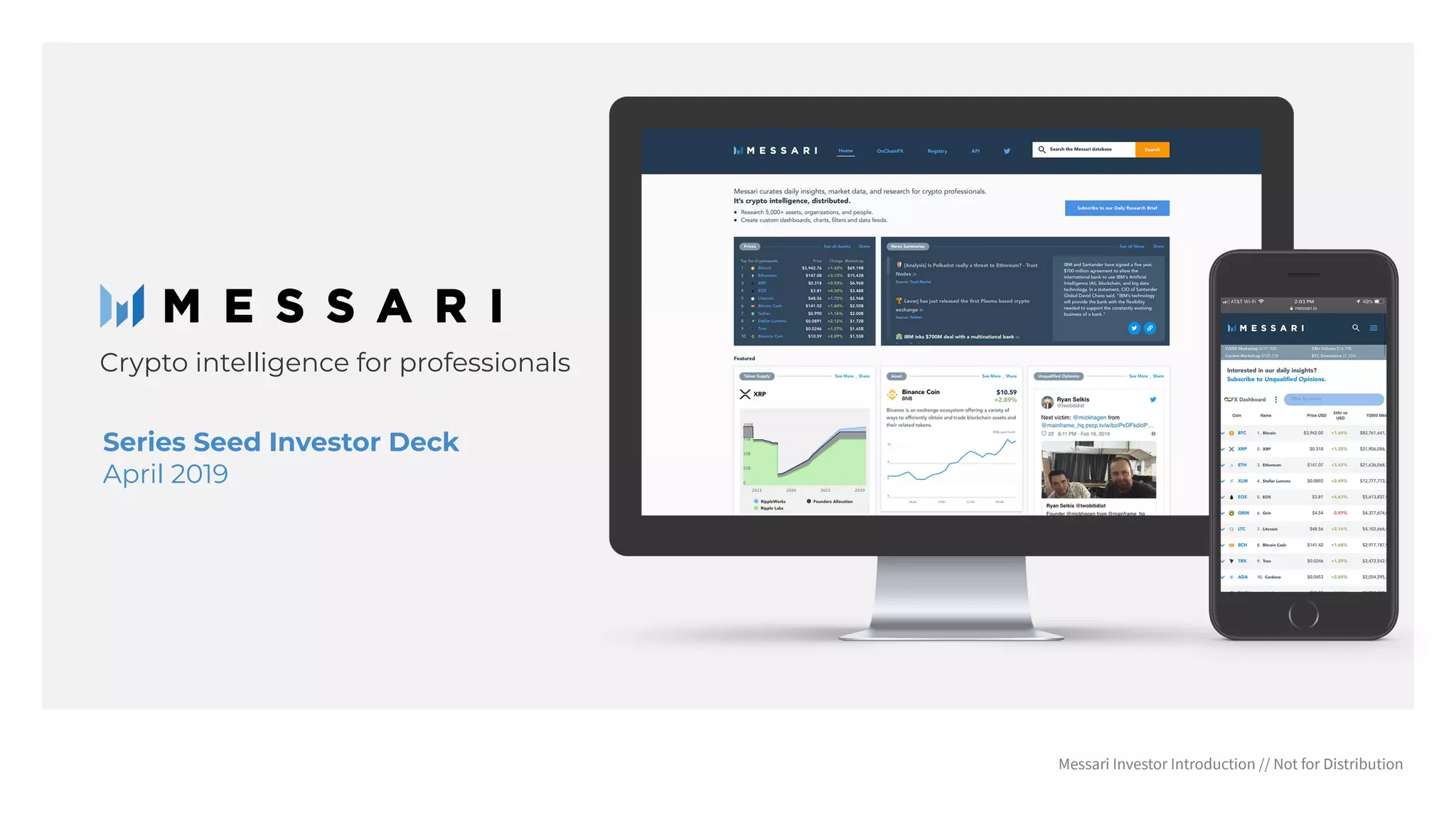
Messari’s April 2019 Series Seed deck is a masterclass in positioning a data business during a market downturn. At a time when the total cryptocurrency market cap was declining, Messari focused on the 'transparency gap' that prevented institutional entry. The deck identifies specific instances where Messari exposed multi-billion dollar market cap overstatements and wash trading, establishing immediate credibility. By mapping their product roadmap to historical financial giants like EDGAR, Capital IQ, and S&P Global, they provide a clear mental model for their long-term value. The deck leans h…
Key takeaways
- The deck identifies a specific $6 billion XRP market cap overstatement and a 20% XLM supply increase bug to prove their data integrity (Slide 3).
- Messari positions itself as a three-tier stack comparable to EDGAR, Capital IQ, and S&P Global (Slide 5).
- The company claims a top-five ranking in 'data & analytics' and 'research & news' brands according to fifty.one rankings (Slide 9).
- Audience growth is shown to be inverse to the crypto market cap, with page views rising as the market declined throughout 2018 (Slide 11).
- Revenue is projected to scale from $167,000 in 2018 to $15,000,000 by 2021 (Slide 13).
- The business model shifts from API and research briefs to enterprise licenses and white-labeled solutions over a four-year period (Slide 13).
- The deck lacks a dedicated team slide, though founder Ryan Selkis is visible in product screenshots (Slide 1).
- There is no explicit 'Ask' slide detailing the amount of capital being raised or the valuation sought in this Series Seed round.
Introduction: The Institutional Bridge
Messari’s Series Seed deck from April 2019 arrived at a pivotal moment for the cryptocurrency industry. The 'crypto winter' of 2018 had cooled retail hype, leaving a vacuum that only institutional professionalization could fill. This deck is not just a product pitch; it is a manifesto for transparency. By positioning themselves as the 'S&P of Crypto,' Messari sought to move the industry away from the 'wild west' era of wash trading and towards a regulated, data-driven future.
Slide 1: Title and Product Vision
The cover slide establishes Messari as 'Crypto intelligence for professionals.' The visual focus is a multi-device mockup showing the Messari dashboard on both a desktop monitor and a smartphone. This immediately communicates that the product is live, functional, and designed for a professional workflow. The date, April 2019, places this deck right at the end of a long bear market, signaling a 'build' phase.
Slide 3: The Transparency Gap
Messari identifies the problem through three pillars: the need to improve transparency, curate information, and create data standards. Rather than using vague platitudes, the slide cites specific wins. They mention identifying a '$6 billion XRP market cap overstatement' in January 2019 and an 'unreported inflation bug' in XLM in March 2019. By calling out 'CoinMarketCap errors' regarding wash trading (overstated by 10-20x), Messari positions itself as the honest broker in a market full of bad actors. The takeaway is clear: low-integrity data is the only thing keeping institutions out.
Slide 5: The Full-Stack Strategy
This slide is the strategic heart of the deck. Messari maps its product offerings against historical financial giants. They align their 'Registry' with EDGAR (standardized records), their 'OCFX and UO' products with Capital IQ (complex analytics), and the core Messari platform with S&P Global (global intelligence). This 'Historical Guides' approach is a brilliant way to help investors understand a complex new asset class by using familiar legacy benchmarks. The thesis at the bottom—that the 'S&P of Crypto' will be built on free datasets and open APIs—underscores their commitment to the open-source nature of blockchain.
Slide 7: Messari Pro and Product Depth
Slide 7 introduces 'Messari Pro,' focusing on the ability to search data modules, build charts, and pull data from APIs. The screenshots show a dense, information-rich UI, including 'My Dashboard' features and a 'Search the Messari database' function that categorizes assets, resources, people, and organizations. This slide proves that Messari is more than just a price ticker; it is a relational database for the entire ecosystem.
Slide 9: Brand as a Moat
In a bold move, Slide 9 argues that 'Good data isn’t enough; brand and community matter.' They contrast themselves with Bloomberg, stating 'Bloomberg has TV. Messari has Twitter.' The slide lists impressive community highlights: 130k+ Twitter followers, 8,500+ email subscribers, and 200+ community analysts. They also cite 'fifty.one rankings' showing Messari as the #2 data & analytics brand, trailing only Blockchain.com but leading CoinMarketCap and CoinMetrics in specific categories. The quote 'Build an aura of inevitability & recruit an army of missionaries' suggests their growth strategy is as much about social proof as it is about software.
Slide 11: Counter-Cyclical Growth
Traction is demonstrated through a chart comparing Messari's monthly page views against the total crypto market cap. While the market cap (the grey line) trends downward throughout 2018 and early 2019, Messari’s page views (the blue line) trend steadily upward, crossing the 300,000 mark. The timeline at the bottom notes key milestones, such as the acquisition of OnChainFX in July 2018 and the launch of the 'Messari Pro' alpha in February 2019, which generated $260k in total revenue by that point.
Slide 13: The Revenue Roadmap
The financial projections are ambitious. Messari shows a jump from $167,000 in revenue in 2018 to a projected $15,000,000 in 2021. The slide breaks down how the revenue mix will evolve: starting with API and research briefs, moving into enterprise licenses in 2020, and culminating in white-labeled solutions and on-chain asset ratings in 2021. This indicates a shift from a retail/prosumer model to a high-ticket B2B enterprise model.
Slide 15: The Internet Scale Vision
The final content slide places Messari in the pantheon of internet giants. It uses a network graph to compare Google (Information - $800B), Facebook (Relationships - $500B), and Messari (Finance). The claim is that 'Crypto’s data giant will be bigger than Bloomberg or S&P.' It’s a classic 'vision' slide designed to show the potential for a venture-scale return by dominating the 'curated financial information' layer of the internet.
What Messari Does Well
Specific Credibility: By citing the exact dollar amounts of market cap errors they discovered ($6B for XRP), Messari proves their utility. They aren't just promising to be better; they are showing that they already are.
Legacy Benchmarking: Comparing their product tiers to EDGAR and Capital IQ is a highly effective way to communicate a roadmap to traditional investors who may not understand the nuances of 'on-chain data' but do understand the value of a Bloomberg Terminal.
Traction vs. Market: Showing growth that is inverse to the market price is the strongest possible argument for a 'need-to-have' tool. It proves that users aren't just speculators; they are professionals who need data even (or especially) when the market is down.
What is Missing from the Deck
The Team Slide: While founder Ryan Selkis is a well-known figure in the space and appears in screenshots, the 8 slides provided do not include a dedicated team slide. In a seed round, the pedigree of the engineering and data science team is usually a top priority for investors.
Unit Economics: While the deck shows total revenue projections, it lacks detail on Customer Acquisition Cost (CAC) or Churn. For a subscription-based 'Pro' model, these metrics are vital to prove the scalability of the $15M revenue target.
The Ask: There is no slide detailing how much money is being raised, the intended use of funds (e.g., hiring more analysts vs. engineering), or the milestones the round is intended to reach. This may have been in the 8 slides not included in this set.
Founder's Playbook: Lessons to Copy
Use the 'Historical Guide' Framework: If you are building in a new or misunderstood category, don't explain what you do from scratch. Map your features to the 1.0 version of your industry (e.g., 'We are the [Legacy Giant] of [New Industry]').
Quantify Your 'Truth': If your value proposition is accuracy or transparency, find a high-profile error in your industry and document how you caught it. One specific example of a $6B error is worth more than a hundred slides claiming you have 'better data.'
Leverage Community as a Moat: In the early stages, your 'army of missionaries' (Twitter followers, open-source contributors) is a leading indicator of becoming the industry standard. Track and present these social metrics alongside your financial ones to show 'inevitability.'
Frequently asked questions
- What is the core problem Messari aims to solve?
- Messari identifies 'low-integrity data and disorganized information' as the primary barrier preventing institutional investors from entering the cryptocurrency market. Slide 3 highlights specific failures in the market at the time, such as CoinMarketCap errors where exchange volumes were overstated by 10-20x due to wash trades and stablecoin price anomalies.
- How does Messari differentiate itself from competitors like Bloomberg?
- Slide 9 explicitly states 'Bloomberg has TV. Messari has Twitter.' The company emphasizes a community-driven approach, citing 130k+ Twitter followers and 200+ community analysts. They argue that in the crypto sector, brand and community 'army of missionaries' are as important as the data itself for establishing a standard.
- What are the primary revenue streams mentioned in the deck?
- Revenue is split into two categories: 'Market Intelligence' and 'Ratings & Data.' According to Slide 13, this includes API subscriptions, 'Pro' accounts, research briefs, a token registry, enterprise licenses, benchmark services, and eventually white-labeled solutions and on-chain asset ratings.
- How did Messari perform during the 2018 crypto recession?
- Slide 11 shows that while the total cryptocurrency market cap fell significantly from June 2018 to April 2019, Messari's monthly page views grew from near zero to over 300,000. This counter-cyclical growth is used to demonstrate the necessity of their tools regardless of market sentiment.
- What is the 'S&P of Crypto' thesis?
- Slide 5 outlines a thesis that the dominant crypto intelligence platform will be built on free datasets and open APIs. They aim to replicate the full-stack utility of traditional finance: providing standardized records (like EDGAR), complex analytics (like Capital IQ), and a global intelligence platform (like S&P Global).