MetaCert's pitch deck is a highly structured argument for a specialized security layer within the mobile app ecosystem. By identifying that 21% of mobile web traffic comes from in-app browsers—which lack the native protections of Safari or Chrome—MetaCert positioned its Security API as an essential utility for developers and enterprises. The deck excels at explaining a technical problem in plain English, particularly through its breakdown of 'WebView' technology. With a clear revenue model targeting both enterprise collaboration tools at $1.50 per user and SME app developers at $5 per app, th…
Key takeaways
- MetaCert identifies a specific security vacuum: in-app browsers (WebViews) do not have the built-in protections found in native browsers like Safari (Slide 4).
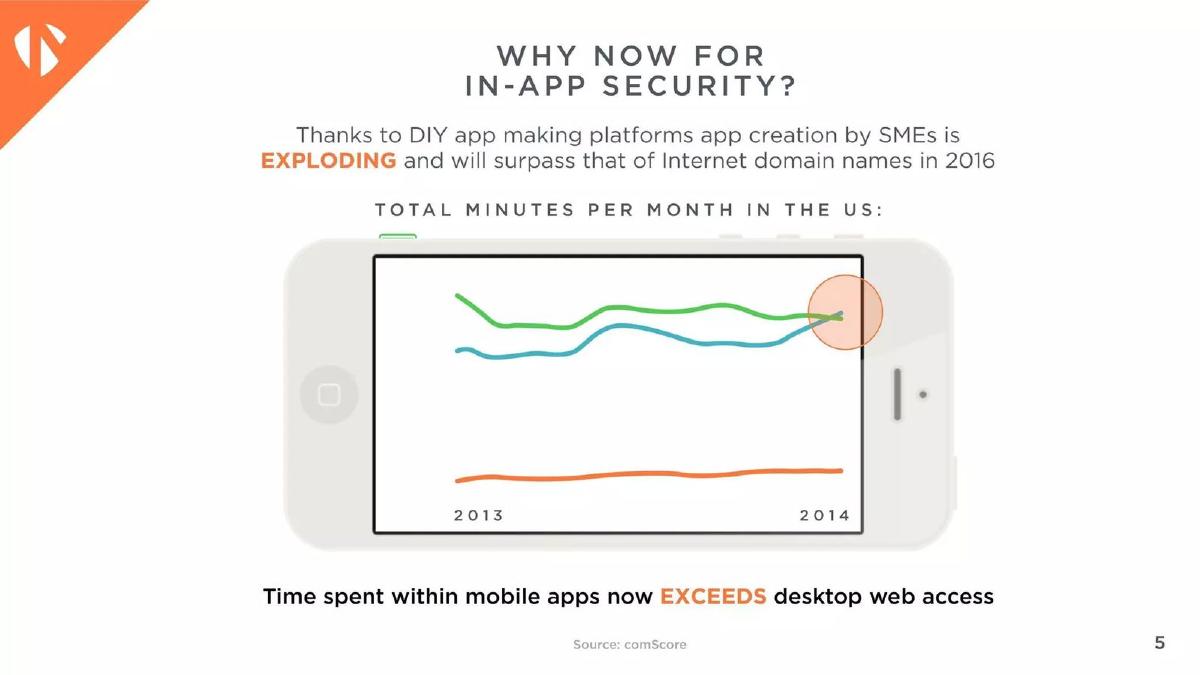
- The company cites that 21% of mobile web traffic now originates from in-app browsers, creating a massive new attack surface (Slide 6).
- The product is designed for frictionless adoption, requiring only six lines of code and less than an hour for developer integration (Slide 18).
- MetaCert utilizes a massive backend index of 10 billion categorized URLs to check request reputations in 250ms (Slide 18).
- The revenue model is bifurcated: $1.50 per user/month for enterprises and $5 per app/month for SMEs (Slide 12).
- Strategic channel partnerships, specifically with HipChat, are central to their go-to-market strategy to reach 49K+ customers (Slide 16).
- The founder, Paul Walsh, brings significant domain authority as a co-instigator of the W3C Standard for Web/URL categorization (Slide 20).
- The deck honestly addresses a past pivot, noting that while they initially targeted internet safety for kids, they shifted to mobile security after failed integrations with Samsung and Apple (Slide 23).
Executive Summary: The In-App Security Layer
MetaCert's pitch deck, used to raise a $2.2M Seed round in 2011, is a textbook example of identifying a technical 'blind spot' in a rapidly growing ecosystem. As mobile usage shifted from standalone browsers to integrated 'in-app' experiences, a massive security gap emerged. MetaCert positioned itself not just as a security tool, but as a foundational API for the mobile web. The deck is notable for its clarity, its focus on channel partnerships, and its willingness to address a significant pivot in the company's history.
The Problem and Market Shift (Slides 1-6)
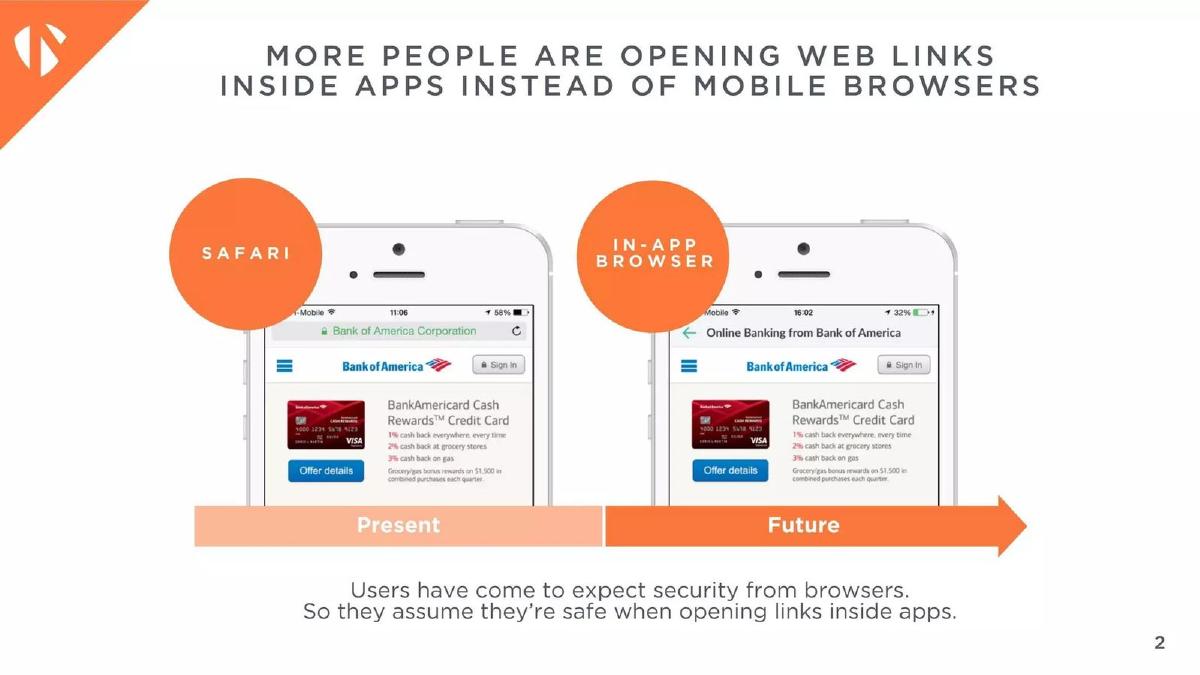
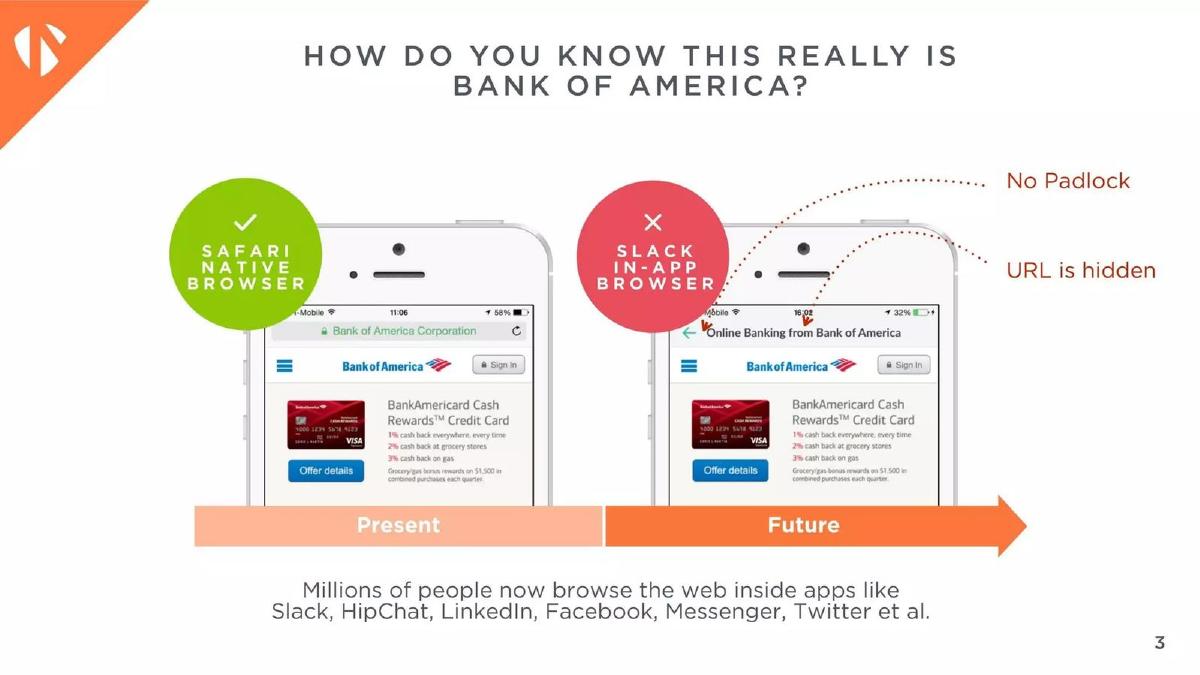
The deck opens by establishing a clear trend: the migration of web activity from native browsers to in-app browsers. Slide 2 uses a simple visual to show that users have come to expect security from browsers like Safari, and they mistakenly assume that same security exists when opening links inside other apps. This sets the stage for Slide 4 , which explicitly states the problem: in-app browsing lacks built-in security, and SMEs building apps have no easy way to protect their users.
Slide 6 provides the 'Why Now' by quantifying the risk. It notes that 21% of mobile web traffic now comes from in-app browsers. By contrasting the 'Then' (Gmail/Outlook on desktop) with the 'Now' (Slack/HipChat on mobile), MetaCert highlights that the tools businesses use to share sensitive information are the most vulnerable because security hasn't kept pace with the shift to mobile collaboration.
The Solution and Product Experience (Slides 8-10)
The solution is presented as a frictionless integration for team collaboration tools. Slide 8 emphasizes that no hardware or software is required, and an enterprise customer can add MetaCert to HipChat in just 30 seconds. The visual shows a simple toggle interface for 'Phishing and Malware Protection' and 'Stop Pornography Websites,' illustrating a user-friendly enterprise experience.
To demonstrate value beyond just 'blocking,' Slide 10 introduces message analytics for management. This feature allows administrators to monitor the types of websites being shared across the organization, providing a 'sticky' reason for management to keep the service active. The slide shows a dashboard with 438 messages, 195 links, and 77 alerts, proving the product provides tangible data to the buyer.
Revenue and Business Model (Slides 12-14)
MetaCert's revenue model is straightforward and segmented by customer type. According to Slide 12 , they sell anti-phishing, malware protection, and pornography blocking. Enterprise customers pay a fixed $1.50 per user/month for all services. SMEs building apps via platforms pay $5 per app/month, with each service paid for separately. This dual-track approach allows them to capture high-volume enterprise seats while also monetizing the long tail of independent app developers.
Slide 14 illustrates the power of their channel partner strategy. It shows a flow where one channel partner (HipChat) leads to one enterprise customer (Uber), which has 1,000 employees. At $1.50 per user, this single chain results in $18,000 in Annual Recurring Revenue (ARR). This visual effectively explains how MetaCert intends to scale without a massive direct sales force.
Go-To-Market and Technology (Slides 16-18)
The Go-To-Market strategy on Slide 16 is divided into three tactics: driving awareness through PR and conferences, demonstrating the solution through Proof of Concept (POC) trials, and driving reach through strategic partnerships. They specifically name-drop AppMakr as a partner to reach the 'bottom of the pyramid' and mention that HipChat is actively helping them approach large customers like Twitter.
Slide 18 dives into the 'Core Backend Technology.' The 'secret sauce' is a world-class categorization platform and web crawlers that maintain an index of 10 billion URLs. The API is described as 'simple, ultra fast,' capable of looking up a URL's reputation across 60 categories in just 250ms. Crucially, the slide mentions a patent application has been filed to prevent others from checking security levels inside apps, providing a hint of a defensive moat.
Team, History, and Competition (Slides 20-27)
The team slide ( Slide 20 ) is a strong point for the deck. Founder Paul Walsh is credited with co-instigating the W3C Standard for Web/URL categorization, placing him among the original founders of the W3C Mobile Web Initiative alongside Tim Berners-Lee. This level of domain expertise is rare and provides immense credibility to the 'patent-pending' claims. David Rooks and Alfonso Valdes round out the team with senior engineering experience from Telefonica, BSkyB, and Sprint.
Slide 23 provides a candid 'Company History.' It explains that the original mission was internet safety for kids, and they raised $1.2M between 2011-2014 to build the underlying technology. However, after Samsung and Apple decided not to proceed with integrations, the company pivoted to the broader 'Mobile Security' market. This honesty helps investors understand that the technology is mature and battle-tested, even if the business model is new.
The competitive landscape on Slide 25 is a comprehensive grid comparing MetaCert against giants like Google, IBM, McAfee, and Symantec. MetaCert distinguishes itself by being the only company focused on the 'In-App' layer of the mobile security stack, whereas most competitors focus on the device, network, or operating system levels. Finally, Slide 27 provides a 'Plain English' definition of a WebView, ensuring that even non-technical investors understand the specific niche MetaCert is occupying.
What Works in This Deck
Specific Problem Identification: By focusing on 'WebViews' rather than general 'mobile security,' MetaCert avoids competing directly with incumbents and identifies a gap those incumbents had ignored. · Domain Authority: The founder's history with W3C standards is a massive trust signal for a Seed-stage company. · Channel Partner Clarity: The deck doesn't just say 'we will partner'; it shows exactly how a partnership with HipChat translates into ARR (Slide 14). · Educational Content: Slide 27 ('What is an In-App Browser in Plain English?') is essential for ensuring the entire room understands the technical premise of the investment.
What is Missing from This Deck
Unit Economics: While the pricing is clear ($1.50/user), there is no mention of Customer Acquisition Cost (CAC) or the expected Lifetime Value (LTV), even in the context of their channel partners. · Current Traction Metrics: The deck mentions a goal of 1,500 monthly subscriptions for SMEs in the 'Milestones' slide (Slide 22), but it doesn't explicitly state how many they have at the moment of the pitch. · Burn Rate and Ask: The attached slides do not include a specific 'Ask' slide detailing how much capital is being raised in this specific round or how the funds will be allocated between engineering and sales.
Founder Takeaways: What to Copy
The 'Then vs. Now' Slide: Slide 6 is a perfect way to show market evolution. If your product solves a problem created by a shift in user behavior, use this format to make the urgency obvious. · Honesty About Pivots: MetaCert's Slide 23 shows that a pivot isn't a failure; it's a redirection of existing assets toward a better opportunity. If you have pivoted, explain why the previous effort made your current technology stronger. · The Revenue Flowchart: Slide 14 is a brilliant way to visualize a B2B2B sales motion. It makes a complex distribution strategy feel simple and inevitable. · Competitive Grid with a Twist: Instead of a standard 'check-box' grid where the startup wins everything, Slide 25 uses a 'Mobile Security Stack' approach to show that they are the only ones in a specific layer, rather than just 'better' than everyone else.
Frequently asked questions
- What is the core problem MetaCert is solving?
- MetaCert addresses the security gap in 'in-app browsers.' When users click a link inside an app like Slack or HipChat, the page opens in a 'WebView' rather than a native browser like Chrome. These WebViews lack the phishing and malware protections standard in native browsers, leaving users vulnerable to malicious links and inappropriate content.
- How does MetaCert's technology work technically?
- The solution is an API-based service. Developers add six lines of code to their app, which then queries MetaCert's backend index. This index contains over 10 billion categorized URLs. When a user attempts to load a page, the API checks the URL's reputation in under 250 milliseconds and blocks the request if it matches a known threat.
- What is MetaCert's primary go-to-market strategy?
- MetaCert relies heavily on channel partnerships. Rather than selling to every enterprise individually, they integrate with 'Team Collaboration' platforms like HipChat and Slack. By becoming a recommended security add-on for these platforms, they can gain access to thousands of enterprise customers simultaneously with minimal direct sales overhead.
- How does the company generate revenue?
- They have two primary pricing tiers. For enterprise customers using team collaboration services, they charge a flat $1.50 per user per month. For small to medium enterprises (SMEs) building their own apps via app-making platforms, they charge $5 per app per month for each specific service, such as anti-phishing or pornography blocking.
- Why did MetaCert pivot from its original mission?
- Originally, the company focused on internet safety for children. However, after winning pitches with Samsung and Apple that ultimately did not result in integrations, the founders realized the market size was too restricted. They pivoted to general mobile security, which they identified as a much larger and more urgent opportunity for their URL categorization technology.